
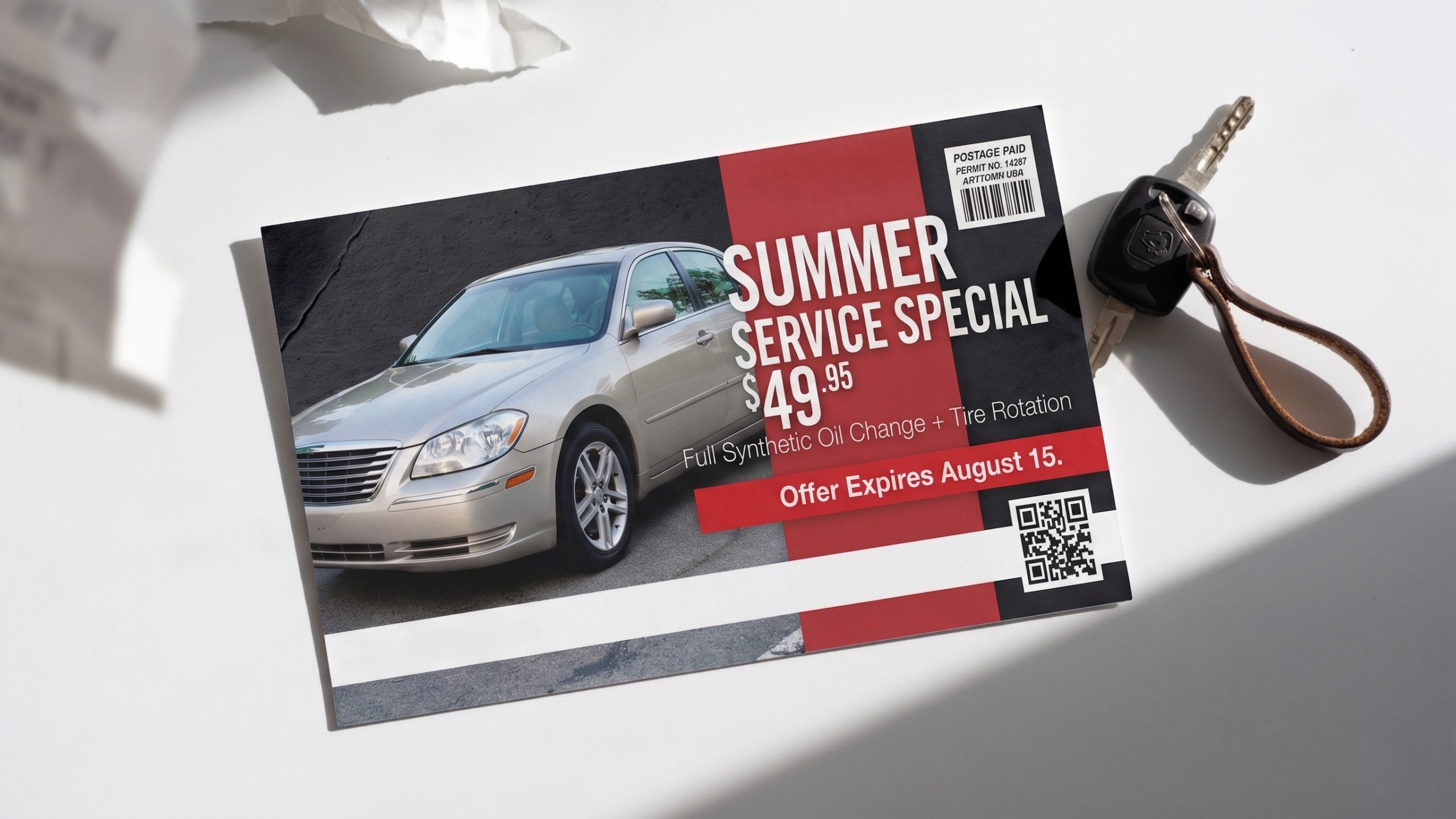
Auto dealer direct mail response rates average 2–5% for conquest campaigns targeting cold in-market prospects. Campaigns mailed to your own service base and leaseholders run 5–9%. (Source: ANA/DMA Response Rate Report, 2025.) List type — prospect or house — is the single biggest variable. Everything else moves the number up or down within those ranges.
This article is part of our guide to direct mail response rates.
I’ve been running direct mail campaigns since 1998. The economics of automotive mail are straightforward. High-ticket purchase. Long decision cycle. A customer base with known vehicles and known service intervals. Direct mail fits that model better than most industries I work with.
For the full benchmark picture across all channels and formats, start at the Direct Mail Response Rates: Benchmarks & Data [2026] overview.
Why Auto Dealerships Are Built for Direct Mail
Vehicle purchases are high-consideration decisions. Buyers research for weeks before they step onto a lot. A mail piece that lands during that window holds attention a digital ad doesn’t.
The average direct mail piece stays in a household for 17 days. (Source: ANA/DMA Response Rate Report, 2025.) A digital ad disappears in seconds. On a $35,000 purchase decision, 17 days of in-home exposure matters.
Auto dealers also have something most businesses don’t: a built-in house list. Every customer who purchased a vehicle or visited the service lane is a known contact with a known vehicle on record. That list is the foundation of the highest-performing automotive direct mail programs.
Most dealerships are also mailing into a defined geographic market. That means you can target your own service radius precisely — by ZIP code, by income band, by vehicle age. That level of targeting precision is what separates a campaign that works from one that wastes postage.
Auto Dealer Direct Mail Response Rate Benchmarks by Campaign Type
Not all dealership direct mail performs the same. The list type determines the benchmark range. The offer and format determine where you land within it.
| Campaign Type | List Type | Expected Response Rate | Best Use Case |
|---|---|---|---|
| Conquest / Prospect Mail | Cold prospect list (in-market shoppers, new movers, geographic saturation) | 2–5% | New customer acquisition, model-year launches, regional sale events |
| Service Reactivation | House list (customers inactive 12–18 months) | 5–9% | Win back lapsed service customers with a specific, timed offer |
| Lease Maturity Targeting | House list (active leaseholders 90–180 days from maturity) | 5–9% | Convert lease renewals, introduce new model options |
| Owner Loyalty / Service Reminder | House list (active purchasers, recent service customers) | 5–9% | Scheduled service reminders, seasonal maintenance offers, referral programs |
| Benchmark ranges sourced from ANA/DMA Response Rate Report, 2025. House list (5–9%) and prospect list (2–5%) benchmarks applied to automotive campaign types by list category. Automotive vertical-specific breakdowns should be verified against the current ANA report at ana.net. | |||
House list campaigns perform consistently at the top of the benchmark range. The customer already knows the dealership. They have a vehicle that ages. The message lands on someone with an active, ongoing need — whether or not they are actively shopping.
Conquest mail is harder. You are reaching cold prospects with no prior relationship to the store. Response rates reflect that reality. But a 2–5% return on a well-targeted in-market prospect list is still strong ROI when the average transaction value is $25,000 or more.
The Variables That Move Automotive Response Rates
List quality determines results more than any other factor. A conquest file filtered by vehicle age, household income, and geography outperforms a broad residential saturation file every time. Precise targeting reduces waste and increases response per piece mailed.
Our data lists service builds and processes targeted prospect files for this kind of campaign. Every file runs through NCOA (National Change of Address) and CASS (Coding Accuracy Support System) processing before anything goes to print. Bad addresses waste postage. A verified, CASS-certified file costs less to mail and produces more responses per thousand pieces.
Offer specificity is the second major variable. A generic message — “come see us for your next service” — does not drive response. A specific offer with a number and a deadline does. The recipient needs a reason to act on this piece, today, rather than set it aside.
Format size controls how much attention the piece earns at the mailbox. Oversized postcards — 6×9 or larger — consistently produce 20–40% higher response rates than standard 4×6 formats at equivalent offer and list quality. (Source: ANA/DMA Response Rate Report, 2023.) Multiple dealerships are mailing into the same ZIP codes. Format size is the first differentiator before the recipient reads a single word.
Timing to life events is where targeting precision pays off most in automotive. A customer with a lease expiring in 90 days is a buyer, not a browser. New movers into your market are actively seeking local service providers and may be in an entirely new commute situation. Reaching these households at their specific moment of readiness pushes response toward the top of the benchmark range.
What I See on High-Consideration Direct Mail Campaigns
The pattern on high-ticket direct mail is consistent. Campaigns that produce results share three things: a list cleaned before anything went to print, a specific offer tied to a hard deadline, and enough format size to earn a second look in the mailbox stack.
The campaigns that don’t work fail on data. They use conquest files that haven’t been NCOA-processed. They mail a generic piece with no offer and no deadline. Or they send one drop and call it a test. Those aren’t campaign problems — they’re execution problems.
One-drop conquest mail rarely works on a high-consideration purchase. A customer evaluating a $35,000 vehicle is not going to call from the first postcard they see. Two or three well-timed drops over 8–10 weeks builds the impression frequency that actually moves a prospect to action.
For campaigns that require this level of execution — list sourcing, NCOA and CASS hygiene, USPS presort compliance, print, and delivery — our direct mail campaigns service handles every step in-house. Nothing is handed off to a broker who doesn’t know postal compliance.
Frequently Asked Questions: Auto Dealer Direct Mail Response Rates
What response rate should I expect from auto dealer direct mail?
Expect 2–5% for conquest campaigns targeting cold in-market prospects and 5–9% for campaigns mailed to your own customers — service records, past purchasers, and active leaseholders. (Source: ANA/DMA Response Rate Report, 2025.) Lease maturity campaigns sent to the right household at the right timing window typically perform at the top of that house list range. Offer specificity and list accuracy determine where within those ranges you land.
Does direct mail still work for car dealerships?
Yes. Automotive is one of the strongest categories for direct mail, driven by high transaction value and the built-in house list most dealerships already maintain. The average direct mail piece has a 17-day in-home lifespan — far outlasting any digital ad or social media post. (Source: ANA/DMA Response Rate Report, 2025.) On a purchase decision that takes weeks of consideration, that extended in-home exposure creates response that digital formats don’t generate.
What is the best direct mail format for auto dealerships?
Oversized postcards — 6×9 or larger — produce the highest response rates for most dealership campaigns. They sit on top of the mailbox stack and earn more handling time than standard formats. Oversized postcards consistently generate 20–40% higher response than standard 4×6 formats at equivalent offer and list quality. (Source: ANA/DMA Response Rate Report, 2023.) Letter packages work better for lease maturity and VIP owner programs where a more personal format matches the message.
How many times should a dealership mail to get results?
For conquest campaigns, plan two to three drops spaced 3–4 weeks apart. One drop to a cold prospect list rarely produces strong response on a high-consideration purchase. Frequency builds the impression repetition that moves a prospect from first awareness to a showroom call. For house list campaigns — service reactivation, lease maturity — a single well-timed drop with a specific offer often performs well because the prior relationship does the heavy lifting.
How Cornerstone Can Help
Cornerstone Services handles direct mail campaigns from list targeting through postal delivery. We build targeted prospect files, run NCOA and CASS processing on your house data, design USPS-compliant mail pieces, and deliver campaigns to the mailstream on schedule — in-house, start to finish.
We serve businesses across Ulster, Dutchess, and Orange Counties and take on campaigns for clients from New York State to Kansas City and Sarasota.
Call us at (845) 255-5722, email info@crst.net, or visit our direct mail campaigns page to talk through your campaign. Get a free estimate with no commitment.
Sean Griffin is the founder of Cornerstone Services, Inc. and has been running direct mail campaigns in the Hudson Valley since 1998. We’ve mailed over 2.3 million pieces for clients across 47 municipalities. Cornerstone Services | 387 Malden Turnpike, Saugerties, NY 12477 | (845) 255-5722 | Serving businesses and nonprofits across NY and beyond.