
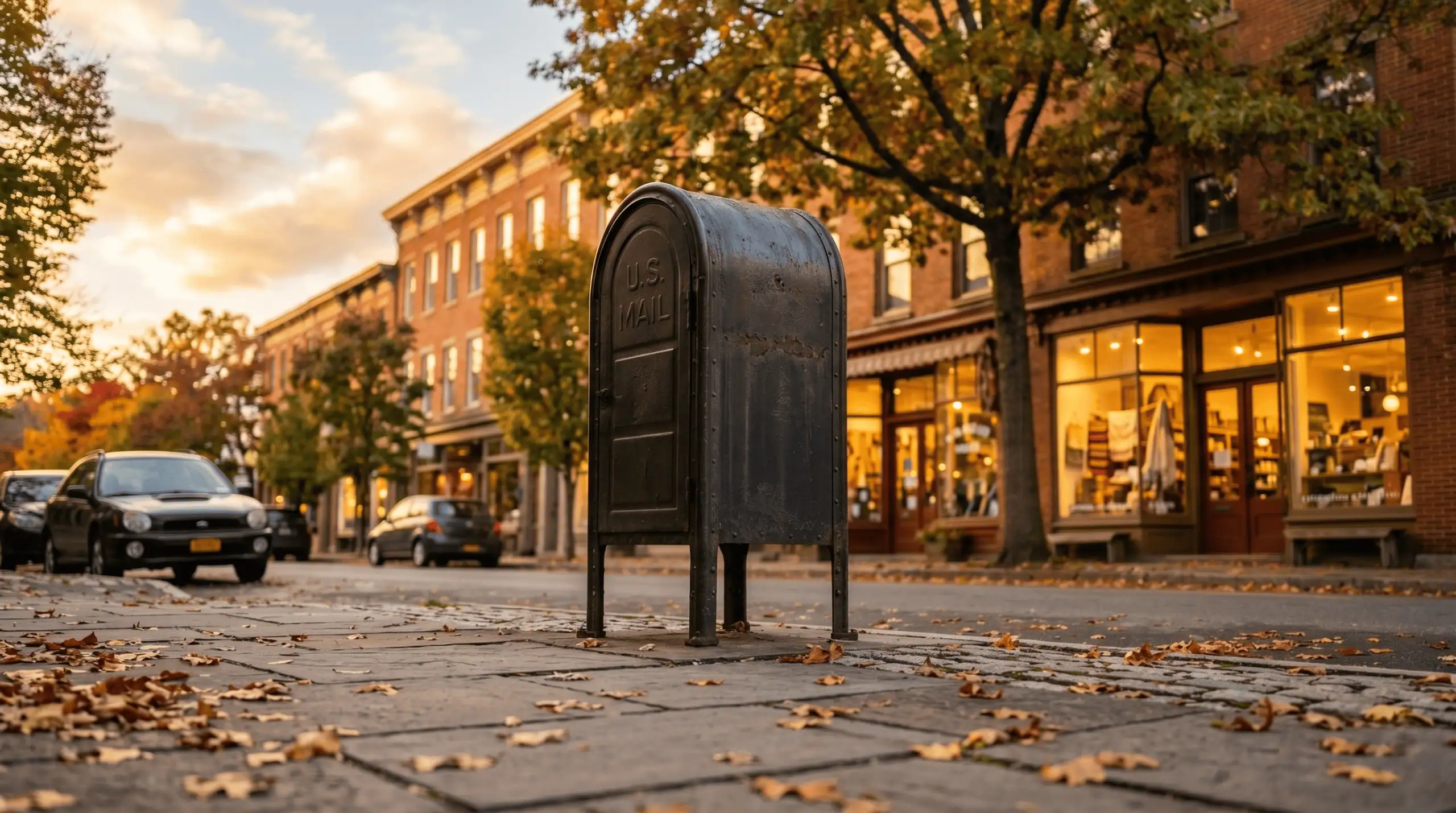
Retail direct mail campaigns typically see response rates between 2% and 5%. That range depends on three things: your offer, your list quality, and your format. Get all three right, and direct mail is one of the strongest return-on-investment tools a brick-and-mortar store can run.
This article is part of our guide to direct mail response rates.
I’ve been running direct mail for retailers across the Hudson Valley since 1998. Furniture stores, boutiques, hardware retailers, specialty shops. The ones hitting the high end of that range aren’t doing anything exotic. They’re mailing cleaner lists, offering sharper discounts, and timing their drops correctly.
For benchmarks across every industry, see the complete direct mail response rates guide. This article focuses specifically on what brick-and-mortar retail stores see.
What Response Rates Do Retail Direct Mail Campaigns Actually See?
The DMA Response Rate Report — now published under the ANA (Association of National Advertisers) — is the most widely cited benchmark in the industry. According to the DMA Response Rate Report 2018, overall direct mail response rates averaged 4.9% for house lists and 2.9% for prospect lists across all industries. (Source: DMA Response Rate Report, 2018)
Retail campaigns I’ve run in Ulster, Dutchess, and Orange Counties track close to those figures. House list mailings to existing customers regularly hit 4% to 6% with a strong offer and a clean list. Cold prospect mailings to new names typically land between 1.5% and 3%.
Those numbers may look modest. Run the math before you dismiss them. A 2.5% response on 5,000 pieces is 125 customers walking through your door. At $60 per transaction, that’s $7,500 in revenue from one mailing. Direct mail earns its cost in retail. Treat it like a business decision, not a marketing experiment.
The Three Variables That Move the Number Most
Offer quality is the biggest driver of retail response rates. A postcard announcing a sale is easy to ignore. A postcard offering 20% off with a hard expiration date gives people a reason to act. The offer has to be worth saving. If it isn’t worth clipping from a newspaper, it won’t generate a response in the mail either.
List quality is the second variable. Every retail mailing I manage goes through two processes before a piece is printed. First: NCOA (National Change of Address) processing to catch addresses where people have moved. Second: CASS (Coding Accuracy Support System) certification to standardize address formats for proper delivery.
I’ve run the same campaign twice for retail clients — once with a raw list and once after cleaning it through NCOA and CASS. The cleaned list outperformed every time. Sometimes by a full percentage point.
Timing completes the three. Holiday drops landing in early November drive the highest response rates of the year for most retail categories. Grand openings, anniversary sales, and post-holiday clearance events all pull strong numbers — when the piece arrives at the right moment.
EDDM vs. Targeted Mailing Lists for Retail
Retail direct mail runs on two approaches: Every Door Direct Mail (EDDM) and targeted list mailings. Each has a place. Knowing which fits your campaign is where the strategy lives.
EDDM is a USPS program that saturates carrier routes without a purchased list. You select the routes. Every household on those routes receives your piece. EDDM works well for grand openings, neighborhood retailers, and broad-awareness campaigns. Per-piece postage is lower. The trade-off is precision — you can’t filter by income, homeownership, or purchase behavior.
Targeted list mailings cost more per piece. But they reach the right people. A specialty kitchen store in Kingston targeting homeowners over 45 with incomes above $80,000 will outperform a blanket EDDM drop to the same ZIP code. The list cost pays for itself when the right offer reaches the right household.
My standard recommendation: use EDDM to build awareness in a new market or around a grand opening. Use targeted lists for loyalty and reactivation campaigns. And whenever possible, mail your house list first — it’s the best-performing list you own, and you’ve already paid to build it.
Retailers also benefit from presort discounts when mailing at volume. When Cornerstone presorts your mailing by carrier route and ZIP, you qualify for lower postage rates — which directly affects your cost per response. That’s not something an online print shop does for you. See our EDDM campaign services for how this works in practice.
Which Direct Mail Formats Work Best for Retail?
Postcards are the workhorse of retail direct mail. No envelope to open. The offer is visible the second the piece leaves the mailbox. In a full stack of competing mail, that immediacy matters.
Oversized postcards — 6×9 inches or larger — consistently outperform standard 4×6 sizes for retail. The larger format accommodates bigger headlines, bigger product images, and more visible offers. Per-piece cost is higher. The response lift typically justifies the difference.
Letters belong in high-ticket retail. A furniture store or jewelry boutique with $400+ average transactions can justify the higher production cost. A personalized letter with a private offer creates exclusivity. A postcard can’t match that.
Self-mailers — folded pieces that don’t need an envelope — are a practical middle-ground format. They give retailers more space for product imagery without the full cost of a letter package. I use them often for seasonal promotions with multiple items to show.
Timing and Seasonality for Retail Mailers
Retail is one of the most time-sensitive categories in direct mail. The right piece at the wrong time gets recycled. The right piece timed correctly drives foot traffic.
Holiday drops landing in early-to-mid November generate the highest response rates of the year for most retail categories. Back-to-school, spring home refresh, and post-holiday clearance windows all create natural reasons for customers to act. A retailer who ignores seasonality is leaving response rate performance on the table.
Grand openings are the highest-response event a retailer can anchor a mailing to. People in a trade area want to know what’s new nearby. A well-timed EDDM drop one week before opening drives traffic. A second wave on opening weekend extends the response window. I haven’t seen any digital channel match that combination at the same cost.
My rule on retail timing: plan your drop date backward from the in-store event, not forward from the print date. The piece needs to arrive two to four days before the sale or event opens. Build that lead time into every campaign schedule from the start.
How Retail Response Rates Compare to Other Industries
Direct mail response rates vary significantly across sectors. If you’re comparing what brick-and-mortar retail sees against other industries, these breakdowns cover the data:
- Home Services Direct Mail Response Rates — HVAC, plumbing, and roofing benchmarks
- Restaurant Direct Mail Response Rates — how dining campaigns perform
- Real Estate Direct Mail Response Rates — what agents and brokerages see
- Healthcare Direct Mail Response Rates — patient acquisition data
- Nonprofit Direct Mail Response Rates — fundraising benchmarks by sector
- Auto Dealer Direct Mail Response Rates — showroom traffic data
For the full picture across all industries, see the complete direct mail response rates benchmark guide.
Frequently Asked Questions
What is a good response rate for retail direct mail?
A 2% to 5% response rate is solid for most retail direct mail campaigns. House list mailings to existing customers often hit 4% to 6% with a strong, deadline-driven offer. Cold prospect mailings to new names typically land between 1.5% and 2.5%. A clean, NCOA-processed list and a compelling offer move the number in the right direction for both types of campaigns.
Does EDDM work for brick-and-mortar retail stores?
EDDM works well for grand openings, neighborhood retailers, and broad-awareness campaigns. It covers entire carrier routes at a lower per-piece postage cost, making it accessible for smaller retail budgets. The limitation is targeting precision — you can’t filter EDDM recipients by demographics or purchase behavior. For campaigns targeting a specific customer profile, a purchased list is a better fit.
What direct mail format gets the best response for retail?
Oversized postcards — 6×9 inches or larger — consistently perform best for most retail campaigns. No envelope to open, large print area for offers and product images, strong in-mailbox presence. High-ticket retailers with average transactions above $400 often see better returns from personalized letter packages, which create a more exclusive feel for a considered purchase.
How do I track the response rate on a retail direct mail campaign?
The most reliable methods are unique promo codes, dedicated tracking phone numbers, and in-store coupons. Each gives you a direct count of responses tied to the mailing. QR codes linked to a campaign landing page let you track digital responses from print. Build at least one trackable element into every retail mailing before it goes to press. Without it, you’re estimating, not measuring.
How Cornerstone Can Help
Cornerstone Services handles retail direct mail from list strategy through postal delivery — all in-house at our facility in New Paltz, NY. We manage list procurement, CASS and NCOA processing, design, printing, and full USPS compliance.
We’ve been running campaigns for retailers across Ulster, Dutchess, and Orange Counties since 1998. If you’re planning a grand opening, a seasonal sale, or a customer reactivation campaign, call me directly. I’ll walk you through the format that fits, the list strategy that works, and what a realistic response looks like for your market.
Call (845) 255-5722 or email info@crst.net. Learn more about our direct mail services and EDDM options. Serving retailers and businesses across the Hudson Valley, New York State, and beyond.
Sean Griffin is the founder of Cornerstone Services, Inc. and has been running direct mail campaigns in the Hudson Valley since 1998. We’ve mailed over 2.3 million pieces for clients across 47 municipalities. Cornerstone Services | 387 Malden Turnpike, Saugerties, NY 12477 | (845) 255-5722 | Serving businesses and nonprofits across NY and beyond.