
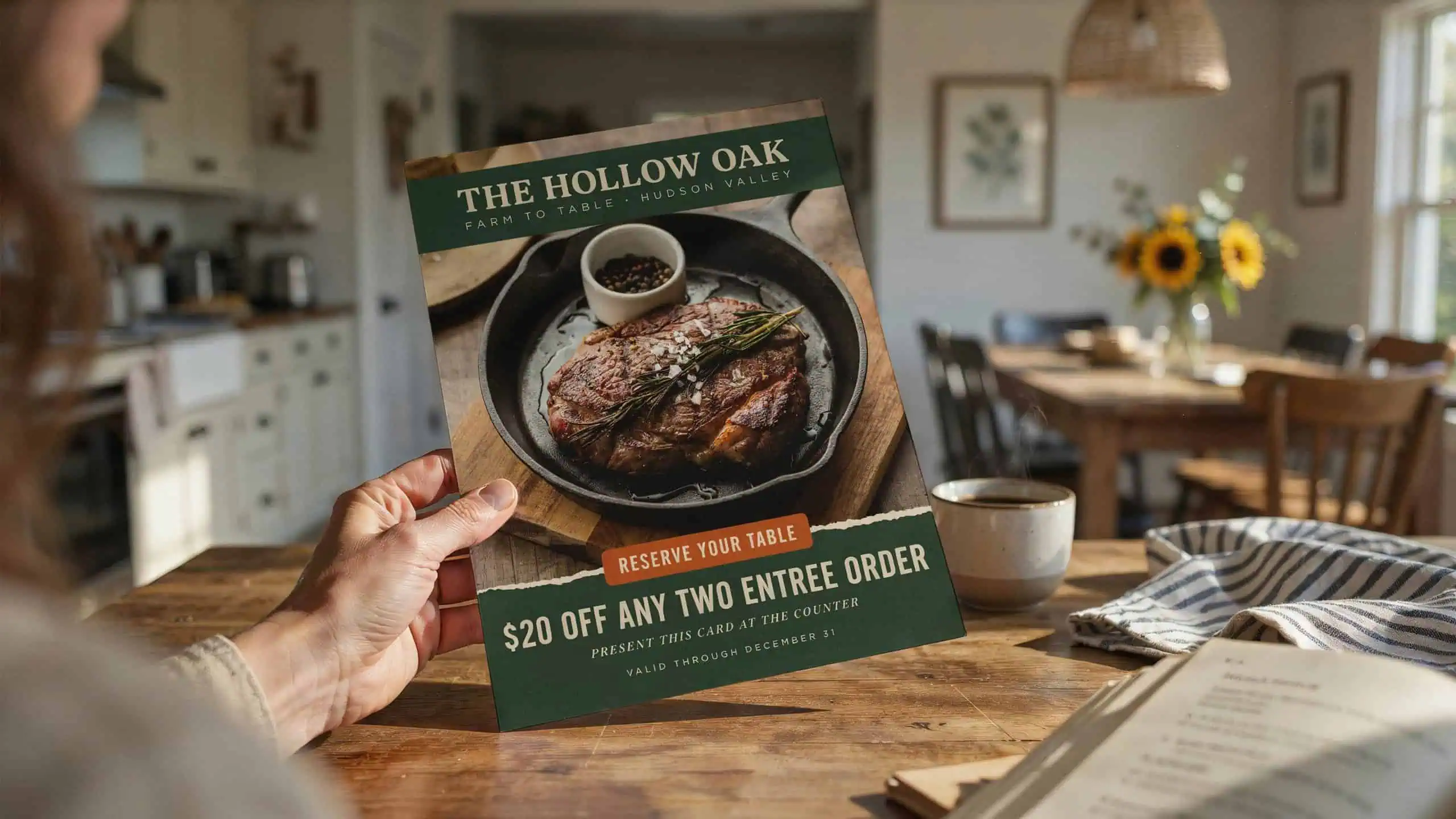
Restaurant direct mail campaigns typically see response rates between 1% and 5% on cold prospect mailings. The variable that moves that number most isn’t your design or your print budget — it’s the quality of your offer.
This article is part of our guide to direct mail response rates.
I’ve run direct mail campaigns for restaurants across the Hudson Valley for over 20 years. Grand openings, slow midweeks, loyalty drives, reactivation pushes. The restaurants that get the best results aren’t always the ones spending the most. They’re the ones with the clearest offer and the tightest targeting.
Here’s what the industry data shows — and what I’ve seen running these campaigns on the ground.
What Response Rate Should Restaurants Expect from Direct Mail?
The most reliable published benchmarks come from the ANA/DMA Response Rate Report (2018). Across all industries, direct mail averages 4.9% for prospect lists (cold audiences who haven’t bought from you) and 9% for house lists (existing customers). Those are industry-wide averages — not restaurant-specific — but they set the frame.
Restaurants tend to land in the lower half of the prospect list range on cold mailings. A neighborhood EDDM drop with a strong offer can realistically hit 2–4%. A targeted campaign filtered by distance and household income can push a bit higher. A reactivation mailing to past customers — people who’ve already eaten with you — is where I’ve seen the most significant lifts.
Here’s the honest baseline for planning: expect 1–2% on a cold list. Build your campaign math around that. If your average check is $45 and you mail 5,000 pieces, a 2% response rate is 100 new covers. Work backward from there to know whether the investment makes sense before you spend a dollar.
What kills restaurant direct mail campaigns isn’t a low response rate. It’s mailing without tracking — and then canceling a campaign that was actually working because you had no way to prove it.
For a full breakdown of how restaurant direct mail fits into the broader direct mail picture, see our pillar post: Direct Mail Response Rates: Benchmarks & Data [2026].
EDDM vs. Targeted List: Which Works Better for Restaurants?
Every Door Direct Mail (EDDM) is a USPS program that delivers a piece to every address on a postal carrier route — no purchased list required. You select the routes that cover your delivery area, submit your pieces at the post office, and every household on those routes receives your mailer. Full program details are available at usps.com.
EDDM makes sense for most casual dining concepts — pizza shops, diners, neighborhood restaurants, coffee shops. You want saturation. Broad neighborhood reach is the goal. You’re not trying to filter out anyone within a few miles of your location.
A targeted mailing list costs more per piece but gives you filtering capability: household income, distance from your location, age range, presence of children in the home, and — critically for restaurants — new movers. Someone who just moved to Kingston or New Paltz hasn’t found their regular spots yet. They’re actively looking. A well-timed new-mover drop can make your restaurant their regular before they ever open Yelp.
Any targeted list campaign should run through NCOA (National Change of Address) processing before it mails. Undeliverable addresses waste postage immediately. We run every list we touch through NCOA before any piece goes out. That step alone can improve deliverability on a purchased list by 5–10%.
My general recommendation: use EDDM for grand openings and seasonal saturation campaigns. Use a targeted list once you have a clearer customer profile. The two approaches aren’t competitors — they’re tools for different campaign goals.
For a deeper comparison of saturation versus targeted approaches: Saturation Mail vs. Targeted List Response Rates.
Format and Offer: What Actually Drives Restaurant Response
Format matters — but it’s the second variable. Here’s what I’ve seen perform consistently in restaurant direct mail campaigns:
- Oversized postcards (6″ × 11″ or larger): My default recommendation for most restaurant mail. High visual impact. No envelope to open. The piece gets seen immediately. Research from the ANA/DMA (2018) indicates that larger-format mail tends to outperform standard letter mail, though the exact lift varies by offer strength and industry vertical.
- Folded menu mailers: Work well for restaurants with a full menu worth showing. Customers keep them. I’ve heard from restaurant owners that customers come in weeks after a campaign with a folded menu mailer they pulled from a kitchen drawer.
- Coupon packs: High perceived value. Effective for multi-location groups or limited-time promotion series.
What underperforms for restaurants: standard #10 envelopes. They look like bills. Half of them get thrown out before they’re opened. Spend the extra few cents on a format that gets seen.
But format is still secondary to offer. Here’s what actually drives response on restaurant direct mail pieces:
- Percentage off the total bill — 15–20% outperforms 10% consistently
- BOGO entree or free appetizer with purchase
- Free item for first-time customers
- Reactivation offer with direct language: “We miss you — here’s 20% off your next visit”
- Hard expiration date: 30 to 45 days, not six months
- Trackable QR code or unique promo code printed on the piece
Every weak restaurant campaign I’ve reviewed had the same problem: no real offer. “Come try our new menu” is an announcement. Nobody drives anywhere for an announcement. Give people a concrete reason to act — and tell them when it expires.
How to Track Your Restaurant’s Direct Mail Response Rate
If you’re not tracking, you’re guessing. I’ve watched restaurant owners cancel campaigns that were working — because they had no attribution method in place and couldn’t tie an uptick in covers to a mailer that went out two weeks earlier.
The simplest tracking method: put a unique promo code or tear-off coupon on every piece. Count redemptions. Divide by total pieces mailed. That’s your response rate. No special software required.
For more precise attribution, use a dedicated phone number that forwards to your main line — you’ll see exactly how many calls came from the campaign. Or use a trackable QR code pointing to a campaign-specific landing page. Either approach ties responses directly to a specific drop, which lets you compare performance across campaigns over time.
Set up tracking before the piece goes to print. You cannot add it afterward. Any direct mail company worth working with will help you build the tracking mechanism into the design before anything is printed or mailed.
For a deeper look at attribution methods: Direct Mail Response Rate Tracking: Methods That Give You Real Numbers.
What I’ve Seen Running Restaurant Campaigns in the Hudson Valley
I’ve run direct mail for restaurants in Ulster, Dutchess, and Orange Counties since 1998. A few patterns I’ve watched consistently in this market:
Seasonal timing matters more here than in most regions. A summer campaign timed around the tourist season reaches a very different audience than a November drop targeting local regulars. Restaurants that mail year-round — varying the offer and timing by season — consistently outperform those that run one campaign and wait to see what happens.
New-mover campaigns are the single highest-value tool I’ve used for restaurants in this region. The Hudson Valley has a steady inflow of new residents — from New York City and elsewhere — who haven’t established their local dining habits yet. A new-mover mailing with a strong first-visit offer can turn those households into regulars before your competitors even know they moved in. I’ve seen response rates on new-mover restaurant campaigns that don’t come close to what cold EDDM drops produce. That audience is actively looking for places to go.
Frequently Asked Questions
What is a good response rate for restaurant direct mail?
A realistic baseline on a cold prospect list is 1–2%. A well-targeted campaign with a strong offer — percentage discount, free item, or BOGO — can push 3–5%. Campaigns mailed to existing customers, particularly reactivation offers, often perform well above that range. Offer quality and list precision drive the number more than design or format choices.
Does EDDM work for restaurants?
Yes — EDDM is one of the most cost-effective direct mail tools for local restaurant marketing. No list purchase is required. You select the carrier routes covering your delivery radius, and every address on those routes receives your piece. It works best for casual dining, pizza, and neighborhood concepts where broad reach matters more than demographic filtering. Fine dining or niche restaurants with a specific customer profile typically benefit more from a targeted list.
What offer works best on a restaurant direct mail piece?
Tangible, specific offers outperform “come visit us” messaging every time. A free appetizer, BOGO entree, or 15–20% off the total bill gives the recipient a concrete reason to act. Include a hard expiration date — 30 to 45 days — to create urgency. Pieces without an expiration get set aside and forgotten. Also include a trackable promo code or QR code so you can count how many people actually redeemed it.
How much does restaurant direct mail cost?
Costs vary by format, print quantity, and whether you’re running EDDM or a targeted list campaign. EDDM is typically the lowest per-piece cost since there’s no list to purchase. The more important number is cost per new customer, not cost per piece. A campaign that brings in 20 first-time covers who each return multiple times is a strong investment regardless of what the per-piece cost was.
How do I track the response rate of my restaurant’s direct mail campaign?
Use a unique promo code, a tear-off coupon, a dedicated phone number, or a trackable QR code on every piece. Count how many responses come in against total pieces mailed. Without a tracking mechanism, you cannot attribute a cover increase to a specific mailer. The tracking has to be built into the design before the piece goes to print — there is no way to add it afterward.
How Cornerstone Can Help
At Cornerstone Services, we’ve handled direct mail campaigns for restaurants across the Hudson Valley for over 25 years. We take care of everything in-house — list targeting, data hygiene, printing, USPS compliance, and delivery. We’ve mailed over 2.3 million pieces for clients across 47 municipalities in Ulster, Dutchess, and Orange Counties.
If you want to run an EDDM neighborhood drop or a targeted direct mail campaign for your restaurant, we’ll help you build the list, design the piece, and get it delivered on time. Call us at (845) 255-5722 or email info@crst.net. Serving restaurants and businesses across the Hudson Valley and beyond.
Every Door Direct Mail (EDDM) · Direct Mail Services
Sean Griffin is the founder of Cornerstone Services, Inc. and has been running direct mail campaigns in the Hudson Valley since 1998. We’ve mailed over 2.3 million pieces for clients across 47 municipalities. Cornerstone Services | 387 Malden Turnpike, Saugerties, NY 12477 | (845) 255-5722 | Serving businesses and nonprofits across NY and beyond.