

Direct mail for financial advisors occupies a unique position in the financial services marketing landscape. It is simultaneously one of the oldest outreach channels in the industry and one of the most consistently effective. Every digital channel is saturated with competing financial offers, data privacy concerns, and algorithmic gatekeeping. In a category where trust is the primary purchase driver and the average client relationship is measured in decades rather than transactions, the most effective channel is not the cheapest or the fastest. It is the one that arrives with physical permanence, professional presentation, and a tangibility that digital alternatives cannot replicate.
This guide covers why direct mail for financial advisors works, how to build campaigns that generate qualified prospect inquiries while respecting compliance requirements, and how to structure the multi-touch sequences that convert initial awareness into advisory relationships. For the broader direct mail channel foundation, Direct Mail Marketing Strategy and Why Direct Mail Still Works provide the essential strategic context. For full-service campaign production and postal delivery, start at CRST.
Why This Category Requires a Different Approach
Financial services marketing faces a trust challenge that most other categories do not. Before choosing any other channel, it helps to understand that challenge — and why physical mail addresses it in ways that digital advertising structurally cannot.
Why Financial Advisors Need a Different Marketing Approach
The Trust Deficit in Financial Services Marketing
Financial services is among the highest-trust categories in consumer marketing — and among the most challenging to market in. A prospective client considering a financial advisor is making a decision that will affect their retirement security, their family’s financial future, and their accumulated lifetime savings. The psychological stakes of that decision create a trust threshold that most marketing channels cannot clear.
Digital advertising in financial services faces this trust deficit acutely. A Facebook ad for a financial advisory practice competes for attention in the same feed as entertainment content, news, and competitor ads. That context is one that research consistently associates with low purchase intent and high skepticism. Moreover, the ad format itself signals mass outreach — which works directly against the personalized, relationship-centered positioning that financial advisors need to establish. According to the Edelman Trust Barometer, financial services consistently ranks among the lower-trust industries. That makes every marketing channel’s credibility signal more important, not less.
Advisory: The Edelman Trust Barometer is published annually and industry trust rankings shift year to year. Verify the current year’s financial services findings at edelman.com/trust before citing specific rankings in client-facing materials.
Physical mail, by contrast, operates in a fundamentally different trust context. A well-produced letter or postcard that arrives in a prospect’s mailbox — on premium stock, with the advisor’s name and credentials, a professional photograph, and a specific relevant offer — communicates deliberateness and investment that digital mass outreach cannot. The recipient understands, implicitly, that a physical mail campaign represents a higher level of commitment than a programmatic digital impression. That understanding is the trust foundation that financial advisor direct mail builds before the first phone call occurs. For the statistical foundation supporting direct mail’s trust and engagement advantage, Direct Mail ROI Statistics 2026 covers the current benchmark data across demographic segments most relevant to financial services.
The Compliance Environment and What It Means for Campaign Design
Advisory: Financial advisor marketing is subject to regulatory oversight from FINRA, the SEC, and state securities regulators, as well as firm-level compliance policies that vary significantly by broker-dealer, RIA structure, and product type. The guidance in this article covers general direct mail campaign strategy and design principles — it does not constitute compliance or legal advice. All direct mail materials for financial advisory practices must be reviewed and approved through the advisor’s compliance department or registered principal before any piece is printed or mailed. Failure to obtain pre-clearance for marketing materials is a regulatory violation that can result in fines, license sanctions, or firm disciplinary action.
With that framework established: compliance requirements in financial services direct mail generally govern what claims can be made, how performance must be disclosed, what disclosures must appear on the piece, and how client testimonials can be used. Understanding these constraints before designing a campaign prevents the costly scenario of a fully produced print run that compliance will not approve.
The practical design implication is that financial advisor direct mail copy must be conservative, accurate, and disclosure-forward. Paradoxically, this is also the copy that performs best with the high-trust, high-consideration audience that financial advisors are targeting. A piece that leads with a specific market promise or guaranteed return will fail compliance — and will also fail with sophisticated prospects who recognize overreach. A piece that instead leads with credentials, community presence, a specific planning service, and a low-pressure invitation to a conversation will pass compliance. It will also reflect the relationship-first positioning that drives financial advisory client acquisition. For the design principles that apply across the full direct mail format spectrum, Best Direct Mail Format for Response Rate covers the hierarchy framework. For production specifications that communicate the professional quality the category requires, Direct Mail Printing covers the stock and finish options relevant to financial services mailers.
Campaign Types That Work for Financial Advisors
Seminar and Event Invitation Campaigns
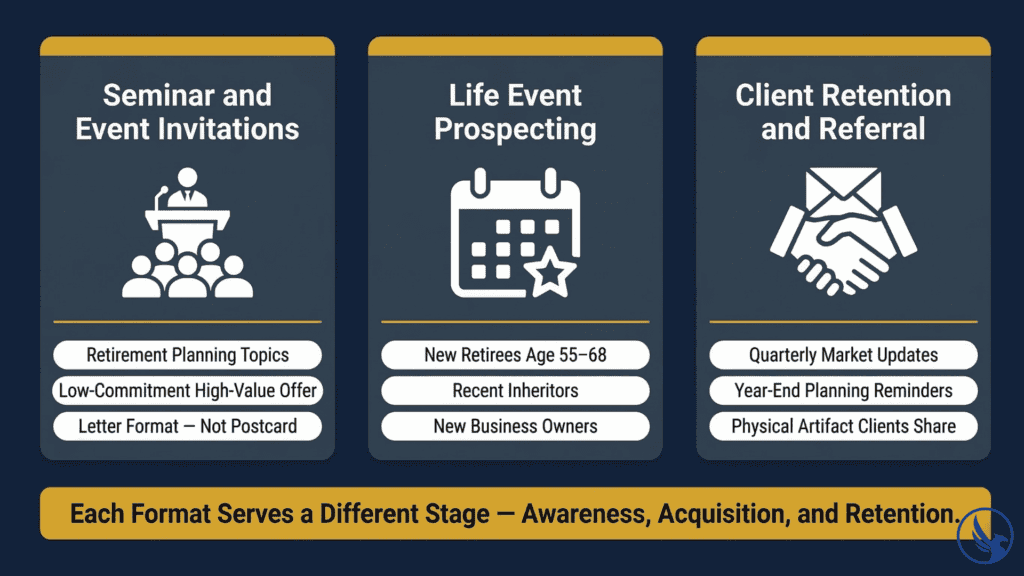
The seminar invitation is the most time-tested and highest-converting direct mail format in financial advisory marketing. A physical invitation to a free educational seminar — retirement planning, Social Security strategy, estate planning essentials, investment basics for pre-retirees — reaches prospects at the awareness and consideration stage with a low-commitment, high-value offer. It gives them free information, no obligation, and a chance to evaluate the advisor in person before any financial commitment.
The direct mail invitation to a seminar works because it matches the format to the audience psychology. Pre-retirement and retirement-age prospects are receptive to educational offers, respond well to physical mail, and are actively seeking trustworthy information about decisions that feel increasingly urgent. A letter-format invitation — rather than a postcard — communicates the tone of a personal invitation rather than a mass marketing piece. That tone is more consistent with the relationship positioning the advisor needs to establish.
Key seminar invitation design elements include: the advisor’s name, professional photograph, and credentials prominently displayed; a specific seminar topic framed around the prospect’s concern rather than the advisor’s product (“The 5 Social Security Mistakes That Cost Retirees Thousands” is more compelling than “Retirement Planning Seminar”); venue name, address, date, and time; and a clear RSVP mechanism — phone, URL, or QR code linking to a registration page. Seating limitations stated explicitly (“Space limited to 20 attendees”) create urgency without manufactured scarcity. For the QR code and UTM tracking framework that makes seminar registration measurable and attributable, Direct Mail QR Codes and Digital Integration covers the complete setup.
Prospecting Postcards for Specific Life Events
Beyond seminar invitations, the highest-performing financial advisor prospecting postcards target households experiencing specific financial life events. These triggers create immediate, high-motivation demand for advisory services. The four primary life event triggers are: new retirees and pre-retirees (ages 55–68), recent inheritors identified through probate records, new executives and business owners identified through business formation filings, and new homeowners who have recently completed a major asset transaction.
Each of these triggers represents a prospect whose financial situation has recently changed significantly. As a result, they are actively — or should be actively — seeking guidance. A prospecting postcard that specifically addresses the prospect’s life stage (“Recently retired? Here’s what most people don’t know about managing retirement income”) achieves a relevance that generic advisory marketing cannot match. For the list segmentation and acquisition methodology that identifies these life event triggers through list vendors, Direct Mail List Segmentation and Direct Mail Audience Targeting cover the full targeting framework.
Client Referral and Retention Mailers
Direct mail for financial advisors is not only a prospecting tool. It is also one of the most effective client retention and referral generation mechanisms available. A quarterly or semi-annual direct mail touchpoint to existing clients — a market update letter, a planning checklist for the current season, a holiday or year-end financial review reminder — reinforces the relationship, demonstrates ongoing value, and positions the advisor as proactive rather than reactive.
Referral generation through direct mail works because it gives existing clients a physical artifact to share. A well-produced client newsletter or planning guide that a satisfied client passes to a friend or colleague is a higher-trust referral mechanism than a request to “share my website.” The physical piece does the credibility work independently once it leaves the client’s hands. For the personalization capabilities that allow client retention mailers to address recipients by name and reference their specific planning stage, Personalized Direct Mail and Variable Data Printing covers the variable data printing technology that elevates response rates in relationship-marketing contexts.
Targeting the Right Prospects
Geographic and Demographic Targeting for Financial Advisors
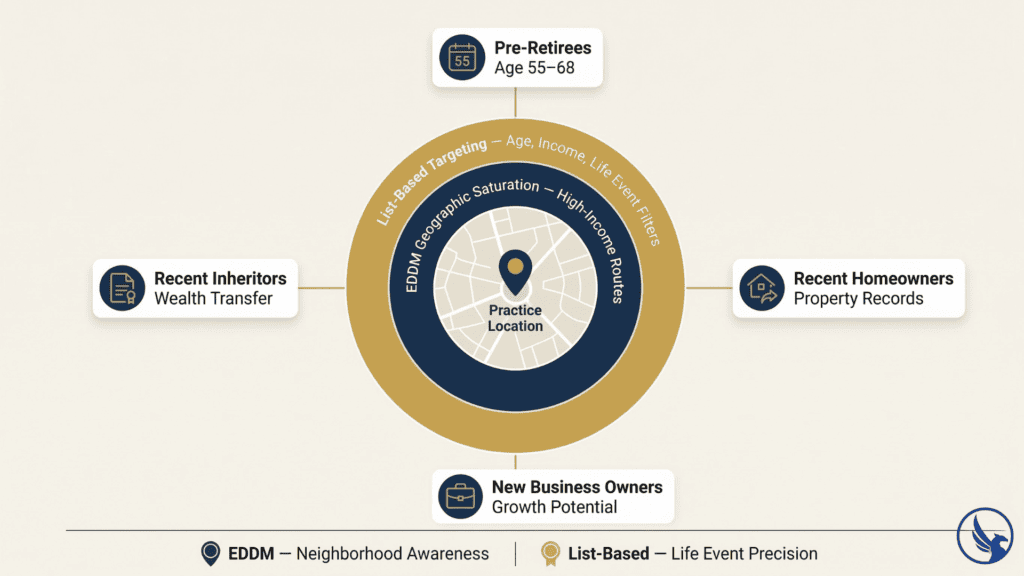
Financial advisory practices typically serve clients within a defined geographic market — the city or region where the advisor has community presence, relationships, and a reputation to leverage. Within that geography, the targeting variables that most predict advisory client potential are household income, net worth indicators (home value, neighborhood wealth proxies), age (55+ for retirement-focused practices), and professional status.
EDDM geographic saturation is appropriate for financial advisors targeting general awareness in high-income neighborhoods. It reaches every household above a certain income threshold within a defined zip code cluster. The USPS route selection tool allows filtering by median household income, enabling advisors to concentrate mailings on routes where the wealth profile aligns with the practice’s client minimum. For EDDM route selection guidance, explore our EDDM printing services and the EDDM Guide.
For more precise targeting — specific age bands, verified income levels, homeowner status, or life event triggers — list-based direct mail provides demographic precision that EDDM’s geographic saturation cannot achieve alone. A financial advisor targeting 60–70-year-old homeowners with household income above $150,000 within a 15-mile radius is describing a list that a direct mail list vendor can provide with reasonable accuracy. For the complete list acquisition and segmentation framework, Direct Mail List Segmentation covers every step from list specification through quality verification.
Niche Specialization as a Targeting Accelerator
Financial advisors who have developed a niche specialization — serving specific professional communities, retirement segments, or industry sectors — can use direct mail to reach that niche with a relevance and specificity that general advisory marketing cannot match. Consider a financial advisor specializing in serving physicians. They can mail to lists of local medical professionals with messaging specific to physician financial planning challenges — student loan management, practice ownership transitions, disability income planning. This creates a targeting precision and message relevance that general retirement planning content cannot achieve.
Niche-specific direct mail performs above average because it reaches people who immediately recognize the piece was designed for them. That recognition increases read-through, reduces skepticism, and elevates response rate compared to generic advisory marketing. For the A/B testing framework that allows niche campaign messages to be optimized across drops, Direct Mail A/B Testing provides the experimental structure. For the direct mail campaign mistakes that are particularly costly in compliance-sensitive categories, Direct Mail Mistakes to Avoid is essential pre-launch reading for any financial services mailer.
Measuring ROI and Building a Sustainable Campaign Program
Attribution for Financial Advisory Direct Mail
Measuring ROI from direct mail for financial advisors requires the same attribution infrastructure as any direct mail category — dedicated tracking phone number, QR code with UTM-tagged landing page, and a structured intake question at first contact. However, it also requires an additional layer of patience in the measurement timeline. Financial advisory client acquisition cycles are longer than most categories. A prospect may receive a seminar invitation, attend the event, have an initial consultation, and convert to a client over a period of 3–6 months. The direct mail piece that initiated the relationship may have been delivered months before the Assets Under Management transfer occurs.
Advisory: The 3–6 month conversion cycle and 6–12 month attribution window are directional figures. Actual timelines vary by advisor, offer type, and prospect profile. Measure your own client acquisition timeline before setting attribution windows for campaign reporting.
Consequently, financial advisor direct mail ROI should be measured on a 6–12 month attribution window rather than the 4–6 week post-delivery window appropriate for consumer retail or service categories. The correct ROI denominator is the lifetime revenue from the advisory relationship. For example, a client who transfers $500,000 in AUM and generates 1% in annual fees represents $5,000 in annual revenue — potentially for decades. At that client lifetime value, the break-even calculation for a direct mail prospecting campaign is profoundly favorable even at very low response rates.
Advisory: The $500,000 AUM and 1% annual fee figures above are illustrative. Actual fee structures, AUM minimums, and client lifetime values vary by practice and should not be used as planning benchmarks without verification against the advisor’s own fee schedule and client economics.
For the ROI modeling framework that accounts for long attribution cycles and high lifetime values, How to Measure Direct Mail ROI and the Direct Mail ROI Calculator provide the complete analytical model.
Building a Multi-Drop Program for Long-Term Client Acquisition
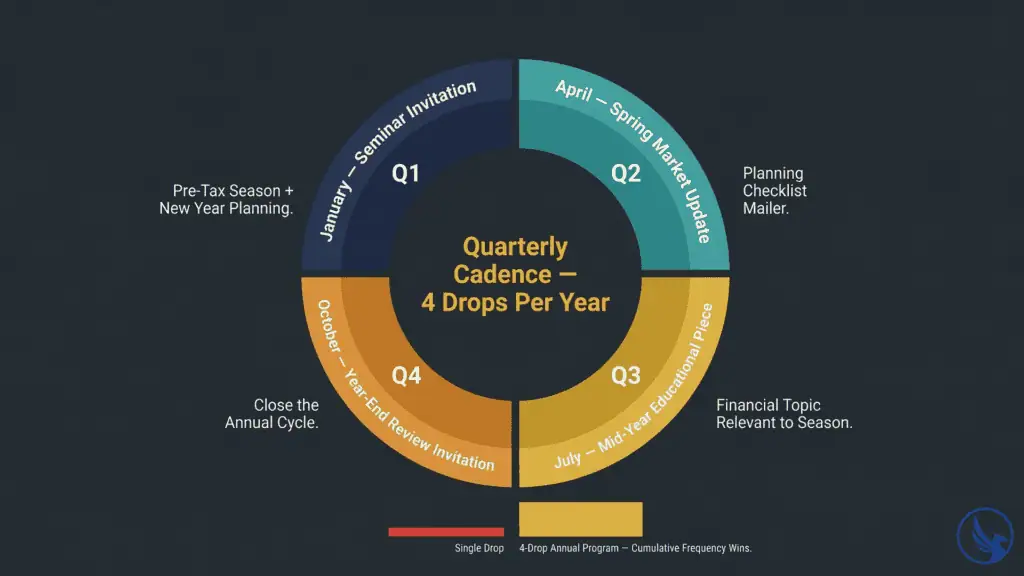
A single-drop prospecting campaign is the least efficient use of direct mail budget for financial advisors. The long decision cycle means most prospects who will eventually convert are not ready to act on the first impression. A multi-drop program — 3–4 mailings over 6–12 months to the same prospect list — builds cumulative frequency. It catches prospects at different points in their consideration cycle. And it maintains top-of-mind presence through the entire period from awareness to decision.
The sustainable financial advisor direct mail program runs on a quarterly cadence. A seminar invitation in January takes advantage of the pre-tax season and New Year planning mindset. A spring market update or planning checklist mailer in April follows. A mid-year educational piece goes out in July. Then a year-end review invitation in October closes the cycle. Each piece serves a different function in the acquisition and retention cycle while maintaining consistent brand presence throughout the year.
For the timing and cadence framework that governs multi-drop financial advisor campaigns, Direct Mail Frequency Best Practices covers optimal spacing and seasonal timing by category. For the complete campaign architecture from first design to multi-year program management, Direct Mail Campaign Planning and How to Create a Direct Mail Campaign provide the structured planning framework. The current channel trends shaping financial advisor direct mail effectiveness in 2026, Direct Mail Trends 2026 frames the evolution. For industry-specific response rate benchmarks that calibrate expectations for financial services campaigns, Direct Mail Response Rate by Industry and Good Response Rate for Direct Mail provide the full benchmark context. For practices building their first structured direct mail program, Direct Mail for Small Business frames the first-campaign decision framework.
Start Your Direct Mail Campaign with CRST
A well-structured direct mail for financial advisors program — seminar invitations to high-income households, life event-triggered prospecting postcards, and a quarterly multi-drop retention sequence — is one of the most sustainable and highest-return client acquisition investments available to an advisory practice operating in a trust-dependent category.
CRST handles direct mail and EDDM printing from file setup through postal delivery, with a team that knows USPS compliance inside out and a track record across industries. Explore our full direct mail printing services, request an estimate, or contact our team to discuss campaign options tailored to your practice.
For the complete breakdown of how the program works, see our EDDM Guide.