

Personalized direct mail variable data printing bridges the gap between the broad reach of physical mail and the audience specificity of digital advertising. It allows every piece in a print run of thousands to carry a unique name, offer, image, or message tailored to the individual recipient. And it does this without slowing the press or multiplying production cost proportionally. The result is a direct mail piece that reads less like a broadcast and more like a personal communication. That shift is precisely why personalized direct mail consistently outperforms generic mass mail on response rate across every category where anyone has measured it.
This guide covers what variable data printing is, how it works technically, which personalization variables produce the strongest response rate lift, and how to build a personalized direct mail campaign that maximizes return without overcomplicating production. For the foundational direct mail strategic context, Direct Mail Marketing Strategy and Why Direct Mail Still Works set the channel framework. For full-service campaign production including variable data capabilities, start at CRST.
What VDP Is and Why It Matters
Before diving into campaign strategy, it helps to understand what variable data printing actually is and what it enables. The section below covers the technical foundation and the full range of what you can personalize.
What Variable Data Printing Is and How It Works
The Technology Behind Personalized Direct Mail
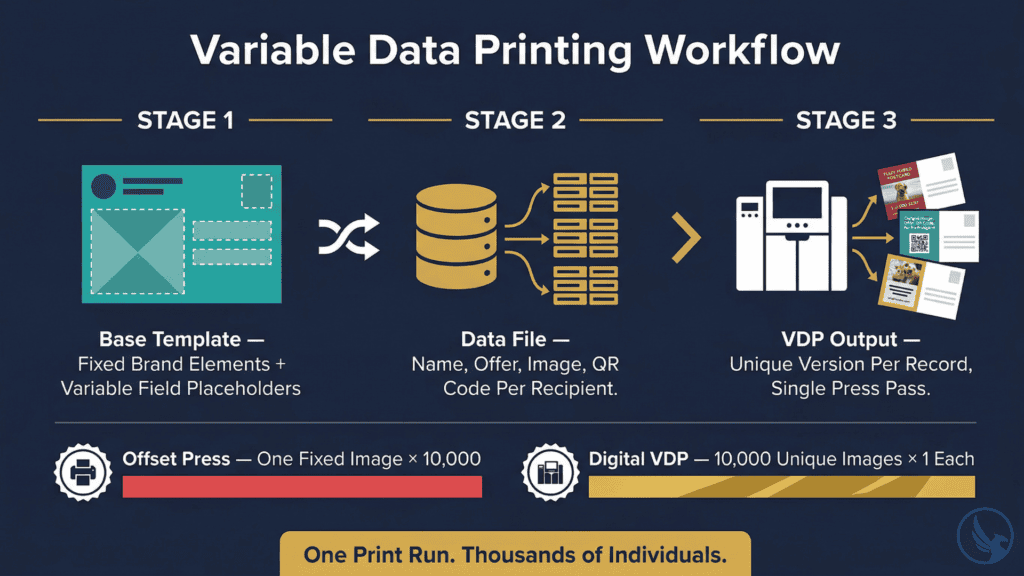
Variable data printing (VDP) is a digital printing process that merges a fixed design template with a database of recipient-specific information. The output is a unique version of each piece in the print run — all in a single pass through a digital press. Unlike offset printing, which prints one fixed image thousands of times, a VDP-enabled digital press pulls a different data record for each impression. It substitutes personalized elements — name, address, offer, image, copy block, or any other variable field — while keeping the fixed design elements consistent across the run.
The technical workflow is straightforward. A designer creates a base template with fixed brand elements and placeholder variable fields. A data file — typically a CSV or database export — provides the recipient-specific values for each variable field. The VDP software — products like XMPie, FusionPro, or PrintShop Mail — then merges the template with the data file and sends a unique print-ready file to the press for each record. The press outputs each piece with its unique personalization in sequence, ready for addressing, bundling, and mailing.
The key enabling factor is the digital press. Offset presses — the workhorse of high-volume commercial printing — cannot accommodate variable data because they use fixed plates. VDP therefore requires a digital press (laser or inkjet). That requirement is also why variable data printing is most cost-effective at run sizes of 500–25,000 pieces. Above that threshold, offset for fixed elements with digital overprinting for variable fields becomes relevant for high-volume campaigns. For the production cost framework across print methods and volume tiers, Direct Mail Printing and Direct Mail Cost Per Piece cover the full cost modeling context.
What Can Be Personalized
The most common personalization variable is the recipient’s name in the headline or salutation — “Dear [First Name]” or “Exclusive Offer for [First Name] in [City]” — but name personalization alone represents only a fraction of what modern VDP enables. The full spectrum of personalization variables includes:
Text variables: Name, address, city, salutation, offer amount, product reference, account number, renewal date, or any other text field the data record carries.
Image variables: Different photographs, product images, or background images swapped based on recipient demographics, purchase history, or geographic segment. A real estate agent’s postcard can show neighborhood-specific property photography based on the recipient’s ZIP code. A retailer’s postcard can, similarly, show product images matched to the recipient’s prior purchase category.
Offer variables: Different discount amounts, product offers, or promotional codes assigned to different recipient segments. High-value customers receive a 20% discount; new prospects receive a free consultation offer; lapsed customers receive a win-back incentive — all from the same print run with the same base design.
QR code variables: Unique QR codes per recipient that link to personalized landing pages, track individual response attribution, or pre-populate forms with the recipient’s information. For the full QR code and digital integration framework, Direct Mail QR Codes and Digital Integration covers the complete implementation methodology including UTM tracking and landing page setup.
The Response Rate Case for Personalization
What the Data Shows About Personalized vs Generic Mail
The response rate advantage of personalized direct mail over generic direct mail is well-documented across industry research. According to the Data & Marketing Association’s Response Rate Report, personalized direct mail generates response rates significantly higher than non-personalized mail to equivalent audiences. The lift ranges widely depending on personalization sophistication — basic name personalization at the lower end, and full image, offer, and message personalization matched to individual purchase history at the upper end.
Advisory: The specific percentage lift figures from the ANA/DMA Response Rate Report should be verified in the current edition at thedma.org before citing in client-facing materials, as figures are updated annually.
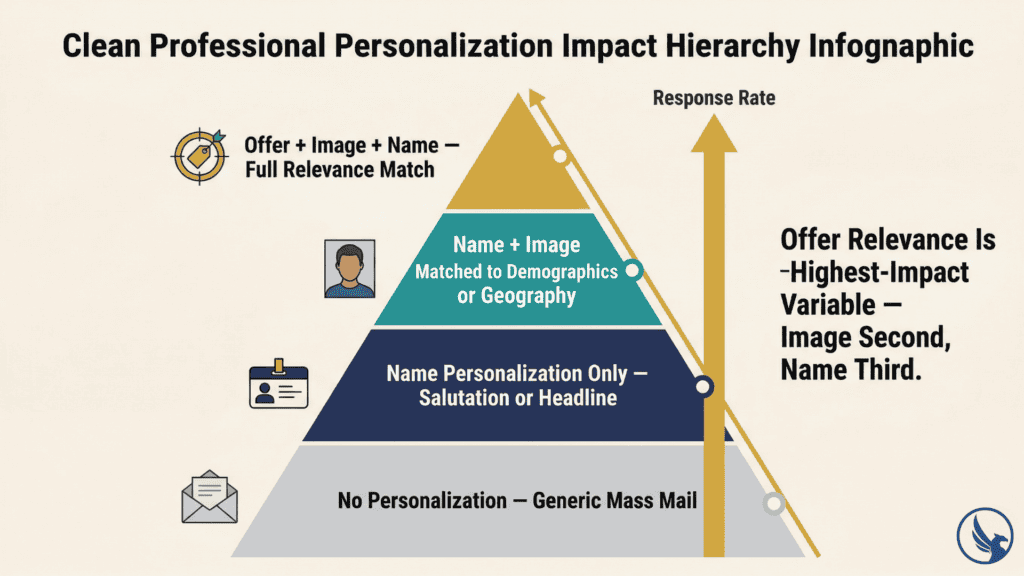
Research from InfoTrends — now operating as Keypoint Intelligence (keypointintelligence.com) — found that campaigns using variable data personalization achieve meaningfully higher response rates than static direct mail on average. That lift, moreover, increases as the number of personalized variables increases. A piece with personalized name, image, and offer outperforms a piece with name only. A name-only piece, in turn, outperforms a generic piece with no personalization at all.
Advisory: The specific percentage figures from InfoTrends/Keypoint Intelligence research should be verified in current Keypoint Intelligence publications before citing with direct attribution, as the organization and its research catalog have evolved since the original studies appeared.
The mechanism behind this lift is psychological. A piece that appears to be created specifically for the recipient generates a higher sense of relevance and personal attention. This, in turn, reduces the cognitive shortcut of “this is generic advertising, I can ignore it.” Furthermore, personalization signals that the sender has invested effort in understanding who the recipient is. That credibility signal is particularly valuable in high-trust categories like financial services, healthcare, insurance, and education. For the response rate benchmark context that frames what personalization lift means for specific categories, Direct Mail Response Rate by Industry and Good Response Rate for Direct Mail provide the full industry benchmark data set.
Personalization Variables That Move Response Rates Most
Not all personalization variables produce equal response rate lift. Research on VDP campaign performance consistently identifies a hierarchy of personalization impact. That hierarchy should govern where production budget goes when not every variable can be customized at once.
Highest impact: Relevant offer personalization — different offers matched to different audience segments based on demonstrated need, life stage, or prior behavior. A prospect who recently purchased a home and receives a home insurance offer will outperform the same prospect receiving a generic “get a quote” message, regardless of whether the name is personalized or not. Offer relevance is therefore the single most powerful personalization dimension.
High impact: Image personalization matched to recipient demographics or geographic segment. A neighborhood-specific photograph, a product image matched to prior purchase category, or a lifestyle image matched to the recipient’s life stage creates immediate visual relevance that generic imagery cannot. Campaigns using geographically or demographically matched imagery consistently outperform those using generic photography.
Moderate impact: Name personalization in the headline or salutation. Name personalization produces a measurable but modest lift compared to no personalization. It is most effective, moreover, when combined with other personalization variables rather than used in isolation.
Lower impact: Address-level personalization (city, neighborhood name) used purely for familiarity signaling without an offer or image component. This variable adds minimal lift on its own but amplifies the effect of higher-impact variables when combined. For the A/B testing framework that allows personalization variables to be isolated and their individual contribution to response rate measured, Direct Mail A/B Testing provides the experimental methodology.
Building a Personalized Direct Mail Campaign
Data Requirements and List Preparation
Personalized direct mail variable data printing is only as good as the data driving the personalization. A VDP campaign built on an inaccurate, incomplete, or outdated data file will produce pieces with wrong names, mismatched offers, or incorrect addresses. Those outcomes are worse than generic mail because they signal carelessness rather than the personal attention personalization is supposed to communicate.
Data preparation requirements for a VDP campaign are straightforward. The data file must be clean — no duplicate records, no blank required fields, no formatting inconsistencies. It must also be accurate — names spelled correctly, addresses deliverable, demographic data current. And it must be appropriately structured — fields formatted consistently to match the template variable field specifications. For house lists — existing customers or known prospects — data hygiene is the primary quality concern. For purchased lists targeting new prospects, list quality and recency take priority instead.
Vendors should apply CASS certification (Coding Accuracy Support System) and NCOA processing (National Change of Address) to all mailing lists before a VDP campaign runs. Both processes ensure address accuracy and deliverability. Most commercial direct mail vendors handle them as part of standard list preparation. For the complete list acquisition, segmentation, and preparation framework, Direct Mail List Segmentation and Direct Mail Audience Targeting cover the full data preparation methodology. For the campaign planning framework that coordinates data preparation with design and production timelines, Direct Mail Campaign Planning provides the end-to-end workflow.
Template Design for Variable Data Campaigns
Designing for variable data printing requires structural discipline that generic direct mail design does not. Every variable field in the template must accommodate the full range of values it will receive — a name field that fits “Li” must also fit “Bartholomew”; an offer field that accommodates “$25 off” must also accommodate “Free 60-minute consultation.” Variable text fields therefore require reserved layout space that accounts for maximum-length values without breaking the design.
Image variable fields require fixed dimensions that all candidate images must match — or the press will crop and scale them to fit — to avoid layout distortion when different images swap in. Offer variable blocks must additionally sit in positions where the overall design hierarchy stays intact regardless of which offer variant appears. These are design requirements, not optional considerations. A VDP template that ignores variable value ranges will produce broken layouts in the print run.
The most effective approach is to design the template around the most complex variable combination first, then verify that all simpler combinations also render correctly. For the design principles that apply across format types and personalization levels, Best Direct Mail Format for Response Rate covers the creative hierarchy framework. For production specifications that ensure VDP files are print-ready, Direct Mail Printing covers the technical requirements.
Personalization by Business Category
High-Impact Use Cases for Variable Data Printing
Financial advisors and insurance agents are among the highest-ROI users of personalized direct mail. Life event trigger campaigns — personalized to the recipient’s specific trigger (new homeowner, new retiree, recent business formation) with a relevant offer — produce response rates that generic prospecting mail cannot approach. For the category-specific campaign frameworks, Direct Mail for Financial Advisors and Direct Mail for Insurance Agents cover the full personalization strategy in context.
Healthcare and chiropractic practices benefit from name personalization and condition-specific messaging — different headline copy for back pain sufferers versus sports injury prospects drawn from the same list. For the healthcare personalization framework, Direct Mail for Chiropractors covers the design and offer variables most relevant to patient acquisition campaigns.
Schools and enrollment programs use VDP to send application deadline reminders with the prospect’s name, inquiry date, and specific program of interest. This approach, consequently, dramatically lifts conversion rates from inquiry to application compared to generic reminder pieces. For the enrollment-specific personalization framework, Direct Mail for Schools and Enrollment covers the campaign architecture in detail.
Retail and e-commerce businesses with purchase history data can use VDP to send product recommendation postcards. These pieces show the specific product categories the recipient has purchased, complementary products they have not yet bought, and a personalized discount code unique to that recipient. The result approaches the targeting precision of email marketing while arriving in the physical mail environment — which delivers demonstrably higher engagement rates for the 35+ demographic.
Cost, Measurement, and Scaling Personalized Campaigns

What Variable Data Printing Costs
VDP adds incremental cost over generic digital direct mail printing — data processing, template setup, and per-record processing all carry a real production cost. However, the incremental cost is typically modest relative to the response rate lift it produces. As a result, VDP is one of the highest-ROI production upgrades available for direct mail campaigns at mid-scale volumes.
At 5,000-piece runs, VDP setup and per-record processing typically adds $0.05–$0.15 per piece over standard digital printing. That range depends on the complexity of the personalization — number of variable fields, image versus text only, and whether unique QR code generation is a requirement. At 10,000 pieces, the per-piece incremental cost decreases as setup costs spread across a larger run.
Advisory: The $0.05–$0.15 per-piece range is directional. VDP pricing varies significantly by vendor, personalization complexity, and run size. Always request a specific quote for VDP production that itemizes setup fees, per-record processing costs, and any data preparation fees separately from base print pricing. Do not rely on generic per-piece estimates that may not include VDP-specific cost components.
For the full cost modeling framework that incorporates VDP incremental costs into campaign ROI calculations, Direct Mail Cost Per Piece and Direct Mail ROI Calculator provide the complete analytical model.
Measuring the Lift From Personalization
The cleanest way to measure the response rate contribution of personalization is a controlled A/B test. Split the mailing list into two matched segments, mail a personalized version to one half and a generic version to the other half, then compare response rates between the two groups. Hold all other variables — offer, format, delivery date, geography — constant throughout. The difference in response rate between the two versions is therefore the attributable lift from personalization.
For campaigns where a full A/B test is not feasible, tracking unique QR codes or phone numbers per personalization segment allows response rate comparison across audience groups even within a single campaign. For the complete A/B testing and measurement framework, Direct Mail A/B Testing and How to Measure Direct Mail ROI provide the experimental design and attribution methodology. The common mistakes that undermine VDP campaign effectiveness — including data quality failures and template design errors — Direct Mail Mistakes to Avoid is essential pre-launch reading. For the current trends shaping personalized direct mail in 2026, Direct Mail Trends 2026 frames the channel evolution. For the full campaign frequency and multi-drop sequencing framework that maximizes the cumulative impact of personalized mail programs, Direct Mail Frequency Best Practices covers the optimal cadence.multi-drop sequencing framework that maximizes the cumulative impact of personalized mail programs, Direct Mail Frequency Best Practices covers the optimal cadence.
Start Your Direct Mail Campaign with CRST
Personalized direct mail variable data printing — matching offer, image, and message to individual recipient data at scale — is the single highest-ROI production upgrade available to direct mail campaigns at mid-volume runs. It consistently delivers meaningful response rate lifts over generic mail, with the size of that lift determined by personalization sophistication and audience data quality.
Advisory: Response rate lift figures cited in VDP research vary widely by study, methodology, and personalization complexity. Verify specific figures from the ANA/DMA Response Rate Report and Keypoint Intelligence research in their current editions before using in client-facing materials or financial projections.
CRST handles direct mail and EDDM printing from file setup through postal delivery, with a team that knows USPS compliance inside out and a track record across industries. Explore our full direct mail printing services, request an estimate, or contact our team to discuss VDP campaign options.
For the complete breakdown of how the program works, see our EDDM Guide.