
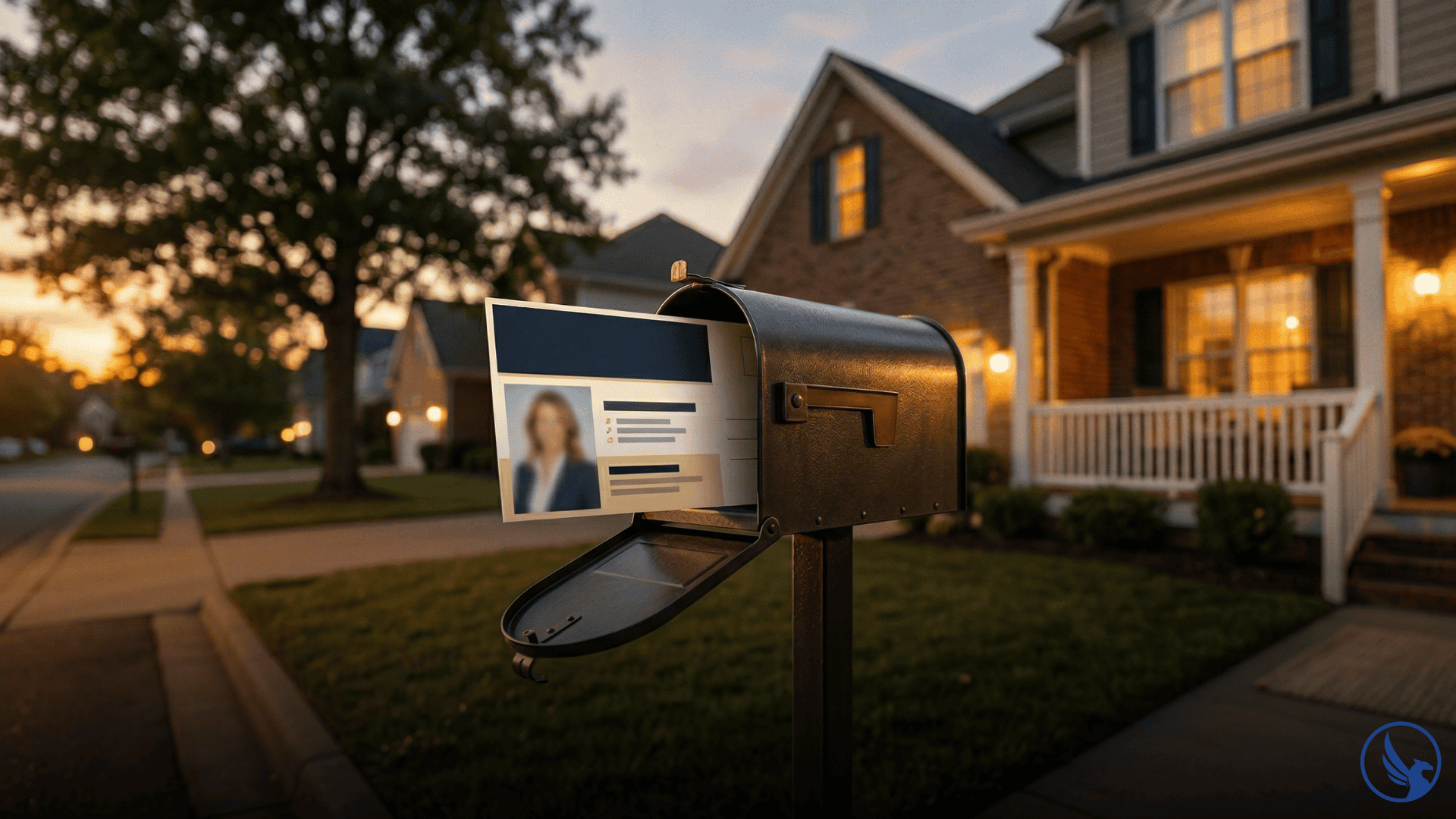
Direct mail for insurance agents is one of the most durable lead generation strategies in this category. Trust, credibility, and persistent local presence drive new client acquisition in insurance. This is not a category where prospects shop impulsively. Rather, it is a considered purchase. It is typically triggered by a life event, a renewal window, or a growing awareness of coverage gaps. In that context, the agent who has already established familiarity and credibility has a decisive advantage. Specifically, that advantage is over the agent who appears only at the moment of search.
Physical mail is purpose-built for persistent, credibility-first outreach. Unlike digital advertising, it reaches every household in your territory without requiring phone numbers, an email database, or an advertising budget. Moreover, it arrives in a low-competition attention environment. And it builds brand recognition through repeated physical impressions — in a way that digital impressions, forgotten the moment the screen changes, structurally cannot.
This guide covers how to build a direct mail for insurance agents program that generates qualified leads, survives the compliance environment, and compounds returns across every campaign drop. For the foundational direct mail strategic context, Direct Mail Marketing Strategy and Why Direct Mail Still Works are the essential starting points. For full-service campaign production, start at CRST.
Why Insurance Requires a Different Marketing Approach
Before choosing campaign formats, it helps to understand why trust-building channels outperform interruption channels in insurance. The sections below explain why physical mail is structurally better suited to insurance lead generation than digital alternatives.
Why Direct Mail Is Exceptionally Well-Suited to Insurance Marketing
The Trust Imperative in Insurance
Insurance is a category where the purchase decision is made almost entirely on trust. A prospect choosing between two agents with comparable products and pricing will choose the agent they feel they know. That means the one who has demonstrated community presence, professional credentials, and a track record of showing up before they were needed. Cold digital ads from unknown agents do not build this trust. Instead, they interrupt attention and then disappear.
A physical direct mail piece from a local agent, by contrast, arrives in a context that builds rather than interrupts. The agent’s name, photograph, and credentials all communicate that the agent is local, established, and invested in reaching the household. According to USPS consumer mail research, physical mail consistently ranks as one of the most trusted communication formats across all consumer demographics. That is a particularly critical advantage where trust is the primary purchase driver.
Advisory: The USPS Household Diary Study covers consumer mail behavior and attitudes broadly. The specific trust ranking relative to other communication formats should be verified in the current edition at postalpro.usps.com before citing with direct attribution.
Furthermore, the 35–65 age demographic represents the core insurance buying audience for life, home, and retirement products. This group has among the highest direct mail engagement rates of any consumer segment. They read their physical mail and retain pieces with relevant offers. Moreover, they are statistically more responsive to physical mail than to digital advertising.
Advisory: The demographic engagement advantage for the 35–65 cohort is directionally supported by ANA/DMA response rate research and USPS Mail Moments data. Verify specific demographic engagement figures in current editions before citing in client-facing materials.
For the statistical foundation of this engagement advantage, Direct Mail ROI Statistics 2026 covers the current benchmark data across audience segments most relevant to insurance marketing.
Compliance Considerations for Insurance Direct Mail
Advisory: Insurance marketing is subject to state-level regulatory oversight through each state’s Department of Insurance, as well as carrier-level compliance requirements that vary by product line, license type, and appointment. The guidance in this article covers general direct mail campaign strategy and design principles — it does not constitute compliance or legal advice. All direct mail materials for insurance agents must be reviewed and approved through the agent’s carrier compliance department or state regulatory framework before any piece is printed or mailed. Requirements typically govern claims about coverage, pricing disclosures, required licensing disclosures, and the use of carrier logos and brand marks.
The practical design implication is that insurance direct mail copy should be conservative, accurate, and disclosure-forward. This approach aligns naturally with the trust-first positioning that insurance direct mail requires anyway. A piece that makes specific pricing promises or guarantees coverage outcomes will fail compliance. It will also fail with sophisticated prospects who recognize overreach. Instead, a piece that leads with the agent’s credentials, community presence, a specific educational offer, and a clear invitation to a no-obligation conversation is both compliant and highly effective. For the design principles that govern this kind of trust-forward copy structure, Best Direct Mail Format for Response Rate covers the creative hierarchy framework applicable to compliance-sensitive categories.
Campaign Types That Generate Insurance Leads

Life Event Trigger Campaigns
The highest-converting insurance direct mail campaigns are those timed to coincide with life events that create immediate, high-motivation demand for insurance review. The five primary triggers for insurance prospecting are: new homeowners (immediate home and auto bundle need), newborns and new parents (life insurance need crystallizes at birth), new drivers and teens reaching driving age (auto policy expansion), recent retirees and pre-retirees ages 60–70 (Medicare supplement, life, long-term care), and new business owners (commercial liability, key person, and group benefits need).
Each of these triggers represents a prospect whose insurance situation has materially changed. As a result, they are actively in need of a coverage review — whether they know it yet or not. A postcard that addresses the prospect’s life stage achieves a relevance that generic marketing cannot. For example, “Just bought your first home? Here’s what most new homeowners don’t know about protecting it” outperforms any generic insurance message. Crucially, it demonstrates that the agent understands the prospect’s specific situation.
Life event lists — new homeowners from deed records, new parents from birth announcements, new business owners from formation filings — are available through direct mail list vendors. These lists can additionally be targeted by geography, income, and property value. For the complete list acquisition and segmentation framework, Direct Mail List Segmentation and Direct Mail Audience Targeting cover the full targeting methodology. For the personalization capabilities that allow life event trigger pieces to address prospects by name, Personalized Direct Mail and Variable Data Printing covers the variable data printing technology that elevates response rates in trigger-based campaigns.
Geographic Saturation Campaigns for Brand Presence
Beyond life event targeting, geographic saturation campaigns build the cumulative brand presence that makes the agent the first call when a prospect enters a buying window. An agent who has mailed a prospect three times over the past year is not a stranger when that prospect’s renewal comes up. On the contrary, they are a familiar presence with a name, a face, and a local address.
EDDM is therefore the ideal vehicle for geographic saturation insurance campaigns. It reaches 100% of residential addresses on selected carrier routes at a flat-rate postage of $0.260 per piece. It also requires no list purchase and no prospect data.
Advisory: The $0.260 EDDM Retail postage rate reflects pricing at time of publication. Verify the current rate at usps.com/business/every-door-direct-mail.htm before building budget models.
For an independent agent with a defined ZIP code territory, an annual EDDM program of 3–4 drops covers the full territory. The total campaign cost, moreover, competes favorably with digital lead generation costs in the insurance category. For the EDDM route selection and submission framework, explore our EDDM printing services and the EDDM Guide. For the cost modeling that compares EDDM against digital alternatives, Direct Mail ROI 2026 and Direct Mail Cost Per Piece provide the budget framework.
Renewal Reminder and Cross-Sell Campaigns
Direct mail for insurance agents is not only a new prospect acquisition tool. It is also one of the most effective client retention and cross-sell mechanisms available. A physical renewal reminder piece mailed 60–90 days before a client’s policy renewal date creates a proactive touchpoint. Specifically, it reduces lapse rates, invites coverage review conversations, and positions the agent as attentive rather than transactional. Clients who receive physical renewal reminders are, as a result, more likely to call the agent before shopping competitors at renewal.
Cross-sell campaigns target existing clients with specific product lines they do not currently carry. An agent with a large auto book, for example, can mail a home insurance offer to clients who carry home coverage elsewhere. Similarly, an agent with strong home and auto can mail a life insurance offer to young families in the book. For the personalization technology that allows client-specific cross-sell offers — including the client’s name, current coverage type, and a gap-closing offer — Personalized Direct Mail and Variable Data Printing covers the complete variable data implementation framework.
Design and Offer Framework for Insurance Direct Mail
What the Front Panel Must Accomplish
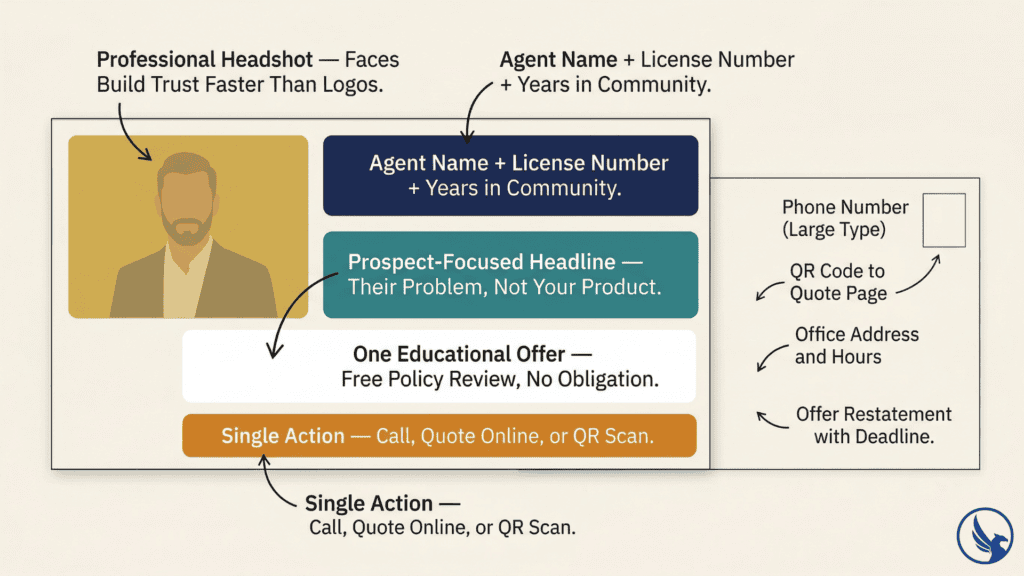
The front panel of an insurance agent direct mail piece carries the entire first-impression burden. In the three seconds between the recipient picking up the mail and deciding whether to read further, the front panel must communicate three things: who is reaching out and why they are credible; what specific problem or opportunity is being addressed; and what the recipient should do next.
Agent name and credentials prominently displayed — not hidden in a footer — is the first credibility signal. A professional headshot is strongly recommended, since faces build trust faster than logos in a relationship category. The headline should also be prospect-focused rather than agent-focused. For instance, “Is Your Home Covered for the True Cost of Replacement?” is more effective than “ABC Insurance — Your Local Agent.” A single, specific call to action — “Free Policy Review, No Obligation” or “Get a Quote in 10 Minutes” — then closes the front panel with a clear next step.
Premium stock selection reinforces credibility. Specifically, 16pt matte aqueous card communicates professional quality without the glossy commercial feel that can undermine personal relationship positioning. For stock and finish guidance applicable to professional service and insurance mailers, Direct Mail Printing covers the production specifications. For the complete design principles that govern high-response insurance mailers, Best Direct Mail Format for Response Rate provides the format selection framework.
The Back Panel: Reducing Friction to First Contact
Every element of the back panel should exist to reduce friction on the path from postcard to phone call or quote request. Required elements include: agent name, license number (required by most state insurance regulations), phone number in large type as the primary CTA, website URL or QR code linking to a quote page or contact form, physical office address, office hours, and the specific offer restated with any applicable expiration date.
The QR code linking to a quote request page deserves particular emphasis. A prospect who would not call cold but is willing to start an online quote is a warm lead. Removing the phone barrier from the first step therefore dramatically increases the conversion of passive interest into active prospect conversations. For the QR code implementation and UTM tracking framework that makes insurance direct mail measurable, Direct Mail QR Codes and Digital Integration covers the complete setup. For the tracking infrastructure — dedicated phone number, QR analytics, intake questions — that turns campaign responses into attributable ROI data, How to Measure Direct Mail ROI is the essential companion.
Targeting, Timing, and Multi-Drop Strategy
Route and List Selection for Insurance Agents
EDDM route selection for insurance agents should prioritize the demographic variables most predictive of insurance purchase potential. For home and auto agents, routes with high homeowner density and median household incomes above $50,000 produce the highest response rates. For life insurance-focused agents, routes with family household compositions and ages 30–55 are the priority. And for Medicare supplement specialists, routes with high concentrations of 65+ households are the primary target.
The USPS route selection tool provides median household income, average age, and residential versus business address counts for each carrier route. This data is sufficient for a well-calibrated first-pass route selection. For agents who need more precise demographic filtering, list-based targeting additionally allows filtering by age band, homeowner status, verified income, and life event triggers at the household level. For the complete route selection and list acquisition methodology, Direct Mail Audience Targeting and Direct Mail List Segmentation cover the full targeting framework.
Seasonal Timing and the Three-Drop Acquisition Sequence
Insurance direct mail has both evergreen and seasonal timing considerations. The evergreen consideration is renewal cycle alignment — campaign drops should be timed to reach prospects 30–60 days before the typical renewal window. For home and auto, this is typically spring and fall when a significant share of annual renewals cluster.
Advisory: Renewal clustering patterns vary by geography, carrier, and book composition. Agents should verify against their own renewal data before setting seasonal campaign timing.
For Medicare products, the Annual Enrollment Period (October 15 – December 7) is the primary campaign window. Direct mail should therefore be in-home by early October.
Advisory: Medicare marketing is subject to strict CMS (Centers for Medicare and Medicaid Services) regulations governing timing, content, disclaimers, and permissible outreach methods. All Medicare-related direct mail must comply with current CMS marketing guidelines. Verify current CMS marketing rules at cms.gov before designing or distributing any Medicare-related direct mail piece. These rules change annually and non-compliance carries significant penalties.
The recommended three-drop acquisition sequence works as follows. Drop 1 is a broad awareness piece establishing the agent’s name, credentials, and territory presence with a soft educational offer. Sent three to four weeks later, Drop 2 is a specific product or life event trigger piece with a stronger call to action and a clear offer deadline. Three weeks after that, Drop 3 is an urgency close — “Last chance for our complimentary policy review through [date]” — targeting the segment that has not yet responded.
For the cadence and spacing framework that governs multi-drop insurance campaigns, Direct Mail Frequency Best Practices covers the optimal timing by product line and campaign type. The A/B testing framework that allows each drop to optimize creative and offer variables, Direct Mail A/B Testing provides the experimental structure. For the production and strategic errors most likely to undermine insurance direct mail campaigns, Direct Mail Mistakes to Avoid is essential pre-launch reading.
Measuring ROI and Building a Scalable Program

The ROI Case for Insurance Direct Mail
The lifetime value calculation for insurance direct mail ROI is highly favorable in most product lines. Consider a home and auto bundle client generating $2,400 in annual premium with an average retention of 7 years. That represents $16,800 in lifetime premium. And if the agent earns a 10–15% commission, lifetime agent revenue is therefore $1,680–$2,520 per acquired client. At those lifetime values, the break-even response rate for a 5,000-piece EDDM campaign at $1,900 total cost is approximately 1–2 new clients — a threshold that any well-targeted campaign should clear.
Advisory: The $2,400 annual premium, 7-year retention, and 10–15% commission figures are illustrative. Actual premium levels, retention rates, and commission structures vary by product line, carrier, and market. Verify against your own book data before using in financial planning.
For life insurance and commercial lines, the lifetime value per acquired client is even more favorable. Consequently, the case for direct mail investment becomes correspondingly stronger. For the complete ROI modeling framework, Direct Mail ROI Calculator and How to Measure Direct Mail ROI provide the analytical structure. The industry response rate benchmarks that calibrate insurance campaign expectations, Direct Mail Response Rate by Industry and Good Response Rate for Direct Mail cover the full benchmark set.
For the broader channel comparison that contextualizes insurance direct mail ROI against digital alternatives, Direct Mail vs Social Media Ads and Direct Mail as an Alternative to Cold Calling provide the full analytical framework. For insurance agents building their first structured direct mail program, How to Create a Direct Mail Campaign and Direct Mail for Small Business provide the foundational planning framework. The current trends shaping insurance agent direct mail effectiveness in 2026, Direct Mail Trends 2026 frames the channel evolution.
Start Your Direct Mail Campaign with CRST
A well-structured direct mail for insurance agents program — geographic saturation drops to build territory presence, life event trigger campaigns to reach high-motivation prospects, and a multi-drop acquisition sequence that builds frequency over six to eight weeks — is one of the most reliable and highest-return lead generation investments available to an independent agent or agency.
CRST handles direct mail and EDDM printing from file setup through postal delivery, with a team that knows USPS compliance inside out and a track record across industries. Explore our full direct mail printing services, request an estimate, or contact our team to discuss campaign options tailored to your practice.team to discuss campaign options tailored to your practice.
For the complete breakdown of how the program works, see our EDDM Guide.