
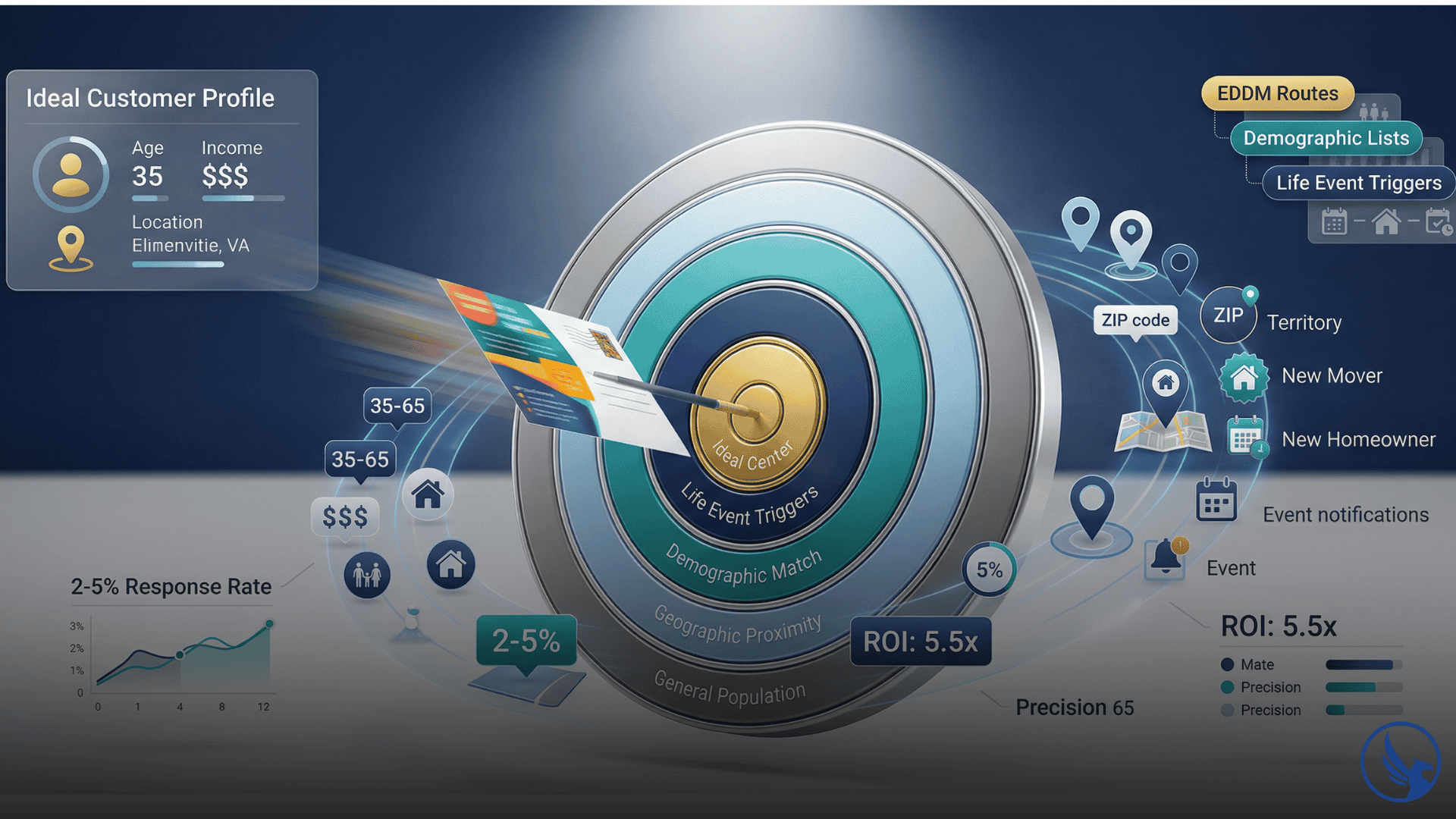
Direct mail audience targeting is the campaign planning decision that has more impact on response rate and ROI than any creative execution, offer structure, or format choice. A perfectly designed postcard with a compelling offer mailed to the wrong audience generates near-zero response regardless of production quality — because relevance, not design, is the primary driver of direct mail response, and relevance begins with the accuracy of audience definition. Conversely, a modestly designed piece with a specific offer mailed to a precisely qualified audience that is experiencing an immediate need for that specific service will generate response rates that consistently exceed category benchmarks. The targeting does the work that no creative execution can substitute for.
The businesses that achieve response rates at the top of their industry benchmark range are not doing so because they have better designers or bigger budgets. Rather, they are doing so because their direct mail audience targeting is precise enough to concentrate every piece mailed on households where the probability of conversion is high, rather than distributing spend equally across households where conversion probability ranges from very high to effectively zero. This guide covers the complete audience targeting framework — from customer profile development through EDDM route selection, demographic list filtering, life event trigger targeting, and the data hygiene standards that make targeting precision achievable. The foundational strategic context lives in Direct Mail Marketing Strategy and Why Direct Mail Still Works. For full-service campaign production, start at CRST.
Starting Point: The Customer Profile
Every effective audience targeting strategy begins from the same starting point: a clearly defined ideal customer profile. The sections below cover how to build that profile and the discipline required to apply it correctly to targeting decisions.
Building the Ideal Customer Profile From Existing Data
Every effective direct mail audience targeting strategy begins from the same starting point: a clearly defined ideal customer profile derived from the business’s existing best customers. The ideal customer profile is not a demographic hypothesis about who might buy — it is a data-derived description of who actually does buy, at what frequency, at what transaction value, and with what retention characteristics. The highest-value customers in any business’s existing book are the template for the prospect audience that direct mail should reach.
The customer profile development process requires analyzing the existing customer base across four dimensions: demographic characteristics (age range, income tier, homeowner versus renter, household composition), geographic characteristics (distance from business location, specific neighborhoods or ZIP codes with disproportionate customer concentration), behavioral characteristics (how they found the business, what service category they initially purchased, how frequently they return), and lifetime value characteristics (average annual spend, years of relationship, referral activity). The intersection of these four dimensions defines the audience profile that direct mail targeting should replicate in the prospect population.
For businesses with CRM or POS systems that contain customer data, this analysis is a data export and sorting exercise. For businesses without structured customer data, the analysis is a qualitative exercise based on the business owner’s knowledge of their best customers — less precise but still directionally useful for initial targeting decisions. Segmentation methodology that applies this customer profile to list selection and route filtering lives in Direct Mail List Segmentation.
The Profile-First Discipline
The most common direct mail audience targeting error is inverting the correct sequence — selecting the list or the EDDM routes first based on availability and convenience, then constructing a campaign for whoever is on that list. This inversion produces campaigns targeted to what was available rather than what was optimal. It generates response rates that reflect the gap between the available audience and the optimal audience rather than the campaign’s true potential.
Profile-first targeting discipline requires that every targeting decision begins with the customer profile question: given what we know about our best customers, what demographic, geographic, behavioral, and life stage characteristics define the households most likely to become best customers? That profile then drives the list specification or EDDM route filter — not the other way around. The discipline is simple in principle and requires deliberate enforcement in practice, because the convenience of selecting the nearest EDDM routes or the cheapest available list is always more immediately accessible than the rigor of profile-driven targeting. Campaign planning framework that integrates targeting discipline into the pre-production workflow lives in Direct Mail Campaign Planning.
EDDM Geographic Targeting
Route Selection Methodology
EDDM Every Door Direct Mail targeting is geographic saturation — it reaches 100% of residential addresses on selected carrier routes without any household-level demographic filtering. The targeting precision in EDDM is therefore determined entirely by carrier route selection: which routes align most closely with the ideal customer profile geography, and which routes represent wasted spend on populations that fall outside that profile.
The USPS EDDM online tool provides four data points for each carrier route that are sufficient for a first-pass targeting filter: total residential deliveries, average household size, percentage of residential versus business addresses, and median household income. For most local service businesses, these four data points allow route qualification by income tier (filtering for routes above a defined median household income threshold), geographic proximity (filtering for routes within a defined distance from the business location), and residential density (filtering for routes with low business address percentages that would represent wasted postage).
Routes with median household income above the business’s customer profile threshold, high residential density, and proximity within the service territory radius are the priority routes. Routes below the income threshold or outside the radius represent lower-priority budget allocation — either mailed at lower frequency or excluded from the initial campaign to concentrate budget on the highest-probability geography. Complete EDDM route selection and submission framework lives in our EDDM printing services page and the EDDM Guide.
Current EDDM Retail postage is $0.247 per piece.
Advisory: Verify current USPS EDDM postage rates at usps.com/business/every-door-direct-mail.htm before finalizing any campaign budget, as rates are subject to periodic adjustment.
When EDDM Saturation Outperforms Demographic Filtering
EDDM geographic saturation is not only appropriate for businesses with broadly applicable offers — it is often the more efficient targeting approach even for businesses with a defined demographic customer profile, when the demographic qualification ratio within the target geography is high enough that demographic filtering saves less in waste elimination than it costs in list acquisition and processing overhead.
Advisory: The 60–70% and 40% qualification ratio thresholds below are directional decision points — not precise formulas. Verify the comparison using own list cost and EDDM cost data before making the efficiency decision for any specific campaign.
A useful threshold: when the qualified audience within the geographic target represents more than 60–70% of total households, EDDM saturation typically produces lower total cost per qualified impression than demographically filtered list targeting. When the qualified audience is below 40% of the geographic population — as with financial advisors targeting pre-retirees in a mixed-age territory, or a private school targeting families with children in a predominantly retiree neighborhood — demographic list targeting consequently produces more efficient economics.
The crossover analysis is straightforward: calculate the cost of EDDM saturation of the territory (pieces × EDDM rate) versus the cost of a demographically filtered targeted list campaign (list cost per record + postage + processing) and compare cost per qualified impression for each approach. Cost modeling framework that enables this comparison lives in Direct Mail Cost Per Piece.
Demographic List Targeting
The Core Demographic Filters
Demographic list targeting purchases or compiles a filtered list of households meeting specific characteristics from the customer profile — enabling mail to be concentrated on qualified households rather than all households in the geographic territory. List vendors provide household-level data filtered by a wide range of demographic variables, of which five produce the most consistent targeting precision improvement for local service business campaigns.
Age band is the primary filter for healthcare, financial services, Medicare products, and age-specific service categories. A Medicare supplement insurance agent targeting 65+ households, a retirement planning advisor targeting 55–70, or a pediatric dental practice targeting households with children ages 3–12 each require age filtering that EDDM geographic saturation cannot provide. Age band filtering reduces the prospect universe to the portion of the geographic population that falls within the relevant life stage — typically a 30–60% reduction in mailed volume for age-specific categories.
Advisory: The 2–3× response rate improvement from age band filtering is directional industry guidance. Actual improvement varies by category, list quality, and offer. Verify against own campaign data before using in ROI projections.
Homeowner status is the primary filter for home services, mortgage, home insurance, and any category where property ownership is a qualifying criterion. EDDM delivers equally to homeowners and renters — for categories where renters have zero conversion probability, homeowner filtering eliminates the renter portion of the mailing.
Advisory: The 30–50% renter proportion figure is a directional estimate for mixed residential markets. Actual renter concentration varies significantly by geographic market. Verify against route-level data in the USPS EDDM tool before using in budget planning.
Household income is the qualifying filter for premium service categories, luxury offerings, and any service with a price point that exceeds what lower-income households can practically afford. Income filtering should be applied conservatively — an income floor that eliminates 40% of the geographic population when only 15% of that 40% would realistically be excluded on income grounds wastes more targeting precision than it creates. Complete segmentation methodology that applies these filters lives in Direct Mail List Segmentation.
List Quality Standards and Data Hygiene
A demographically filtered list produces its intended targeting precision only if the underlying data is accurate, current, and deliverable. A list with 15% undeliverable addresses wastes the print and postage cost of every non-delivered piece — typically more expensive than the CASS/NCOA processing that would have identified and removed those addresses before production. With outdated income data may include households that no longer meet the financial qualification criteria the filter was designed to enforce. A list with duplicate records generates multiple pieces to the same household — wasting budget and risking brand perception damage.
The four data quality standards that must be met before any targeted list campaign: CASS certification (USPS address standardization and deliverability verification — removes approximately 5–10% of undeliverable addresses from a typical purchased list), NCOA processing (National Change of Address — updates addresses for households that have moved within the past 48 months), duplicate suppression (removes duplicate household records that would generate multiple pieces to the same address), and data recency verification (confirming the list vendor’s data refresh cycle — monthly or quarterly refresh is preferable to annual for life event trigger lists).
Advisory: The estimate that approximately 15% of households change addresses per year is directional. Verify current NCOA coverage and data refresh cycles with your list vendor before committing to a purchased list. List data quality varies significantly across vendors. Always request a sample list of 200–500 records for quality validation before committing to a full list purchase. Evaluate the sample for address format consistency, completeness of required fields, and spot-check a random selection of addresses against publicly available records to assess accuracy. Complete list acquisition and vendor evaluation framework lives in Direct Mail List Segmentation.
Life Event Trigger Targeting
The Five Primary Life Event Triggers
Life event trigger targeting is the highest-precision direct mail audience targeting methodology available — reaching households at their specific moment of maximum purchase readiness rather than on an arbitrary calendar schedule. The five primary life event triggers with commercially available, frequently updated list data represent the targeting approach most likely to produce response rates above the industry benchmark ceiling for the categories they serve.
New movers are households that have recently changed their primary address — a trigger available from USPS change-of-address data and commercial data vendors with delivery latency as low as 7–14 days from the move. New movers have immediate needs for virtually every local service category — dentist, HVAC contractor, landscaper, pest control, financial advisor, insurance agent — and are in an active service-seeking mode that makes them disproportionately responsive to well-timed direct mail.
Advisory: The 2–4× response rate improvement for new mover campaigns over demographically equivalent non-mover lists is directional industry guidance. Actual improvement varies by category, timing, and offer. Verify against own campaign data before using in ROI projections.
The New homeowners are identified from deed recording data — available at county recorder offices and from commercial data vendors within 7–21 days of the deed recording. New homeowners have immediate home services needs (security systems, HVAC tune-up, roof inspection, lawn care, pest control) and insurance coverage review needs that make them among the most motivated prospects available through any targeting mechanism.
New parents
Identified from birth announcement data — available from hospital reporting and consumer data sources with varying latency. Parents have immediate financial planning, insurance, and pediatric healthcare needs that create predictable, high-motivation demand for the specific categories that target this trigger.
Recent retirees are identified from Social Security benefit commencement records and age-based modeling in the 62–68 age band — the primary trigger for Medicare supplement, financial advisory, and senior care categories. Recent retirees are in an active financial review and insurance reconfiguration mode that makes them highly responsive to well-targeted, well-timed offers from financial and insurance professionals.
New business formations are identified from state business registration filings — available with 7–14 day latency. New business owners have immediate needs for commercial insurance, business banking, accounting services, and professional services that make them a high-motivation trigger audience for B2B direct mail programs.
Category-specific life event targeting frameworks live in Direct Mail for Insurance Agents, Direct Mail for Financial Advisors, Direct Mail for Chiropractors, and Direct Mail for Schools and Enrollment.
Timing Precision: When to Mail After a Trigger Event
The response rate advantage of life event trigger campaigns depends not only on identifying the right trigger but on reaching the prospect within the timing window when their purchase readiness is highest. For new movers, the highest-response timing window is 0–30 days after the move — the period of active service establishment when the household is deliberately seeking local service providers. Response rates decline measurably for campaigns that reach new movers 60–90 days after the move, when initial service relationships have been established and the window of peak openness has closed.
For new homeowners, the highest-response timing window for home services categories is 0–60 days after deed recording — before the initial home assessment and repair prioritization is complete and while the homeowner is still evaluating service providers for each category. Financial services and insurance, the new homeowner window extends 90–180 days as coverage review and financial planning decisions are made more gradually.
For Medicare and retirement financial products, the pre-retirement window — 6–24 months before the estimated retirement date based on age modeling — is more valuable than the post-retirement window, because decisions about Medicare coverage and financial planning are ideally made before retirement rather than reactively after it. Timing frameworks that govern trigger-based campaign scheduling live in Direct Mail Frequency Best Practices. Personalization capabilities that allow trigger pieces to reference the specific event — “Congratulations on your new home” or “Welcome to the neighborhood” — live in Personalized Direct Mail and Variable Data Printing.
Supporting Resources for Audience Targeting
A/B testing methodology that validates trigger timing windows against actual response data lives in Direct Mail A/B Testing. Measurement infrastructure that tracks trigger campaign response rates against non-trigger baseline campaigns lives in How to Measure Direct Mail ROI. ROI modeling that quantifies the response rate premium from trigger targeting against the incremental list cost lives in Direct Mail ROI Calculator and Direct Mail ROI 2026. Response rate benchmarks that contextualize trigger campaign performance against category averages live in Direct Mail Response Rate by Industry and Good Response Rate for Direct Mail.
Common targeting mistakes that undermine audience precision are covered in Direct Mail Mistakes to Avoid. Current targeting trends shaping direct mail audience selection in 2026 live in Direct Mail Trends 2026. Businesses building their first targeted direct mail audience strategy will find the foundational planning framework in How to Create a Direct Mail Campaign and Direct Mail for Small Business.
According to the USPS Household Diary Study, physical mail engagement is highest among the 35–65 demographic — the same demographic that represents the target audience for most of the life event triggers described in this article, making trigger timing and demographic filtering naturally complementary targeting strategies.
Advisory: The specific engagement finding should be verified in the current USPS Household Diary Study at postalpro.usps.com before citing with direct attribution, as findings and methodologies are updated periodically.
According to the Data & Marketing Association, targeted list campaigns consistently outperform geographic saturation campaigns on response rate for categories with clearly defined audience profiles.
Advisory: The specific DMA finding should be verified in the current ANA/DMA Response Rate Report at thedma.org before citing with direct attribution, as figures are updated annually.
To discuss full-service campaign support including list acquisition, targeting strategy, and production, contact our team or request a campaign estimate.
Start Your Direct Mail Campaign with CRST
Effective direct mail audience targeting — customer profile development from existing best customer data, EDDM route selection filtered by income and homeowner density, demographic list filtering by age, homeowner status, and income tier, and life event trigger targeting timed to the 0–30 day window of maximum purchase readiness — is the highest-leverage pre-production investment in any direct mail campaign, consistently producing the response rate improvements that separate campaigns at the top of the benchmark range from those at the bottom.
CRST handles direct mail and EDDM printing from file setup through postal delivery, with a team that knows USPS compliance inside out and a track record across industries. Explore our full direct mail printing services, request an estimate, or contact our team to discuss targeting strategy and campaign production options.
For the complete breakdown of how the program works, see our EDDM Guide.
Questions? Call 845-255-5722