

Direct mail for schools and enrollment is one of the most consistently effective tools in an education marketer’s campaign arsenal. It is also one of the most underutilized. School marketing budgets increasingly allocate toward social media, digital ads, and SEO. Yet the channel that generates the highest-quality enrollment inquiries is still the physical piece of mail. It arrives in a parent’s hand — tangible, credible, and impossible to scroll past.
Enrollment is not an impulse decision. Instead, it is a considered, high-stakes choice. Parents and students evaluate institutions on trust, community fit, academic quality, and outcomes. The most effective marketing channel is therefore not the one with the lowest CPM. Rather, it is the one that arrives with permanence, design quality, and a credibility signal that digital outreach cannot replicate. For the foundational direct mail strategic context, Direct Mail Marketing Strategy and Why Direct Mail Still Works provide the essential channel framework. For full-service campaign production, start at CRST.
Why Physical Mail Works Differently for Education
Before choosing campaign formats, it helps to understand why direct mail performs differently in education than in retail or service categories. The decision cycle is longer, the stakes are higher, and the trust threshold is greater. The sections below explain how those factors make physical mail the stronger primary channel.
Why Direct Mail Works for Education and Enrollment
The High-Consideration Decision Cycle
Education enrollment decisions involve multiple decision-makers, extended evaluation timelines, and high emotional stakes. This is especially true for private K–12 schools, independent colleges, vocational programs, and specialized learning centers. A family considering a private school weighs financial commitment, community belonging, academic trajectory, and values alignment simultaneously. That decision process cannot be compressed into a 30-second ad impression. Nor can it be reduced to a social media click.
Direct mail, by contrast, reaches this audience in a deliberate, low-pressure context. A well-designed enrollment packet arrives in the family’s mailbox. It can be read, discussed, and returned to over multiple days. It therefore functions as a decision-support tool that digital impressions are structurally unable to provide. Moreover, the physical quality of the piece communicates institutional quality before a single word is read. A premium-stock mailer with professional photography, student testimonials, and a clear open house invitation signals that the institution is established, invested, and worth serious consideration.
According to USPS consumer mail research, physical mail is among the most trusted communication formats across all demographics — a particularly important advantage for educational institutions where trust and community standing are primary enrollment drivers.
Advisory: The USPS Household Diary Study covers consumer mail behavior and attitudes broadly. The specific trust ranking relative to other communication formats should be verified in the current edition at postalpro.usps.com before citing with direct attribution.
For the statistical foundation of direct mail’s engagement advantage in high-consideration categories, Direct Mail ROI Statistics 2026 covers the current benchmark data.
Geographic Density and the Draw Area Advantage
Schools recruit from a defined geographic draw area — typically determined by commute distance, district boundaries, or regional reputation. Unlike digital advertising that serves impressions globally, direct mail is inherently local. For education enrollment, that is a strength rather than a limitation. Reaching every household within the draw area is more efficient than targeting behavioral segments on social media that may or may not be in a relevant life stage.
EDDM — Every Door Direct Mail — is the ideal delivery mechanism for school enrollment geographic saturation. It reaches 100% of residential addresses on selected carrier routes within the draw area. It requires no list purchase and no student data. Furthermore, it runs at a flat-rate postage of $0.260 per piece.
Advisory: The $0.260 EDDM Retail postage rate reflects pricing at time of publication. Verify the current rate at usps.com/business/every-door-direct-mail.htm before building budget models.
For the EDDM route selection and campaign process, explore our EDDM printing services and the EDDM Guide. For schools that want to layer demographic targeting beyond geographic saturation — filtering by income, presence of school-age children, or specific age bands — Direct Mail Audience Targeting and Direct Mail List Segmentation cover the list-based options that complement EDDM for enrollment campaigns.
Campaign Types That Drive Enrollment Results
Open House and Information Session Invitations
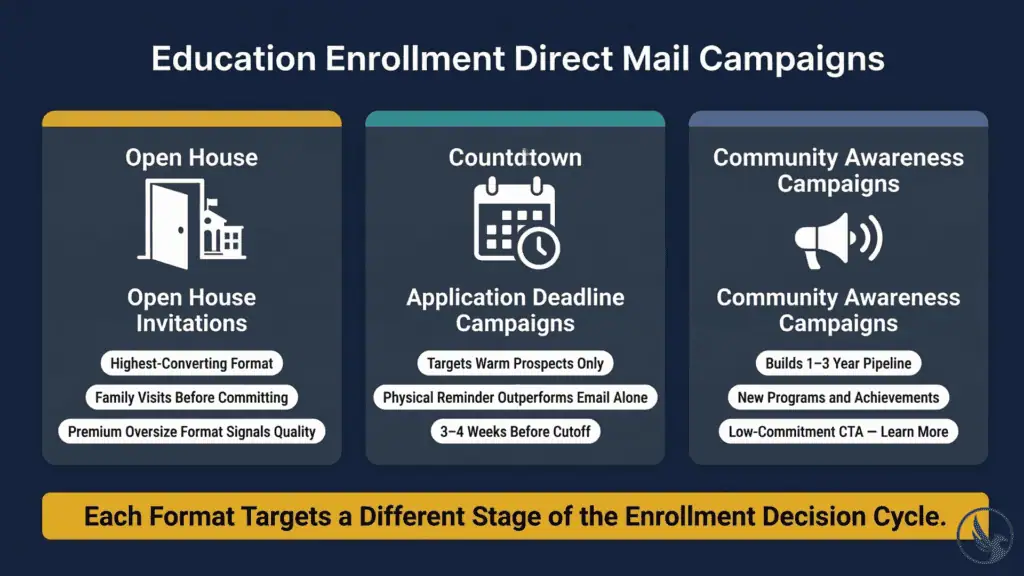
The single highest-converting direct mail format for school enrollment is the open house invitation. A physical invitation to a campus visit — free, no obligation, a chance to meet faculty and tour facilities — moves high-consideration prospects from awareness to active evaluation. Families who would never respond to a general “apply now” call to action will attend an open house. And open house attendance is a strong predictor of enrollment conversion across most education categories.
Advisory: The claim that open house attendance is the strongest predictor of enrollment conversion should be verified against your institution’s own enrollment funnel data before using in strategic planning documents, as conversion rates vary significantly by institution type, market, and campaign execution.
Open house invitation design requirements include: school name and visual identity prominently displayed; an event headline framed around the family’s aspiration rather than the school’s features (“See Why Families Choose [School] for Their Child’s Future” outperforms “Open House — All Welcome”); specific date, time, and location; an RSVP mechanism via phone, URL, or QR code; and one or two student or parent testimonial pull-quotes. Additionally, the invitation format itself — a larger envelope piece or a premium oversize postcard — signals institutional quality before it is opened.
For the QR code and UTM tracking setup that makes open house registration measurable and attributable, Direct Mail QR Codes and Digital Integration covers the full implementation framework. For the design principles that govern high-response education mailers, Best Direct Mail Format for Response Rate provides the format selection and creative hierarchy guidance.
Application Deadline and Enrollment Window Campaigns
Beyond open house invitations, direct mail for schools also performs strongly in two additional scenarios. The first is application deadline reminders. The second is enrollment window urgency campaigns. Both target families who have already expressed interest — attended an open house, visited the website, or requested information — but have not yet submitted an application or confirmed enrollment.
A physical deadline reminder piece — mailed 3–4 weeks before the application cutoff — creates urgency through the combination of a hard date and a persistent physical reminder. Digital email reminders cannot replicate this effect. Specifically, a family that receives both an email reminder and a physical postcard reminder converts at meaningfully higher rates than a family that receives only the email. The physical piece therefore demonstrates institutional seriousness in a way that another email cannot.
For the personalization capabilities that allow deadline reminder pieces to address families by name and reference their specific inquiry date or open house attendance, Personalized Direct Mail and Variable Data Printing covers the variable data printing technology that elevates conversion rates in follow-up direct mail contexts.
Community Awareness and Brand Building Campaigns
Not every school direct mail campaign has an immediate enrollment conversion goal. Instead, community awareness campaigns serve the longer-term enrollment pipeline. They establish institutional reputation with families who are not yet in an active enrollment decision but will be within one to three years. Examples include introducing a new program, announcing a campus expansion, or celebrating an accreditation achievement.
These brand-building pieces perform best as well-designed postcards or folded mailers. They should include strong visual identity, specific achievement highlights such as graduation rates or college placement statistics, and a low-commitment CTA — “Learn more at [URL]” or “Follow us on [social platform].” A school that mails a community awareness piece annually to its entire draw area maintains top-of-mind presence throughout the entire consideration cycle. Consequently, when a family enters the active enrollment decision phase, the school is already familiar rather than unknown. For the frequency and timing framework that governs multi-purpose school direct mail programs, Direct Mail Frequency Best Practices covers the optimal cadence for mixed-purpose campaign calendars.
Targeting the Right Households
Demographic Targeting for School-Age Families
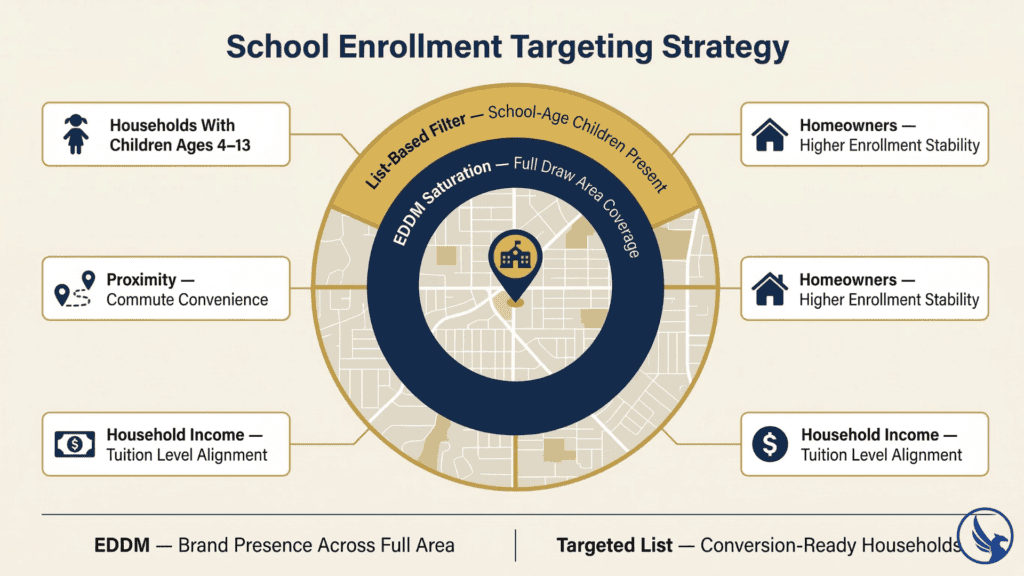
Effective direct mail targeting for schools and enrollment begins with one primary demographic filter: the presence of school-age children in the household. List vendors can provide household-level data filtered by the presence and approximate age of children. As a result, a K–8 private school can target households with children ages 4–13 within a defined radius — a targeting precision that EDDM geographic saturation cannot achieve alone.
Secondary filters that improve campaign efficiency include household income (for tuition-level alignment), homeowner status (homeowners are statistically more stable residents and more likely to complete multi-year enrollment commitments), and geographic proximity to the school. Commute convenience is, after all, a primary enrollment decision factor for most families. For the complete list segmentation methodology, Direct Mail List Segmentation covers the full targeting framework from list specification through vendor selection and quality verification.
For schools running both EDDM and list-targeted campaigns simultaneously, the combined approach produces the best results. EDDM reaches every household in the draw area at low per-piece cost, building general brand presence. The targeted list, by contrast, reaches the specific households most likely to convert with a more personalized piece. The two campaigns reinforce each other — provided the visual identity and messaging are consistent across both formats. For the campaign planning framework that coordinates multiple simultaneous direct mail efforts, Direct Mail Campaign Planning covers the multi-campaign coordination methodology.
Seasonal Timing for Maximum Enrollment Impact
School enrollment direct mail has a defined seasonal structure that should govern campaign timing. The primary enrollment season for most K–12 private schools runs from October through March. During this period, families are researching options for the following academic year, open house events are scheduled, and application deadlines approach. Consequently, this is the window when direct mail investment produces the highest ROI.
The secondary enrollment window is August. This period covers late enrollment outreach targeting families who are reconsidering their back-to-school plans, families who have recently moved into the area, and households that missed the primary season. A late-summer piece targeting the draw area with a specific late-enrollment availability message reaches a motivated audience at a moment of high decision readiness.
For higher education and vocational programs with rolling enrollment or semester-based intake, the seasonal model shifts. However, the governing principle remains the same: time direct mail to coincide with the prospect’s decision window rather than the institution’s marketing calendar. Research compiled by the National Association for College Admission Counseling suggests that prospective students and families begin their school research significantly earlier than institutions typically assume. Early-cycle brand awareness direct mail is therefore an important component of the full enrollment pipeline.
Advisory: Verify the specific finding in NACAC’s current State of College Admission report at nacacnet.org before citing with direct attribution, as research findings and publication formats change year to year.
For production planning that ensures materials arrive before enrollment decision windows open, Direct Mail Printing covers the production timelines and lead-time requirements. For the complete seasonal timing and backward production planning guide, Direct Mail Frequency Best Practices covers the timing framework across enrollment campaign types.
Measuring Enrollment Campaign ROI
Attribution Methods for Education Direct Mail
Measuring ROI from direct mail for schools and enrollment requires the same attribution infrastructure as any direct mail campaign: a dedicated tracking phone number, a QR code with a UTM-tagged landing page, and a structured “how did you hear about us” intake question at every inquiry touchpoint. It also requires an extended measurement window that accounts for the enrollment decision cycle.
Consider a family that receives an open house invitation in October. They may visit the campus in November, submit an application in January, and enroll in March. The direct mail piece that initiated the relationship was therefore delivered five months before the enrollment conversion occurred. Attribution systems that only credit direct conversions within 30 days of delivery will, as a result, significantly undercount direct mail’s enrollment contribution. For the full attribution methodology and measurement window framework, How to Measure Direct Mail ROI covers the long-cycle attribution model that education enrollment campaigns require.
The ROI Case for Education Direct Mail
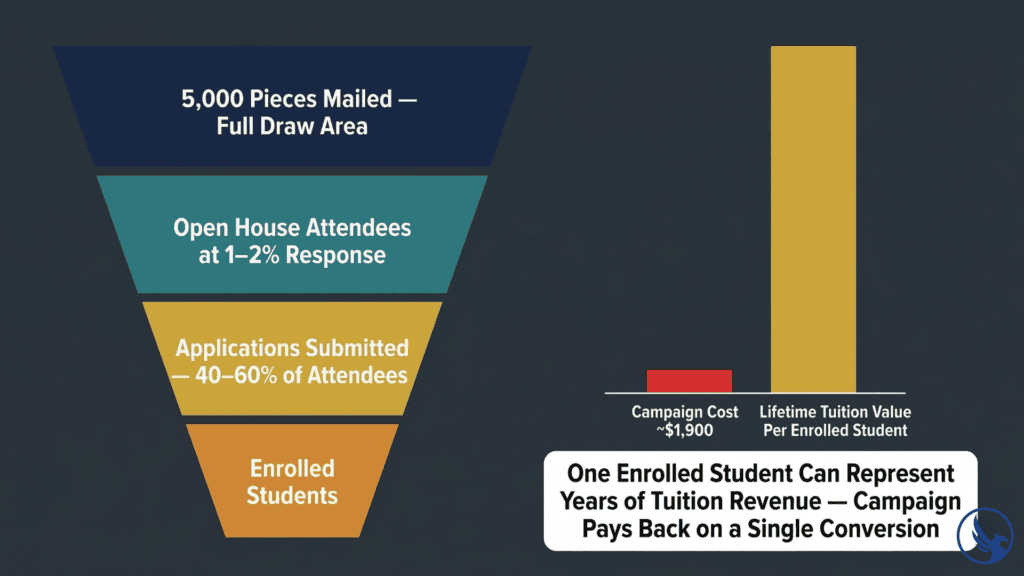
The lifetime value calculation for school enrollment direct mail is straightforward and highly favorable. Consider a K–8 private school with annual tuition of $18,000 that acquires a student in kindergarten. That student represents a potential 9-year enrollment — a total tuition revenue of $162,000 per enrolled family. At that lifetime value, the break-even response rate for a direct mail campaign is almost negligibly low. Specifically, a 5,000-piece EDDM campaign at $0.38 per piece ($1,900 total) needs to generate fewer than one enrolled student across a 9-year enrollment to break even.
Advisory: The $18,000 annual tuition, 9-year retention, and $162,000 lifetime value figures are illustrative. Actual tuition levels, student retention rates, and campaign costs vary by institution. Verify against your own institutional data before using in financial planning or budget justifications.
Even for shorter-duration programs — a two-year vocational certification or a single academic year — the lifetime value calculation produces campaign economics that make direct mail one of the most defensible marketing investments in an education budget. For the ROI modeling framework that structures these calculations across different tuition levels and program lengths, Direct Mail ROI Calculator and Direct Mail ROI 2026 provide the complete analytical model. Industry benchmark data that contextualizes education enrollment response rates against category averages, Direct Mail Response Rate by Industry and Good Response Rate for Direct Mail cover the full benchmark set.
For the common campaign errors that undermine enrollment direct mail ROI, Direct Mail Mistakes to Avoid is essential pre-launch reading. For schools building their first structured direct mail enrollment program, How to Create a Direct Mail Campaign and Direct Mail for Small Business provide the foundational planning framework. The current channel trends shaping education enrollment marketing in 2026, Direct Mail Trends 2026 frames the broader landscape. For the A/B testing framework that allows enrollment campaign creative and offer variables to be optimized across drops, Direct Mail A/B Testing provides the experimental structure.
Start Your Direct Mail Campaign with CRST
A well-structured direct mail for schools and enrollment program — open house invitations to the full draw area, deadline urgency pieces to active inquirers, and annual community brand campaigns to the broader residential population — is one of the most reliable and highest-lifetime-value marketing investments available to any educational institution.
CRST handles direct mail and EDDM printing from file setup through postal delivery, with a team that knows USPS compliance inside out and a track record across industries. Explore our full direct mail printing services, request an estimate, or contact our team to discuss campaign options tailored to your institution.
For the complete breakdown of how the program works, see our EDDM Guide.