

Direct mail as an alternative to cold calling is a conversation happening in sales teams and small business offices across every industry. It’s not because cold calling has stopped working entirely. Rather, the conditions that made it effective have deteriorated significantly over the past decade. Answer rates are down. Regulatory scrutiny is up. The combination of caller ID, spam filters, and do-not-call list compliance has made reaching new prospects by phone harder, more expensive, and more legally complex than it was even five years ago.
This guide examines whether direct mail genuinely replaces cold calling as a prospecting channel, where it outperforms phone outreach, where it falls short, and how the two methods can be sequenced together for better results than either achieves alone. For the foundational direct mail strategic context, Direct Mail Marketing Strategy and Why Direct Mail Still Works provide the current channel landscape before making any head-to-head comparison. For full-service campaign production support, start at CRST.
Why This Comparison Matters in 2026
The choice between direct mail and cold calling isn’t just a tactics question — it’s a resource allocation decision. Each channel carries different cost structures, compliance requirements, and scalability ceilings. Understanding those differences before committing budget prevents the most common prospecting mistakes.
The Problem With Cold Calling in 2026
Declining Answer Rates and Rising Regulatory Costs
Cold calling’s core metric — the percentage of dials that reach a live, willing prospect — has declined steadily for over a decade. According to research from Cognism’s B2B sales benchmarks, the average cold call connect rate across industries now sits below 5%. Some estimates place it as low as 2% for business-to-consumer outreach. That means 95+ calls out of every 100 reach voicemail, a hang-up, or no answer at all.
Advisory: Cognism’s connect rate benchmarks shift with regulatory changes and market conditions. Verify current figures at cognism.com before using in client-facing materials.
The regulatory environment compounds the operational problem. The Telephone Consumer Protection Act (TCPA), Federal Trade Commission do-not-call regulations, and state-level equivalents impose compliance requirements that are increasingly expensive to navigate. TCPA violations carry statutory damages of $500–$1,500 per call, and class action litigation in this space is active.
Advisory: This article does not constitute legal advice. TCPA compliance is complex and fact-specific. Consult qualified legal counsel before making compliance decisions for your business.
As a result, the hidden compliance cost of cold calling is significant for businesses without dedicated legal resources. Furthermore, the time cost is front-loaded and unpredictable. A sales representative making 80 dials per day to achieve 4 live conversations spends the majority of working hours on unproductive activity — leaving voicemails, navigating gatekeepers, and being told “take me off your list.” That time cost does not appear on a per-lead calculation, but it is nonetheless a real resource expenditure. Direct mail does not carry this burden. For a direct comparison of how these resource allocations translate into ROI, Direct Mail ROI 2026 and Direct Mail ROI Statistics 2026 provide the current benchmark data for the direct mail side of the equation.
Why Prospects Have Tuned Out Cold Calls
The psychological dynamic of cold calling has also shifted. Consumers and business decision-makers alike have developed robust filtering behaviors — screening unknown numbers, letting calls go to voicemail by default, and treating unsolicited phone contact as an intrusion. This psychological resistance is not a temporary trend. It reflects a fundamental recalibration of how people manage attention in an era of information overload.
Direct mail, in contrast, arrives in an entirely different context. A physical piece of mail — particularly a well-designed, professionally produced postcard or letter — enters a low-intrusion channel that recipients engage with on their own terms. According to USPS consumer mail research, the majority of consumers sort and read their mail the same day it arrives. Moreover, physical mail is consistently perceived as more trustworthy and personal than digital or phone outreach.
Advisory: The USPS Mail Moments study covers consumer mail behavior and attitudes broadly. The specific trust ranking relative to phone outreach should be verified in the current edition at postalpro.usps.com before citing with direct attribution.
Consequently, the psychological receptivity that cold calling has to fight for is something direct mail receives passively — simply by virtue of the channel.
Direct Mail vs Cold Calling: The Core Metrics Compared

Response Rate and Cost Per Lead
The most important comparison is cost per qualified lead — because response rate alone doesn’t capture the full resource cost of each channel.
Cold calling cost per lead: At a 3% connect rate and a 20% conversion of connected calls to a qualified lead conversation, a sales rep making 100 calls generates 3 connections and 0.6 qualified leads. If a fully loaded rep costs $25/hour and makes 15 calls per hour, 100 calls costs approximately $167 in labor. That produces a cost per qualified lead of roughly $278. This figure does not include list costs, dialers, CRM tools, or compliance overhead.
Direct mail cost per lead: At a 1.5% response rate on a 5,000-piece campaign at $0.38 per piece, total campaign cost is $1,900, responses are 75, and cost per lead is $25.33. Even at a conservative 0.8% response rate, cost per lead is $47.50 — still well below the cold calling benchmark for most categories.
Advisory: Both cost-per-lead estimates above use directional assumptions. The cold calling inputs — connect rate, conversion rate, labor cost, and call rate — will vary significantly by industry, list quality, rep experience, and geography. The direct mail figure is based on $0.38/piece, which is consistent with current print plus $0.260 USPS EDDM Retail postage. Verify the current postage rate at usps.com/business/every-door-direct-mail.htm. Measure your own cold calling cost per lead before running a precise comparison.
For the full print and postage cost breakdown underlying these figures, Direct Mail Cost Per Piece and Direct Mail Printing cover production cost variables across format and volume tiers.
Scalability and Consistency
Cold calling scales linearly with headcount. To double prospecting volume, you need to double the number of people making calls — or double the hours each rep spends dialing. This linear constraint creates a ceiling tied directly to labor costs and management overhead.
Direct mail, however, scales with print volume. Doubling a campaign from 5,000 to 10,000 pieces does not double management complexity. It primarily adds incremental print and postage cost, with a declining per-piece unit cost as volume increases. A single campaign submission can reach 10,000 households simultaneously — something a small sales team would take weeks to achieve through cold outreach.
Additionally, direct mail campaigns produce consistent output regardless of team variables. A cold calling campaign’s daily output fluctuates with rep availability, morale, illness, and turnover. A direct mail campaign, by contrast, delivers the same number of impressions on the same scheduled day regardless of any internal operational variable. That consistency makes planning and forecasting more reliable. For the volume economics that govern direct mail scaling, Direct Mail Services and Direct Mail Campaign Planning cover the full production and logistics framework.
Where Direct Mail Outperforms Cold Calling
High-Ticket B2C and Local Service Categories
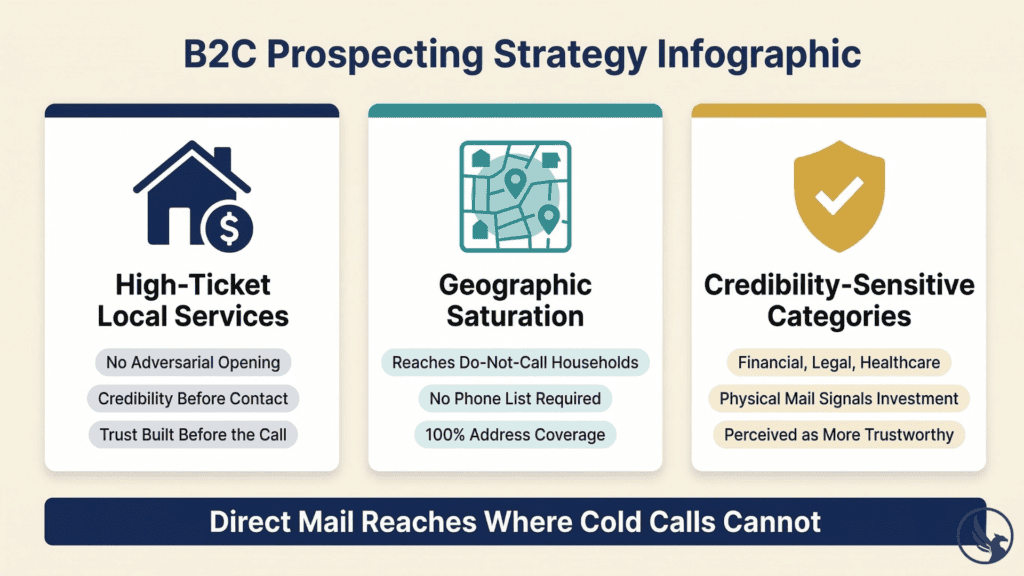
For business-to-consumer outreach in high-ticket local service categories — home services, dental, legal, financial, real estate — direct mail is frequently the stronger primary prospecting channel. These categories share a common characteristic: purchase decisions require trust before any transaction occurs, and the conversion cycle involves multiple touchpoints over days or weeks.
Cold calling into these categories creates an adversarial dynamic from the first second of contact. The prospect is immediately on guard, trying to determine whether the caller is legitimate, and emotionally primed to decline. A physical postcard, in contrast, arrives without social pressure. It can be read, set aside, and returned to. It communicates credibility through design quality and production value before a single word of copy is evaluated. For industry-specific campaign frameworks, Direct Mail for Chiropractors, Direct Mail for Financial Advisors, and Direct Mail for Insurance Agents cover the channel dynamics and campaign structures relevant to each.
Geographic Saturation Campaigns
Cold calling is fundamentally list-dependent. You can only call people whose phone numbers you have, and residential phone number lists are incomplete, outdated, and increasingly restricted by regulation. Direct mail, however, can reach every address within a defined geographic area — including households with no phone listing, numbers on do-not-call registries, or those who have never appeared on any purchasable list.
For businesses whose customer acquisition model is based on geographic saturation — “we want to reach every homeowner within 3 miles” — direct mail accomplishes this in a way that cold calling structurally cannot. EDDM in particular reaches 100% of residential addresses on selected carrier routes without any list requirement, at a postage cost of $0.260 per piece. For the EDDM route selection and campaign framework, explore our EDDM printing services and the EDDM Guide. For businesses that need targeted list-based direct mail beyond geographic saturation, Direct Mail Audience Targeting and Direct Mail List Segmentation cover the list acquisition and segmentation framework.
Credibility-Sensitive Categories
Certain business categories carry an inherent credibility requirement that cold calling actively undermines. Financial services, insurance, legal services, healthcare, and education are categories where unsolicited phone contact frequently triggers suspicion. The very act of cold calling can signal “this business couldn’t get my attention any other way.”
A professionally produced direct mail piece, by contrast, communicates investment, deliberateness, and institutional quality. For schools and enrollment-driven organizations, Direct Mail for Schools and Enrollment covers how physical mail outperforms cold outreach in generating enrollment inquiries. For political campaigns where voter trust is the primary conversion driver, Direct Mail for Political Campaigns frames the channel dynamics. According to USPS consumer mail research, physical mail consistently ranks among the most trusted communication formats — a credibility signal that cold calls rarely achieve. For personalization capabilities that amplify direct mail’s credibility by addressing recipients by name with relevant offers, Personalized Direct Mail and Variable Data Printing covers the technology and implementation framework.
Where Cold Calling Still Has the Edge
Immediate Qualification and Two-Way Dialogue
Cold calling’s primary genuine advantage is immediacy of qualification. A live phone conversation allows a sales representative to ask questions, handle objections, assess fit, and move a prospect through multiple stages of the sales process in a single interaction. A postcard cannot do this. It can generate a response — a call, a form fill, a visit — but the qualification conversation happens in a separate step that the postcard initiates rather than completes.
For businesses with a short sales cycle where immediate qualification is the primary value driver — appointment setting, event registration, subscription offers with a hard deadline — cold calling’s two-way dialogue capability is a genuine differentiator. In these cases, the most effective approach is not a choice between channels but a sequencing strategy: direct mail establishes awareness and credibility, and a follow-up call converts warm prospects who have already received the physical piece. For how this sequencing integrates with digital touchpoints, Direct Mail QR Codes and Digital Integration covers the multi-channel contact architecture.
High-Value B2B Account Prospecting
For B2B outreach targeting a small number of high-value accounts — enterprise sales, commercial services, large contract opportunities — cold calling and its evolved forms (cold email, LinkedIn outreach) remain more targeted and dialogue-oriented than direct mail. When the target account universe is 50 named companies rather than 5,000 households, direct mail’s volume economics are less relevant. Personalized, multi-channel outreach sequences outperform physical mail saturation in these scenarios.
However, even in B2B contexts, direct mail plays a supporting role. A well-timed physical piece to a decision-maker — a relevant case study in a premium-stock mailer or a personalized letter on branded letterhead — stands out precisely because business decision-makers receive relatively little physical prospecting mail. The direct mail piece achieves attention through channel novelty. It mirrors, in this way, the same attention advantage it carries in consumer mailboxes.
The Sequencing Strategy: Direct Mail and Cold Calling Together
Using Direct Mail to Warm Cold Calls
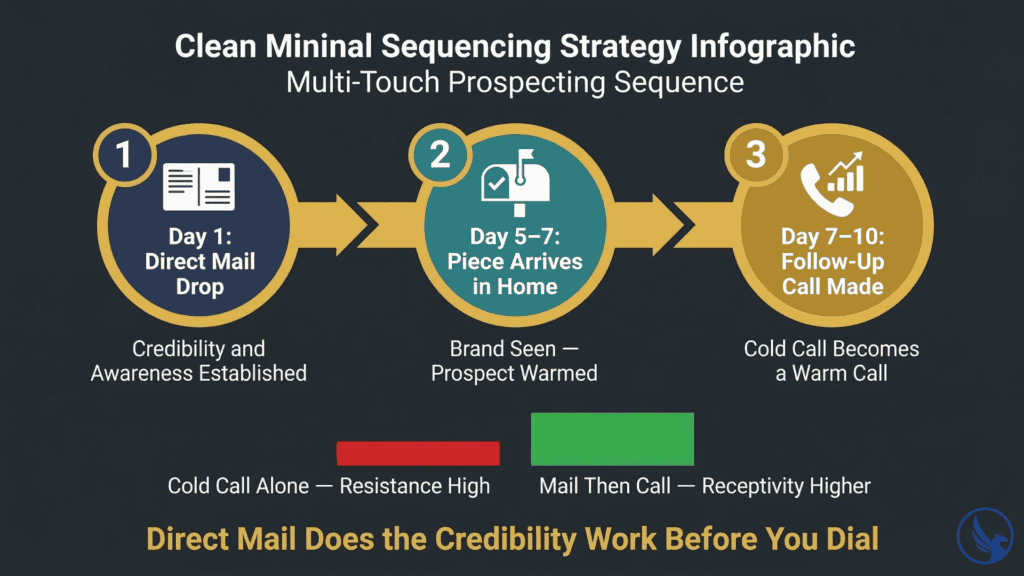
The most effective use of direct mail as an alternative to cold calling is not replacement — it is warm-up. A direct mail piece sent 5–7 days before a follow-up call transforms the nature of that call from cold to warm. The prospect has seen the brand, received the offer, and has a physical reference point that the caller can cite immediately. “I’m following up on the postcard we sent you last week” is a fundamentally different opening than “I’m calling to introduce our company.”
Research on multi-touchpoint prospecting consistently shows that response rates for follow-up calls made after a direct mail touch are meaningfully higher than cold calls to the same list with no prior contact. The direct mail piece does the credibility-building work that the cold call would otherwise have to accomplish in the first 30 seconds — precisely the period when resistance is highest and attention is lowest. For the tracking infrastructure that identifies which recipients responded to the direct mail piece before a follow-up call is made, How to Measure Direct Mail ROI covers the attribution methodology. For A/B testing frameworks that isolate which direct mail formats generate the highest warm-call conversion rates, Direct Mail A/B Testing provides the experimental structure.
Frequency and Follow-Through
A single direct mail piece — like a single cold call — rarely converts on its own. The most effective direct mail prospecting sequences mirror the multi-touch approach of professional sales development: an initial awareness piece, a follow-up offer piece two to three weeks later, and a third conversion-focused piece with urgency and a hard deadline. This three-drop sequence produces cumulative response rates significantly above a single-drop campaign.
For the cadence and timing framework that governs multi-drop sequences, Direct Mail Frequency Best Practices covers optimal spacing and drop count by business category. Production and strategic errors that undermine direct mail prospecting sequences, Direct Mail Mistakes to Avoid is essential pre-launch reading. For businesses building their first direct mail prospecting program from scratch, How to Create a Direct Mail Campaign and Direct Mail for Small Business provide the step-by-step framework. To track results and calculate actual ROI, the Direct Mail ROI Calculator models returns at different response rate and transaction value assumptions. For current channel trends shaping both direct mail and cold outreach effectiveness in 2026, Direct Mail Trends 2026 frames the broader landscape.
Start Your Direct Mail Campaign with CRST
Used as a standalone prospecting channel or as a warm-up layer ahead of phone outreach, direct mail as an alternative to cold calling consistently delivers better cost per lead, higher prospect receptivity, and more predictable campaign economics than phone-first prospecting strategies for most local business categories.
CRST handles direct mail and EDDM printing from file setup through postal delivery, with a team that knows USPS compliance inside out and a track record across industries. Explore our full direct mail printing services, request an estimate, or contact our team to discuss campaign options tailored to your business category.
For the complete breakdown of how the program works, see our EDDM Guide.