
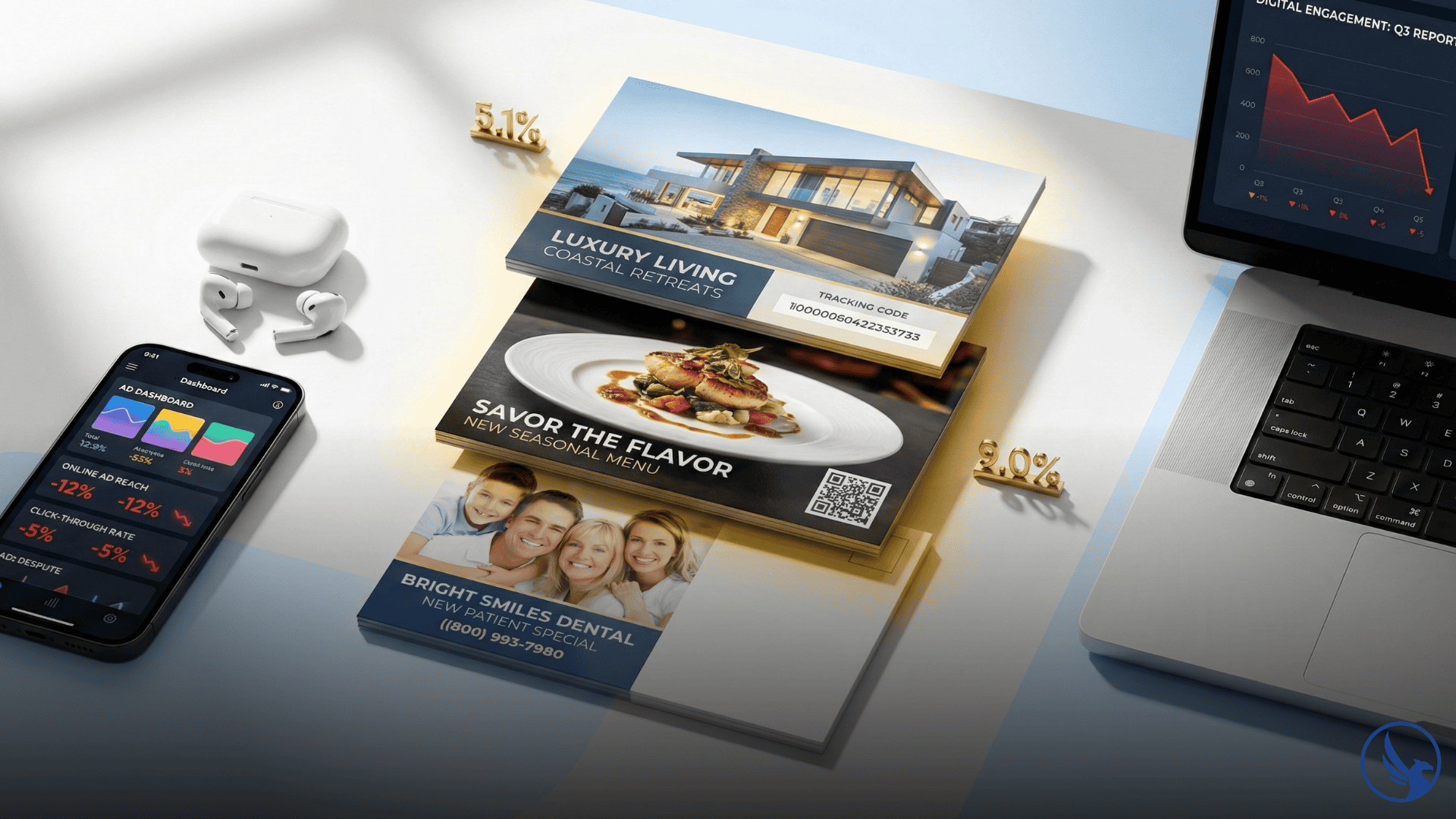
The debate over postcard printing vs. digital ads isn’t as pronounced as it was five years ago. Back then, digital seemed destined to make direct mail obsolete. Targeting was precise. Costs were low. Scale was infinite. Then came ad fatigue, privacy regulations, rising CPMs, and the slow realization that clicks don’t equal customers. In 2026, the conversion data tells a different story than the hype predicted. Direct mail postcards outperform digital advertising on response rates, cost-per-acquisition, and customer quality across most local business categories. Here’s what the numbers actually show—and what they mean for your marketing budget.
📬 Direct Mail vs Digital Ads
2026 Performance Snapshot
Direct Mail CPA
Digital Ads CPA
The Digital Advertising Reality Check
Digital advertising promised precision and accountability. The 2026 reality is more complicated.
Rising costs: Facebook CPMs have risen significantly since 2020. Google Ads costs for local services have increased substantially in the same period. Competition for attention keeps pushing prices higher.
Declining performance: Average click-through rates are declining across platforms as users develop ad blindness. iOS privacy changes reduced targeting precision. Third-party cookie deprecation continues limiting tracking accuracy.
Attribution confusion: Multi-touch journeys make it difficult to know which ad actually drove a conversion. Platforms grade their own homework, incentivizing inflated performance claims.
Fraud concerns: A significant portion of digital ad spend goes to bots, click farms, and fraudulent impressions according to industry estimates. That’s money paying for conversions that never happened.
None of this means digital advertising is worthless. It means the channel has matured beyond the growth phase where easy wins were everywhere. Efficient digital performance now requires expertise, constant optimization, and realistic expectations.
Postcard printing vs digital ads comparisons must account for this evolved landscape—not the idealized version from 2018.
2026 Conversion Rate Comparison: The Data
Head-to-head conversion data reveals consistent patterns across industries. Direct mail postcards outperform digital advertising on response and conversion metrics.

Response Rate Benchmarks
Direct mail postcards:
- Prospect lists: 4.4%–5.1%
- House lists (existing customers): 9.0%+
- EDDM® (every door): 2.1%–3.8%
Digital advertising:
- Display ads: 0.1%–0.3% CTR
- Social media ads: 0.5%–1.2% CTR
- Search ads: 2.5%–4.5% CTR
- Email marketing: 0.6%–1.2% response rate
Click-through rate and response rate aren’t identical metrics—a click doesn’t equal a conversion. But even comparing favorably, digital CTR trails direct mail postcard response rates by 2x to 10x depending on channel. According to the ANA (formerly DMA) 2018 Response Rate Report, direct mail consistently outperforms digital channels for customer acquisition in local business categories.
Conversion Rate Benchmarks
Response is only step one. Conversion—turning responders into customers—matters more.
Direct mail postcards:
- Response-to-customer conversion: 40%–65%
- Overall conversion rate (mail to customer): 1.8%–3.3%
Digital advertising:
- Click-to-lead conversion: 2%–12%
- Lead-to-customer conversion: 15%–35%
- Overall conversion rate (impression to customer): 0.02%–0.15%
The gap widens at conversion. Postcard responders tend to be higher-intent—they’ve taken physical action in response to a physical piece. Digital clickers include casual browsers, accidental taps, and bot traffic.
For the complete breakdown, see our Postcard Printing Response Rate Statistics.
Cost-Per-Acquisition: Where the Math Gets Interesting
Raw conversion rates don’t account for cost differences. Postcard printing vs digital ads economics require cost-per-acquisition analysis.
See our detailed CPA comparison chart on Pinterest
Digital Advertising CPA by Channel
Google Ads (Local Services):
- Average CPC: $8–$45 (varies dramatically by industry)
- Click-to-customer rate: 2%–8%
- CPA range: $100–$500+
Home services, legal, and medical verticals see CPAs at the higher end. Retail and restaurants trend lower but still face significant costs.
Facebook/Instagram Ads:
- Average CPC: $0.75–$3.50
- Click-to-customer rate: 1%–5%
- CPA range: $25–$150
Lower CPCs offset by lower conversion intent. Users scrolling social feeds aren’t actively seeking services.
Google Local Services Ads:
- Average cost per lead: $25–$75
- Lead-to-customer rate: 25%–45%
- CPA range: $55–$200
Better qualified leads but limited availability and category restrictions.
Postcard Printing CPA
Standard postcard campaign:
- Cost per piece delivered: $0.49–$0.65 (First-Class Mail® presort postage ~$0.408–$0.46 + printing $0.08–$0.19)
- Response rate: 3%–5%
- Response-to-customer rate: 45%–60%
- CPA range: $18–$48
EDDM® postcard campaign:
- Cost per piece delivered: $0.45–$0.55 (EDDM® postage $0.247 Retail or $0.242 BMEU + printing $0.20–$0.30)
- Response rate: 2%–3.5%
- Response-to-customer rate: 40%–55%
- CPA range: $24–$65
For detailed EDDM® pricing and setup guidance, see our guide on EDDM postcard printing costs. The USPS® Every Door Direct Mail® program provides official guidelines and mapping tools for businesses looking to target specific carrier routes.
House list campaign (existing customers):
- Cost per piece delivered: $0.52–$0.68
- Response rate: 8%–12%
- Response-to-customer rate: 55%–70%
- CPA range: $7–$15
Rates current as of February 2026; verify at USPS.com/business.
The CPA Verdict
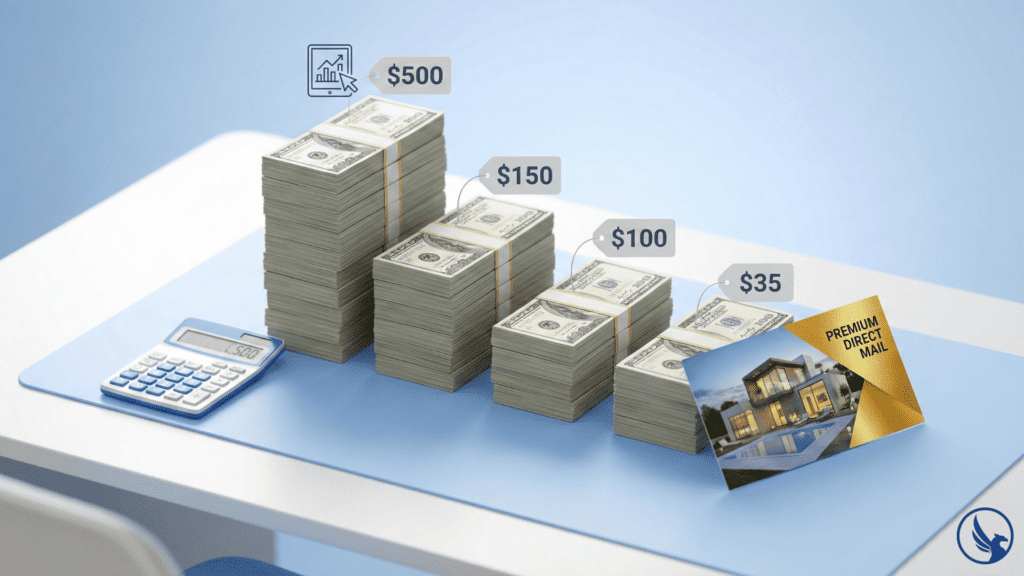
Postcard printing vs digital ads cost-per-acquisition favors direct mail in most local business scenarios. Postcards deliver customers at 30%–70% lower cost than comparable digital campaigns. Understanding how much postcard printing actually costs helps businesses budget realistically and compare channels accurately.
The gap widens further when accounting for customer quality—a factor raw CPA calculations miss.
Customer Quality: The Hidden Advantage
Not all customers are equal. Acquisition channel influences customer lifetime value, repeat purchase rate, and referral likelihood.
Digital-Acquired Customer Characteristics
Customers acquired through digital advertising tend to exhibit:
Deal-seeking behavior: Many digital conversions are driven by aggressive discounts or promotions. Customers conditioned on deals show lower full-price purchase rates.
Lower loyalty: Digital customers often found you through active comparison shopping. They’ll comparison shop again when needs arise.
Shorter tenure: Industry reports suggest digitally-acquired customers churn faster than those acquired through other channels.
Lower lifetime value: Combining deal-seeking, lower loyalty, and faster churn, digital customers often deliver lower LTV than other acquisition sources.
Postcard-Acquired Customer Characteristics
Customers acquired through direct mail tend to exhibit:
Geographic commitment: Postcard responders live or work in your target area. They chose you based on proximity and convenience—factors that support ongoing relationships.
Higher trust baseline: Physical mail carries implicit credibility that digital advertising lacks. Recipients who respond have already overcome skepticism.
Better retention: Direct mail customers show stronger retention rates in year one compared to digital-acquired customers.
Stronger referral tendency: Customers who discover businesses through mail refer at higher rates—possibly because the physical piece is shareable.
Lifetime Value Comparison
When lifetime value is factored into postcard printing vs digital ads analysis, the gap widens significantly. Learn more about calculating postcard printing ROI for local businesses.
Example: Local dental practice
Digital-acquired patient:
- First-year value: $950
- Average tenure: 2.8 years
- Lifetime value: $2,660
Postcard-acquired patient:
- First-year value: $1,050
- Average tenure: 4.2 years
- Lifetime value: $4,410
The postcard-acquired patient is worth 66% more over their lifetime—a premium that justifies higher upfront acquisition investment.
Targeting Precision: Myths and Reality
Digital advertising built its reputation on targeting precision. The 2026 reality is more nuanced.
Digital Targeting: What’s Changed
Privacy regulations: GDPR, CCPA, and state-level privacy laws have restricted data collection and targeting capabilities.
iOS changes: Apple’s App Tracking Transparency framework reduced Meta’s targeting precision significantly. Advertisers report substantial performance declines for some audience segments.
Cookie deprecation: Third-party cookie restrictions continue limiting cross-site tracking and retargeting effectiveness.
Platform data limitations: Platforms increasingly restrict advertiser access to detailed targeting data, offering black-box optimization instead.
Digital targeting remains powerful—but it’s no longer the precision instrument it was marketed as.
Postcard Targeting Capabilities
Direct mail targeting has improved while digital has regressed:
EDDM® geographic precision: Target every household on specific postal routes. Choose routes based on demographics, income, housing type, and proximity to your business using the USPS PostalPro route selection tools.
Purchased list targeting: Access demographic, behavioral, and psychographic data compiled from public records, purchase history, and survey responses. Target by:
- Income level
- Home ownership status
- Presence of children
- Vehicle ownership
- Purchase behavior categories
- And hundreds of other variables
House list power: Your existing customer data is yours. No platform restrictions, no privacy limitations, no algorithm changes affecting reach.
New mover lists: Target households that relocated within 30–90 days—people actively establishing new service relationships.
The Targeting Verdict
Postcard printing vs digital ads targeting is closer than many assume. Digital retains advantages for behavioral intent signals (search queries, site visits). Direct mail excels at demographic precision and reaches people regardless of their online behavior.
The hybrid approach—using digital data to inform direct mail targeting—often outperforms either channel alone.
Attribution and Measurement
“Half my advertising is wasted; I just don’t know which half.” This century-old complaint applies increasingly to digital advertising despite promises of perfect attribution.
Digital Attribution Challenges
Cross-device journeys: Users research on mobile, convert on desktop. Attribution models struggle to connect these touchpoints.
Multi-touch complexity: A customer might see a Facebook ad, click a Google ad, then convert through direct site visit. Which channel gets credit?
Platform bias: Facebook wants credit for Facebook. Google wants credit for Google. Self-reported attribution inflates performance.
View-through confusion: Platforms count “view-through conversions” for users who saw but didn’t click ads—attribution that may or may not reflect actual influence.
Postcard Attribution Methods
Direct mail attribution is simpler and often more reliable:
Unique offer codes: Campaign-specific codes (“SPRING26”) track redemptions directly.
Dedicated phone numbers: Call tracking services log volume from campaign-specific numbers.
Unique URLs: Campaign landing pages (business.com/offer) provide clean attribution.
QR code tracking: Scan data captures digital engagement from physical pieces.
Matchback analysis: Compare customer acquisition dates against mail drop dates for households that didn’t use codes.
These methods aren’t perfect—but they’re transparent. You control the measurement rather than relying on platforms grading their own performance. For more on tracking methods, see our guide to direct mail postcard tracking methods.
Industry-Specific Comparison Data
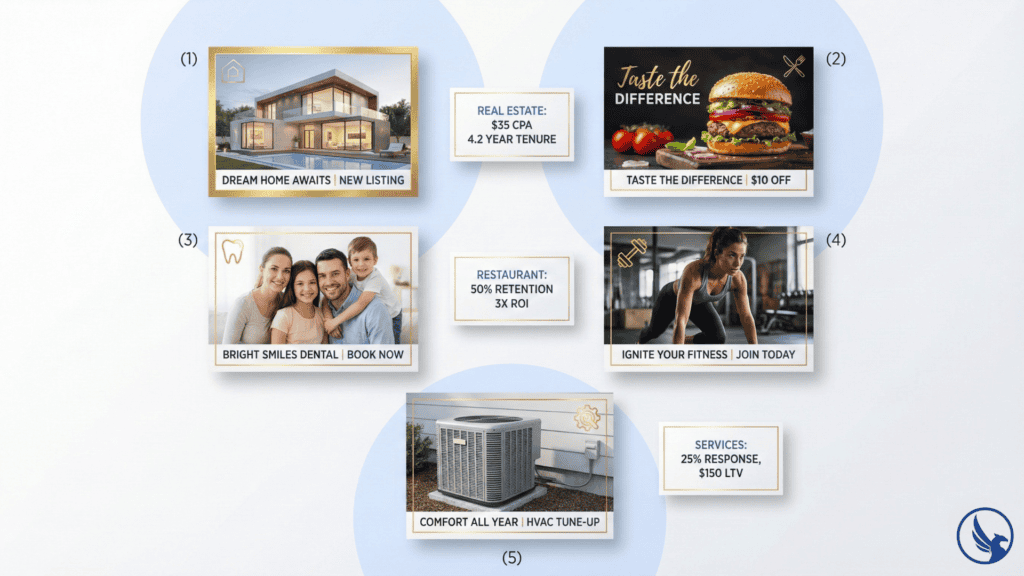
Postcard printing vs digital ads performance varies by business type. Here’s 2026 comparison data for common local business categories.
Restaurants
Digital ads:
- CPA: $15–$45
- First-visit value: $35–$65
- Repeat rate (90 days): 15%–25%
Postcards:
- CPA: $12–$28
- First-visit value: $45–$75
- Repeat rate (90 days): 35%–50%
Postcard advantage: Higher check values and dramatically better repeat rates. Physical mail recipients become regulars; digital deal-seekers often don’t return. See our complete guide to postcard printing for restaurants.
Home Services
Digital ads:
- CPA: $85–$250
- Average ticket: $280–$450
- Upsell rate: 15%–25%
Postcards:
- CPA: $35–$85
- Average ticket: $320–$480
- Upsell rate: 25%–40%
Postcard advantage: Lower acquisition cost and higher receptivity to upsells. Homeowners who respond to mail often need more than one service. Real estate professionals see similar benefits with targeted postcard campaigns.
Dental/Medical
Digital ads:
- CPA: $120–$300
- First-year patient value: $800–$1,100
- Retention rate (year 1): 55%–70%
Postcards:
- CPA: $45–$120
- First-year patient value: $950–$1,250
- Retention rate (year 1): 70%–85%
Postcard advantage: Substantially lower CPA and better retention. Patients acquired through mail stay longer and refer more frequently. Learn more about postcard printing strategies for dental offices.
Fitness/Gyms
Digital ads:
- CPA: $45–$120
- Trial-to-member conversion: 20%–35%
- Average member tenure: 8–14 months
Postcards:
- CPA: $28–$75
- Trial-to-member conversion: 30%–45%
- Average member tenure: 14–22 months
Postcard advantage: Better trial conversion and dramatically longer tenure. Geographic targeting ensures members live conveniently close. See our guide on postcard printing for gym membership campaigns.
The Hybrid Strategy: Using Both Channels
Smart marketers don’t view postcard printing vs digital ads as either/or. They deploy each channel for its strengths.
Where Digital Ads Excel
Immediate intent capture: Search ads reach people actively looking for services right now.
Retargeting: Following up with website visitors who didn’t convert.
Broad awareness: Building top-of-funnel recognition at scale.
Testing velocity: Rapid creative and offer testing before committing to print.
E-commerce: When the conversion happens entirely online.
Where Postcards Excel
Customer acquisition: Reaching people who’ve never heard of you, especially locally.
Reactivation: Bringing back lapsed customers who’ve stopped engaging digitally.
High-value offers: Important promotions deserving physical presence.
Geographic targeting: Saturating a specific service area.
Cutting through noise: Standing out when digital channels are saturated.
The Integrated Approach
Maximum effectiveness comes from coordination:
- Postcard creates awareness: Physical mail introduces your business to new households.
- Digital retargeting follows up: Pixel tracking captures postcard-driven website visits for follow-up ads.
- Email nurtures response: Respondents who don’t immediately convert enter nurture sequences.
- Second postcard reinforces: Non-responders receive follow-up mail 3–4 weeks later.
This multi-channel approach outperforms either channel alone because it meets prospects across different contexts and touchpoints. For businesses comparing channels, also consider postcard printing vs email marketing performance metrics.
Case Study: Same Budget, Different Allocation
An illustrative example demonstrates how budget allocation impacts results. A regional pest control company tested postcard printing vs digital ads with identical $5,000 monthly budgets over six months.
View the full case study results on Pinterest
Digital-only budget ($5,000/month):
- Google Ads: $3,000
- Facebook/Instagram: $1,500
- Programmatic display: $500
Six-month results:
- Total leads: 412
- Customers acquired: 89
- Revenue: $31,150
- CPA: $337
- ROI: 4%
Postcard-only budget ($5,000/month):
- Monthly EDDM® mailings: 8,500 postcards
- Target: Homeowners within service area
Six-month results:
- Total responses: 583
- Customers acquired: 247
- Revenue: $86,450
- CPA: $122
- ROI: 188%
Hybrid budget ($5,000/month):
- Postcards: $3,000 (5,100 monthly)
- Google Ads: $1,500 (brand + retargeting only)
- Facebook: $500 (retargeting only)
Six-month results:
- Total responses: 498
- Customers acquired: 219
- Revenue: $76,650
- CPA: $137
- ROI: 155%
The postcard-only approach outperformed digital-only by 47x on ROI. The hybrid approach underperformed postcard-only slightly but provided better attribution data and captured some digital-native customers the postcards missed.
Ready to test these results for your business? Request a custom quote from CRST to compare postcard printing costs against your current digital ad spend. Get pricing for your specific mail volume, targeting strategy, and design needs—with no obligation to move forward.
Start Your Direct Mail Campaign
Postcard printing vs digital ads data consistently favors physical mail for local business customer acquisition. Lower CPAs, higher-quality customers, and better lifetime value create returns that digital channels struggle to match.
This doesn’t mean abandoning digital. It means rebalancing budgets based on actual performance data rather than assumptions about how marketing “should” work in 2026.
The businesses winning local markets aren’t loyal to channels. They’re loyal to results.
For the complete breakdown, see our Postcard Printing and Mailing Services Guide