
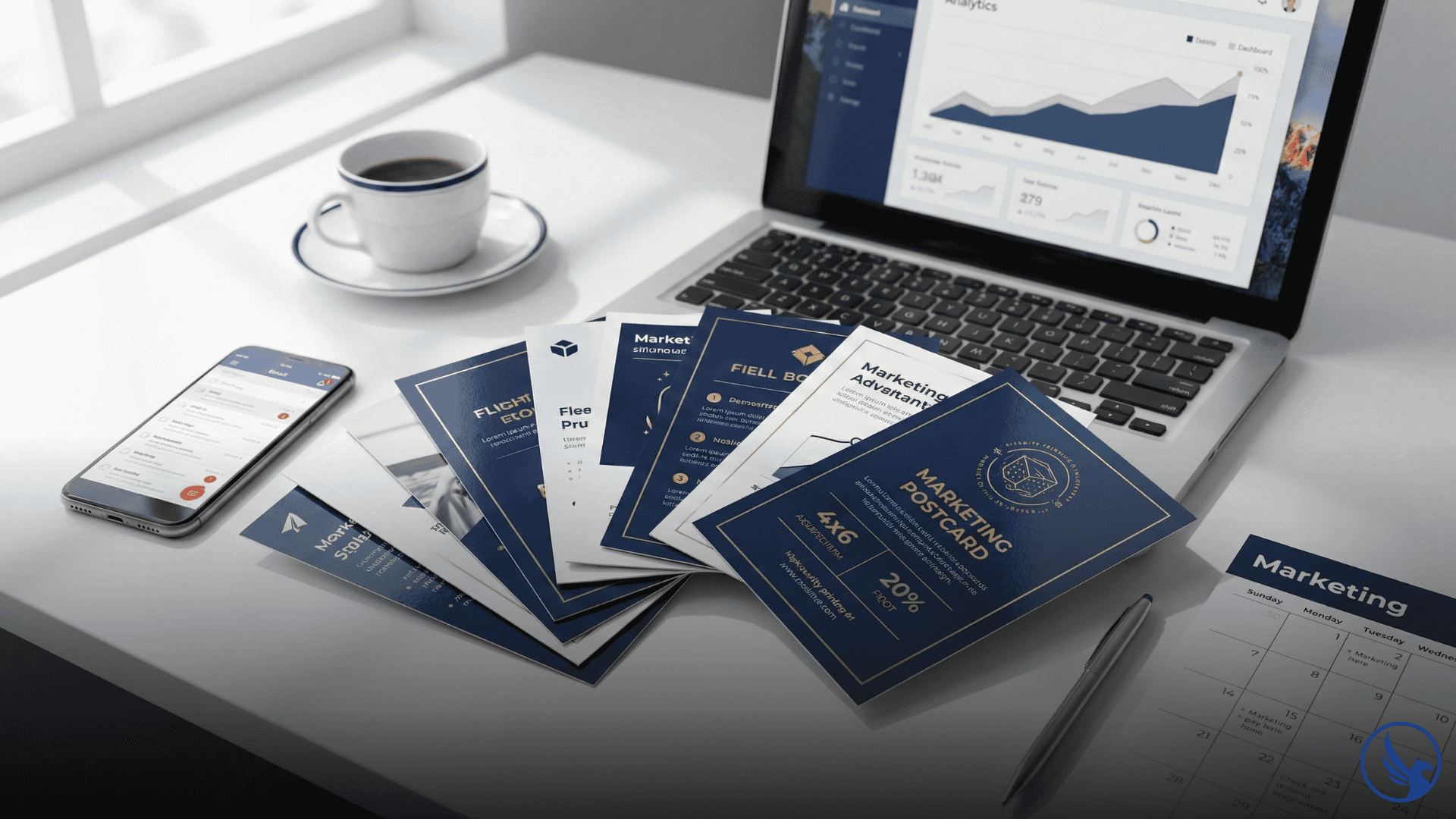
Postcard printing vs email marketing isn’t a debate about old versus new. It’s a debate about attention—and which channel actually earns it. Email promised to replace direct mail decades ago. It didn’t. Instead, inboxes became battlegrounds where 300 billion messages compete daily for increasingly scarce attention. Open rates decline. Click rates crater. Spam filters get smarter. Meanwhile, physical mailboxes sit half-empty, waiting. In 2026, the marketers driving real response rates aren’t choosing between digital and physical. They’re recognizing that tangible wins when attention is the scarcest resource. Here’s the data behind why postcards outperform email—and how to use both strategically.
Postcard Printing vs Flyers: Conversion Showdown
Real data on response rates, costs, and ROI
The Attention Crisis Email Can’t Solve
Email marketing faces a fundamental problem: volume has destroyed value.
The average office worker receives 121 emails daily. The average consumer receives 40+ marketing emails per week. Inboxes are battlegrounds where even well-crafted messages get lost, filtered, or deleted unread.
Open rates tell the story. According to Mailchimp’s industry benchmarks, average email open rates hover around 21% across industries in 2023-2024 data (ranging 15-28% by sector)—and that number has declined steadily for a decade. Click-through rates average 2.6%. Actual conversions from email clicks? A fraction of that.
Email isn’t dying. It remains essential for transactional communication, nurture sequences, and retention. But as a primary driver of new response and action? The channel is saturated beyond recovery.
Postcard printing vs email marketing comparisons must account for this attention crisis. Email’s theoretical reach is unlimited. Its practical reach shrinks every year as consumers develop inbox blindness and filters get more aggressive.
Physical mail operates in a different reality. The average American household receives only 2–3 pieces of marketing mail daily. That scarcity creates attention that digital channels have lost.
Response Rate Comparison: The Numbers Don’t Lie
Data on postcard printing vs email marketing response rates is unambiguous. Physical mail outperforms digital by significant margins.
See detailed response rate comparisons on Pinterest
Email Marketing Response Rates
Industry benchmarks from major email platforms:
- Average open rate: 21.3% (varies 15-28% by industry)
- Average click-through rate: 2.6%
- Average conversion rate: 0.1%–0.5%
These numbers vary by industry. Retail performs worse. Nonprofits perform better. B2B falls somewhere in between. But the pattern holds: for every 1,000 emails sent, expect 210 opens, 26 clicks, and 1–5 conversions.
And these are optimistic figures. They assume good list hygiene, strong subject lines, and content that survives spam filters. Poorly executed campaigns perform far worse.
Postcard Response Rates
According to the ANA (formerly DMA), average response rates for direct mail significantly outperform digital channels:
- Average response rate (prospect lists): 4.9%
- Average response rate (house lists): 9%+
- Response rate for well-targeted campaigns: 2%–10%
For every 1,000 postcards mailed, expect 49 responses from cold prospects and 90+ responses from existing customers. For deeper analysis of direct mail response rate data across industries, recent campaign data shows these numbers hold consistent even as digital metrics decline.
The Math Is Clear
Postcard printing vs email marketing response rates favor physical mail by 5x to 10x depending on campaign type and list quality.
A postcard campaign to 1,000 prospects generating 49 responses outperforms an email campaign to 10,000 subscribers generating 26 clicks. The postcard reached fewer people but earned more action.
For the complete breakdown, see our Postcard Printing and Mailing Services Guide.

The Science of Tangibility: Why Physical Mail Works
The postcard printing vs email marketing performance gap isn’t random. It’s rooted in how humans process physical versus digital information.
Cognitive Processing Differences
Research from the Temple University/Center for Neural Decision Making neuromarketing study funded by USPS® used eye tracking, biometrics, and neuroimaging to compare responses to physical and digital marketing.
Key findings:
- Physical ads required 21% less cognitive effort to process
- Physical ads generated stronger emotional responses
- Physical ads produced greater recall and brand association
- Physical ads activated the brain’s spatial memory networks
The study concluded that physical media creates a “deeper footprint” in the brain. Tangible materials engage multiple senses—sight, touch, even sound when paper is handled—creating richer memory encoding than screen-based content.
The Endowment Effect
Behavioral economics offers another explanation. The endowment effect describes how people value things more highly simply because they possess them.
A postcard is an object. Holding it creates a subtle sense of ownership that digital content cannot replicate. Recipients are more reluctant to discard something they physically possess than to delete an email they never emotionally held.
This psychological quirk partially explains why direct mail persists on kitchen counters while emails vanish with a swipe.
Attention and Distraction
Digital environments are built for distraction. Email exists alongside notifications, tabs, apps, and endless scroll. The context suppresses focused attention.
Physical mail exists in a different context. The mailbox ritual—walk outside, collect mail, sort through items—creates a moment of focused attention absent from digital consumption.
That moment of undivided attention is increasingly rare and increasingly valuable.

Cost Analysis: Reframing the Comparison
The common objection to postcard printing vs email marketing: “Email is essentially free. Postcards cost money.”
This framing misses the point. Marketing cost should be measured per response, not per send.
View cost-per-response analysis on Pinterest
Email Cost Per Response
Email platforms charge based on list size. A mid-tier plan handling 10,000 subscribers costs approximately $100–$150/month.
At a 2.6% click-through rate and 0.3% conversion rate, that’s 260 clicks and 30 conversions monthly.
Cost per conversion: $3.33–$5.00
Not bad—until you factor in the cost of building and maintaining that list. Lead magnets, opt-in incentives, content creation, and list hygiene represent significant hidden investments.
Postcard Cost Per Response
A 1,000-piece postcard campaign costs approximately:
- Printing: $250–$350
- Postage (EDDM®): $247 (Retail) or $242 (BMEU)
- Total: $497–$597
At a 4% response rate, that’s 40 responses.
Cost per response: $12.43–$14.93
More expensive per response than email—but reaching people who never opted in, never provided an email address, and may not exist in any digital database. For a detailed breakdown of postcard printing costs and pricing structures, cost-per-response calculations often reveal surprising advantages over digital channels.
Ready to compare costs for your specific campaign? Request a custom quote from CRST to see how postcard printing fits your marketing budget.
The Real Comparison
Postcard printing vs email marketing cost analysis must compare apples to apples:
- Email reaches people who’ve already opted in (warmer audience)
- Postcards reach people who haven’t (colder audience)
- Email responses often require multiple touchpoints before conversion
- Postcard responses frequently convert in a single interaction
When comparing cost-per-new-customer (not just cost-per-response), postcards often outperform email because they access audiences email cannot reach. Understanding postcard printing ROI for local businesses reveals that customer acquisition costs often favor physical mail despite higher per-piece expenses.
Deliverability: The Hidden Email Crisis
Email marketing suffers from a problem that doesn’t exist in physical mail: deliverability failure.
Email Deliverability Challenges
- Spam filters block or redirect legitimate marketing emails
- Promotional tabs in Gmail bury messages away from primary inbox
- Bounces from invalid addresses waste sends
- Unsubscribes and complaints damage sender reputation
- Domain blacklisting can destroy entire campaigns
Industry estimates suggest 15–25% of legitimate marketing emails never reach the inbox at all. They’re filtered, bounced, or blocked before the recipient has any chance to engage.
Postcard Deliverability
USPS® delivers mail. Period.
There’s no spam filter between your postcard and the recipient’s hands. No algorithm deciding whether your message is worthy of attention. No bounce rate eating into your reach.
When you mail 1,000 postcards, 1,000 postcards arrive. The only question is whether recipients engage—not whether they receive. The USPS® Every Door Direct Mail® program guarantees delivery to every address on selected routes, making deliverability a non-issue. Understanding EDDM postcard printing costs and delivery logistics shows how Every Door Direct Mail® guarantees 100% delivery to targeted routes.
Postcard printing vs email marketing deliverability isn’t close. Physical mail has a 100% delivery rate that email can never match.
Audience Reach: Beyond the Opt-In Wall
Email marketing requires permission. You can only reach people who’ve provided their email address and consented to receive messages.
This creates a fundamental limitation. Your email audience is confined to people who’ve already discovered you, engaged enough to opt in, and remained interested enough not to unsubscribe.
The Opt-In Ceiling
Most businesses struggle to build email lists beyond a small percentage of their total addressable market. A local restaurant might have 2,000 email subscribers in a zip code with 50,000 households. A B2B company might have 500 contacts in an industry with 10,000 potential buyers.
Email can only reach the slice of the market that’s already aware and interested.
Postcards Break the Ceiling
Postcard printing vs email marketing audience potential favors physical mail because postcards require no permission.
EDDM® reaches every household on selected postal routes—no list required. Purchased mailing lists access demographics, geographies, and behaviors regardless of prior relationship.
A local restaurant can mail every household within three miles. A B2B company can reach every decision-maker at target accounts. The addressable market expands dramatically.
This reach difference matters most for customer acquisition. Email nurtures existing relationships. Postcards create new ones.
Longevity: Persistence vs. Ephemeral
Email exists until deleted. The average email lifespan? Seconds. A message is opened, scanned, and either acted upon immediately or forgotten forever.
Postcards persist.
The Refrigerator Effect
Physical mail accumulates on counters, desks, and refrigerator doors. A postcard with a compelling offer might sit visible for days or weeks before action—or disposal.
This persistence creates multiple exposure opportunities. Someone who ignores a postcard on Monday might notice it Thursday when the offer becomes relevant.
Email offers no equivalent. Scroll past an email once, and it’s buried forever.
Shareability
Physical mail can be handed to someone else. A postcard with a restaurant offer gets passed between household members. A B2B postcard left on a desk catches a colleague’s eye.
This organic sharing extends reach beyond the mailing list at no additional cost.
Email theoretically can be forwarded—but forwarding rates are negligible compared to physical hand-offs.
Integration Strategy: Using Both Channels
The smartest marketers don’t view postcard printing vs email marketing as either/or. They deploy both channels strategically based on strengths.
Email Excels For:
Nurture sequences: Multi-touch educational content guiding prospects toward purchase decisions.
Transactional communication: Order confirmations, shipping updates, appointment reminders.
Retention and loyalty: Regular touchpoints with existing customers who’ve opted in.
Time-sensitive alerts: Flash sales, limited inventory notifications, deadline reminders.
Cost-sensitive high-frequency: When you need to reach the same audience repeatedly at minimal cost.
Postcards Excel For:
Customer acquisition: Reaching prospects who haven’t opted in to any digital communication.
Reactivation: Bringing back lapsed customers who’ve stopped opening emails. Dental offices reactivating patient lists and salons promoting seasonal offers use postcards to cut through digital fatigue.
High-value offers: Important promotions deserving physical presence and perceived value. Gym membership campaigns and real estate listings benefit from tangible credibility.
Local targeting: Geographic campaigns where EDDM® reaches every household efficiently. Restaurant menu mailers and real estate farming strategies leverage geographic precision.
Cutting through noise: When email performance has plateaued and you need a breakthrough channel.
The Combined Approach
Sequence physical and digital touchpoints for maximum impact:
- Postcard introduces offer and drives awareness
- Email follow-up (to those who’ve opted in) reinforces message
- Retargeting ads create digital touchpoints
- Second postcard arrives for non-responders
This multi-channel approach outperforms any single channel by creating multiple impressions across different contexts. Marketing best practices suggest consumers need multiple touchpoints before making a purchase decision. For brands considering postcard printing vs digital ads, the most effective campaigns combine both rather than choosing one.
Case Study: Same Offer, Different Channels
A representative example based on typical campaign performance: a home services company tested postcard printing vs email marketing for their spring HVAC tune-up promotion.
Email campaign:
- List size: 8,500 subscribers
- Open rate: 19%
- Click-through rate: 2.1%
- Appointments booked: 38
- Cost: $150 (email platform)
- Cost per appointment: $3.95
Postcard campaign:
- Mail quantity: 5,000 households (EDDM®)
- Response rate: 3.4%
- Appointments booked: 170
- Cost: $2,750
- Cost per appointment: $16.18
The email campaign produced cheaper appointments from an existing audience. The postcard campaign produced 4.5x more appointments from households who’d never engaged digitally.
The marketing director’s analysis: “Email maintains relationships. Postcards build new ones. We need both.”
When Email Believers Convert
Marketing teams conditioned on digital metrics often resist direct mail until they test it. The results typically convert skeptics quickly.
Common realizations:
“Our email list was smaller than we thought.” Deliverability issues meant actual reach was 30% lower than list size suggested.
“We were only reaching existing customers.” Email audiences skew toward retention. Growth requires channels that reach non-customers.
“Response rates weren’t comparable.” Side-by-side testing revealed postcard responses were more qualified and converted at higher rates.
“Physical mail commanded attention.” Premium printing on quality stock created brand impressions email couldn’t match. Understanding best postcard sizes and paper types helps maximize this advantage.
The postcard printing vs email marketing debate usually ends when marketers stop theorizing and start testing. Avoiding common postcard design mistakes ensures first campaigns deliver results that convert skeptics.
Start Your Print Marketing Campaign
Postcard printing vs email marketing isn’t about replacing digital with physical. It’s about recognizing that different channels solve different problems.
Email maintains relationships at scale and minimal cost. Postcards acquire new customers and break through attention barriers that digital cannot penetrate.
The brands growing in 2026 aren’t loyal to channels. They’re loyal to results. They deploy email where email works and direct mail where tangible wins.
Your next campaign deserves more than another email blast competing with 300 billion other messages. Give it something physical. Something tangible. Something that earns attention, digital has lost.
For the complete breakdown, see our Postcard Printing and Mailing Services Guide.