
Postcard printing vs flyers conversion rates reveal a clear winner for most marketing objectives—but the answer isn’t as simple as picking one format over the other. Both serve distinct purposes. Both have strengths and limitations. The businesses getting the best results from print marketing understand when to deploy each format and why. In 2026, the question isn’t which is universally better. It’s which is better for your specific campaign, audience, and goal. Here’s a comprehensive breakdown of how postcards and flyers compare on the metrics that actually matter.
Postcard Printing vs Flyers: Conversion Showdown
Real data on response rates, costs, and ROI
The Fundamental Difference: Delivered vs. Distributed
Before comparing conversion rates, understand the core distinction between these formats.
Postcards are delivered. They arrive via USPS® to a specific address. The recipient has no choice but to handle them—even if only to move them from mailbox to trash. That forced interaction creates an attention window that other formats lack.
Flyers are distributed. They’re handed out, left on windshields, posted on bulletin boards, or inserted into bags. Receipt is passive and often unwanted. Many flyers never reach their intended audience at all.
This fundamental difference shapes everything that follows: response rates, targeting precision, cost efficiency, and conversion potential.
Postcard printing vs flyers conversion analysis must account for this delivery mechanism gap. A flyer with a 1% response rate among people who actually read it might look comparable to a postcard with a 4% response rate—until you factor in that 60% of flyers were discarded unread, left on car windshields in the rain, or blown into gutters.
Response Rate Comparison: What the Data Shows
Direct mail response rates are well-documented. Flyer response rates are harder to pin down because distribution methods vary so widely. Here’s what the available data tells us.
Postcard Response Rates
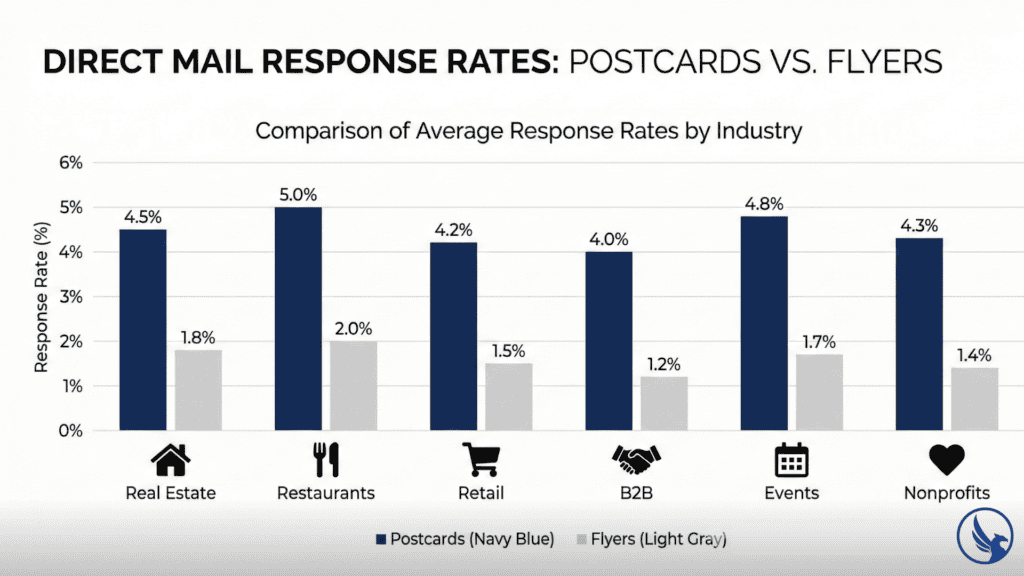
According to the ANA (formerly DMA), direct mail achieves response rates of 4.9% for prospect lists and 9% or higher for house lists (existing customers). Postcards specifically achieved 4.25% in the ANA’s 2018 study. Postcards tend to perform at the higher end of direct mail because they require no envelope opening—the message is immediately visible.
Industry benchmarks for postcard campaigns:
- Real estate farming: 0.5%–2% (cold prospects), 3%–8% (past clients)
- Restaurant promotions: 2%–5%
- Retail offers: 1%–4%
- B2B lead generation: 1%–3%
- Nonprofit appeals: 3%–7%
These rates assume proper targeting, compelling offers, and professional design. Poorly executed campaigns perform worse regardless of format. For detailed data on what drives these numbers, see our breakdown of postcard printing response rate statistics.
Flyer Response Rates
Flyer response data is less reliable because tracking is inconsistent. Industry estimates suggest:
- Door-to-door distribution: 1%–3%
- Handout distribution (events, street): 0.5%–2%
- Windshield placement: 0.1%–0.5%
- Bulletin board/public posting: Essentially unmeasurable
The wide variance reflects distribution quality. A flyer handed personally to a qualified prospect at a trade show performs very differently than one left on a car windshield in a parking lot.
The Verdict on Response Rates
Postcard printing vs flyers conversion rates favor postcards in most direct comparisons—often by 2x to 5x margins. The guaranteed delivery mechanism and forced interaction create attention that passive flyer distribution cannot match.
For the complete breakdown, see our Postcard Printing and Mailing Services Guide.
Cost Analysis: True Cost Per Response
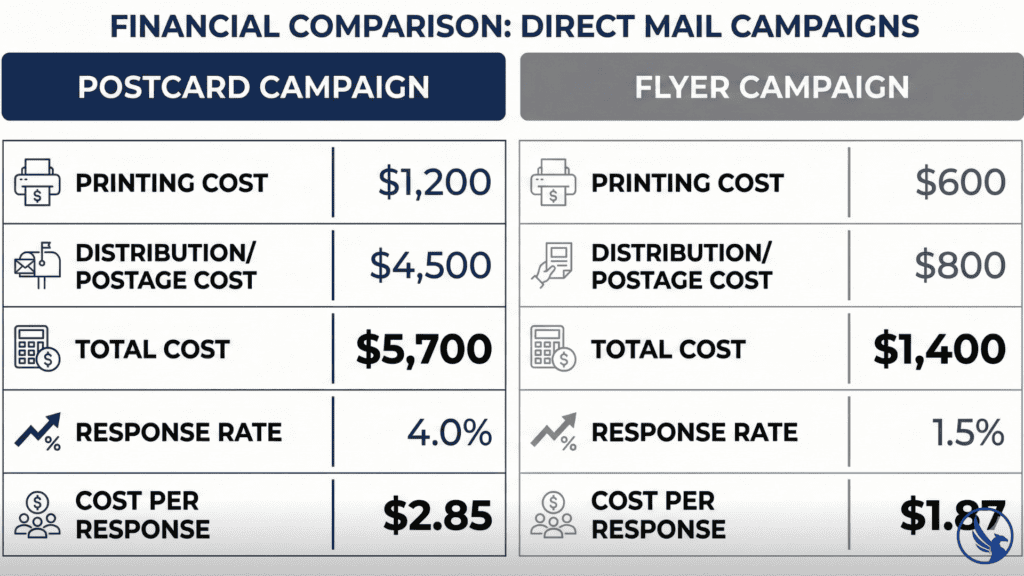
Raw printing costs favor flyers. A single-sided flyer on 80lb gloss paper costs $0.08–$0.15 per piece at volume. A 4×6 postcard on 14pt cardstock with UV coating costs $0.18–$0.28 per piece.
But printing cost is only part of the equation. Postcard printing vs flyers conversion economics must account for total campaign cost and cost per response.
See detailed cost comparison on Pinterest
Postcard Total Cost
- Printing (4×6, 14pt, UV): $0.20–$0.30
- Postage (EDDM®): $0.260 (Retail) or $0.259 (BMEU)
- Postage (First-Class Mail® presort): ~$0.408–$0.46
- Delivered cost per household: $0.46–$0.76
For a 2,000-piece campaign: $920–$1,520 total
At a 4% response rate: 80 responses
Cost per response: $11.50–$19.00
For more granular cost breakdowns by campaign size, see how much does postcard printing cost. Ready to price your specific campaign? Request a quote from CRST for accurate printing and mailing costs based on your volume and specifications.
Flyer Total Cost
- Printing (8.5×11, single-sided): $0.10–$0.15
- Distribution (door-to-door service): $0.08–$0.15
- Distributed cost per piece: $0.18–$0.30
For a 2,000-piece campaign: $360–$600 total
At a 1.5% response rate: 30 responses
Cost per response: $12.00–$20.00
The Verdict on Cost Efficiency
Despite lower upfront costs, flyers often deliver higher cost-per-response because of lower conversion rates. Postcards cost more to produce and mail but generate more responses per dollar spent. Understanding postcard printing ROI for local business helps frame these economics properly.
The exception: high-traffic event distribution where flyers reach a dense, qualified audience. A flyer handed to every attendee at a home show or trade expo can outperform mailed postcards because the audience is pre-qualified by their presence at the event.
Rates current as of February 2026; verify at USPS.com/business.
Targeting Precision: Reaching the Right People
Postcard printing vs flyers conversion analysis must consider who actually receives each format.
Postcard Targeting
Postcards can be targeted with surgical precision:
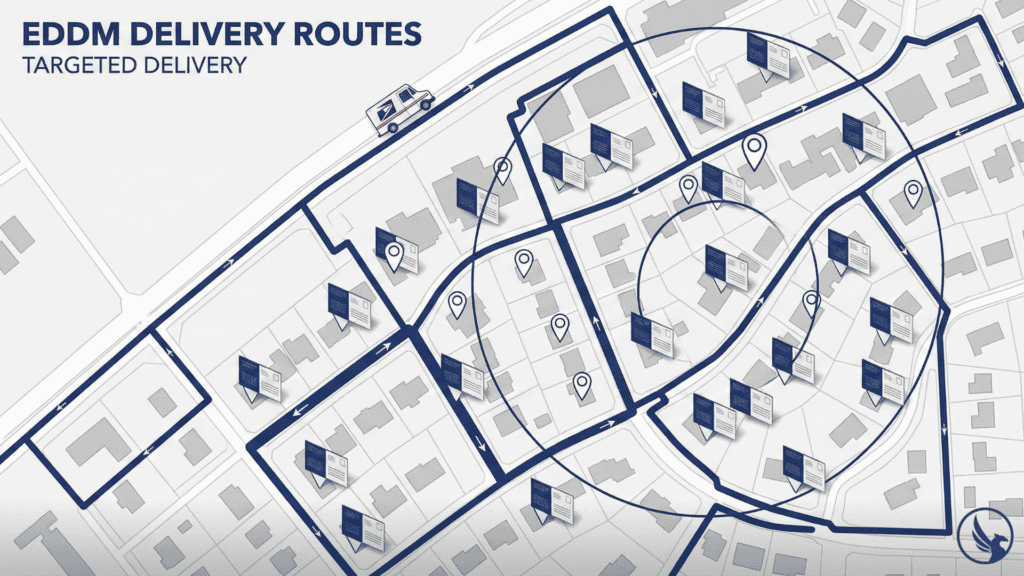
EDDM® (Every Door Direct Mail®): Reach every household on selected postal routes. Choose routes by zip code, demographics, or proximity to your business. No mailing list required. The USPS® EDDM® program makes geographic targeting accessible to businesses of any size. Learn more about EDDM postcard printing cost and setup.
Purchased lists: Target by demographics, purchase behavior, homeownership status, income level, or hundreds of other variables. Reach exactly the households most likely to convert.
House lists: Mail your existing customers, past purchasers, or leads. The highest-converting postcard campaigns target people who already know you.
Every postcard reaches a real address where a real person lives. There’s no waste from distribution to empty lots or abandoned buildings.
Flyer Targeting
Flyer targeting is inherently less precise:
Door-to-door: Reaches households but with less demographic control than EDDM®. Distribution services vary in reliability—some skip houses, miss neighborhoods, or discard portions of their load.
Handout distribution: Depends entirely on location selection and distributor quality. A flyer handed to passersby outside a grocery store reaches a different audience than one distributed at a farmers market.
Public posting: Essentially zero targeting. Anyone who happens to see a bulletin board might see your flyer—or might not.
Windshield placement: Often illegal, always annoying, rarely effective. This method damages brand perception more than it generates leads.
The Verdict on Targeting
Postcards win decisively on targeting precision. The ability to reach specific households based on demographics, geography, or purchase history creates efficiency that flyer distribution cannot match.
Design and Messaging Constraints
Format shapes message. Postcards and flyers offer different creative opportunities and limitations.
Postcard Design
Standard postcard sizes (4×6, 5×7, 6×9, 6×11) limit real estate. You have two sides—typically a dominant image on the front and offer details on the back. For detailed guidance on choosing dimensions, see best postcard size for direct mail.
This constraint forces clarity. There’s no room for meandering copy or multiple competing messages. Effective postcards communicate one thing powerfully: a single offer, a single call to action, a single reason to respond.
The forced simplicity often improves conversion. Decision paralysis kills response rates. A postcard that says “one thing, do one thing” outperforms cluttered alternatives. Avoid common pitfalls with our guide to postcard design mistakes to avoid.
Flyer Design
Flyers offer more space. A standard 8.5×11 sheet accommodates extensive copy, multiple images, detailed specifications, or complex offers.
This flexibility cuts both ways. More space enables richer storytelling—but also enables clutter, competing messages, and visual chaos that suppresses response.
Flyers work best when the additional space serves a purpose: detailed event schedules, product specifications requiring explanation, or offers complex enough to need context.
The Verdict on Design
Neither format is inherently better for design. Postcards force discipline that often improves conversion. Flyers allow depth that certain campaigns require. Match format to message complexity.
Perception and Credibility
How recipients perceive each format affects response rates in subtle but meaningful ways.
Postcard Perception
Direct mail carries implicit legitimacy. Receiving a postcard signals that a business invested in reaching you specifically—not just littering the neighborhood.
Quality printing enhances credibility further. Thick postcard printing for durability communicates established, trustworthy business through tactile quality alone.
Postcards also feel personal in ways flyers don’t. Address personalization (“Dear Sarah” or “Current Resident at 123 Main St”) creates connection, however small.
Flyer Perception
Flyers carry baggage. Decades of low-quality pizza coupons, political spam, and windshield clutter have trained consumers to view flyers skeptically.
This perception can be overcome with exceptional design and quality printing—but you’re swimming upstream. A flyer must work harder to earn the same credibility a postcard receives by default.
The exception: flyers distributed at events or locations where they’re expected and welcomed. A flyer handed out at a home improvement expo feels different than one stuffed under a windshield wiper.
The Verdict on Perception
Postcards start with a credibility advantage. Flyers must overcome negative associations through superior design and strategic distribution.
Use Case Comparison: When Each Format Wins
Postcard printing vs flyers conversion depends heavily on campaign type. Here’s where each format excels.
Postcards Win For:
Local business marketing: Restaurants, salons, dental offices, gyms—any business serving a geographic area benefits from postcards’ precise targeting and guaranteed delivery.
Customer retention: Reactivation campaigns, loyalty offers, and renewal reminders work best when they reach the intended recipient reliably.
Real estate: Farming campaigns, listing announcements, and market updates require the credibility and targeting precision that postcards provide.
Direct response offers: When you need trackable response to a specific offer, postcards’ higher conversion rates justify the additional cost. Learn more about direct mail postcard tracking methods.
B2B lead generation: Decision-makers receive too much email. A postcard on their desk gets attention that another digital message won’t.
Flyers Win For:
Event promotion: Concerts, festivals, grand openings, and community events can leverage flyer distribution at high-traffic locations where the audience is pre-qualified.
Hyperlocal saturation: Apartment complexes, college campuses, or dense urban neighborhoods where door-to-door distribution is efficient.
Complex information: When your message genuinely requires more space than a postcard allows—event schedules, detailed menus, multi-service offerings.
Very tight budgets: When cash constraints make postcard postage impossible, well-designed flyers with strategic distribution beat nothing. For budget-conscious approaches, see affordable postcard printing for startups.
Supplemental touchpoints: Flyers as leave-behinds at events, in-store handouts, or bag stuffers complement other marketing rather than serving as primary lead generation.
Real-World Comparison: Same Business, Both Formats
A representative example based on typical campaign performance: a regional HVAC company tested postcard printing vs flyers conversion for their spring AC tune-up promotion.
View response rate breakdown on Pinterest
Postcard campaign:
- 5,000 postcards mailed via EDDM® to homeowners within service area
- Offer: $79 AC tune-up (regularly $129)
- Total cost: $2,850 (mid-range $0.57 per piece)
- Response rate: 3.2%
- Appointments booked: 160
- Cost per appointment: $17.81
Flyer campaign:
- 5,000 flyers distributed door-to-door by hired service
- Same offer, same design adapted to 8.5×11 format
- Total cost: $1,100
- Response rate: 0.9%
- Appointments booked: 45
- Cost per appointment: $24.44
The postcards generated 3.5x more appointments at a 27% lower cost per booking. The flyers weren’t worthless—45 appointments from $1,100 is still positive ROI—but the postcards dramatically outperformed.
The marketing manager’s conclusion: “Flyers feel cheaper until you track results. Postcards cost more upfront but deliver more customers per dollar.” Industry research confirms this pattern holds across sectors—direct mail consistently delivers higher ROI than businesses expect when campaigns are properly executed and measured.
Combining Both Formats Strategically
The smartest marketers don’t choose postcard printing vs flyers—they use both strategically.
Primary campaign via postcard: Use postcards for your core direct response campaigns where response rate and ROI matter most.
Supplemental touchpoints via flyer: Use flyers for event distribution, in-store handouts, or leave-behinds that reinforce the postcard message.
Testing via flyer, scaling via postcard: Test messaging and offers with small flyer distributions before investing in larger postcard campaigns.
Event-specific flyers: For trade shows, community events, or grand openings, flyers make sense when you’re reaching people in person.
The formats complement rather than compete when deployed thoughtfully.
Start Your Print Marketing Campaign
Postcard printing vs flyers conversion data points clearly toward postcards for most direct response marketing—but the right format depends on your specific goals, audience, and budget.
Postcards deliver higher response rates, better targeting, and stronger ROI for most business objectives. Flyers serve supplemental roles where their lower cost or larger format provides specific advantages.
The businesses winning with print marketing in 2026 aren’t guessing. They’re tracking results, testing formats, and optimizing based on data. For common misconceptions about these metrics, see postcard printing ROI myths debunked.
Choose the format that fits your campaign. Execute with quality. Measure everything.
For the complete breakdown, see our Postcard Printing and Mailing Services Guide