
A bent postcard in the mailbox tells your recipient you cut corners. Thickness matters when your direct mail campaign competes with bills, catalogs, and the recycling bin. In 2026, smart marketers choose paper weight based on mailing conditions, message urgency, and perceived value. Here’s how to select thick postcard printing for durability without overpaying for specs you don’t need.
📏 Postcard Thickness Comparison Guide
Choose the right cardstock weight for durability, cost, and campaign goals
Why Postcard Thickness Determines Campaign Success
Postcard durability starts with paper weight, measured in point thickness (pt) or pounds per ream (lb). A flimsy 10pt postcard arrives wrinkled and damaged. A premium 16pt postcard feels substantial, survives postal machinery, and commands attention.
The USPS® handled approximately 127 billion mail pieces in 2023. Your postcard travels through automated sorters, conveyor belts, and delivery trucks before reaching its destination. Thin stock bends, tears, and loses print clarity during transit. Thicker cardstock protects your design, maintains color vibrancy, and signals professionalism.
Recipients form first impressions within seconds. They judge your brand by what they feel before they read a word. A sturdy postcard communicates quality, investment, and credibility. A weak one suggests spam or budget constraints.
Your thickness choice also affects postage costs. USPS categorizes postcards by dimensions and rigidity. First-Class Mail® postcards ranging from 3.5″×5″ minimum to 6″×9″ maximum qualify for the postcard rate ($0.56 as of 2025-2026) if they meet USPS thickness requirements of 0.007″-0.016″. Oversized or improperly sized cards pay letter rates ($0.73), increasing costs by approximately 30% per piece. For complete specifications, see our guide to USPS postcard printing requirements.
Understanding Paper Weight and Point Thickness
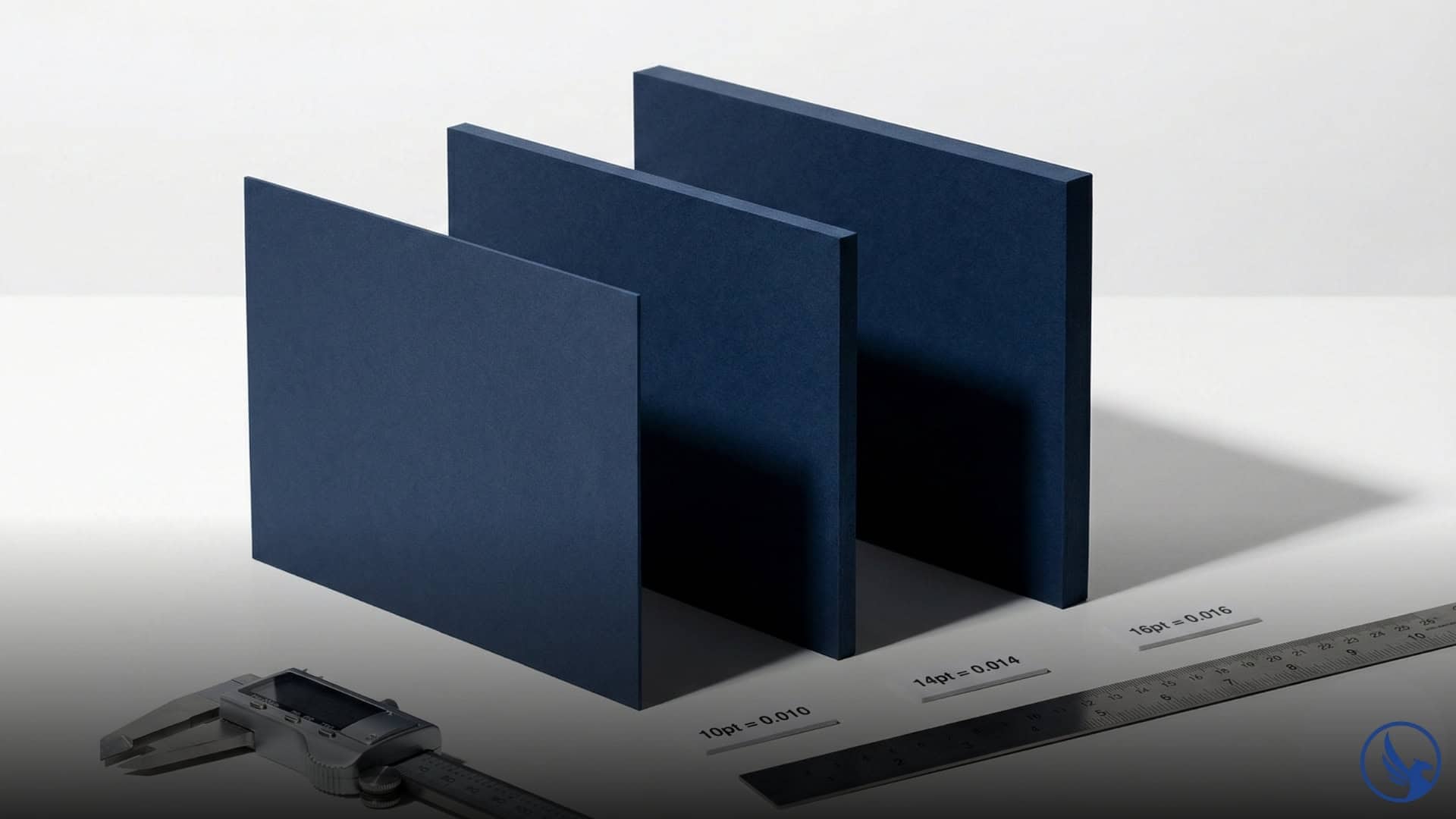
Paper weight and point thickness measure the same property using different scales. Both indicate durability, but they aren’t interchangeable. Our visual thickness comparison guide breaks down how different cardstock weights look and feel in practice.
Point Thickness vs Pound Weight
Point thickness (pt) measures the actual caliper—the physical distance between two sides of the card. One point (pt) equals 0.001 inches, so a 14pt postcard measures 0.014 inches thick. Common postcard weights range from 10pt to 16pt.
Pound weight (lb) refers to the weight of 500 sheets (a ream) at the paper’s standard size before cutting. A 14pt postcard typically uses approximately 100-111 lb cover stock, but this varies by paper type and manufacturer.
For postcard printing, point thickness offers more precision. A 14pt postcard maintains consistent rigidity regardless of paper finish or coating. Pound measurements fluctuate based on paper density and texture, making comparisons across printers difficult. See our paper weight comparison chart for a quick visual reference.
Standard Postcard Thickness Options
Most direct mail campaigns use these standard thicknesses:
10pt cardstock: Budget-friendly but prone to bending. 10pt measures 0.010″ thick and correlates to approximately 80 lb cover stock. Suitable for high-volume, low-value promotions where cost per piece matters more than durability. Common for EDDM® campaigns targeting entire carrier routes.
13pt cardstock: Mid-range option balancing cost and quality. 13pt measures 0.013″ thick (approximately 90-95 lb cover). Handles USPS sorting equipment without damage. Works for event invitations, seasonal promotions, and first-time customer offers.
14pt cardstock: Industry standard for professional direct mail. 14pt measures 0.014″ thick and correlates to approximately 100-111 lb cover stock. Survives postal handling, feels premium, and supports vibrant printing on both sides. Recommended for real estate listings, dental reminders, and restaurant grand openings.
16pt cardstock: Premium thickness reserved for luxury brands, high-value offers, and VIP communications. 16pt measures 0.016″ thick (approximately 120 lb cover). Noticeably heavier in hand. Used for exclusive invitations, executive networking events, and high-ticket product launches.
USPS minimum postcard thickness is 0.007″—anything below this requires envelope packaging. However, 10pt (0.010″) is the practical minimum for durability through postal handling. Anything above 16pt risks increased postage and printing costs without proportional benefits.
Matching Thickness to Campaign Goals
Your postcard thickness should align with your campaign objectives and target audience expectations.
Budget Volume Campaigns
Budget volume campaigns prioritize quantity over perceived quality. If you’re mailing 10,000 postcards to promote a one-day sale, 10pt cardstock delivers adequate durability at the lowest cost. Recipients expect promotional mail to feel lightweight, and your ROI depends on reach, not premium materials.
Relationship-Building Campaigns
Relationship-building campaigns require thicker stock to signal investment in the recipient. Real estate agents farming neighborhoods, dentists reactivating patients, or nonprofits soliciting donations need 14pt cardstock minimum. These audiences receive abundant mail and discard obvious junk immediately. Thickness earns the extra seconds of attention that converts.
High-Value Offers
High-value offers demand premium materials. If your postcard promotes a $50,000 product, a luxury service, or an exclusive membership, 16pt cardstock matches the message. Recipients associate paper quality with product quality. A flimsy postcard undermines a premium offer.
Multi-Touchpoint Campaigns
Multi-touchpoint campaigns benefit from consistent thickness across mailings. If you send quarterly updates, use the same 14pt stock each time. Recipients recognize your brand by feel before they see your logo, building familiarity and trust over repeated exposures.
See full material specifications in our Postcard Printing Guide.
Cost Comparison: Thickness vs ROI
Postcard thickness directly impacts printing and postage costs, but durability protects your investment. For comprehensive ROI benchmarks across industries, see our postcard printing ROI for local business analysis.
Printing Cost Analysis
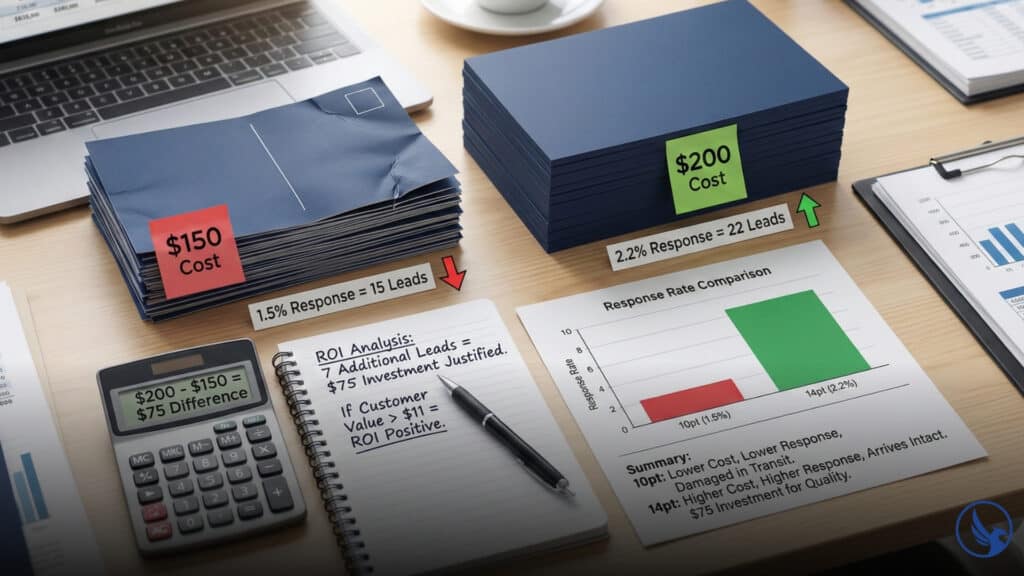
A 1,000-piece campaign at 10pt costs roughly $150-200 for printing. The same run at 14pt costs $200-275. That $75 difference buys damage protection, better response rates, and professional perception.
Here’s the math: If your 10pt campaign generates a 1.5% response rate, you get 15 responses. If your 14pt campaign generates a 2.2% response rate due to improved durability and perception, you get 22 responses. Seven additional leads justify the $75 upcharge if your average customer value exceeds $11.
Postage Considerations
Postage costs remain constant within USPS® postcard dimensions, so thickness upgrades don’t increase mailing fees—as long as you stay within the 6″ × 9″ maximum for postcard rates and the 0.007″-0.016″ thickness range. A 10pt and 14pt postcard both qualify for standard postcard rates ($0.56 for First-Class Mail®) if they meet size requirements.
Damaged mail destroys campaigns. A 10pt postcard that arrives bent and torn yields zero response. A 14pt postcard that survives transit intact converts at full potential. Durability isn’t a luxury—it’s risk mitigation. For practical postcard durability tips that protect your investment, see how different thicknesses perform under real-world mailing conditions.
Practical Testing: What Works for Different Industries
Real estate agents consistently report better response with 14pt glossy postcards. Homeowners associate thick cardstock with successful agents who invest in marketing. Thin postcards get confused with ValPak coupons and discarded.
Restaurants succeed with 12pt matte postcards for menu mailers and special event promotions. The slight texture gives a handmade feel without the premium price of 16pt stock.
Gyms and salons use 14pt UV-coated postcards for durability during seasonal campaigns. The coating adds extra rigidity and protects against moisture damage during winter and summer mailing seasons.
Nonprofits split-test 12pt vs 16pt for donation appeals. Higher-value donor segments receive 16pt stock with personalized messages, while broader appeals use 12pt to maximize volume.
Start Your Thick Postcard Printing Campaign
Postcard thickness isn’t cosmetic. It’s structural. Your campaign survives or fails based on whether your message arrives intact and commands attention.
Choose thickness based on audience expectations, offer value, and campaign frequency. Test, measure, and adjust. The right cardstock protects your investment and respects your recipients.
Ready to print durable postcards that survive the mail? Contact CRSTNET for professional thick postcard printing with 14pt and 16pt cardstock options. Our team helps you select the right paper weight for your campaign goals, budget, and target audience. Get expert guidance on material specifications, coating options, and volume pricing that maximizes your ROI.
See our Postcard Printing Guide for complete specifications and templates.