
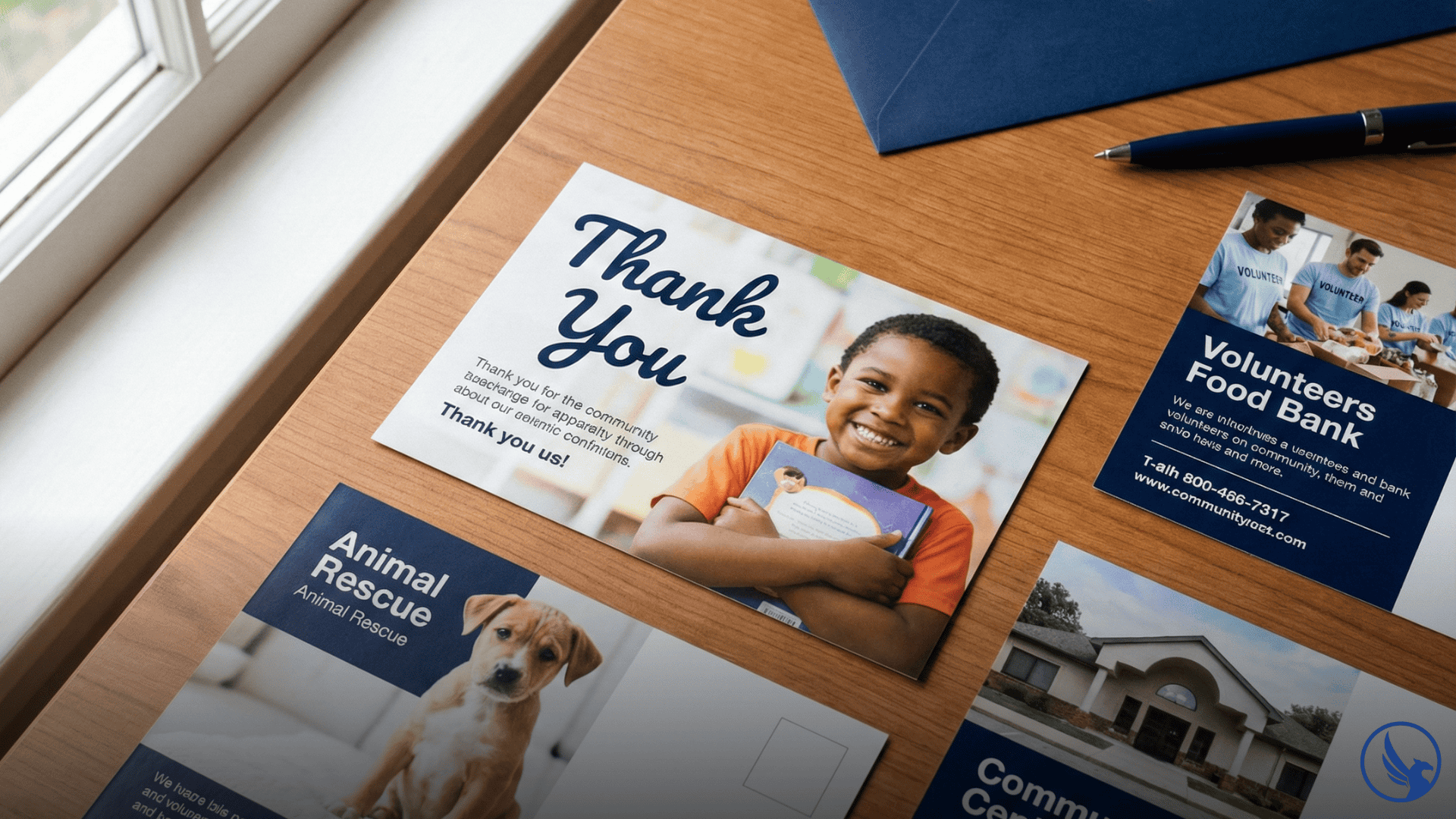
Cheap postcard printing for nonprofits stretches limited marketing budgets further than any digital channel can. Every development director knows the frustration: email open rates declining, social media reach evaporating, and donation appeals getting lost in crowded inboxes. Meanwhile, a physical postcard lands in a donor’s hands and earns attention through sheer tangibility. In 2026, the nonprofits growing their donor base aren’t abandoning direct mail for digital. Instead, they’re combining both—and finding that postcards deliver response rates that email can only dream of. Here’s how to build postcard campaigns that increase donations without draining your budget.
📬 Nonprofit Fundraising Response Rates
Which Channel Drives the Most Donations?
Why Direct Mail Still Drives Nonprofit Donations
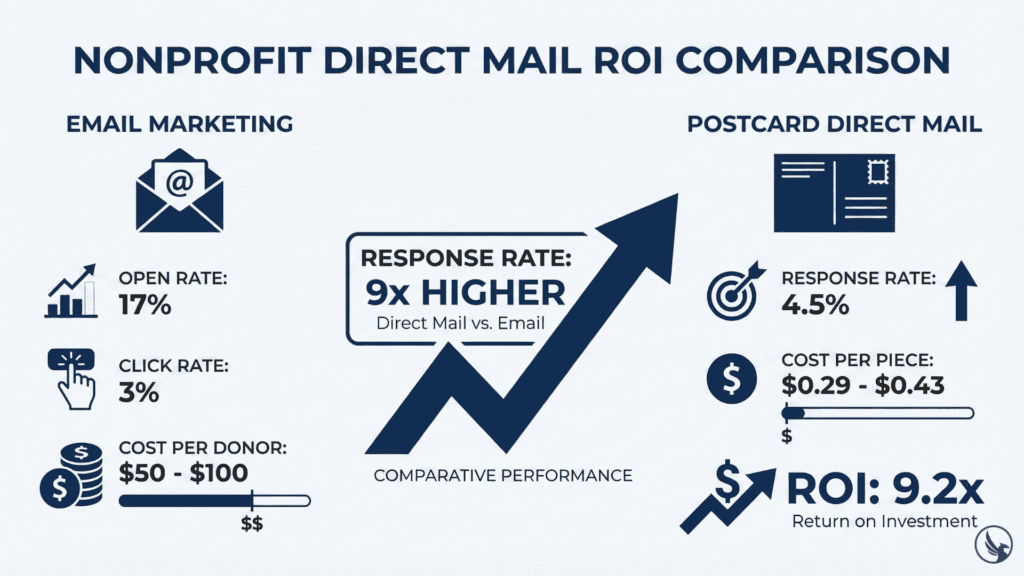
The nonprofit sector faces a paradox. Digital tools have never been more sophisticated, yet donor acquisition costs keep climbing and retention rates keep falling. Industry studies suggest the average nonprofit loses a significant portion of donors after their first gift, though retention rates vary widely by organization type and stewardship practices. Meanwhile, email open rates for nonprofit appeals hover around 17%, with click-through rates below 3%.
Direct mail tells a different story.
According to the ANA (formerly DMA), direct mail achieves response rates of 4.9% for prospect lists and 9%+ for house lists—significantly higher than email marketing. For nonprofits specifically, the Association of Fundraising Professionals reports that direct mail still generates the majority of individual donations for organizations with established mail programs. For deeper analysis of these metrics, see our breakdown of postcard printing response rate statistics.
Cheap postcard printing for nonprofits works because it meets donors where decisions happen: at home, during the daily mail sort, in moments of reflection rather than distraction. Moreover, a well-designed postcard doesn’t compete with 47 unread emails. Instead, it exists in physical space, demanding acknowledgment before it can be dismissed.
There’s also the trust factor. Notably, older donors—who statistically give more and give more consistently—respond to direct mail at significantly higher rates than digital appeals. A physical piece signals legitimacy in ways that yet another email cannot.
The nonprofits growing sustainably in 2026 understand that direct mail isn’t outdated. Rather, it’s underutilized by competitors who’ve chased digital trends while abandoning a channel that still works.
Designing Donation Postcards That Actually Convert
A postcard earns roughly two seconds of attention. For nonprofits, those two seconds hinge on emotional connection. If the card doesn’t make someone feel something—urgency, compassion, hope, responsibility—it fails. Design choices either amplify that emotional response or bury it under clutter.
Here’s how to create postcards that drive donations.
Photography That Tells a Story
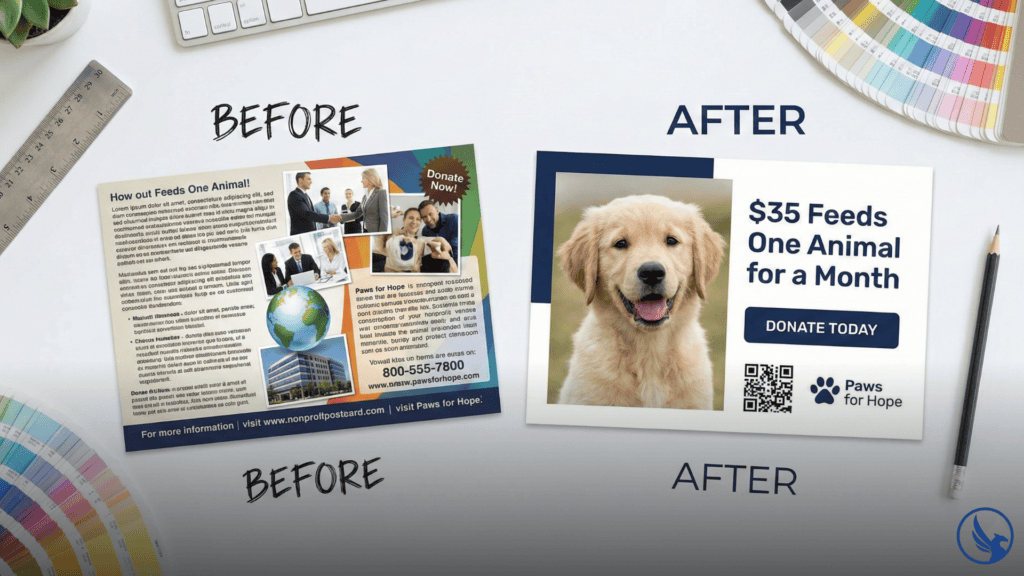
The hero image carries your entire message. This isn’t the place for your logo on a plain background or a group photo of your board of directors. Instead, feature the impact—a face, a moment, a transformation that your organization made possible.
One compelling image outperforms collages every time. For example, a child reading a book your literacy program provided. A veteran receiving housing assistance. A rescued animal in a foster home. Ultimately, specificity creates connection, while generic images of “people helping people” create nothing.
Cheap postcard printing for nonprofits doesn’t mean cheap photography. In fact, one professional photo shoot—or even thoughtful smartphone photos with good lighting—gives you assets for an entire year of campaigns. Consequently, the investment pays for itself in improved response rates.
Resolution matters critically. Postcard printing requires 300 DPI minimum. Low-resolution images look unprofessional and undermine trust. However, if your photos can’t meet print standards, use bold graphic design instead. For guidance on choosing formats and avoiding common errors, see best postcard size for direct mail and postcard design mistakes to avoid.
Headlines That Create Urgency
Generic headlines generate generic results. “Support Our Mission” says nothing, while “Please Donate” feels desperate and uninspired.
Effective nonprofit postcard headlines do one of three things: quantify impact, create urgency, or make the donor the hero.
Impact-focused headlines work well: “$25 Provides a Week of Meals for a Homeless Veteran” or “Your Gift Sends One Child to Summer Camp.”
Similarly, urgency headlines drive immediate action: “Matching Gift Deadline: December 31” or “48 Families Still Need Holiday Meals.”
Donor-as-hero headlines shift the frame: “You Can Change a Life Today” or “Be the Reason a Student Graduates.”
The headline and image should communicate a complete emotional story in one glance. If someone has to read body copy to understand why they should care, you’ve already lost most of your audience.
Asks That Are Specific and Tangible
Vague donation requests (“Give generously”) underperform specific asks by significant margins. Donors want to know exactly what their money accomplishes.
Use concrete amounts tied to concrete outcomes:
- “$35 provides school supplies for one student”
- “$100 funds a week of job training”
- “$250 covers one month of transitional housing”
Offer multiple giving levels on the response mechanism, but anchor with a suggested amount. Research consistently shows that donors give more when provided a recommended starting point.
Additionally, include a clear, simple call to action. QR codes linking to donation pages work well—they bridge physical mail to digital payment seamlessly. Likewise, unique campaign URLs (yournonprofit.org/spring2026) allow tracking and create urgency. Learn more about direct mail postcard tracking methods.
For the complete breakdown, see our Postcard Printing and Mailing Services Guide.
Campaign Types That Drive Donations Year-Round
Cheap postcard printing for nonprofits delivers strongest results when integrated into a strategic annual calendar. Different campaign types serve different fundraising objectives.
Year-End Appeals (October–December)
Industry data shows that roughly 30% of annual giving occurs in December, with approximately 10% happening in the final three days of the year. Therefore, year-end campaigns are non-negotiable for any nonprofit with a direct mail program.
Campaign structure:
- Early November: Gratitude postcard thanking donors for past support, previewing year-end needs
- Early December: Primary appeal with specific ask and matching gift opportunity if available
- Mid-December: Deadline reminder emphasizing tax-deductibility and year-end matching
Messaging angle: Combine urgency (tax deadline, matching gift expiration) with impact summary (what was accomplished this year, what’s needed next year).
Spring Renewal Campaigns (March–May)
Spring represents a natural moment for renewal and fresh commitment. Donors who gave during year-end are primed for re-engagement before summer lulls set in.
Campaign structure:
- Single postcard highlighting a specific spring initiative or program milestone
- Focus on sustaining momentum from year-end success
Messaging angle: “Together we accomplished X in 2025. Here’s what we’re tackling in 2026.”
Emergency and Urgent Appeals (As Needed)
Disaster response, unexpected funding gaps, or time-sensitive opportunities justify unscheduled appeals. Fortunately, postcards can be printed and mailed within days for urgent needs.
Campaign structure:
- Single-touch postcard with clear urgency and specific need
- Emphasis on immediate impact of giving now
Messaging angle: Authentic urgency only—donors recognize manufactured crises and respond negatively.
Donor Appreciation Campaigns (Ongoing)
Not every postcard should ask for money. In fact, gratitude mailings build relationships that pay dividends when appeals do arrive. Consider approaches similar to postcard printing for moving announcements—keeping donors informed without always asking.
Campaign structure:
- Quarterly or semi-annual thank-you postcards featuring impact stories
- No ask—pure appreciation and stewardship
Messaging angle: “Because of you, this happened.” Donors who feel appreciated give again at higher rates.
Lapsed Donor Reactivation (Quarterly)
Donors who gave 13–24 months ago but haven’t given recently represent low-hanging fruit. After all, they’ve already demonstrated affinity for your mission. A targeted reactivation postcard can restart the relationship.
Campaign structure:
- Personalized postcard acknowledging past support
- Updated impact story showing what’s changed since their last gift
- Specific ask to rejoin the donor community
Messaging angle: “We’ve missed you. Here’s what’s happened since you last gave—and why we need you back.”
Real-World ROI: What Nonprofit Postcard Campaigns Actually Cost
Cheap postcard printing for nonprofits delivers measurable returns when tracked properly. Here’s how the economics break down.
Printing and Mailing Costs
A standard 4×6 postcard on 14pt cardstock with UV coating runs $0.15–$0.25 per piece at quantities of 1,000–5,000. Notably, larger runs reduce per-unit cost significantly—critical for nonprofits mailing to substantial donor lists. For detailed pricing guidance, see how much does postcard printing cost.
Most commercial printers offer nonprofit pricing tiers with volume discounts. Before committing to your first campaign, request a quote from qualified printers to compare per-piece costs at your anticipated mail volumes—the difference between 1,000 and 5,000 postcards can drop your unit cost by 40% or more. Premium cardstock options like thick postcard printing for durability may cost slightly more but command attention.
Furthermore, nonprofit postage rates offer meaningful savings. USPS® Nonprofit Marketing Mail® rates run approximately $0.24–$0.30 per piece for qualified 501(c)(3) organizations depending on automation and presort level. In comparison, First-Class Mail® single-piece postcard stamps cost $0.56 if you need faster delivery or smaller quantities that don’t qualify for bulk rates.
Total delivered cost for nonprofit mailings: $0.39–$0.55 per household at volume.
Rates current as of February 2026; verify at USPS.com/business.
View donation campaign ROI calculator on Pinterest
Calculating Return on Investment
Here’s a realistic scenario for a mid-sized nonprofit:
Year-end appeal campaign:
- Mail size: 3,000 postcards to existing donor list
- Total cost: $1,400 (printing $0.20/piece + nonprofit postage $0.27/piece = $0.47 × 3,000)
- Response rate: 4.5%
- Donors responding: 135
- Average gift: $75
- Revenue generated: $10,125
That’s a 7.2x return on investment. Moreover, this calculation ignores lifetime value—a reactivated donor who gives three more times over the following two years represents far more than one $75 gift. For comprehensive ROI analysis frameworks, see postcard printing ROI for local business—the same principles apply to nonprofits.
Comparing to Digital Fundraising
Digital advertising benchmarks show that Facebook and Instagram ads for nonprofits typically cost $1.00–$3.00 per click. Converting a click to an actual donation requires multiple steps with significant drop-off at each stage. As a result, cost per acquired donor through digital advertising often exceeds $50–$100.
In contrast, a postcard arrives directly in the donor’s home, requires no click, and persists physically until acted upon. Many nonprofits find direct mail delivers lower cost-per-donation than digital once both channels are tracked properly.
The most effective approach combines both: digital for awareness and younger donor acquisition, direct mail for retention, major gifts, and older donor segments. For channel performance comparisons, see postcard printing vs email marketing.
Case Study: How One Animal Rescue Doubled Year-End Donations
A representative example based on nonprofit year-end campaign patterns: A regional animal rescue in the Pacific Northwest relied almost exclusively on social media and email for fundraising. Year-end 2024 raised $18,400—disappointing given a donor list of 2,800 names.
They tested cheap postcard printing for their 2025 year-end campaign.
The campaign:
- Audience: 2,800 donors (segmented by last gift date and amount)
- Postcard design: Single rescued dog, close-up portrait, direct eye contact
- Headline: “She Was Hours from Euthanasia. You Gave Her a Future.”
- Ask: Three giving levels ($35, $75, $150) with specific impact statements
- QR code linking to donation page with unique campaign tracking
- Wave structure:
- Wave 1 (November 15): Full list, emotional appeal, matching gift announcement
- Wave 2 (December 10): Lapsed donors only (12+ months), “We Miss You” angle
- Wave 3 (December 26): All non-responders, deadline urgency
Total campaign cost: $2,940
Results:
- Wave 1: 142 gifts, $12,780 raised
- Wave 2: 38 gifts, $3,420 raised
- Wave 3: 89 gifts, $8,010 raised
- Total raised: $24,210
- Total new donors reactivated: 67
- Year-over-year increase: 31.5%
The campaign paid for itself 8.2x over.
More importantly, 67 lapsed donors returned—people who hadn’t responded to any email appeal in over a year but opened their wallets when a postcard arrived.
The development director’s observation: “Email told people we needed help. The postcard made them feel something.”
Common Mistakes That Kill Nonprofit Postcard Campaigns
Cheap postcard printing for nonprofits fails when organizations treat direct mail as an afterthought. Avoid these errors:
No emotional hook: Data and statistics don’t drive donations—stories do. Instead, lead with a face, a name, a specific moment of transformation.
Vague asks: “Support our work” converts worse than “$50 feeds a family for a week.” Be specific about what donations accomplish.
Poor photography: A dark, blurry, or generic stock photo undermines credibility. Instead, invest in images that show your actual impact.
No tracking mechanism: If you can’t measure which campaign generated which donations, you’re guessing. Use unique URLs, QR codes, or campaign codes.
One-and-done mailing: A single postcard is a flyer. Consistent campaigns build recognition and trust. Therefore, plan multiple touchpoints throughout the year.
Ignoring segmentation: A major donor and a first-time $25 giver have different relationships with your organization. Consequently, tailor messaging to giving history for maximum response.
Forgetting to say thank you: Nonprofits that only mail when asking for money train donors to dread their mail. In contrast, gratitude mailings without asks build relationships that sustain giving over time.
Start Your Nonprofit Postcard Printing Campaign
Cheap postcard printing for nonprofits isn’t about abandoning digital fundraising. Rather, it’s about reclaiming a channel that still works while competitors chase declining email metrics.
The nonprofits growing their donor base in 2026 understand that attention is scarce online but mailboxes remain open. They’re showing up with compelling stories, specific asks, and systems that track every dollar raised.
Your donor list is your most valuable asset. Put it to work.
For the complete breakdown, see our Postcard Printing and Mailing Services Guide