

EDDM for auto dealers is one of the most direct, cost-efficient methods available for putting a compelling offer in front of every household within your primary market area. Digital advertising costs in the automotive category continue to rise. Google Ads CPCs for dealer keywords regularly exceed $10–$20 per click.
Advisory: Google Ads CPC benchmarks for automotive dealer keywords vary significantly by market, keyword competitiveness, and campaign configuration, and change frequently. Verify current automotive CPC benchmarks via Google Keyword Planner or current WordStream automotive industry benchmarks before using specific figures in budget comparisons or board presentations.
By contrast, Every Door Direct Mail delivers a physical, full-color piece to every mailbox on a target route for a fraction of that cost per impression.
More importantly, a well-designed EDDM postcard reaches the household, not just the individual. Car purchase and lease decisions are frequently made jointly. A postcard sitting on a kitchen counter generates repeated impressions across multiple decision-makers. A digital ad seen once on a mobile screen cannot do the same. For the complete EDDM foundation, start with the EDDM Guide at CRST.
- Lease-end capture — 36-month renewal window
- Model year clearance with specific APR offer
- New model launch to high-income routes
- Oil change + tire rotation specials
- QR code → online service scheduling
- 5-mile radius from service entrance
- Specific inventory — year/model/payment
- Mid-income routes ($40K–$75K median)
- Inventory-specific creative beats generic
- Shared print run — lower per-piece cost
- Location-specific versioning per store
- BMEU submission for regional scale
Photo 3/4 angle, clean bg
Offer Payment or rate
Deadline Date drives urgency
Traffic Measurable visits
Why Direct Mail Works for Automotive Marketing
The Local Radius Advantage
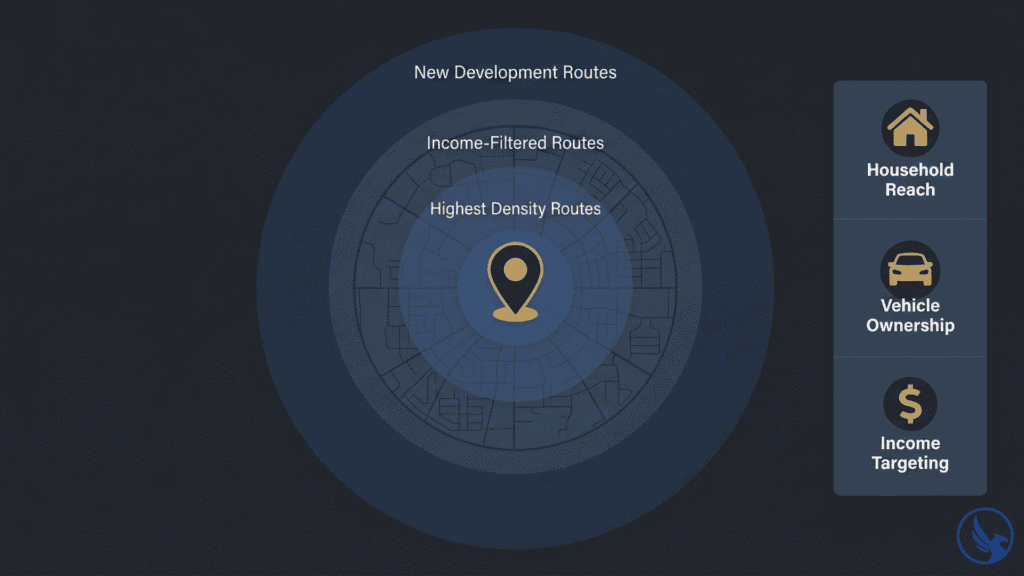
Automotive retail is among the most geographically concentrated purchase categories in consumer marketing. The vast majority of vehicle buyers shop at a dealership within 10–15 miles of their home.
Advisory: The 10–15 mile dealership shopping radius is widely cited in automotive retail market analysis but is not attributed to a specific named study in this article. Ranges vary by market density, vehicle type, and brand. Verify current primary market area benchmarks with NADA, Cox Automotive, or your OEM’s market representation data before using this figure in dealer planning presentations.
This applies whether they’re purchasing new, used, or leasing. Consequently, it creates a precisely bounded primary market area that EDDM is built to saturate.
The USPS EDDM route selection tool allows dealers to map and select carrier routes within their exact service radius. Filters include household income, average age, and residential density. For example, a luxury dealership can target routes with median household incomes above $90,000. Similarly, a high-volume used-car operation can target high-density residential routes across a broad radius. Furthermore, a dealer near a new housing development can immediately saturate those routes with an introductory offer — reaching new-to-market households before any competitor establishes recognition.
This geographic precision, combined with the physical impact of a large-format postcard, gives EDDM a targeting efficiency that rivals digital channels at a significantly lower cost per thousand impressions. For a side-by-side cost and ROI comparison, EDDM vs. Digital Ads provides the full framework.
Physical Mail in a High-Consideration Purchase Category
Vehicle purchases are high-consideration decisions — research-heavy, comparison-intensive, and spread across weeks or months. In this context, physical mail plays a different role than it does for an impulse-purchase category. A postcard from a dealership isn’t expected to close a sale on its own. Instead, it plants a brand impression that resurfaces when the recipient enters the active shopping phase.
According to the USPS Household Diary Study, 70% of consumers say direct mail feels more personal than digital outreach.
Advisory: The 70% figure references the USPS Household Diary Study. Other articles in this series cite a separate 57% finding from the same study (relating to feeling “more valued” by brands that use physical mail). These are distinct findings. Both are drawn from USPS Household Diary Study data, which is updated periodically. Verify both figures in the current edition at postalpro.usps.com before citing in client presentations or dealership marketing plans.
That perception is particularly valuable in automotive retail, where trust and relationship are primary purchase drivers. A premium-printed, large-format EDDM postcard signals dealership quality before a customer ever walks through the showroom door. Consequently, the creative investment in an automotive EDDM piece pays dividends beyond the direct response rate.
EDDM Campaign Strategy for Auto Dealerships
New Vehicle Sales: Lease End and Model Year Campaigns
The two highest-ROI EDDM campaigns for new vehicle sales are lease-end capture and model year clearance. Lease-end campaigns target households whose lease agreements are likely approaching expiration. Typically, 36-month terms mean a 2022 lease customer is due for renewal in 2025. While EDDM can’t target by individual lease data, dealers can time campaigns to saturate routes where a prior direct mail push drove traffic three years earlier. That approach creates a statistically valid overlap with current lease-end prospects.
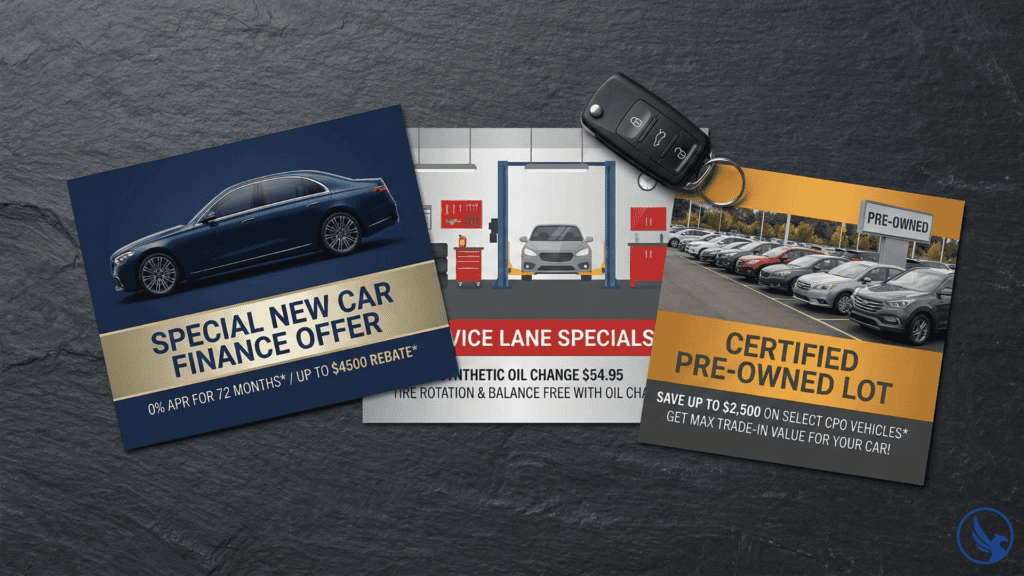
Model year clearance campaigns benefit from EDDM’s broad reach and low cost per piece. They work best when current model year inventory needs to move before next year’s vehicles arrive. A 9″ × 12″ postcard with a specific clearance offer — “2025 models, 0% APR for 60 months through [date]” — creates urgency across thousands of households simultaneously. For timing guidance, Best Time to Send EDDM covers the automotive calendar in the context of the broader seasonal mailing framework.
Service Lane Traffic: The Underused Revenue Stream
Many dealerships focus their direct mail budget exclusively on vehicle sales while ignoring the service department. That’s a strategic oversight. Fixed operations revenue is both more predictable and more margin-dense than new vehicle sales for most dealers.
EDDM is exceptionally well-suited to service lane campaigns. Oil change specials, tire rotation packages, brake inspection offers, and multi-point inspection promotions all translate naturally to postcard format — simple offer, clear price, obvious call to action. Furthermore, service customers who experience a positive dealership visit are statistically more likely to purchase their next vehicle from the same brand and location.
A service lane campaign targeting residential routes within 5 miles of the service entrance can drive incremental appointments at a cost per new customer well below digital alternatives. Additionally, a time-limited offer and a QR code linking to online scheduling strengthens response further. For design principles that make service offers stand out, see EDDM Design Tips and EDDM Postcard Design.
Used Vehicle and CPO Campaigns
Used vehicle and certified pre-owned campaigns have different audience profiles than new vehicle promotions. EDDM’s route-level demographic filtering makes it possible to target them separately. For used vehicle campaigns, routes with moderate household income ($40,000–$75,000 median) and higher residential density tend to produce stronger response. For CPO campaigns, routes with higher income overlap and existing brand registration data can sharpen the targeting further.
The offer structure for used and CPO postcards also differs from new vehicle campaigns. Rather than a finance rate or lease payment, the most effective used vehicle postcards lead with a specific vehicle or category. “In Stock: 2022–2024 Certified [Brand] SUVs from $299/mo” drives curiosity — and curiosity, in turn, drives showroom visits. As a result, inventory-specific creative consistently outperforms generic “great deals on used cars” messaging.
Designing EDDM Postcards That Move Automotive Customers
Size, Format, and Premium Production
Automotive is one of the few retail categories where postcard size directly corresponds to brand perception. A 6.5″ × 9″ postcard may be sufficient for a tire shop’s oil change special. However, a franchise dealership promoting a new model launch should be mailing on 9″ × 12″ stock — the largest standard EDDM format. The physical weight and presence of a 9″ × 12″ postcard signals a brand with resources. That perception maps directly to the consumer’s implicit evaluation of dealership quality and trustworthiness.
Paper stock and finish matter equally. A 16pt coated card with soft-touch matte finish or UV gloss on the vehicle photography communicates premium before any copy is read. For how stock and finish choices interact with brand perception at each dealership tier, EDDM Paper Stock Options covers the full decision framework. See also EDDM Postcard Sizes for a size-to-impact reference, and EDDM Postcard Printing Cost for volume-based cost modeling across formats.
Front Panel: One Vehicle, One Offer, One Deadline
The most common design mistake in automotive EDDM is overcrowding. Trying to feature three models, four financing options, and a service special on the same front panel dilutes every message and produces no clear call to action. In contrast, the highest-performing automotive postcards follow a single-focus formula: one hero vehicle photograph, one specific offer, one deadline.
The vehicle photography must be compelling. Use a sharp, three-quarter angle shot of the specific model being promoted, in a color that photographs well, against a clean background. Reserve your largest type for the offer figure — “$289/month” or “0% for 72 months” — and include a clear expiration date. Together, those three elements accomplish everything the front panel needs to do in the three-second mailbox decision window.
Back Panel: Directions, Hours, and Trust Signals
The automotive EDDM back panel serves a navigational and trust-building function. At minimum, it should include dealership name and address, hours of operation for both sales and service, a Google Maps QR code for directions, and a direct phone number to the sales desk — not a general switchboard. Additionally, include your manufacturer’s franchise badge or certified dealer logo and any relevant awards or recognition.
A secondary offer on the back panel — a trade-in appraisal incentive, a service coupon, or a referral bonus — gives recipients a second reason to act. This is especially useful when the front panel offer doesn’t match their immediate purchase timeline. For tracking which elements generate the most response, EDDM Tracking Results covers dedicated phone number, QR code, and UTM landing page setup for campaign-level attribution.
Timing and Scaling EDDM for Dealerships
When to Mail for Maximum Showroom Impact
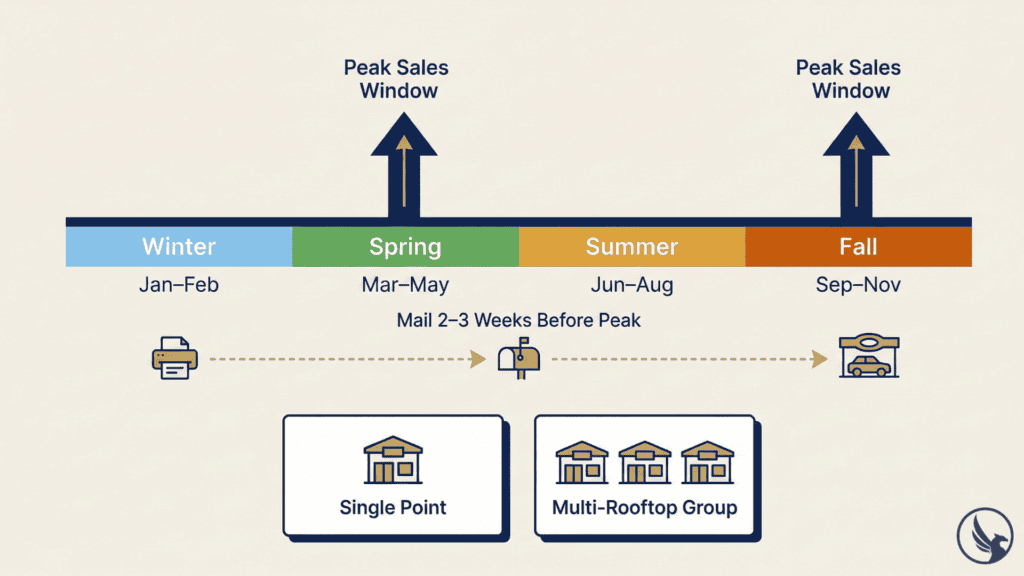
Automotive retail follows a predictable seasonal pattern. Spring (March–May) and fall (September–November) are the strongest new vehicle sales periods in most US markets. By contrast, January and July tend to be slower. Consequently, EDDM campaigns should arrive 2–3 weeks before these peak periods, capturing early-funnel prospects when they’re beginning to research — not after the peak has passed.
For end-of-month and end-of-quarter pushes, a tight-turnaround EDDM drop targeting the highest-density routes in the primary market area can generate incremental showroom traffic precisely when it’s needed. Contact CRST to discuss fast-turnaround options. For a full seasonal calendar, Best Time to Send EDDM maps the automotive window across the full year.
Scaling From Single-Point to Multi-Rooftop Campaigns
For dealer groups operating multiple rooftops, EDDM bulk mailing offers significant economies of scale. Consolidating print production across locations reduces per-piece cost. At the same time, each rooftop can still maintain distinct creative and offer messaging. A regional dealer group can run a coordinated campaign across 10 locations with a shared print run and location-specific versioning — dramatically reducing cost versus running each location independently.
For multi-rooftop campaign logistics — including BMEU submission, route allocation by location, and file versioning best practices — EDDM Bulk Mailing covers the full operational framework. Contact CRST to discuss multi-location campaign structuring, or visit our EDDM printing services for the full service overview. Additionally, use the EDDM ROI Calculator to model per-rooftop cost and expected return before committing to a group campaign budget.
Start Your EDDM Campaign with CRST
For auto dealers, EDDM delivers the geographic saturation, physical brand impact, and household-level reach that digital channels alone cannot replicate. Moreover, the cost-per-impression makes large-scale primary market area coverage genuinely accessible for dealers of every size.
CRST handles EDDM printing from file setup through postal delivery, with a team that knows USPS compliance inside out and a track record across industries. Explore our full EDDM printing services to see how we support campaigns from first template to final delivery. Ready to move forward? Request an estimate or contact our team with your project details.
For the complete breakdown of how the program works, see our EDDM Guide.