

You’ve run the Facebook campaigns. You’ve boosted the Instagram posts. And yet, your local foot traffic hasn’t budged the way you’d hoped. For businesses targeting customers within a few miles of their front door, EDDM vs digital ads isn’t just a budget question — it’s a question of what actually works at the neighborhood level.
Every Door Direct Mail puts a physical piece in the hands of every household on a chosen route. Digital ads put a disappearing banner in front of a scrolling thumb. The math is shifting in ways that may surprise you. For the complete EDDM system overview, start with the EDDM Guide at CRST.
- Geographic saturation — no list needed
- Household dwell time vs. 1.5-sec scroll
- No algorithm, no auction, flat rate
- Local businesses within 5-mile radius
- Behavioral and interest targeting
- Instant iteration — change creative in minutes
- National and e-commerce reach
- Real-time click and conversion tracking
EDDM vs Digital Ads: Why Physical Mail Is Winning Local Markets
The digital advertising landscape has become brutally competitive. Small and mid-sized businesses are fighting for impressions against national brands with seven-figure ad budgets. Cost-per-click rates on Google Search have climbed steadily, and Meta’s algorithm changes have made organic reach nearly meaningless for local businesses.
Every Door Direct Mail operates on an entirely different logic. Through the USPS EDDM program, you select mail routes by ZIP code, carrier route, or demographic filter, and a full-color postcard lands in every mailbox on that route. No auction, algorithm. No mailing list required.
For businesses like restaurants, dental practices, gyms, and home service companies, that physical presence creates something digital ads struggle to replicate: dwell time. A postcard sits on the kitchen counter. It gets passed between family members. It might stick to the fridge for two weeks. A digital ad disappears in seconds.
If you’re exploring how other local industries are using this channel, the EDDM for Small Business marketing playbook breaks down route selection and neighborhood targeting in detail. And if you’re just getting started, the EDDM First Campaign Guide walks you through every step from route selection to drop-off.
EDDM vs Digital Ads: The Real Cost Comparison

Here’s what local businesses are actually paying — all figures are directional benchmarks and subject to change with market conditions:
| Channel | Cost Per 1,000 Impressions | Response Rate | Cost Per Response |
|---|---|---|---|
| EDDM Postcard | $327–$397 | 1–5%* | $8–$40 |
| Facebook/Instagram Ads | $8–$15 CPM | 0.5–1.5% | $15–$50 |
| Google Display Ads | $3–$10 CPM | 0.1–0.5% | $30–$100 |
| Google Search Ads | $15–$50 CPC | 2–5% | $15–$50 |
Advisory: All figures in this table are directional benchmarks. EDDM cost per 1,000 reflects $0.260 current USPS postage plus typical print costs — verify the current postage rate at usps.com/business/every-door-direct-mail.htm before budgeting. Digital CPM, CPC, and response rate figures vary significantly by industry, creative quality, audience, targeting, and platform algorithm changes. Verify current Google Ads benchmarks via WordStream’s industry data and Meta Ads Manager before using these figures in client or board presentations. *EDDM response rate range reflects prospect mail benchmarks — see advisory below.
EDDM postcard printing currently runs $0.33–$0.40 per piece all-in (print plus $0.260 USPS postage). For a run of 5,000 pieces, that’s approximately $1,650–$2,000 — with zero targeting fees, no platform commissions, and no ad account minimums.
Digital ads can feel cheaper upfront because the entry cost is low. But once you account for creative production, A/B testing, campaign management time, and the reality that most impressions never convert, the true cost-per-response climbs fast.
For a deeper breakdown of what EDDM campaigns actually cost across different scales, see the EDDM Postcard Printing Cost guide. Use the EDDM ROI Calculator to model your specific campaign before committing budget.
EDDM Design and USPS Requirements
One area where digital ads hold an edge: iteration speed. You can change a Facebook ad in minutes. EDDM requires upfront design investment — and that design has to meet USPS specs before it ships.
Design Elements That Drive Response
The good news is that a well-designed EDDM postcard is a proven conversion tool. High-contrast imagery, a single dominant offer, and a clean call-to-action outperform cluttered designs every time. Large format pieces — particularly the 8.5″ × 11″ and 9″ × 12″ sizes — have more visual real estate to work with than a cramped digital banner.
For restaurants, a photo of a signature dish with a limited-time offer works better than a list of menu items. For gyms, a membership discount with a deadline creates urgency that drives calls. And for home services, a seasonal offer tied to the neighborhood is highly effective.
Browse EDDM Design Tips and EDDM Postcard Templates before briefing your designer — they cover what actually gets read versus what gets tossed. The EDDM Postcard Design guide covers both print-specific design principles and what USPS expects to see in your artwork file. Before you finalize anything, check EDDM Postcard Sizes so your piece qualifies for the program’s flat-rate postage.
USPS Compliance
EDDM flat mail pieces must meet a minimum of 6.125″ × 11″ and a maximum of 15″ × 12″, with a maximum thickness of 0.75″. Pieces must include the EDDM postal indicia in the address area. Getting these wrong delays your campaign and can result in returned mail. EDDM Printing Requirements walks through every specification so nothing gets returned at the post office window.
EDDM vs Digital Ads: Response Rates and What They Mean for ROI
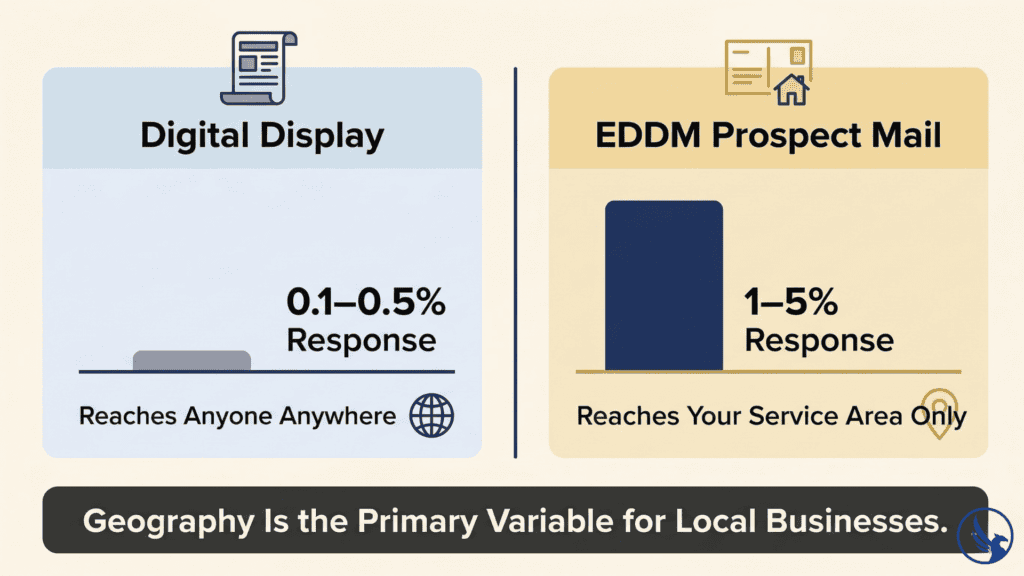
Direct mail response rates have been climbing as digital fatigue sets in. According to the Data & Marketing Association, direct mail response rates range from roughly 4.4% to 9% for house lists — significantly higher than digital display benchmarks.
Advisory: The DMA/ANA response rate figures distinguish between house lists (existing customers) and prospect lists (cold audiences). EDDM campaigns route to carrier-route households with no prior relationship — they function as prospect mailings. The 1–5% prospect mail range is the more applicable benchmark for most EDDM campaigns. The EDDM Response Rates breakdown covers what’s realistic by industry and campaign type, including which offer structures consistently outperform.
But raw response rate isn’t the whole picture. What matters is qualified response rate: how many of those respondents actually convert to paying customers. Here, EDDM’s geographic targeting gives it a structural advantage. Every recipient lives or works within your service area. You’re not paying to reach people in a different city who happen to match a demographic profile.
Digital ads offer behavioral and interest targeting that EDDM can’t match — that’s a genuine advantage for e-commerce businesses or brands selling nationwide. But for the local pizza shop, the dentist looking for new patients within five miles, or the gym trying to fill its January class schedule, geography is the primary targeting variable. And EDDM owns that variable.
For a side-by-side look at EDDM versus purchased list mail — another channel that often gets compared in the same conversation — see EDDM vs. Targeted Mail.
When to Use EDDM, When to Use Digital Ads — and When to Use Both

The honest answer is that EDDM vs digital ads is a false binary for most local businesses. The strongest campaigns use both channels, sequenced deliberately.
A typical high-performing local campaign looks like this: EDDM saturates a target ZIP code with a physical offer. Two weeks later, a geofenced Facebook campaign reinforces the same message to people in the same geography who use social media. The postcard creates brand awareness and tangibility. The digital ad creates urgency and a trackable click.
Advisory: The claim that combined EDDM and digital campaigns lift response rates 25–40% over either channel alone reflects practitioner reports and omnichannel direct mail case studies rather than a specific peer-reviewed study. Results vary significantly by campaign type, creative quality, offer, and market. Use this range as directional framing rather than a guaranteed outcome.
Timing matters too. Best Time to Send EDDM covers seasonal windows, delivery timing by route, and how to align your drop date with your digital campaign launch for maximum overlap.
If you’re running campaigns for a restaurant or gym and want to see how other local businesses have structured this, EDDM for Restaurants and EDDM for Gyms include real campaign structures you can adapt. Home service companies will find EDDM for Home Services particularly relevant — especially the section on seasonal campaign timing and route density. In real estate, EDDM for Real Estate covers neighborhood farming strategies that pair well with digital retargeting.
For businesses ready to see measurable results from a physical channel, EDDM Tracking Results covers promo codes, dedicated landing pages, and phone tracking methods that make attribution clean — so you can compare your EDDM cost-per-acquisition directly against your digital spend.
Start Your EDDM Campaign with CRST
EDDM vs digital ads doesn’t have to be a guessing game. EDDM gives local businesses something digital advertising has struggled to deliver: guaranteed physical presence in every home on your target route, at a cost that pencils out for budgets of all sizes. No mailing list, algorithm. No competing for attention in a feed.
CRST handles the full process — design, USPS-compliant printing, and delivery preparation — so your campaign moves from concept to mailbox without the bottlenecks. Explore our full EDDM printing services, request an estimate, or contact the team to get started.
For the complete breakdown of how the program works, see our EDDM Guide.