
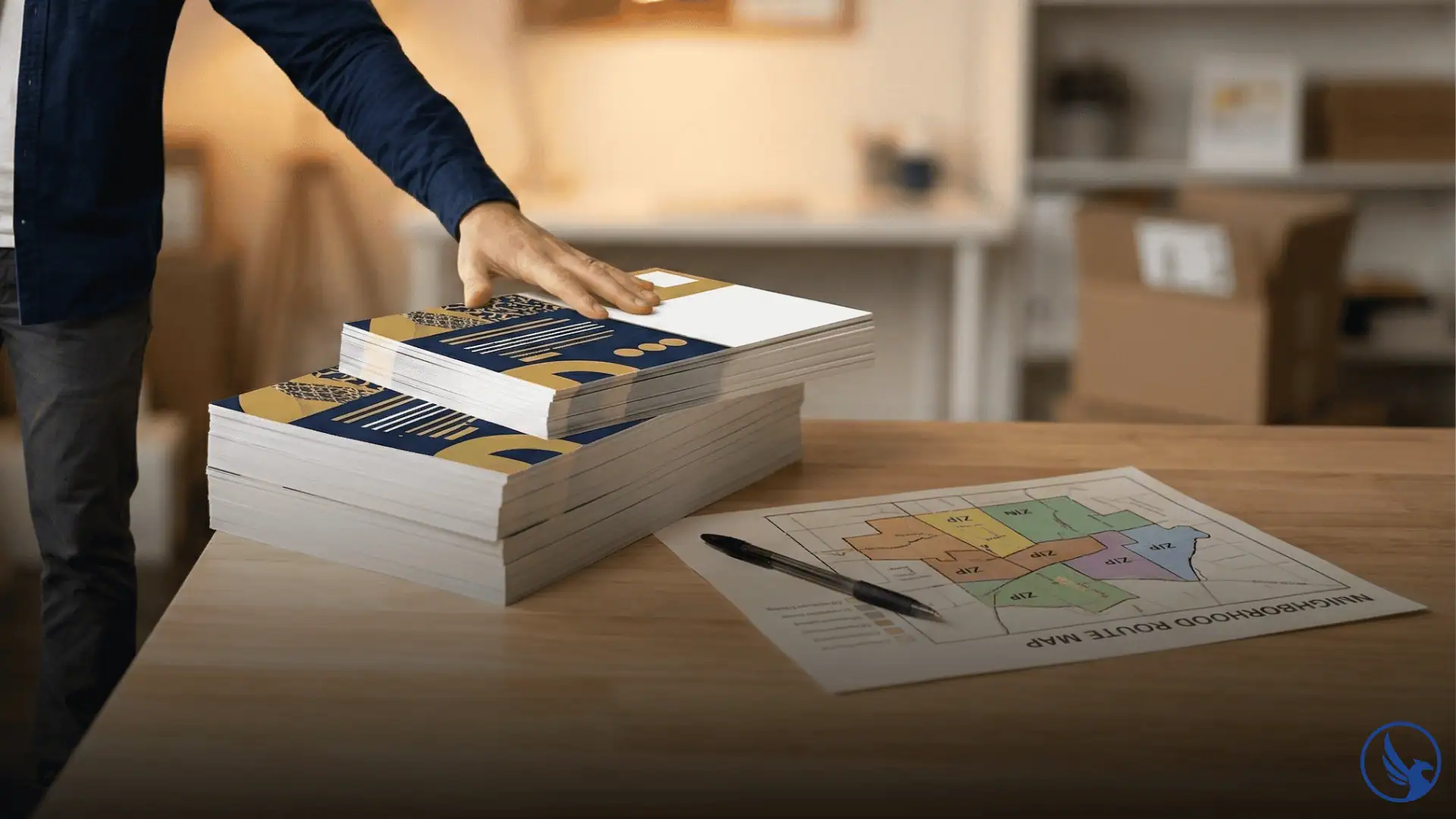
If you’ve never run a direct mail campaign before, the EDDM first campaign guide you need isn’t buried in USPS documentation. It’s a plain-language walkthrough that takes you from zero — no mailing permit, no print vendor, no design file — to a stack of professionally printed postcards delivered to every door in your target neighborhood.
What Makes EDDM the Right Starting Point
Every Door Direct Mail is the most accessible entry point into physical marketing for a new business. There’s no list to buy, no minimum spend that requires a corporate budget, and no agency required to get started. What it does require is understanding the process end to end before you commit to a print run. Mistakes at the design or file preparation stage are expensive to correct after the fact. For the full system overview, see the EDDM Guide at CRST before you begin.
What EDDM Is and Why New Businesses Should Use It
The Core Mechanics in Plain Language
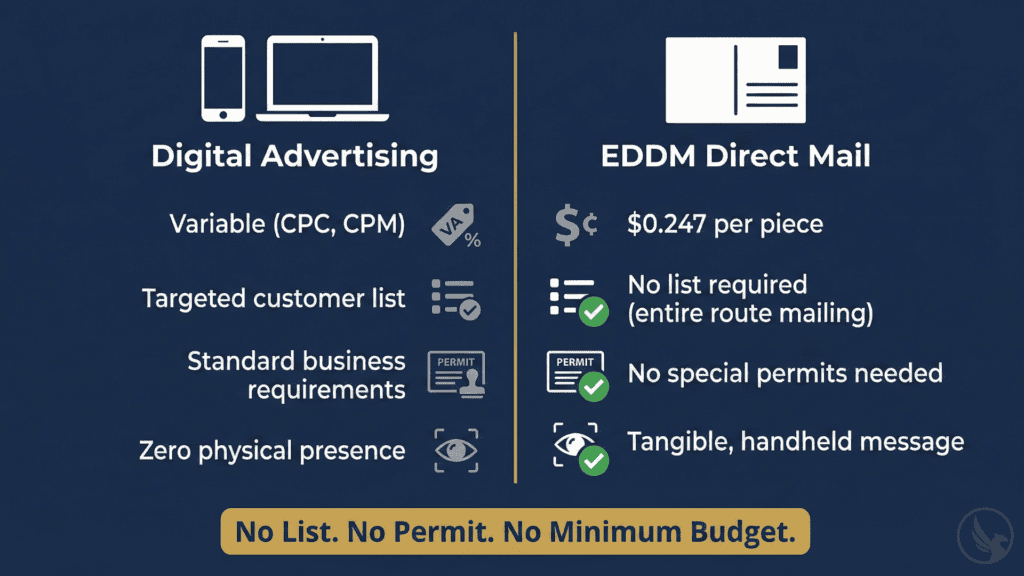
Every Door Direct Mail is a USPS program that allows businesses to mail to every address on a mail carrier route — residential, business, or both — without needing a mailing list, a bulk mail permit, or a marketing agency. Specifically, you select the routes you want to target, print a postcard that meets USPS size and format requirements, bundle it correctly, and drop it at your local post office. USPS then delivers one piece to every door on the routes you selected.
The flat-rate postage — currently $0.260 per piece through EDDM Retail — makes the math simple. You know your exact postage cost before you print a single card. For the most current rate, see current postage rates. Combined with the absence of list costs and the relatively low cost of postcard printing at modest volumes, EDDM is frequently the lowest cost-per-household-reached marketing channel available to a new local business. According to USPS EDDM program information, there is no maximum volume limit and no permit required for EDDM Retail submissions up to 5,000 pieces per day per ZIP code.
Furthermore, for a new business without an established customer database, EDDM’s route-based model is a distinct advantage. You’re reaching everyone in a geographic area. That’s exactly what a business trying to build local awareness needs to do.
How EDDM Compares to Other First-Campaign Options
New business owners evaluating their first marketing spend often compare EDDM against social media advertising, Google Search, and local print advertising. Each has a place. For businesses that depend on local foot traffic or service-area proximity — restaurants, home services, retail, salons, dental practices — EDDM delivers a physical, lasting impression at a cost per household that digital channels rarely match.
EDDM vs. Digital Ads breaks down the full channel comparison. Additionally, EDDM vs. Targeted Mail explains how EDDM’s route-saturation model compares to list-based targeted mail — useful context before you decide which approach fits your first campaign. For small businesses specifically, EDDM for Small Business covers the strategic case with real-world cost examples.
Step 1 — Define Your Campaign Goal and Offer
Choose One Goal for Your First Campaign
The most common mistake first-time EDDM mailers make is trying to accomplish too much with a single postcard. A new restaurant wants to announce its grand opening, introduce the full menu, promote a happy hour, and ask people to follow them on Instagram — all on one 8.5×11 card. The result is a cluttered piece that accomplishes nothing well.
Your first EDDM campaign should have exactly one goal: drive a specific action from recipients. That action is almost always one of three things — visit the location, call to book an appointment, or redeem an offer. Everything on the postcard should serve that single goal. Consequently, before you design a single element, write your goal in one sentence: “Get new households within two miles to visit our restaurant and use this first-visit discount.”
Build an Offer That Motivates Action
An EDDM postcard without a specific offer is a brochure. A brochure mailed to strangers rarely converts. Your offer needs to give a recipient who has never heard of your business a concrete reason to act now rather than later. The best first-campaign offers combine value with urgency: a percentage or dollar discount, a free first service, or a bundled promotion with a clear expiration date.
For service businesses, a free consultation or free estimate removes the financial risk of the first contact entirely. That’s a powerful offer for a new business that needs to build a customer base quickly. For retail and food businesses, a first-visit discount or a free item with purchase creates a low-friction entry point. For home services, a seasonal special tied to an immediate need is often the strongest motivator. See EDDM Design Tips for offer framing guidance across specific business categories.
Step 2 — Select Your Routes
Using the USPS Route Selection Tool
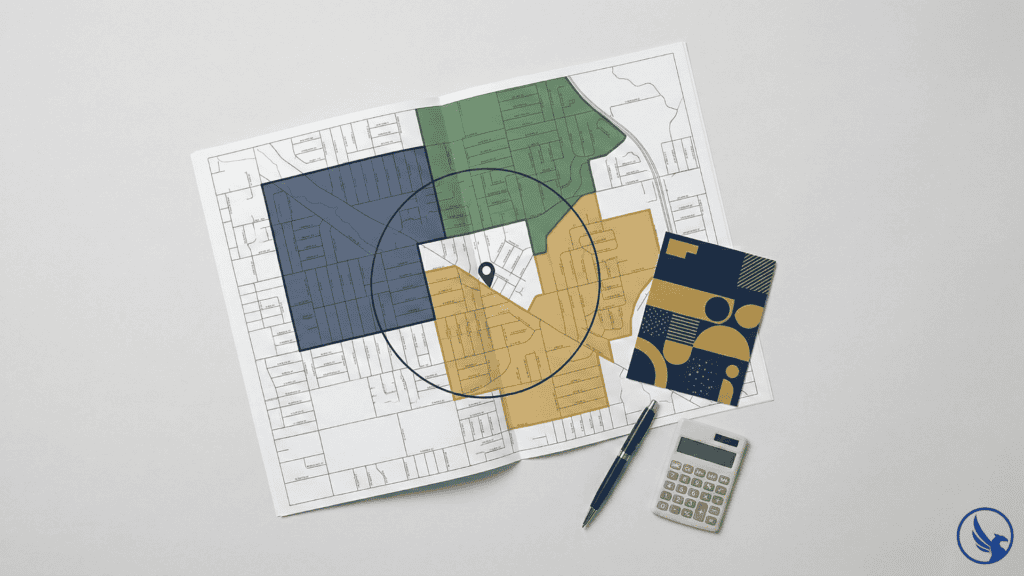
USPS provides a free online mapping tool at usps.com/business/every-door-direct-mail.htm. It allows you to browse and select mail carrier routes by geography. You can search by ZIP code, draw a radius around your business address, or browse a map view. Each route displays the number of residential addresses, business addresses, and PO boxes it covers. It also shows demographic summary data including median household income, average age, and household size.
For your first campaign, start by selecting routes within a 1–3 mile radius of your location. This keeps your audience geographically relevant and your campaign volume manageable. Most businesses run 2,000–5,000 pieces for a first EDDM drop, which translates to roughly 3–7 average-size carrier routes. Furthermore, mailing close to home maximizes the likelihood that recipients can act on your offer conveniently — essential for businesses that depend on in-person visits.
For a detailed walkthrough of the selection tool and route demographic filters, EDDM Mailing Routes is the dedicated resource. It covers how to use income, age, and residential/business filters to sharpen targeting within your radius.
How Many Pieces to Mail
For a first campaign, mailing between 2,000 and 5,000 pieces is the practical range for most new small businesses. This volume is large enough to generate statistically meaningful response data — you’ll know whether the campaign is working. At the same time, it avoids committing to a budget that can’t be recovered if the creative or offer needs adjustment.
At 3,000 pieces on an 8.5×11 postcard, total campaign cost typically falls in the $600–$900 range. That range depends on your print vendor and paper stock. For detailed cost modeling before you commit, EDDM Cost and Pricing and EDDM Postcard Printing Cost both provide current estimates across sizes and volumes.
Step 3 — Design Your Postcard
USPS Size and Format Requirements
Your postcard must meet USPS EDDM “flat” mail specifications to qualify for the flat-rate program. The minimum size is 6.125 × 11 inches and the maximum is 12 × 15 inches. The three most practical sizes for a first campaign are 6.5×9 (budget-friendly, limited design space), 8.5×11 (the most popular — best balance of impact and cost), and 9×12 (maximum presence, recommended for high-ticket offers or premium brand positioning).
Every print-ready EDDM file must include a 0.125-inch bleed on all sides, a 0.25-inch safe zone, and a reserved USPS indicia box in the lower-right corner of the back panel (typically 1.75×2.5 inches, kept clear of all design elements). For the complete technical specification, EDDM Printing Requirements is the essential reference before you send any file to a printer. For choosing the right size, EDDM Postcard Sizes provides a full comparison with cost implications for each format.
Front Panel Design: The Three-Second Rule
Your postcard has approximately three seconds to capture attention in the mailbox before a recipient decides whether to engage or discard. In those three seconds, the front panel needs to communicate one thing with unmistakable clarity: the most compelling reason to keep reading.
The front panel structure that consistently performs best follows a simple hierarchy. Use a bold, benefit-driven headline in your largest type. Add a strong image that contextualizes the offer — food photography for a restaurant, a before/after for a home service, a welcoming exterior for a retail location. Then place your offer or value proposition in the secondary type position. Do not include your full menu, your full service list, or your full backstory. Instead, save those for your website — linked via a QR code.
EDDM Postcard Design covers the full visual hierarchy framework. Additionally, EDDM Postcard Templates provides pre-built layout structures for common business types that you can adapt without starting from scratch.
Back Panel: Contact, Offer Mechanics, and Trust
The back panel of your EDDM postcard does the conversion work. It should include your business name, address, and phone number in clear, large type; your website URL; a QR code linking to a dedicated landing page or online booking page; your hours of operation; and the specific terms of your offer (expiration date, any restrictions). Finally, add one or two trust signals — years in business, a professional certification, or a five-star review excerpt with attribution.
If your business is new with no reviews yet, lead with your credentials, your background, or a brief human story that establishes connection — “Family-owned since 2024, serving [Your City] with [service].” Authenticity substitutes effectively for review volume in a first campaign context. Additionally, include a simple neighborhood reference — “Serving [Neighborhood], [Neighborhood], and [Neighborhood]” — to help recipients immediately confirm your relevance to their location.
Step 4 — Print Your Postcards
Choosing a Print Vendor
For a first EDDM campaign, the choice between a local print shop, an online print-on-demand vendor, and a full-service EDDM printer comes down to three factors: price, file support, and postal compliance expertise. Online vendors such as Vistaprint, GotPrint, and PrintingForLess offer competitive pricing and EDDM-specific templates. However, they provide limited prepress support — if your file has a resolution problem or an indicia placement error, you may not find out until the cards arrive.
In contrast, a full-service EDDM printer like CRST reviews your file before it goes to press, confirms USPS compliance, and flags issues before they become costly. For a first-time mailer, this review step is worth prioritizing. Request an estimate that includes file review, or contact the team for guidance on preparing your first print file. To see the full service offering, visit our EDDM printing services.
For paper stock recommendations by business type and budget, EDDM Paper Stock Options covers the full range — from standard 14pt coated to premium 16pt soft-touch matte — with notes on which finishes photograph best and which hold up best in postal handling.
Production Timeline
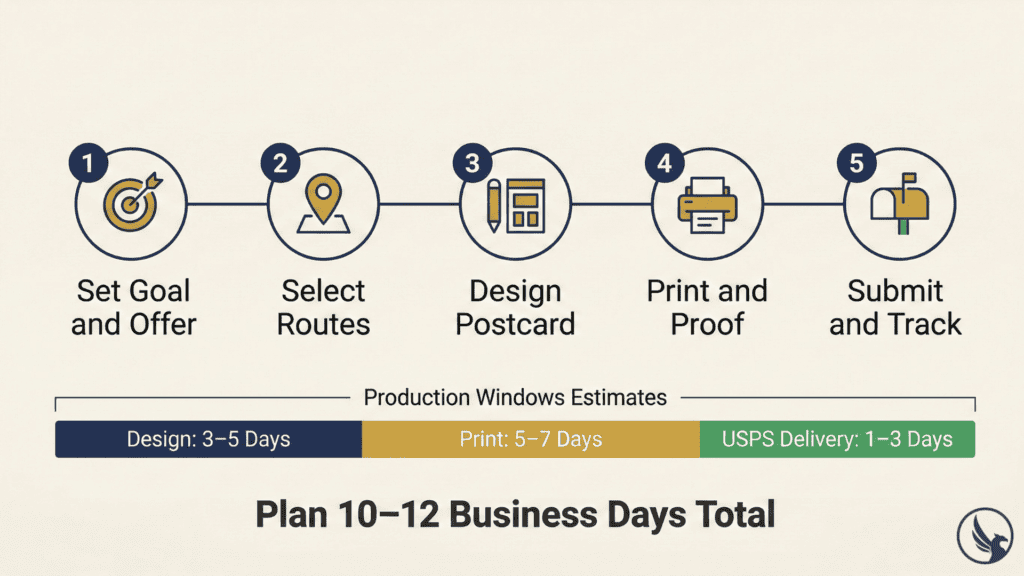
Standard print production for an EDDM postcard run takes 5–7 business days from approved file to shipped product. USPS processing and in-home delivery adds 1–3 business days after acceptance at the post office. Therefore, plan for a minimum of 10–12 business days from final file approval to in-home delivery. Add buffer time if your campaign has a hard deadline tied to a seasonal offer or event.
For more on lead-time planning and the full backward-planning calendar framework, Best Time to Send EDDM is the companion resource to this guide. It maps production timelines against seasonal campaign windows for every major business category.
Step 5 — Submit to USPS and Track Results
The EDDM Retail Submission Process
EDDM Retail submission is simpler than most first-time mailers expect. Once your postcards are printed, bundle them in groups of 50–100 with a facing slip (a small printed form identifying the carrier route for each bundle). Next, complete the EDDM Retail online postage form at usps.com to calculate your total postage, pay online or at the counter, and drop the bundles at the post office serving the ZIP codes you’re targeting.
According to USPS EDDM Retail instructions, each bundle must be banded, facing slips must be placed on top and visible, and pieces must be sorted by carrier route before drop-off. Your print vendor may provide pre-sorted, bundled cards as part of their service — confirm this before assuming it’s included.
Measuring Your First Campaign
Building tracking into your first EDDM campaign is not optional — it’s the only way to know whether the campaign is working and how to improve the next one. At minimum, include a dedicated phone number (different from your main business line) printed on the postcard, and a QR code linking to a campaign-specific landing page or online booking URL with a UTM parameter identifying the traffic source.
Log every call that comes in on the dedicated number for the four weeks following your in-home date. Track QR code scans through your landing page analytics. Additionally, ask every new customer who walks in how they heard about you. These three data streams, combined, give you a response rate, a cost per lead, and a directional read on whether the offer and timing resonated with your audience. For the full attribution framework, EDDM Tracking Results covers every measurement method in detail.
For the common production, design, and submission errors that derail first campaigns before they reach a single mailbox, EDDM Mistakes to Avoid is essential reading before you finalize any element of your campaign. Once your first campaign is complete and you have response data in hand, the EDDM ROI Calculator helps you model whether and how to scale your next drop.
Start Your EDDM Campaign with CRST
Following this EDDM first campaign guide end to end — from a single, clear goal through route selection, compliant design, print production, and tracked submission — gives a new business the clearest possible path from print to paying customers.
CRST handles EDDM printing from file setup through postal delivery, with a team that knows USPS compliance inside out and a track record across industries. Explore our full EDDM printing services to see how we support campaigns from first template to final delivery. Ready to move forward? Request an estimate or contact our team with your project details.
For the complete breakdown of how the program works, see our EDDM Guide.