
EDDM mailing routes are the backbone of every successful Every Door Direct Mail campaign — but most small businesses pick them wrong. They choose ZIP codes based on gut feeling, spray postcards across entire counties, and then wonder why response rates disappoint. The truth is, selecting the right neighborhoods is where your campaign is won or lost, long before anything goes to print. In this guide, you’ll learn exactly how to evaluate, filter, and finalize EDDM mailing routes that put your postcards in front of the households most likely to respond. For the complete EDDM system overview, start with the EDDM Guide at CRST.
EDDM Mailing Routes Explained: What You’re Actually Selecting
Before you map a single route, it helps to understand what you’re working with. Every Door Direct Mail is a USPS program that lets businesses deliver postcards to every household on a mail carrier’s route — no mailing list, no addresses, no sorting required. You choose the routes; USPS delivers to every door on them.
Each route is a defined geographic segment, typically covering a few hundred to a few thousand delivery points.
Advisory: Carrier route sizes vary significantly by route type — city routes, rural routes, and highway contract routes each have different delivery point ranges. The USPS EDDM mapping tool displays live delivery point counts for each route. Use those figures rather than published averages when calculating print quantities and postage budgets.
The mapping tool overlays carrier routes on a map and shows household counts, average income, average age, and home value data for each one. That data is your competitive advantage — and most businesses ignore it entirely. The ones that don’t consistently outperform on response rates.
For a broader overview of how the program works from start to finish, the EDDM Guide covers the full process from route selection through USPS drop-off. If you’re running your first campaign and want a structured walkthrough, the EDDM First Campaign Guide is a smart starting point. Ready to get pricing in place before finalizing your route list? Request an estimate here.
Why Getting EDDM Mailing Routes Right Matters More Than Design
Here’s an uncomfortable truth: a mediocre postcard sent to the right neighborhood outperforms a brilliant postcard sent to the wrong one. Route selection is audience targeting — and getting it wrong means paying $0.260 per piece to reach people who will never buy from you.
Consider a dental practice in a suburb of a mid-sized city. If they blanket every carrier route within a five-mile radius, they’ll inevitably spend budget reaching renters who move frequently, households without children (if the practice focuses on pediatric dentistry), and ZIP codes with household incomes below what their services typically attract. Tightening that selection to routes with higher homeownership rates, families with children, and median incomes aligned with the patient base can meaningfully reduce waste and improve conversion rates.
Advisory: The efficiency gains from demographic filtering — including any specific figures like “cut waste by 40%” or “double conversion” — are illustrative of the directional impact of route targeting rather than published benchmark outcomes. Actual results vary by market, offer, competitive density, and campaign structure. For dental-specific targeting guidance, see EDDM for Dentists.
The same logic applies whether you’re running campaigns for restaurants, promoting a gym membership drive with EDDM for Gyms, or launching a real estate farming campaign. Route demographics shape response — always.
One of the most preventable ways campaigns fail is poor route planning combined with weak design. Before finalizing your neighborhood list, review common EDDM Mistakes to Avoid — many of them trace directly back to route selection errors.
How to Use the USPS Mapping Tool to Select EDDM Mailing Routes
The USPS EDDM mapping tool is free, straightforward, and more powerful than most businesses realize. Here’s how to work through it strategically.
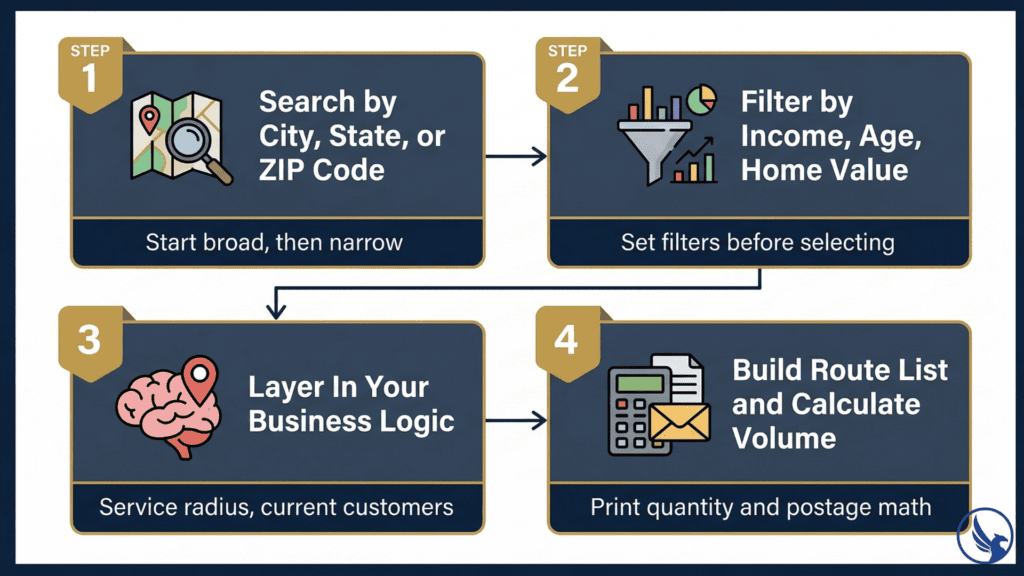
Step 1: Search by City, State, or ZIP Code
Start broad. Enter your city or service area and let the tool populate all available carrier routes on the map. Each route appears as a shaded polygon with a route ID and delivery point count.
Step 2: Filter by Demographics
This is where most businesses leave money on the table. The USPS tool allows you to filter routes by average household income, average age, average home value, and total residential delivery points. Set your filters before selecting routes, not after — it’s far easier to narrow from a filtered view than to manually evaluate 40 routes one by one.
Step 3: Layer in Your Own Business Logic
The USPS data gives you demographics; you need to add business context. Ask yourself: What’s my realistic service radius? Where are my current best customers located? Are there areas with new construction or recent neighborhood growth? Are there competitor-dense areas I should prioritize or avoid?
If you’re working on a real estate EDDM campaign, for instance, cross-reference carrier routes with recent sales data to identify neighborhoods with high turnover — those are your farming zones. Auto dealers take a similar approach; EDDM for Auto Dealers breaks down how dealerships use radius targeting around their lots to maximize showroom foot traffic.
Step 4: Build Your Route List and Calculate Volume
Once you’ve identified target routes, select them and the tool tallies your total delivery count automatically. From there, you can calculate postcard print quantity and estimate your total USPS postage spend.
At the current EDDM Retail rate of $0.260 per piece, a campaign reaching 5,000 households costs $1,300 in postage alone — before printing.
Advisory: The $0.260 EDDM Retail rate reflects pricing at time of publication. Always verify the current rate at usps.com/business/every-door-direct-mail.htm before finalizing your budget.
Understanding this math upfront keeps budgets from blowing out mid-campaign. For a full pricing breakdown, see EDDM Cost and Pricing and EDDM Postcard Printing Cost.
Demographic Targeting Strategies for EDDM Mailing Routes
Not every business needs the same demographic profile. Here’s how different industries should think about route selection.
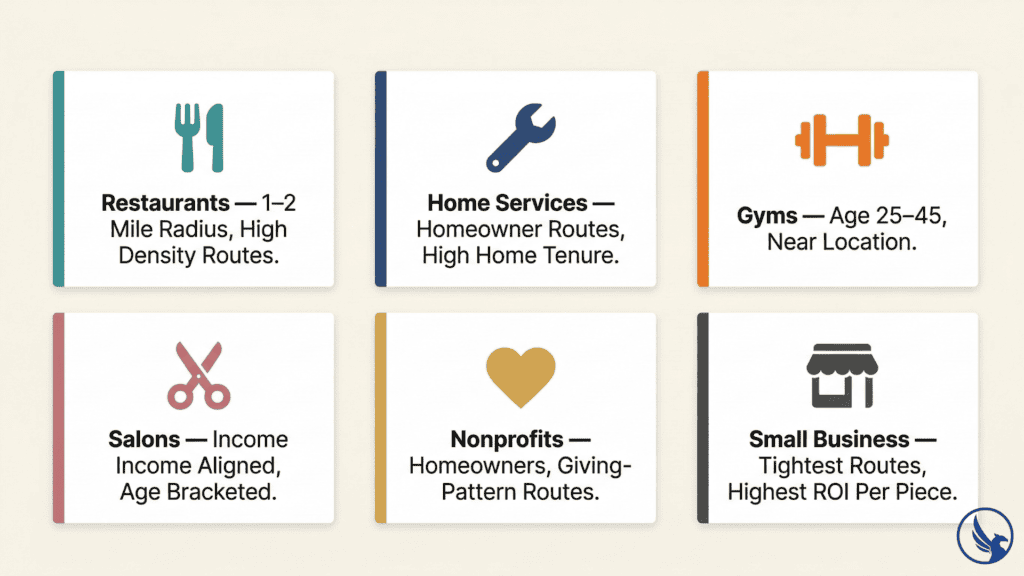
Restaurants and Food Service
Proximity is everything for restaurant EDDM. Filter for routes within a tight radius — 1–2 miles for dine-in, up to 3 for delivery-focused campaigns. Routes with higher household density mean more impressions per dollar. Day-part promotions like lunch specials and weekend brunch, moreover, tend to perform better on routes with higher concentrations of working adults.
Home Services (HVAC, Landscaping, Cleaning)
Target homeowners. Specifically, use the average home value and home tenure filters to isolate routes where residents have lived for several years — these households are more invested in maintaining their properties. Avoid high-renter routes, as tenants typically don’t hire exterior landscapers or HVAC contractors. EDDM for Home Services outlines a full targeting framework for this vertical, including which route demographics correlate most strongly with service inquiries.
Gyms and Fitness Studios
New Year campaigns and seasonal promotions drive the most EDDM volume in this category. Filter for routes with a younger median age (25–45) and, if your membership price point is above market average, higher income brackets as well. Routes near your physical location matter most — most members won’t drive more than 10–15 minutes to a gym, regardless of how compelling the offer.
Advisory: The 10–15 minute gym drive-time threshold is widely cited in fitness industry marketing but is not attributed to a specific named study here. For current data on member travel behavior, consult IHRSA (now Health & Fitness Association) research before using this figure in business planning.
Salons and Beauty Services
Grand openings, seasonal promotions, and referral campaigns all perform well through EDDM when routes are chosen carefully. EDDM for Salons covers how beauty businesses use carrier route demographics — particularly age brackets and household income thresholds — to drive chair bookings with consistency.
Nonprofits and Fundraising
EDDM is an underused tool in the nonprofit space, largely because organizations assume direct mail requires purchased donor lists. It doesn’t. EDDM for Nonprofits explores how mission-driven organizations can use carrier route selection to reach likely donors based on income, homeownership, and neighborhood giving patterns — all without purchasing a list.
Small Business Campaigns
For small businesses running campaigns on tighter budgets, route selection discipline is especially important. Every wasted delivery point is a wasted dollar. EDDM for Small Business covers how to prioritize your highest-value routes when working with limited print quantities and wanting the strongest possible ROI per piece.
EDDM Mailing Routes and Response Rate Optimization
Selecting routes is step one. Maximizing return from those routes is step two — and the two are more connected than most businesses realize.
Match Message to Neighborhood
Route demographics should directly shape your postcard’s message hierarchy. A route with a median household income of $120,000 calls for a different headline than one at $55,000 — even if the product is identical. Higher-income routes respond to quality signals, exclusivity, and outcomes. In contrast, middle-income routes tend to respond more strongly to value, savings, and convenience.
For a breakdown of what actually moves response rates in EDDM campaigns, EDDM Response Rates covers the data behind what works — including how offer framing, postcard size, and delivery timing interact with route-level demographics.
Consider Delivery Timing by Route
USPS delivers EDDM mail on specific days that vary by carrier route. While route-level timing isn’t always fully controllable, what you can control is when you initiate the campaign. Aligning delivery with promotions, grand openings, or seasonal windows matters significantly. For time-sensitive campaigns, Best Time to Send EDDM offers scheduling guidance by industry and offer type. Pair that with EDDM Tracking Results to measure which routes generate the strongest response, so you can double down on the right neighborhoods in your next drop.
Don’t Overextend Your Route List
One of the most common EDDM mistakes is selecting too many routes in an attempt to maximize reach. Doing so dilutes budget, reduces frequency, and often pulls in demographics that don’t align with your offer. A tighter route list mailed two or three times, by contrast, outperforms a sprawling one-time blast almost every time. Frequency builds familiarity; familiarity builds trust; trust drives response. For campaigns that need to reach higher volumes efficiently, EDDM Bulk Mailing covers how to scale without sacrificing targeting precision.
EDDM Retail vs. EDDM BMEU: Which Submission Option Is Right for You?
Once your EDDM mailing routes are selected, you need to decide how to submit and drop your mail. USPS offers two primary options.
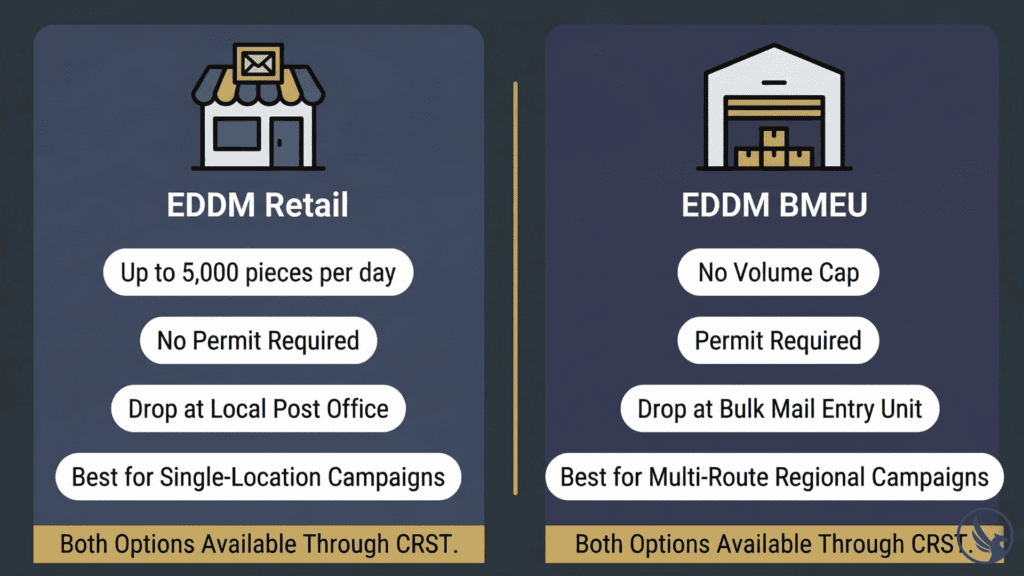
EDDM Retail is designed for smaller campaigns — typically under 5,000 pieces per day per ZIP code. You bundle your postcards with USPS paperwork and drop them directly at the post office serving your target routes. It’s straightforward, requires no postage permit, and works well for local businesses running single-location campaigns.
EDDM BMEU (Bulk Mail Entry Unit) is better suited for larger volume campaigns, multi-location drops, or businesses that want a print partner to handle USPS logistics. It requires a USPS permit and involves drop-shipping to a USPS Bulk Mail Entry Unit facility. The USPS EDDM Online tool is used to manage the submission process for these larger campaigns.
Before submitting either way, make sure your postcards meet EDDM Printing Requirements — non-compliant pieces are rejected at the counter, which delays campaigns and wastes print budget. Additionally, choosing the right EDDM Postcard Size is part of that compliance picture, as oversized or undersized pieces don’t qualify for EDDM postage rates.
Most small businesses start with EDDM Retail. As campaigns scale — or when a business wants to saturate multiple ZIP codes simultaneously — EDDM BMEU becomes the more efficient path. CRST handles both, managing print specs, USPS compliance, and delivery coordination whether you’re running a 2,500-piece neighborhood saturation or a multi-route regional campaign. Learn more at our EDDM printing services page.
EDDM Mailing Routes vs. Targeted Direct Mail: Knowing When Each Wins
EDDM mailing routes work best when your ideal customer is broadly distributed across a neighborhood rather than concentrated in a specific segment that requires precision filtering. If you’re a pizza place, a gym, or a home services company, saturation mailing to every household in a carrier route makes economic sense — your customer could realistically be anyone on that street.
When your target audience is narrower, however — say, households that have recently moved, or businesses within a specific SIC code — targeted direct mail with a purchased list often outperforms EDDM on conversion rate, even if the cost per piece is higher. EDDM vs. Targeted Mail breaks down exactly when each approach wins, with side-by-side cost and response rate comparisons.
For businesses weighing print against digital, EDDM vs. Digital Ads offers a channel comparison grounded in real campaign data — useful context when allocating a limited marketing budget across neighborhoods. Some campaigns also benefit from pairing EDDM with USPS Informed Delivery; EDDM vs. Informed Delivery explains how the two programs interact and whether the combination is worth the added complexity.
Start Your EDDM Campaign with CRST
EDDM mailing routes are the strategic foundation of any direct mail campaign that actually works. Get the demographics right, tighten your radius, align your message to the neighborhood — and the medium does the heavy lifting. Every Door Direct Mail removes the barriers that make traditional direct mail expensive and complicated: no lists to buy, no addresses to sort, no targeting guesswork.
CRST handles EDDM postcard printing from design through USPS-compliant delivery. If you know your routes, we can have postcards ready to drop. If you’re still mapping your strategy, we can help with that too. Explore our full EDDM printing services, request an estimate, or contact the CRST team to get started.
For the complete breakdown of how the program works, see our EDDM Guide.