
Empty chairs. Gaps in the schedule. A waiting room that should be full but isn’t. If you run a dental practice, you already know the frustration of watching a well-equipped office sit underutilized while patients in your own neighborhood are still searching for a dentist they trust. The problem isn’t your clinical skill — it’s visibility. Every Door Direct Mail, or EDDM, gives dental practices a direct line into every household on a chosen route, no mailing list required, no demographic guesswork, no inflated digital ad budget. In this guide, you’ll learn exactly how EDDM for dentists works in 2026, what it costs, how to design a postcard that books appointments, and what a real campaign looks like from start to finish. For the complete program overview, see the EDDM Guide at CRST before building your first campaign.
(5,000 pcs, gloss)
@ $0.260/pc
(if outsourced)
cost est.
Why EDDM for Dentists Is One of the Most Efficient Patient Acquisition Channels in 2026
Proximity Is the Foundation of Dental Marketing
Dentistry is fundamentally a neighborhood business. Your patients don’t drive forty-five minutes for a cleaning. They want someone close, someone they’ve heard of, someone whose name they’ve seen before. That familiarity — that low hum of brand recognition — is exactly what EDDM builds, and it builds it at a fraction of what Google Ads or social media campaigns charge per lead.
With EDDM for dentists, you select the postal carrier routes surrounding your practice, and the United States Postal Service delivers your postcard to every single household on those routes. There’s no list to buy, no segmentation software to configure, and no third-party data broker involved. You choose the zip codes, you choose the routes, and USPS does the rest — typically within 3 to 5 business days of acceptance. If you’re new to the channel altogether, the EDDM First Campaign Guide is a solid starting point before you dive into the dental-specific strategy below.
The Economics of Neighborhood Saturation
The economics make immediate sense for practices looking to grow a patient base or reactivate lapsed patients. EDDM postage currently runs at a flat rate of $0.260 per piece through EDDM Retail, and when you factor in printing costs for a standard 6.5″ × 9″ postcard, your all-in cost per piece often lands between $0.37 and $0.43. For a practice that books a single new patient worth $800 to $2,000 in lifetime value, the math is hard to argue with.
Advisory: USPS EDDM Retail postage rates are subject to change. Always verify the current rate at usps.com/business/every-door-direct-mail.htm before finalizing any campaign budget. The rate cited here reflects the current rate at time of publication.
New practices especially benefit from the saturation model. Unlike targeted mail — which requires purchasing a verified list of homeowners within a specific age or income bracket — EDDM covers everyone. That means the retired couple, the young family with kids who just moved in down the street, and the office worker who’s been putting off a check-up for two years. All of them get your card. Some of them will call.
For a deeper look at how EDDM compares to list-based direct mail strategies, EDDM vs. Targeted Mail is worth reviewing before you commit to either approach. And if you’re wondering how direct mail stacks up against paid digital, EDDM vs. Digital Ads breaks down cost-per-lead across both channels with real numbers.
EDDM Design and USPS Requirements for Dental Postcards
Getting the design right is where most dental practices either win or waste their print budget. A postcard that ends up on the kitchen counter for three days before getting tossed has already done its job — the impression was made. But a postcard that gets set aside because the offer was compelling? That one books appointments.
Design Elements That Convert for Dental Practices
The front of your EDDM postcard has roughly two seconds to earn a second look. Lead with the offer, not the logo. Common high-converting offers for dental EDDM campaigns include:
- New Patient Special: Exam, X-rays, and Cleaning for $99 (or free with insurance)
- Free Teeth Whitening with New Patient Exam
- Same-Day Emergency Appointments Available
- Invisalign Consultations — No Obligation
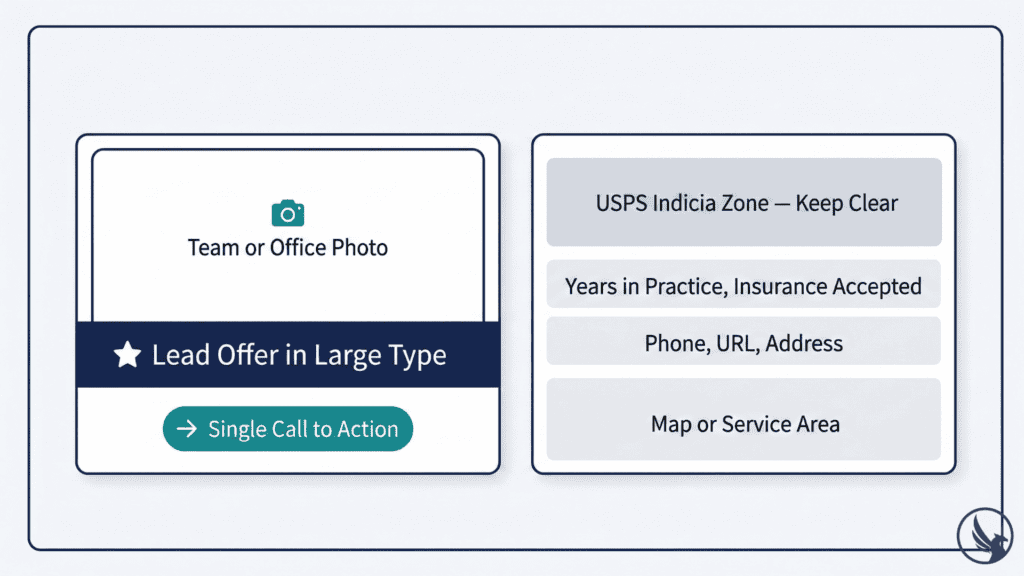
Whatever offer you lead with, make sure it’s readable at arm’s length. Large, high-contrast type. A real photo of your office or your team — not stock photography. A clear, single call to action: one phone number, one URL, one next step. For a deeper look at layout decisions that drive response, EDDM Design Tips covers hierarchy, color contrast, and offer framing in detail. You can also browse EDDM Postcard Design examples specifically formatted for service businesses to see what works before you brief your designer.
On the back, keep it clean. Practice name, address, a brief credential line (years in practice, accepting new patients, insurances accepted), and your contact details. USPS requires that the back panel include the Postal Indicia and an address area compliant with their dimensions — leaving that zone clear is non-negotiable.
For a full breakdown of what USPS requires, EDDM Printing Requirements covers every spec you need before submitting to print.
When it comes to sizing, the most popular formats for dental EDDM campaigns are the 6.5″ × 9″ and 6.5″ × 11″ postcards. Both exceed the EDDM flat mail minimum, which means they stand out in a standard mail stack. If you’re weighing the size decision more carefully, the EDDM Postcard Sizes guide walks through every approved USPS dimension with examples.
Thinking about using a pre-built layout? Several print providers, including CRST, offer EDDM Postcard Templates formatted specifically for dental and healthcare verticals — fully editable, pre-sized to USPS specs, ready for your offer and branding.
USPS Compliance Requirements
Every EDDM piece must meet these USPS specifications:
- Size: Minimum 6.125″ × 11″, maximum 12″ × 15″ for EDDM flat mail
- Maximum thickness: 0.25″
- Weight: No more than 3.3 oz per piece
- Indicia: Must appear in the upper-right corner of the address side
- Bundling: Pieces must be bundled by carrier route in stacks of 50–100 with a facing slip on top of each bundle
Advisory: USPS EDDM compliance specifications — including size, weight, thickness, and indicia requirements — are subject to change. Always verify current requirements directly at usps.com/business/every-door-direct-mail.htm or with your print vendor before submitting files to press.
Your print provider should handle the bundling and preparation if you’re using a full-service EDDM partner. If you’re managing the drop-off yourself through EDDM Retail, the post office will walk you through the submission process at the counter. One thing to double-check before you print: paper stock. The EDDM Paper Stock Options guide explains how different weights and coatings affect both USPS compliance and the physical impression your piece makes in someone’s hand.
Real-World EDDM Cost and ROI Breakdown for Dental Practices
The Budget Breakdown
A mid-sized dental campaign targeting 5,000 households in a suburban market on a 6.5″ × 9″ gloss postcard might budget like this:
| Line Item | Details | Cost |
|---|---|---|
| Design (if outsourced) | One-time fee | $150–$300 |
| Printing (5,000 postcards, 6.5″ × 9″, gloss) | Per piece: ~$0.12–$0.18 | $600–$900 |
| USPS EDDM Postage ($0.260/piece) | 5,000 pieces | ~$1,300 |
| Total Campaign Cost | 5,000 pieces | ~$2,050–$2,500 |
Advisory: Print production costs vary by vendor, paper stock, finish, and run size. The figures above are estimates based on typical commercial pricing at time of publication. Request a current quote from your print vendor before building a campaign budget. For CRST-specific pricing, request an estimate.
The Conversion Math
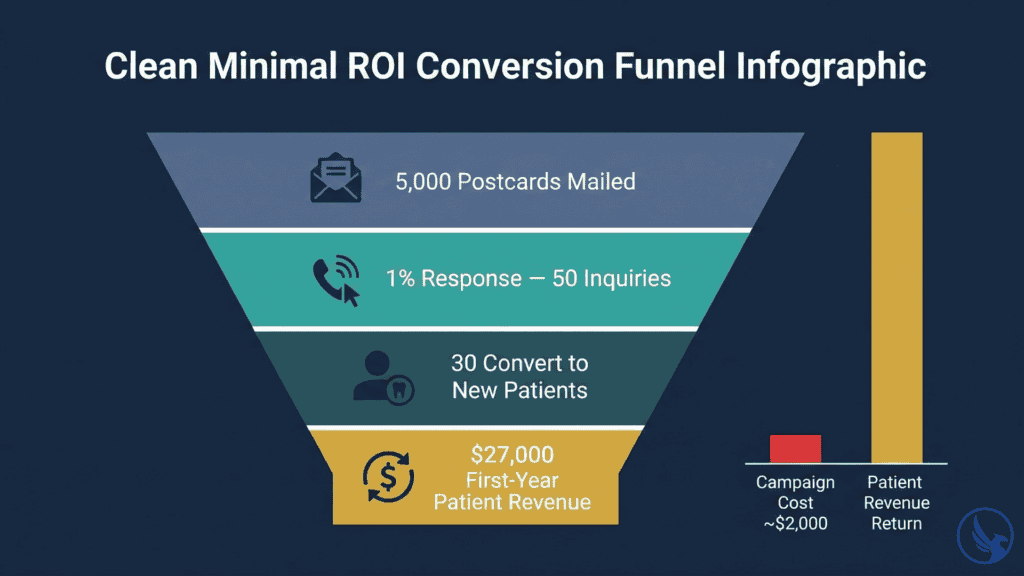
At a conservative 1% response rate — which is achievable for dental offers with clear calls to action — 5,000 postcards generates 50 inquiries. If 30 of those convert to new patients and each patient is worth $900 in first-year revenue, that’s $27,000 returned on roughly a $2,000 investment. In other words, the campaign pays back many times over in the first patient cycle. Want to run your own numbers before committing? The EDDM ROI Calculator lets you model response rates, patient value, and campaign volume side by side.
EDDM response rates in healthcare and dental verticals typically run between 0.5% and 2.5%, depending on offer strength, design quality, and how saturated the routes are with competitor mailings. For a broader look at what drives response in direct mail campaigns, the EDDM Response Rates guide aggregates industry benchmarks across verticals — including healthcare — so you can set realistic expectations before your first drop. Practices that run campaigns consistently across multiple mail drops, moreover, tend to see compounding response as name recognition builds.
Advisory: Response rate benchmarks vary by offer strength, creative quality, route selection, and seasonal timing. The 0.5%–2.5% range reflects DMA healthcare vertical benchmarks per the Data & Marketing Association and should be treated as a directional estimate, not a guaranteed outcome. Use the EDDM ROI Calculator to model your specific scenario before committing to a print run.
For a more detailed breakdown of what drives EDDM costs up or down, EDDM Postcard Printing Cost breaks it down by quantity, paper stock, and finishing options. And if you’re running a high-volume campaign across multiple zip codes, the EDDM Bulk Mailing guide covers the logistics of scaling a campaign without losing efficiency.
EDDM for Dentists: A Campaign Strategy That Actually Works
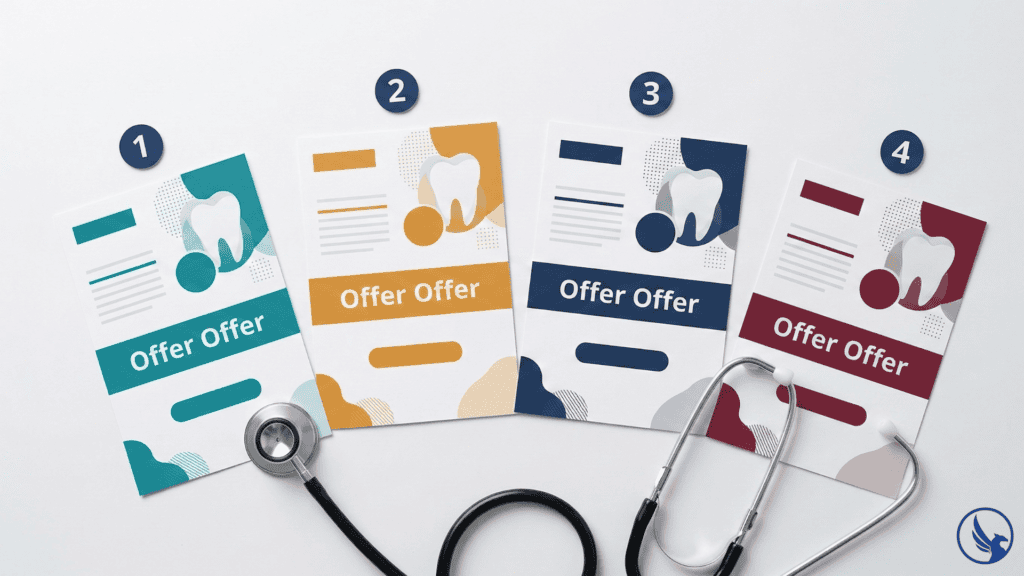
The practices that see the strongest EDDM results aren’t the ones that mail once and wait. They’re the ones that treat direct mail as a frequency play — three or four drops across a twelve-month period, rotating offers seasonally, hitting the same routes with enough consistency that residents start to recognize the name before they ever walk through the door. If you want to avoid the most common pitfalls before you get started, EDDM Mistakes to Avoid is worth a read — several of them are specific to service businesses running their first campaign.
The Four-Drop Annual Framework
Here’s a framework that works for dental practices across market sizes. According to Dental Economics, consistent multi-touch direct mail campaigns outperform single drops significantly in patient acquisition — the framework below reflects that frequency model.
Drop 1 (Month 1): Awareness + New Patient Offer Lead with your strongest acquisition offer — new patient exam, X-rays, and cleaning at a reduced rate. The goal is to generate calls from households that are actively looking for a dentist.
Drop 2 (Month 3 or 4): Seasonal Reminder Back-to-school season (July–August) and the end-of-year insurance deadline push (October–November) are the two highest-converting windows for dental EDDM. Specifically, remind residents to use their benefits before they expire — this urgency trigger is unique to dental and drives strong response in the fall window.
Drop 3 (Month 6–8): Social Proof + Specialty Services Feature a patient testimonial (with permission), highlight a specialty offering like Invisalign, implants, or cosmetic services, and reinforce your availability. By this point, your name has appeared in their mailbox at least twice. Consequently, the conversion threshold is lower.
Drop 4 (Month 10–12): Re-engagement Push Target the same routes. Some of those 5,000 households now have different circumstances — someone aged into needing dental work, a new baby, a change in insurance, or simply a higher comfort level with your name. In turn, consistent presence pays off in ways that a single drop cannot replicate.
If you want to understand how timing affects overall EDDM performance, the Best Time to Send EDDM guide covers seasonal patterns and optimal mail windows by industry. Dental sits in a favorable position because the back-to-school and year-end insurance windows create two natural urgency triggers that don’t exist for most other verticals.
Tracking and Benchmarking Your Results
Tracking performance is straightforward: use a unique phone number or landing page URL on your EDDM postcard that isn’t used anywhere else. Every call or form fill from that source is then directly attributable to the campaign. Review results after each drop, adjust your offer or design based on response, and optimize from there. For more on setting up a trackable campaign, EDDM Tracking Results walks through the mechanics of measurement including call tracking, QR codes, and unique landing pages.
It’s also worth knowing how other local service businesses are using EDDM to benchmark your strategy. EDDM for Gyms and EDDM for Home Services share similar neighborhood-saturation dynamics with dental campaigns — the route selection logic, the offer structure, and the frequency model all translate directly. Additionally, EDDM for Small Business covers the broader framework for any local operation running its first direct mail push. You can also explore EDDM Mailing Routes to understand how to select carrier routes that match your target patient demographics before you commit to a zip code.
Start Your EDDM Campaign with CRST
Why EDDM Works for Dental Practices
EDDM for dentists isn’t a speculative marketing bet — it’s a proven neighborhood saturation tool that gets your practice name in front of every household on your chosen routes, at a postage rate that makes the numbers work even for smaller budgets. With no mailing lists to purchase, no complex targeting algorithms, and USPS-handled delivery, the barrier to entry is low and the ceiling on new patient acquisition is high.
CRST handles design, print, and USPS-compliant bundling so your campaign goes out on time and on spec. Explore our full EDDM printing services to see how we support dental campaigns from first template to final delivery. Ready to move forward? Request an estimate or contact our team with your campaign details.
For the complete breakdown of how the program works, see our EDDM Guide.