
Gym ownership is a local game. Your members live within a few miles of your facility — they drive past your sign, walk through your neighborhood, and make decisions based on what lands in their mailbox. Yet most fitness studios waste money on digital ad campaigns chasing cold audiences who may never set foot inside. Every Door Direct Mail (EDDM) cuts through that noise entirely. No mailing list to purchase, no audience guessing, no wasted impressions — just your postcard, delivered to every household within the zip codes you choose. In 2026, EDDM for gyms has become one of the sharpest low-cost tools in the fitness marketing playbook. For the complete foundation, see the EDDM Guide at CRST before building your first campaign.
(7,500 pcs)
@ $0.260/pc
(if outsourced)
cost est.
EDDM for Gyms: Why Neighborhood Saturation Beats Targeted Ads
Proximity Is the Deciding Factor
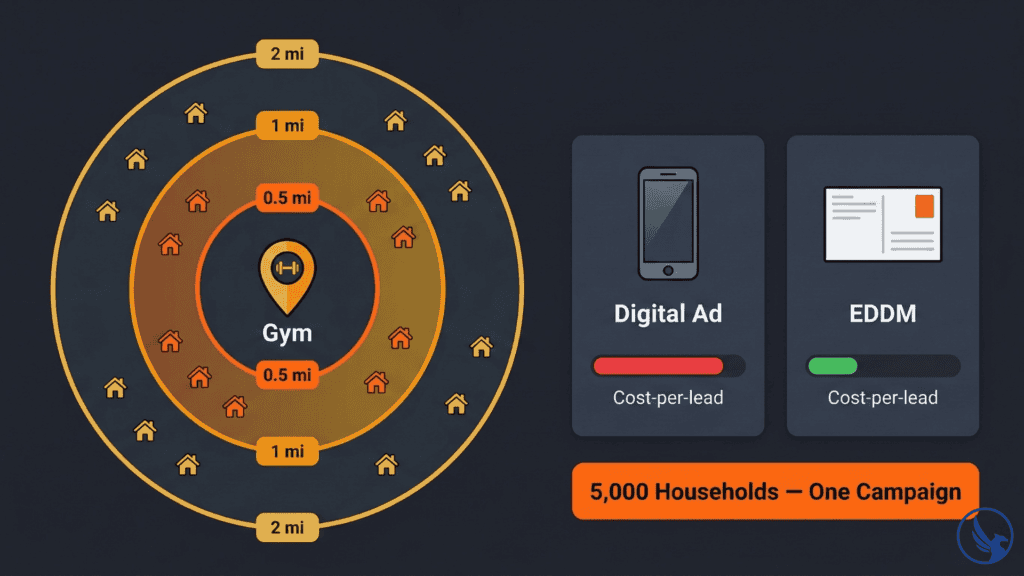
When someone decides to join a gym, location is almost always the deciding factor. Proximity wins. That’s the core reason EDDM for gyms outperforms most other acquisition channels — you’re not trying to find your audience online. Instead, you’re walking into their homes.
EDDM lets you select specific mail carrier routes by zip code, household income, or demographic filter through the USPS route selection tool. You print your postcards, bundle them correctly, and drop them at the post office. From there, USPS delivers one piece to every mailbox on every route you’ve selected. No opt-in required. No algorithm deciding who sees it.
Why the Cost Math Favors EDDM
For a gym running a January membership drive or a summer challenge promotion, this kind of saturation matters. You’re building top-of-mind awareness in the exact neighborhoods where your future members live. A single EDDM campaign covering 5,000 households typically costs between $1,000 and $1,500 all-in — postage runs $0.260 per piece through EDDM Retail, with printing adding another few cents per card depending on size and quantity. By contrast, a Facebook campaign with a $15–$25 cost-per-lead in a competitive local market makes that math shift quickly.
Advisory: USPS EDDM Retail postage rates are subject to change. Always verify the current rate at usps.com/business/every-door-direct-mail.htm before finalizing any campaign budget. The rate cited here reflects the current rate at time of publication.
Fitness studios launching new locations benefit especially from this model. Rather than spending months building a social following from scratch, you can blanket a two-mile radius before you even open the doors. Furthermore, EDDM campaigns timed 3–4 weeks before a grand opening consistently outperform digital-only launches in local foot traffic and same-week sign-ups. For a comparison of how other local service businesses apply this same saturation strategy, EDDM for Home Services shows comparable results in local markets.
If you’re comparing channels, EDDM vs. Digital Ads covers response rates and cost-per-acquisition data that often surprises gym owners who assume social is cheaper. And if you’re weighing EDDM against a purchased list, EDDM vs. Targeted Mail lays out the trade-offs clearly.
Designing EDDM Postcards for Fitness Studios
EDDM Design Elements That Drive Membership Sign-Ups
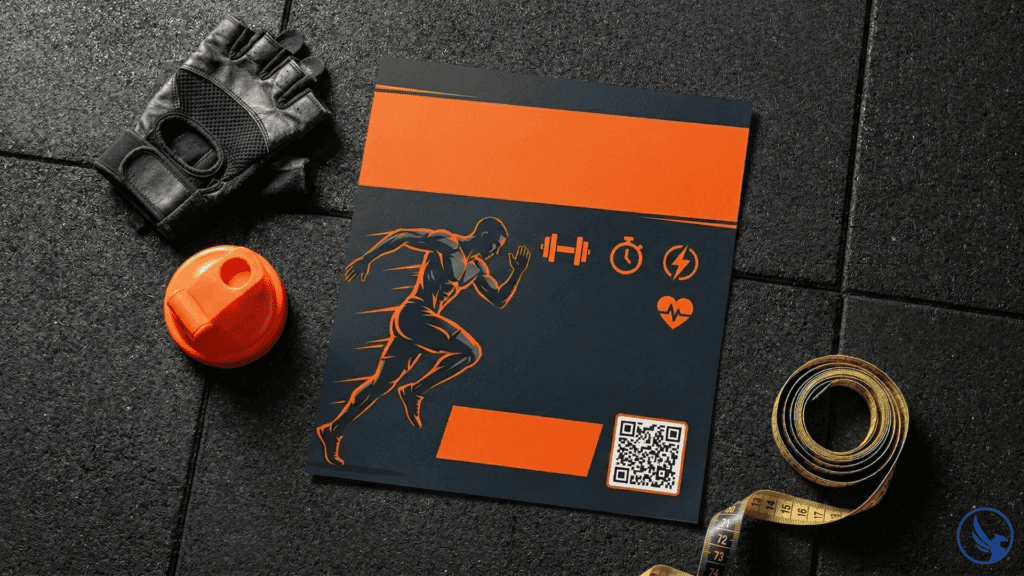
The difference between an EDDM postcard that gets pinned to a refrigerator and one that gets recycled is almost entirely design. Fitness is a visual category — people respond to energy, transformation, and urgency. Consequently, your postcard needs to communicate a compelling offer in under three seconds of attention.
Lead with the offer, not your logo. The most common mistake gyms make with direct mail is designing brand-first. The offer — “Join for $0 Enrollment,” “First Month Free,” “Free 7-Day Trial” — needs to be the largest element on the front of the card. Your gym name matters, but it doesn’t drive action. The offer does.
Use high-contrast photography. A clean image of your facility, a strong before/after testimonial photo (with permission), or a bold typographic layout all outperform cluttered collage designs. EDDM postcards get a fraction of a second of decision-making time. In that moment, simplicity converts.
Include a clear, single CTA. “Scan to claim your free week” with a QR code. “Call to reserve your spot.” One action — not three. When you give people multiple options, they choose none.
For deeper guidance on layout and visual hierarchy, EDDM Postcard Design covers everything from typography choices to image resolution standards. Additionally, EDDM Design Tips addresses color psychology, CTA placement, and readability standards that translate directly into better response rates for fitness campaigns.
For sizing, EDDM-approved postcards must fall within USPS flat mail minimum and maximum dimensions. Most gyms choose the 6.5″ × 9″ or 8.5″ × 11″ sizes for maximum visual impact — both qualify for EDDM postage rates and stand out in a standard mailbox. Review the full EDDM Postcard Sizes guide to confirm dimensions before sending files to print.
If design isn’t your team’s strength, pre-built EDDM Postcard Templates can dramatically cut turnaround time while keeping you USPS-compliant. Most templates are built to the correct bleed, safe zone, and resolution requirements out of the box. It’s also worth reviewing EDDM Mistakes to Avoid before finalizing your artwork — small errors at the design stage cost more to fix after printing.
USPS Compliance for Gym EDDM Campaigns
EDDM postcards must meet specific USPS requirements to qualify for the discounted postage rate. Miss these, and your pieces either get rejected at the counter or mailed at standard rates — both outcomes hurt your budget.
Key compliance requirements include:
- Size: Minimum 6.125″ × 11″, maximum 12″ × 15″ for EDDM flat mail
- Weight: Must not exceed 3.3 oz for EDDM Retail
- EDDM Indicia: Your postcard must carry the correct USPS EDDM indicia in the upper-right corner — no metered or stamped postage
- Bundling: Pieces must be bundled in groups of 50–100 with facing slips
- No individual addressing: EDDM pieces cannot be addressed to specific individuals
Advisory: USPS EDDM compliance specifications — including size, weight, and indicia requirements — are subject to change. Always verify current requirements directly at usps.com/business/every-door-direct-mail.htm or with your print vendor before submitting files to press.
For the complete technical breakdown, EDDM Printing Requirements covers every specification in detail. Getting these right before your file goes to print saves you a round of costly reprints. You should also understand how EDDM and Informed Delivery can add a digital touchpoint to your physical campaign — USPS emails recipients a preview of incoming mail, giving your postcard a second impression before it even arrives.
Real-World EDDM Cost and ROI for Gyms
The Budget Breakdown
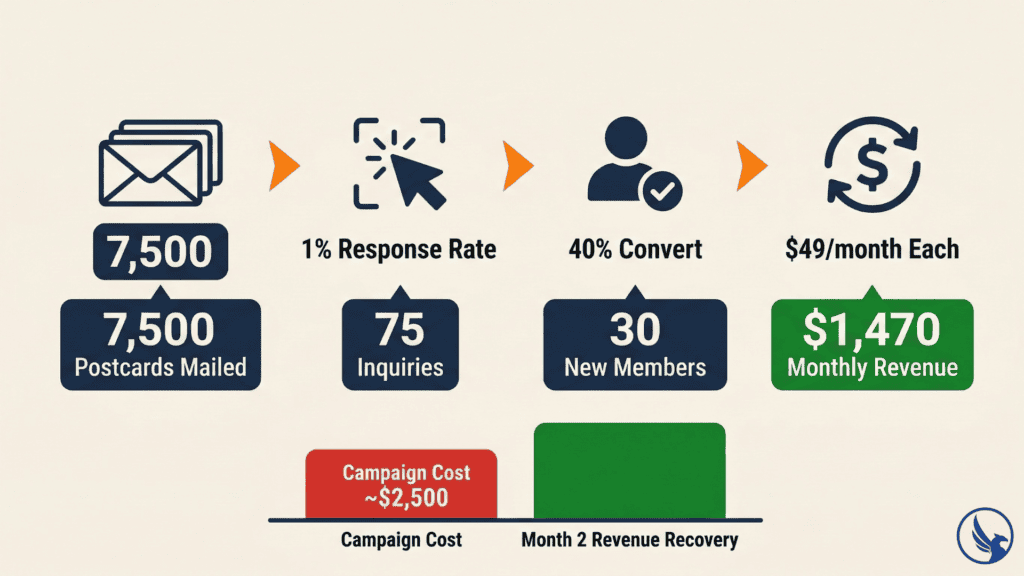
A mid-size fitness studio targeting 7,500 households in two zip codes with a 6.5″ × 9″ EDDM postcard might budget like this:
| Line Item | Cost |
|---|---|
| Printing (7,500 postcards) | ~$450–$600 |
| USPS Postage ($0.260/piece) | ~$1,950 |
| Design (if outsourced) | $150–$300 |
| Total Campaign Cost | ~$2,550–$2,850 |
Advisory: Print production costs vary by vendor, paper stock, finish, and run size. The figures above are estimates based on typical commercial pricing at time of publication. Request a current quote from your print vendor before building a campaign budget. For CRST-specific pricing, request an estimate.
The Conversion Math
Now work the conversion math. If your campaign generates a 1% response rate — modest by EDDM standards, which typically run 0.5% to 2% for local fitness offers per the Data & Marketing Association — you’re looking at 75 new inquiries. If 40% of those convert to memberships at $49/month, that’s 30 new members generating $1,470/month in recurring revenue. In other words, the campaign pays back in under two months.
Advisory: Response rate benchmarks vary by offer strength, creative quality, route selection, and seasonal timing. The 0.5%–2% range cited reflects DMA prospect mail benchmarks and should be treated as a directional estimate, not a guaranteed outcome. Use the EDDM ROI Calculator to model your specific scenario before committing to a print run.
Response rates improve significantly when the offer is timed strategically. January, late August (back-to-school fitness surge), and pre-summer (April/May) are the highest-intent windows for gym campaigns. Specifically, knowing the best time to send EDDM can be just as important as the offer itself — timing your drop to hit mailboxes on the right day of the week dramatically affects how much attention your piece gets.
For a more detailed cost comparison across EDDM campaign sizes, EDDM Postcard Printing Cost covers quantity pricing tiers and how print volume affects your per-piece cost. If you’re planning a large-scale campaign or coordinating multiple locations, EDDM Bulk Mailing explains how volume discounts work and when it makes sense to consolidate drops. Additionally, you can use the EDDM ROI Calculator to model your expected return before committing to a print run.
Case Study: How a Local Gym Added 47 Members with One EDDM Drop
From Facebook Ads to EDDM
A boutique CrossFit affiliate in the Hudson Valley was preparing for its fall membership push. They’d tried Facebook ads the previous year — spent $900, got 12 clicks to a landing page, and converted three. Disappointing.
As a result, they shifted budget to EDDM for gyms and ran a single campaign targeting 6,000 households within a 1.5-mile radius of the box. Before launch, they used the EDDM Mailing Routes tool to select carrier routes with the highest concentration of households matching their target demographic — households aged 25–44, within a 10-minute drive. The postcard led with a “First Month Free with 3-Month Commitment” offer and included a QR code linking to a simple landing page.
The Results
Total spend: approximately $1,900 (printing plus postage). Response: 89 QR code scans, 47 converted to the trial offer within 30 days. Of those 47, 38 continued past the first month. At $129/month for a CrossFit membership, that’s roughly $4,900/month in new recurring revenue from an approximately $1,900 campaign.
Advisory: The figures in this case study reflect one specific campaign and should not be taken as a guarantee of results. Response rates, conversion rates, and revenue outcomes vary based on offer, creative, route selection, market conditions, and membership pricing. Model your own scenario using the EDDM ROI Calculator before projecting returns.
They used EDDM Tracking Results methods — campaign-specific QR codes, a unique phone number, and a dedicated landing page URL — to attribute every sign-up back to the EDDM drop. Consequently, this closed-loop measurement let them optimize the next campaign with confidence, not guesswork.
Why This Pattern Repeats
This pattern repeats across gym types. Yoga studios, Pilates boutiques, martial arts academies, and big-box franchises all see similar returns when the fundamentals are right — right offer, right route selection, right timing. It’s the same model that works for EDDM for Restaurants, EDDM for Salons, and EDDM for Small Business broadly — neighborhood saturation with a compelling local offer.
For gyms thinking long-term, EDDM works well as a quarterly channel — not just for grand openings or seasonal pushes, but for re-engagement campaigns targeting lapsed members, referral promotions, and class schedule announcements. Moreover, the low cost per piece makes it viable for ongoing deployment in ways that paid digital rarely is. The EDDM First Campaign Guide is a solid starting point if your team is running its first drop and needs a step-by-step walkthrough.
Start Your EDDM Campaign with CRST
Why EDDM Works for Gyms
EDDM for gyms works because it meets your future members where they already are — at home, in their neighborhood, within driving distance of your facility. At $0.260 per piece and no mailing list required, a well-executed EDDM campaign remains one of the highest-ROI tools in local fitness marketing.
CRST handles EDDM printing end-to-end — from design-ready file prep and USPS-compliant printing to bundling and drop-off coordination. Whether you’re running your first campaign or scaling a seasonal membership drive, the process is straightforward and built around your timeline. Explore our full EDDM printing services to see how we support campaigns from first template to final delivery. Ready to move forward? Request an estimate or contact our team with your campaign details.
For the complete breakdown of how the program works, see our EDDM Guide.