
Every Door Direct Mail sounds simple — drop postcards in every mailbox on a route, no mailing list required. But here’s what catches most businesses off guard: USPS enforces strict EDDM printing requirements, and a single spec error can get your entire mailing rejected at the post office. Understanding EDDM printing requirements USPS enforces isn’t optional — it’s the difference between a campaign that launches on time and one that ends in a wasted print run.
This guide breaks down every size, weight, and design rule you need to follow before your postcards go to press. Whether you’re running your first campaign or trying to figure out why your last one got flagged, these are the specs that matter. For the complete EDDM program overview, see the EDDM Guide at CRST.
Why EDDM Printing Requirements USPS Sets Are Non-Negotiable
EDDM — Every Door Direct Mail — operates under a special USPS program that lets businesses saturate entire carrier routes without purchasing a mailing list. The tradeoff for that access is compliance. USPS has defined a specific window of acceptable dimensions, weight thresholds, and design rules for EDDM pieces. If your postcard falls outside that window, it doesn’t qualify for EDDM postage rates and may not be accepted at all.
The core reason USPS enforces these rules is operational. Each EDDM piece is bundled by carrier route and handed directly to mail carriers. Those that are too small get lost in the bundle. Oversized or overweight pieces disrupt route economics. Additionally, anything with improper indicia placement slows down processing. Every rule exists because the postal system is running millions of pieces through a standardized workflow.
For businesses, the practical consequence is clear: you cannot finalize your design before confirming your specs. Size, weight, paper stock, and layout all feed into compliance. Consequently, getting this right at the design stage — not the delivery stage — is what separates smooth campaigns from expensive reprints.
If you’re newer to the program, it helps to first understand how EDDM Mailing Routes work before locking in your design decisions. Route selection and piece size are connected decisions, not separate ones. You can also review the EDDM First Campaign Guide if this is your first time navigating the USPS submission process.
EDDM Postcard Size Requirements: Minimum and Maximum Dimensions
USPS defines a specific dimensional range for EDDM flat-mail pieces. Your postcard must fall within these boundaries to qualify.
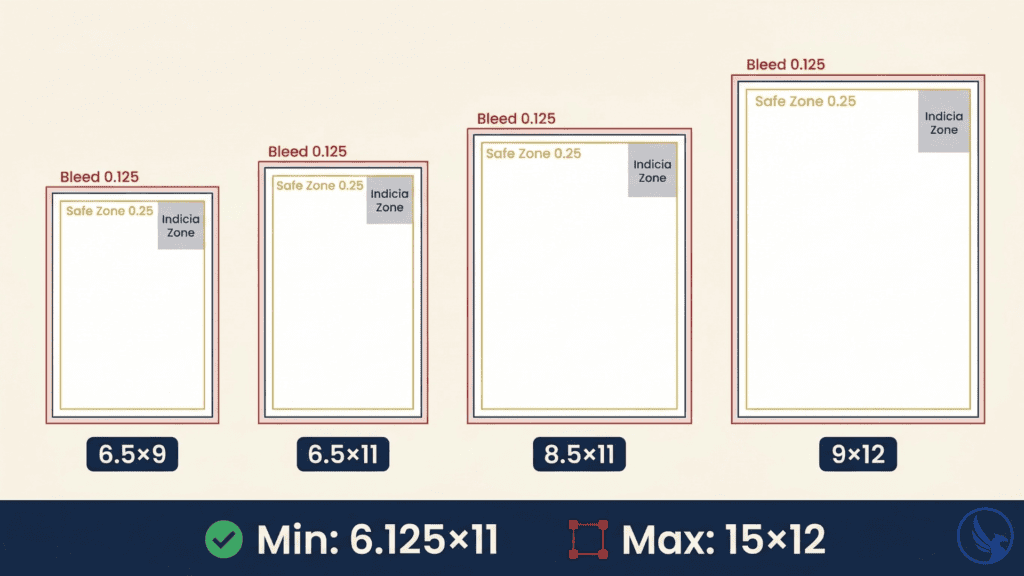
Minimum size: 6.125″ × 11″ Maximum size: 15″ × 12″ (with a maximum thickness of 0.75″)
Advisory: The minimum dimensions cited here — 6.125″ × 11″ — reflect current USPS EDDM flat-mail requirements as confirmed throughout this series. Always verify current specifications at pe.usps.com/DMM300 or with your print vendor before submitting files to press, as USPS specifications are subject to revision.
The most common EDDM sizes used in practice are:
- 6.5″ × 9″ — compact, cost-effective, lower print cost
- 8.5″ × 11″ — high visibility, popular for restaurants and retail
- 9″ × 12″ — maximum impact, used for real estate and grand openings
- 6.5″ × 11″ — elongated format, sometimes used for menus and service lists
Editor’s note: The 6.5″ × 11″ format is within USPS dimensional range but is not a standard size cited in the CRST series. Confirm with the CRST production team whether this format is regularly accepted at BMEU or retail window before including it as a recommended option.
For a complete breakdown of which size performs best for different campaign types, see the full EDDM Postcard Sizes guide. The size you choose has direct implications for cost per piece, mailing bundle weight, and overall visual impact. If you’re weighing size against budget, EDDM Postcard Printing Cost breaks down how dimensions affect your total spend.
EDDM Design and Layout Requirements: What USPS Enforces
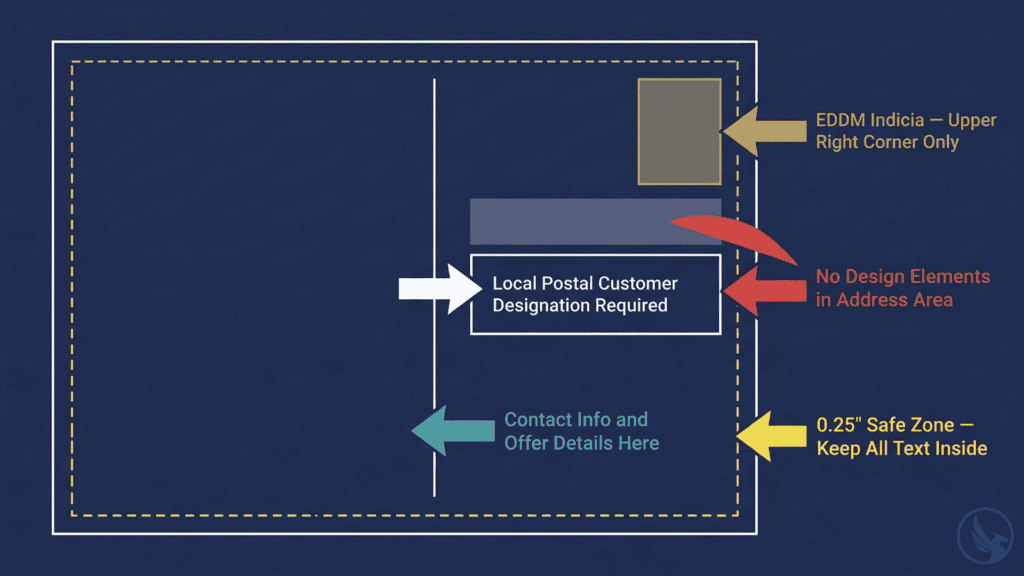
Design Elements That Satisfy EDDM Printing Requirements
Beyond dimensions, the design of your EDDM piece must meet USPS layout requirements. These are enforced at the point of acceptance.
Indicia placement: Every EDDM piece must carry either an EDDM Retail indicia or an EDDM BMEU indicia, depending on your submission method. Specifically, it must appear in the upper right corner of the address side — no barcode, no return address, and no individual addressee.
“Local Postal Customer” designation: In place of a specific recipient name, your piece must carry the words “Postal Customer,” “Local Postal Customer,” or a similar USPS-approved phrase. This signals to the carrier that the piece is an EDDM saturation mailing.
No live stamps: EDDM pieces cannot carry live postage stamps, as the indicia replaces postage entirely.
Address block area: USPS requires the address area to be kept clear of any design elements that would obstruct processing or carrier handling.
Most professional printers who handle EDDM campaigns provide pre-built templates that incorporate these requirements from the start. If you’re designing your own piece, however, working from an EDDM Postcard Template already formatted to USPS specs is significantly safer than building from scratch. For broader layout and creative direction, the EDDM Design Tips guide covers what actually moves response rates once your piece is compliant.
According to USPS EDDM program documentation, indicia and layout rules are reviewed at the point of acceptance — not after mailing — which is why front-end compliance matters more than most businesses expect.
USPS Compliance for Paper Stock and Weight
The EDDM printing requirements USPS enforces on paper stock are tied to the physical durability needed for carrier handling.
Weight limits:
- Minimum: Pieces must be rigid enough to qualify as flat-size mailpieces
- Maximum: No more than 3.3 oz per piece
Most EDDM postcards are printed on 100 lb. gloss cover (a basis-weight classification), 14pt cardstock, or 16pt cardstock (point-thickness classifications). These stocks hit the sweet spot between durability and weight compliance. Notably, coated stocks also hold color better, which matters when you’re using photography or bold brand colors.
If you’re comparing stock options for durability versus cost, the EDDM Paper Stock Options guide breaks down which weights and coatings work for different campaign goals. For campaigns where EDDM Bulk Mailing is in play, moreover, stock weight decisions at scale can meaningfully shift your postage classification.
For campaigns where design quality is a differentiator — real estate, premium restaurants, dental practices — investing in 16pt with a UV or soft-touch coating is worth the additional production cost. In contrast, for high-volume saturation campaigns where cost-per-household is the priority, 100 lb. gloss cover is the standard choice.
PRINTING United Alliance (formerly Printing Industries of America) publishes coatings and stock standards relevant to commercial print production.
Advisory: The authoritative compliance reference for USPS flat-size mailpiece specifications is the USPS Domestic Mail Manual, not third-party print industry publications. Consult pe.usps.com/DMM300 for current dimensional and durability requirements before specifying stock with your printer.
EDDM Cost and ROI: How Spec Compliance Affects Your Budget
Understanding EDDM printing requirements USPS enforces isn’t just about avoiding rejection — it directly affects your cost structure. Pieces that qualify for EDDM postage rates cost $0.260 per piece for postage, and that rate is only available for compliant pieces. A non-compliant piece, by contrast, gets reclassified at standard marketing mail rates, which can be two to three times higher.
On the printing side, size is the biggest cost driver. A 6.5″ × 9″ postcard printed at 5,000 pieces runs significantly less per unit than a 9″ × 12″ at the same volume. Paper stock adds another variable — heavier, coated stocks cost more to produce but reduce the risk of damage and rejection.
A realistic cost breakdown for a 5,000-piece EDDM campaign:
| Component | Estimated Cost |
|---|---|
| Printing (6.5″ × 9″, 100 lb. gloss) | $350–$500 |
| Postage ($0.260/piece) | $1,300 |
| Design (if outsourced) | $150–$400 |
| Total | ~$1,800–$2,200 |
Advisory: The $0.260 EDDM Retail postage rate reflects pricing at time of publication. Verify the current rate at usps.com/business/every-door-direct-mail.htm before finalizing any campaign budget. Print and design costs are directional estimates — actual costs vary by vendor, stock, coating, and run size.
At those numbers, reaching 5,000 households costs roughly $0.35–$0.43 per household all-in. For a side-by-side channel comparison, EDDM vs. Digital Ads and EDDM vs. Targeted Mail are worth reviewing before you finalize your channel mix.
For a deeper look at how postage and printing costs interact — including how EDDM Retail and EDDM BMEU options affect pricing — the EDDM Cost and Pricing guide covers it in full. Run your numbers through the EDDM ROI Calculator to model expected returns before committing to a print run.
Common EDDM Printing Mistakes That Cause USPS Rejection
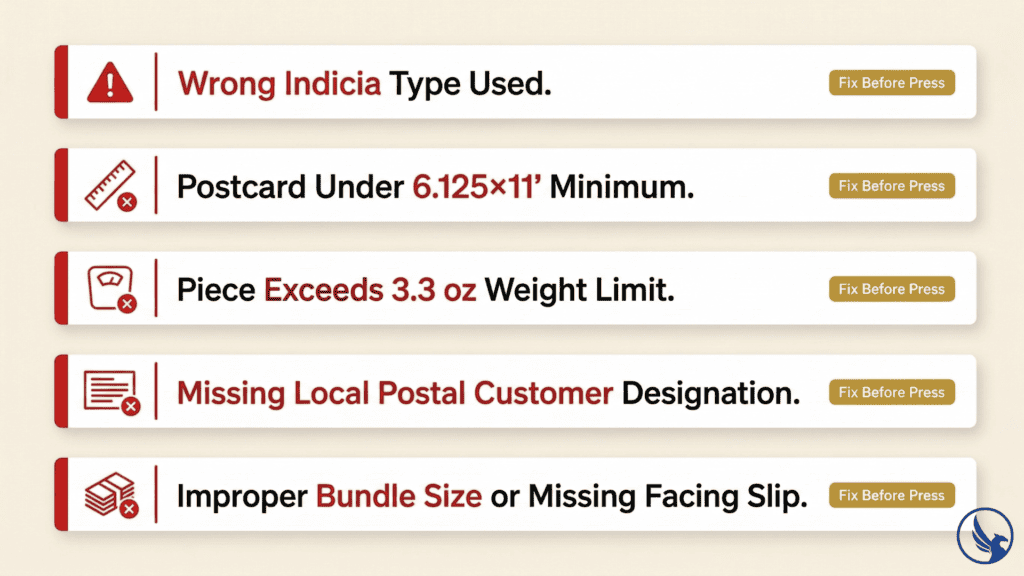
Most EDDM campaign failures at the post office trace back to a short list of avoidable errors.
Wrong indicia. Using a standard Marketing Mail indicia instead of an EDDM-specific indicia is one of the most common rejections — the indicia must specifically identify the piece as EDDM.
Piece is undersized. Any postcard that does not meet the flat-mail minimum of 6.125″ × 11″ will be rejected, so always verify against the USPS DMM before going to press.
Overweight piece. Extra panels, thick stock, or additional inserts can push a piece past the 3.3 oz. limit. Weigh a sample before printing the full run to catch this early.
Missing “Local Postal Customer” language. Omitting this designation — or replacing it with something USPS doesn’t recognize — flags the piece for rejection at the acceptance window.
Improper bundling. EDDM pieces must be prepared in bundles of 50–100 pieces per carrier route, with a facing slip on top of each bundle. Some printers handle this; many don’t, so confirm before you place your order.
Reviewing the full list of EDDM Mistakes to Avoid before you submit your print files can save you a reprint. Once your campaign is live, use EDDM Tracking Results tools to measure response and refine future mailings.
According to the ANA’s direct mail response rate research, physical mail consistently outperforms digital channels for local, household-level campaigns — which is precisely the use case EDDM was built for.
Advisory: ANA/DMA response rate reports are updated periodically. Verify the current edition at thedma.org before citing specific figures in client-facing materials.
How a Professional EDDM Printer Handles Compliance for You
Working with a printer that specializes in EDDM campaigns removes most of the compliance risk from your side of the table. A qualified EDDM printer will:
- Provide templates pre-formatted to USPS size and indicia requirements
- Review your file for spec compliance before going to press
- Print on approved stock weights that satisfy USPS durability requirements
- Handle bundling preparation per USPS carrier route rules
- Advise on EDDM Retail vs. EDDM BMEU submission options based on your volume
The difference between a general commercial printer and an EDDM-specialized printer shows up in that last step. EDDM Retail works for smaller campaigns submitted directly at the post office, while EDDM BMEU — submitted at a Bulk Mail Entry Unit — is required for larger campaigns. In either case, a printer experienced with EDDM will know which path fits your campaign size without you having to research it yourself.
The EDDM Postcard Design guide covers how design decisions — not just compliance decisions — drive response rates once your piece is in the door.
For small businesses new to the channel, the EDDM for Small Business guide outlines how to structure a first campaign from spec selection through submission. Additionally, reviewing EDDM Response Rates data helps set realistic benchmarks before launch.
The USPS Business Mail Acceptance resource is the authoritative reference for bundling and acceptance procedures — worth bookmarking before your first post office visit.
Start Your EDDM Campaign with CRST
EDDM printing requirements USPS enforces exist to protect the integrity of the program — and when you follow them, you get access to one of the most cost-effective neighborhood marketing tools available. Getting the specs right at the design stage means no reprints, no rejections, and no delays. In other words, your postcards reach every household on your target routes, on schedule, at a postage rate that makes mass outreach genuinely affordable for small and mid-size businesses.
CRST handles EDDM printing from file review through delivery prep, ensuring your campaign meets every USPS requirement before a single piece goes to press. Explore our full EDDM printing services to see how we support campaigns from first template to final delivery. Ready to move forward? Request an estimate or contact our team directly.
For the complete breakdown of how the program works, see our EDDM Guide.