
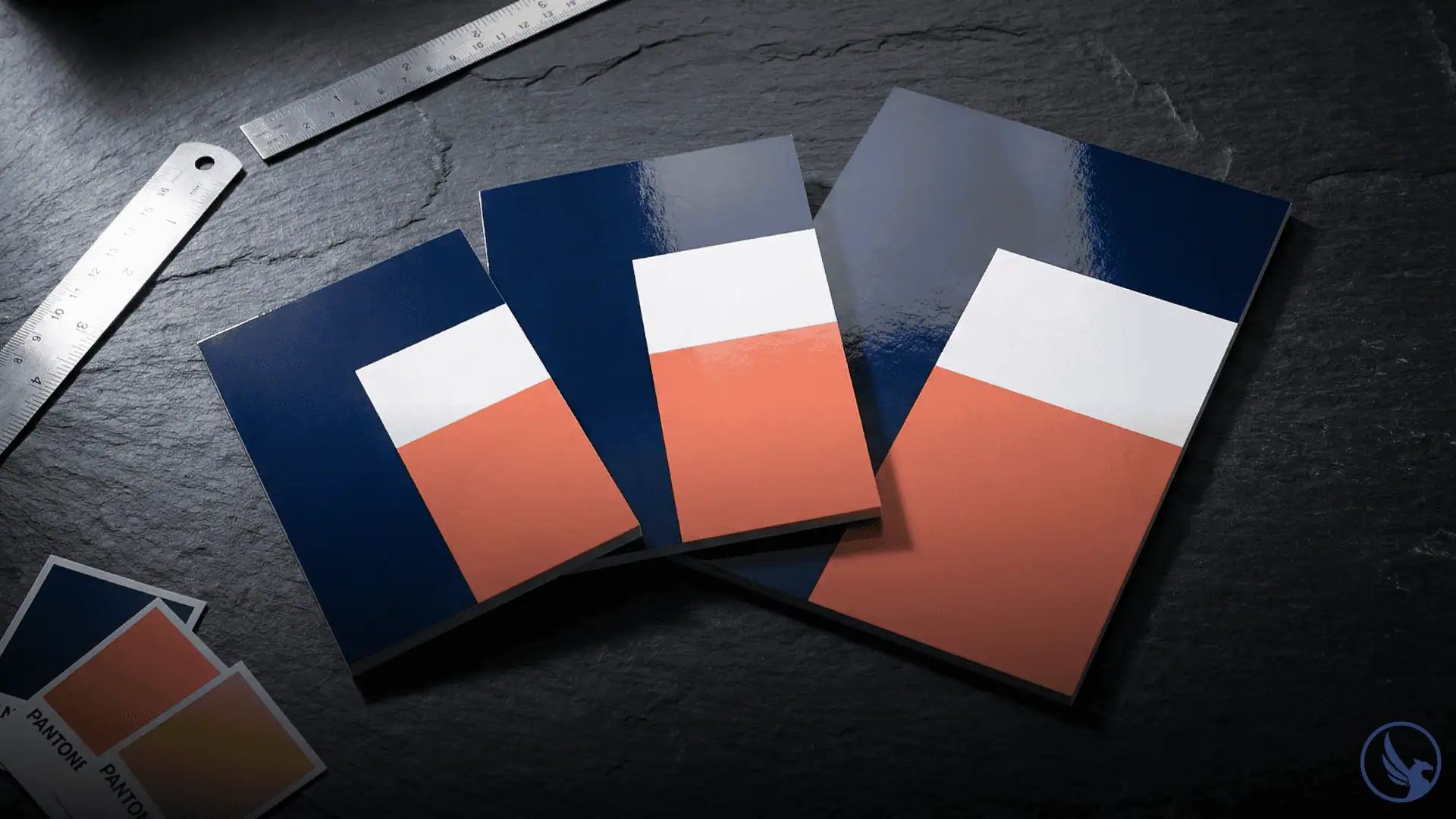
Every Door Direct Mail gives local businesses something most marketing channels can’t — complete neighborhood coverage without a mailing list, a targeting algorithm, or a bloated ad budget. But here’s what most first-time senders don’t realize: the size of your postcard isn’t just a design preference. It’s a strategic decision that affects whether your piece gets noticed, remembered, or tossed before it reaches the kitchen table. In 2026, as mailboxes get more competitive, choosing the right EDDM postcard sizes could be the difference between a campaign that breaks even and one that fills your schedule for months. This guide breaks down every approved format, what the USPS requires, and which size performs best for your specific goals. For the complete program foundation, see the EDDM Guide at CRST before diving into format specifics.
EDDM Postcard Sizes
That Drive Results
Choose the right format — visibility, compliance & ROI in one decision
Rate Range
Postage
Per Campaign
total/pc
total/pc
total/pc
| Dimension | Minimum | Maximum |
|---|---|---|
| Width | 6.5″ | 15″ |
| Height | 4.25″ | 12″ |
| Thickness | 0.007″ | 0.75″ |
| Weight | — | 3.3 oz |
No mailing list required. Full neighborhood coverage. USPS-compliant printing.
Read the Full EDDM Guide → Questions? Call 845-255-5722Why EDDM Postcard Sizes Matter More Than You Think
Most businesses treat postcard sizing like an afterthought — something to finalize after the design is done. That instinct gets the process backwards.
Size determines your first impression. When a mail carrier drops a stack into a mailbox, the largest piece almost always sits on top. Recipients see it first. They hold it first. And if it’s well-designed, they read it first. That physical advantage is built into your format choice before a single word of copy is written.
Size also determines USPS eligibility. Every Door Direct Mail — which lets businesses saturate entire carrier routes at $0.260 per piece through EDDM Retail — has strict dimensional requirements. If your postcard falls outside the approved range, it won’t qualify for EDDM postage rates. According to the USPS Every Door Direct Mail official program page, mail pieces that fall outside approved dimensions are rejected at the postal acceptance window entirely.
Advisory: USPS EDDM Retail postage rates are subject to change. Always verify the current rate at usps.com/business/every-door-direct-mail.htm before finalizing any campaign budget. The rate cited here reflects pricing at time of publication.
Finally, size affects print cost. Larger pieces require more paper stock, more ink coverage, and sometimes different finishing options. Understanding the relationship between format, cost, and ROI before you go to press saves real money. For a deeper look at what you’ll actually spend across a full campaign, the EDDM Cost and Pricing breakdown is worth bookmarking early in your planning process.
USPS-Approved EDDM Postcard Sizes: The Complete Dimension Guide
USPS sets the boundaries. Every EDDM mailpiece must fall within these parameters to qualify:
- Minimum dimensions: 6.125″ × 11″
- Maximum dimensions: 15″ wide × 12″ tall
- Minimum thickness: 0.007″
- Maximum thickness: 0.75″
- Maximum weight: 3.3 oz
Advisory: USPS EDDM flat mail size requirements are subject to change. Always verify current minimum and maximum dimensions at usps.com/business/every-door-direct-mail.htm or with your print vendor before submitting files to press. Pieces that do not meet current USPS flat mail specifications will not qualify for EDDM postage rates.
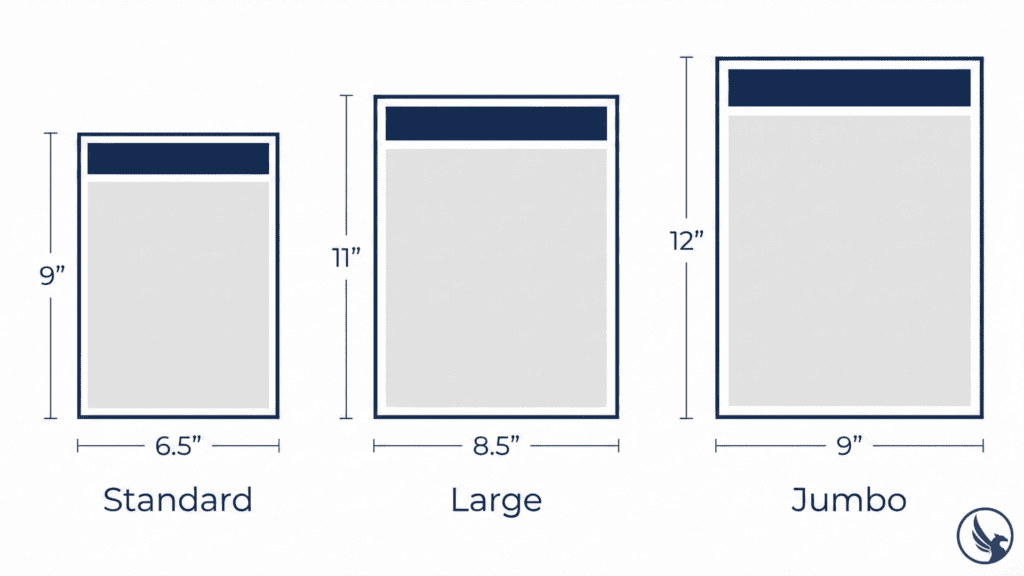
Within those outer limits, three sizes have become the industry standard — each with its own use case, cost profile, and response pattern. Knowing which EDDM postcard sizes work best for your campaign type is the fastest way to avoid wasted spend. You can also explore EDDM Postcard Sizes in more detail for a side-by-side visual comparison of every approved format.
Standard Postcard: 6.5″ × 9″
This is the entry-level EDDM format, and for campaigns where volume is the priority, it’s a legitimate workhorse. The 6.5″ × 9″ clears USPS flat mail minimums while keeping per-unit print costs low. It fits cleanly in a standard mailbox, doesn’t require special handling, and can be printed in high quantities on a short turnaround.
Where it works: coupon-heavy offers, grand opening announcements, and businesses mailing to multiple zip codes simultaneously. Where it struggles: premium brand positioning, detailed service menus, or any design that needs room to breathe. A crowded 6.5″ × 9″ postcard reads as cheap, not efficient.
For campaigns running on tight timelines, this size pairs well with a streamlined design workflow. The EDDM Postcard Design guide covers layout principles that apply across all formats, but the efficiency tips are especially relevant here. If you’re also evaluating paper and finish options at this stage, the EDDM Paper Stock Options guide walks through durability and cost trade-offs by format size.
Large Postcard: 8.5″ × 11″
This is the most popular EDDM postcard size among experienced direct mail marketers — and for good reason. The 8.5″ × 11″ hits a sweet spot between presence and production cost. It’s large enough to dominate the mailbox, standard enough that most print providers can run it efficiently, and versatile enough to work for nearly any industry.
Real estate agents use this format for neighborhood farming because it provides enough space for a full property photo, agent branding, market stats, and a clear call to action — all without feeling cluttered. Restaurants use it for seasonal menus. Gyms use it for membership promotions with before/after imagery and pricing tiers.
If you’re choosing a default format for your first EDDM campaign, this is the one. It’s also worth reviewing EDDM Design Tips to understand how to maximize a format this size — particularly how to use the front-to-back split effectively. For businesses just starting out, the EDDM First Campaign Guide pairs well with format selection and helps you avoid common setup errors before you go to press.
Jumbo Postcard: 8.5″ × 14″ or 9″ × 12″
The jumbo format is a power move. It sits on top of everything else in the mailbox. It’s impossible to miss and nearly impossible to dismiss without at least a glance. For businesses running high-value campaigns — luxury real estate, premium home services, specialty retail — the jumbo format justifies its higher production cost through stronger visual authority.
The trade-off is real: jumbo pieces cost more per unit to print and require tighter design discipline. A poorly designed 9″ × 12″ postcard doesn’t just underperform — it looks expensive and sloppy at the same time. But when the design is right, the jumbo format outperforms every smaller option on response rate.
For context on how EDDM Mailing Routes interact with format selection — particularly when you’re targeting high-income carrier routes — it’s worth understanding the full geographic picture before committing to premium production costs. Pairing a jumbo format with the wrong route profile is one of the EDDM Mistakes to Avoid that experienced mailers learn the hard way.
EDDM Postcard Sizes and USPS Compliance: What You Must Know
Choosing the right EDDM postcard sizes is only half the equation. The other half is making sure your file is built to spec before it goes to press. USPS has firm rules, and print providers who specialize in EDDM will tell you that compliance errors are the most common reason campaigns get delayed.
Design Elements, Bleed, and Resolution Requirements
Every EDDM postcard needs a bleed — typically 0.125″ on all sides — to ensure the printed edge doesn’t show white when the card is cut. Safe zones (usually 0.25″ from the trim edge) keep your text and logos from getting clipped.
Resolution must be at least 300 DPI at final print size. A design that looks crisp on screen at 72 DPI will print soft, blurry, or pixelated. This is especially critical for the jumbo format, where any image quality issues are magnified at scale. The USPS Domestic Mail Manual is the authoritative reference for verifying any specification directly from the source.
Color mode matters too. Print files should be built in CMYK, not RGB. Colors shift when RGB files are converted at the press, and blues especially can drift toward purple in ways that undermine brand consistency. If you want a ready-made starting point, EDDM Postcard Templates are pre-built to the correct dimensions and color mode for each approved size.
USPS Compliance and the Indicia Requirement
EDDM pieces must include an EDDM indicia — the postal marking that replaces a stamp and identifies the mail class. This indicia has specific placement rules and minimum size requirements. Your print provider should supply a template that includes the correct indicia placement for whichever EDDM postcard size you’re using.
The piece must also include the phrase “Postal Customer” or “Local Postal Customer” in place of a specific address. This is what makes EDDM a route saturation tool rather than a targeted mailer — and it’s also what keeps costs so low. For a detailed walkthrough of every USPS specification, the EDDM Printing Requirements guide covers compliance from file setup through postal acceptance.
Paper Weight: Choosing the Best Cardstock for Direct Mail Postcards
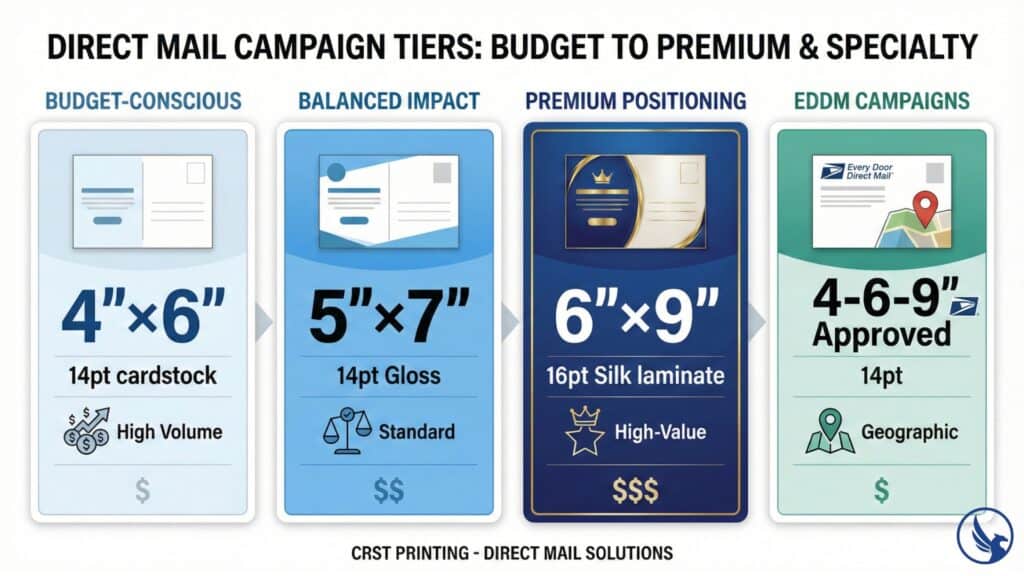
Choosing the best postcard size for direct mail is only half the decision. Paper stock determines whether your piece arrives intact and how recipients perceive your brand. For an in-depth look at cardstock options, read our guide on thick postcard printing for durability.
14 pt Cardstock (≈100–111 lb Cover): Professional Standard
The default choice for most direct mail postcards. Thick enough to feel substantial. Won’t curl or bend during USPS® sorting and delivery.
Recommended for:
- Business postcards across all industries
- EDDM® campaigns (Every Door Direct Mail®)
- High-volume mailings where durability matters
Finish options: Gloss (vibrant colors, photo-friendly) and matte (upscale, writable surface for handwritten notes).
16 pt Cardstock (≈120–130 lb Cover): Premium Thickness
A 16 pt postcard feels expensive in hand. It resists bending completely, which makes it ideal for luxury brands, high-end real estate, upscale restaurants, and nonprofit galas.
Caution: 16 pt stock on larger sizes (6″ × 9″ or bigger) may push you into letter-rate pricing instead of postcard rates depending on total piece weight. Always calculate postage before committing to this thickness on jumbo sizes.longevity matters (gym passes, loyalty programs).
Real-World EDDM Cost and ROI Breakdown by Format Size
The postage rate for EDDM is consistent regardless of size — currently $0.260 per piece through EDDM Retail. What changes is your print cost, and that’s where format choice has a direct effect on campaign economics.
| Format | Typical Print Cost (per piece, 5,000 qty) | Postage | Total Per Piece |
|---|---|---|---|
| 6.5″ × 9″ | $0.07–$0.10 | $0.260 | $0.32–$0.35 |
| 8.5″ × 11″ | $0.10–$0.14 | $0.260 | $0.35–$0.39 |
| 8.5″ × 14″ / 9″ × 12″ | $0.14–$0.20 | $0.260 | $0.39–$0.45 |
Advisory: USPS EDDM Retail postage rates are subject to change. Always verify the current rate at usps.com/business/every-door-direct-mail.htm before finalizing budget projections. Print costs vary by vendor, stock, and coating — request a current quote before committing to a run. For CRST-specific pricing, request an estimate.
At a 5,000-piece run targeting two or three carrier routes, the total campaign cost ranges from approximately $1,600 to $2,250 depending on format. For a granular look at per-piece costs across different print quantities, the EDDM Postcard Printing Cost guide breaks down exactly where the numbers land at 1,000, 2,500, 5,000, and 10,000 pieces.
Now consider what one new customer is worth. For a dentist, a single new patient relationship is worth thousands in lifetime value. For a restaurant, a family of four that visits twice a month adds up fast. The ROI math on EDDM consistently favors larger formats when the offer is strong, because the additional $200–$400 in production cost is easily recovered by improved response rates. To model your own campaign numbers before committing to a format, the EDDM ROI Calculator lets you input your industry, quantity, and offer type to estimate projected returns.
Choosing the Right EDDM Postcard Size for Your Industry
Not every format fits every business. Here’s how to match your campaign type to the right EDDM postcard size:
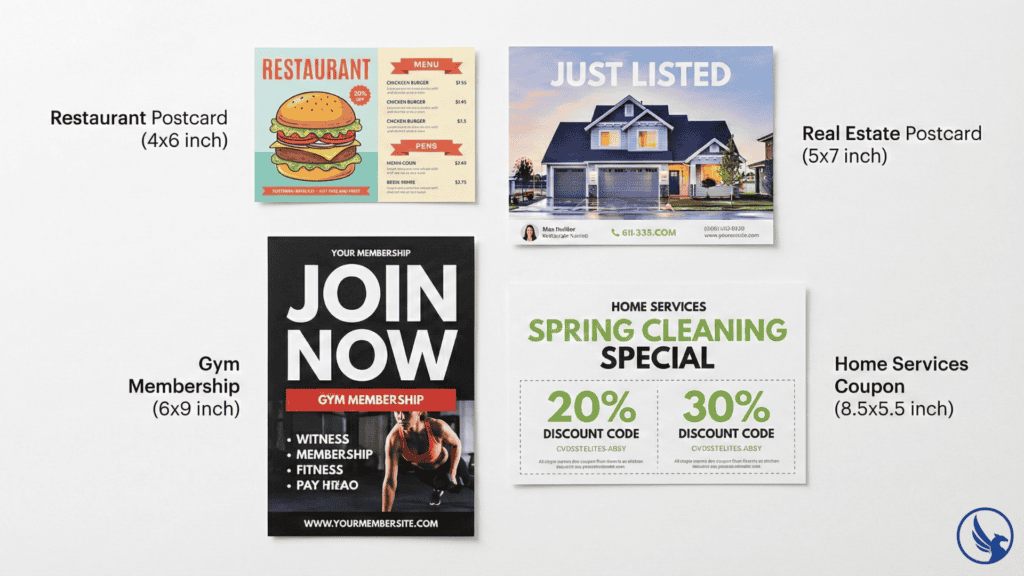
Restaurants and food service: The 8.5″ × 11″ gives enough real estate for appetizing photography, a coupon, and location details. EDDM for Restaurants covers format recommendations alongside offer structure and timing.
Real estate agents: The 8.5″ × 11″ or jumbo format is standard for neighborhood farming. EDDM for Real Estate goes deeper on farming cadence and format recommendations by market type.
Gyms and fitness studios: Bold imagery, a single offer, and a deadline drive action on the 8.5″ × 11″. EDDM for Gyms covers format selection alongside offer structure and seasonal timing.
Home services (HVAC, plumbing, landscaping): The 6.5″ × 9″ works for pure offer plays; the 8.5″ × 11″ wins when you need to establish credibility. EDDM for Home Services covers this trade-off, including split-test results across service categories.
Salons and personal care: Grand opening and reactivation campaigns respond well to the large format. EDDM for Salons breaks down how appointment-based businesses can use format size and timing to drive immediate bookings.
Nonprofits and community organizations: Larger formats work best for donor acquisition, where the story needs room to develop. EDDM for Nonprofits addresses format selection alongside budget constraints and carrier route targeting strategies.
Dental practices: The 8.5″ × 11″ gives space to build trust through credentialing, offer a promotion, and include a clear CTA. EDDM for Dentists covers format, timing, and offer structure in detail.
Small businesses across categories: If you’re still weighing whether EDDM is the right channel before committing to a format, EDDM for Small Business provides an honest look at when the program works — and when other channels might serve you better.
Real-World Results: EDDM Postcard Sizes and Response Rate
Across the direct mail industry, larger postcards consistently outperform smaller ones in controlled A/B tests — not because bigger is always better, but because the additional space forces more intentional design and allows clearer communication. According to the Data & Marketing Association response rate report, direct mail consistently outperforms digital channels in response rate, with oversized formats driving the highest engagement within the mail category.
Industry benchmarks suggest EDDM response rates ranging from 1.5% to 4.5% for well-executed campaigns, compared to 0.5%–1% for most digital channels. The top end of that range almost always involves premium formats, strong offers, and high-quality print production.
Advisory: EDDM response rate benchmarks vary significantly by industry, offer strength, creative quality, and route selection. The Data & Marketing Association reports prospect direct mail response rates of 0.5%–2% as a broader benchmark. The upper ranges cited here reflect well-executed campaigns with premium formats and strong offers, and should be treated as optimistic estimates rather than guaranteed outcomes. Use the EDDM ROI Calculator to model conservative, base, and optimistic scenarios for your specific campaign before committing budget.
For a full breakdown of what drives those numbers, the EDDM Response Rates guide covers benchmarks by industry, format, and offer type.
Timing also plays a significant role. A well-timed jumbo postcard arriving ahead of a seasonal decision — back-to-school, the winter home services rush, spring fitness resolutions — can push response rates well above average. Pairing the right EDDM postcard size with the Best Time to Send EDDM is one of the highest-leverage optimizations available to any campaign. And if you’re comparing EDDM against other channels before finalizing your format budget, EDDM vs. Digital Ads provides a data-grounded side-by-side comparison that’s useful for internal budget conversations.
Once your campaign is running, tracking your EDDM results by format — using unique phone numbers, promo codes, or landing page URLs — gives you the data to make smarter format decisions on the next campaign wave.
Start Your EDDM Campaign with CRST
EDDM postcard sizes aren’t a minor detail — they’re a core campaign variable that affects visibility, design quality, production cost, and response rate. Whether you’re launching with a lean 6.5″ × 9″ or going all-in on a jumbo format, the key is making that decision intentionally and building everything else around it.
CRST handles EDDM printing from file setup through postal delivery, with a team that knows USPS compliance inside out and a track record across industries. Explore our full EDDM printing services or request an estimate to get current pricing for your specific format, quantity, and target routes. Questions? Contact our team directly.
For the complete breakdown of how the program works, see our EDDM Guide.