

Knowing the best time to send EDDM is one of the highest-leverage decisions in any direct mail campaign. The same postcard — same design, same offer, same routes — can generate dramatically different response rates depending on when it lands in the mailbox. Timing your drop to align with seasonal demand, consumer psychology, and competitive mail volume can be the difference between a campaign that pays for itself many times over and one that barely breaks even.
For the complete EDDM system foundation, see the EDDM Guide at CRST before building your campaign calendar.
Why Timing Is a Strategic Variable, Not an Afterthought
How Seasonality Affects Response Rates
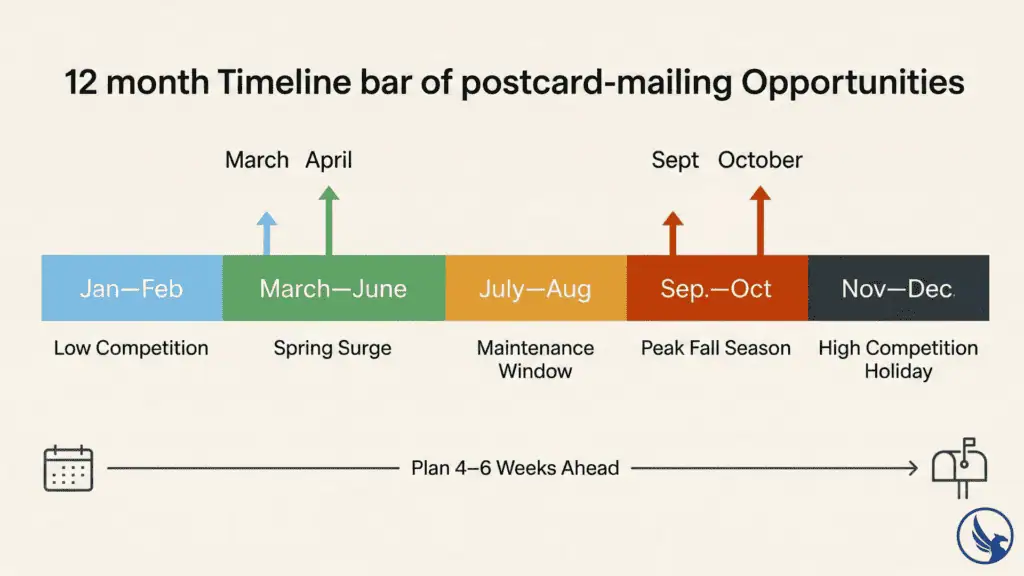
Direct mail response rates are not static. They shift meaningfully with seasons, consumer spending cycles, and the volume of competing mail in any given household’s mailbox. According to USPS Postal Facts mail volume data, mail volume — and competition for attention — peaks in November and December. That’s when retail catalogs, holiday promotions, and year-end appeals flood residential mailboxes. Consequently, a campaign dropped in that window faces substantially more competition than the same piece dropped in February or early March, when mailbox volume hits its annual low.
Understanding when your target audience is most psychologically primed to act is equally important. A roofing company mailing in January is fighting consumer inertia. The same company mailing in April — two weeks after the first spring storm — is meeting demand that already exists. Therefore, aligning your EDDM drop with the moment recipients are already thinking about your category of service is the most reliable timing strategy available.
For context on how timing interacts with overall campaign ROI, see EDDM Response Rates and the EDDM ROI Calculator. Both are useful for modeling how a well-timed drop compares to a poorly timed one at equivalent spend levels.
Lead Time: Planning Backward From In-Home Date
One of the most common timing mistakes in EDDM campaigns is confusing the decision date with the drop date. Most businesses decide to run a campaign and then expect to be in-home within days. In practice, a well-executed EDDM campaign requires 10–21 business days from campaign brief to in-home delivery. That breaks down into three stages: design and approval (3–5 days), print production (5–7 business days for standard runs, longer for large volumes), and USPS processing and delivery (1–3 business days after acceptance).
Advisory: Production and delivery lead times vary by print vendor, campaign volume, and season. The 10–21 business day total range cited here is directional. October and November typically add press time at most vendors due to peak holiday production demand. Confirm current lead times directly with your print vendor and local USPS acceptance facility before committing to a campaign drop date.
For seasonal campaigns with a hard deadline — a spring promotion ending May 31, or a Thanksgiving appeal timed to arrive before the holiday — working backward from the target in-home date is essential. Furthermore, peak production seasons at print vendors in October–November add press time. As a result, building a campaign calendar means planning drops 4–6 weeks before you need the piece in recipients’ hands.
The EDDM Campaign Calendar: Month by Month
January–February: Low Competition, High Opportunity
January and February represent the most underutilized mailing window of the year. Mailbox volume drops sharply after the holiday season, meaning your postcard faces minimal competition for attention. Consumer psychology in January is also favorable for specific categories: home improvement, fitness, financial services, and fresh-start messaging all align naturally with the resolution mindset that dominates the first six weeks of the year.
For home services companies — HVAC, plumbing, insulation, and weatherproofing — a January drop promoting a winter maintenance special or spring booking incentive generates leads at a time when competitors are typically dark on direct mail. As a result, businesses willing to mail in January often report their lowest cost-per-lead of the year simply due to reduced mailbox competition.
February is Valentine’s season for restaurants, florists, and hospitality — but it’s also a strong window for any business wanting to establish brand presence before the spring rush. A February drop lands after the post-holiday mail flood and well before the spring surge, giving it unusually clean mailbox real estate. For restaurant-specific timing guidance, EDDM for Restaurants covers seasonal promotions in detail.
March–April: The Spring Surge
March and April mark the beginning of peak EDDM season for the widest range of industries. Consumer spending ramps up, daylight hours extend, and homeowners begin making decisions about properties that have been dormant all winter. Specifically, home services — roofing, landscaping, painting, pest control, HVAC, and pool services — all experience their primary demand spike between late March and mid-May.
The best in-home target window for spring campaigns is March 15 to April 15. That’s early enough to capture decision-makers before competitors saturate routes, but late enough that recipients are psychologically out of winter mode. For HVAC companies specifically, an AC tune-up promotion arriving in the second week of April — before the first hot weekend of the season — consistently outperforms the same campaign arriving in late May when competition is louder.
Real estate is another strong spring category. March–April is peak listing season in most US markets, making it the optimal window for agents to saturate farm neighborhoods. See EDDM for Real Estate for a dedicated timing and design framework for real estate campaigns.
May–June: Pre-Summer Capture Window
May and June represent the second major mailing window of the year — ideal for businesses whose peak service period is summer. Pool services, outdoor contractors, AC replacement companies, summer camp enrollment, and food or beverage businesses gearing up for warm-weather traffic should all target in-home delivery by late May at the latest.
This window is also strong for gyms and fitness studios promoting summer programs, for auto dealers promoting summer lease and purchase incentives, and for home services businesses that missed the March–April window. Furthermore, June brings graduation season — a natural trigger for restaurants, event venues, and gift-based retailers. See EDDM for Gyms and EDDM for Auto Dealers for category-specific timing and offer guidance.
Editor’s note: The EDDM for Auto Dealers page URL above is assigned by series pattern. Confirm this page exists before publishing.
July–August: Strategic Maintenance Window
July and August are the slowest months for new EDDM campaign launches in most categories. Consumer attention is dispersed, families are in vacation mode, and response rates across direct mail categories tend to dip slightly. However, this is not a reason to go dark. It’s a reason to mail strategically.
Back-to-school is the dominant consumer event of late July and August, creating a strong window for tutoring services, school supply retailers, and any business targeting families. Dentists promoting back-to-school checkups, salons promoting back-to-school cuts, and nonprofits promoting fall program enrollment all have strong late-summer mailing cases. EDDM for Dentists and EDDM for Salons both include summer-specific campaign guidance.
Additionally, businesses planning fall campaigns should use August as their production and strategy window. Finalizing creative, selecting routes, and building campaign files in August means fall drops can land precisely when demand peaks in September and October.
September–October: Peak Fall Season
September and October rival spring as the strongest EDDM mailing period of the year. Consumer attention returns from summer, household spending re-engages with home and services decisions, and the emotional urgency of getting things done before winter creates natural conversion pressure across dozens of categories.
For home services, fall is the second critical window. HVAC companies mailing furnace inspection and heating system promotions in late September to early October capture homeowners before the first cold snap — when urgency is high but panic hasn’t yet set in. Roofing companies benefit similarly from September drops, particularly in markets prone to fall storms or early frost.
The best target window for fall campaigns is a September 15–October 15 in-home date. Drops targeting November in-home dates start competing with holiday mail volume, which increases cost-of-attention significantly. For businesses that do need to mail in November — nonprofits running Giving Tuesday campaigns, retailers promoting holiday gift cards, or restaurants advertising Thanksgiving reservations — arriving in the first two weeks of November is essential. That’s before the primary holiday catalog surge begins. For nonprofit-specific fall and year-end timing, EDDM for Nonprofits covers the full end-of-year giving calendar.
November–December: High-Competition Holiday Window
November and December represent the highest-volume mail period of the year. According to USPS Postal Facts mail volume data, total mail volume can increase significantly during peak holiday weeks compared to an average week in Q1.
Advisory: The specific percentage increase in holiday mail volume varies year to year and by mail class. USPS Postal Facts (facts.usps.com) and the USPS Annual Report are the authoritative sources for current mail volume data. Verify current figures before citing specific percentages in client presentations or campaign planning documents.
Your EDDM postcard consequently arrives in a significantly more crowded mailbox than at any other time of year. This doesn’t mean nonprofits, retailers, and restaurants should avoid the holiday window — the consumer spending intent is too high. It does mean the creative bar is higher and timing precision matters more. For holiday campaigns, targeting in-home dates in the first two weeks of November gives your piece a week or more of less-crowded mailbox time before the holiday catalog deluge begins in earnest.
Industry Timing Quick Reference
Service Businesses and Home Services
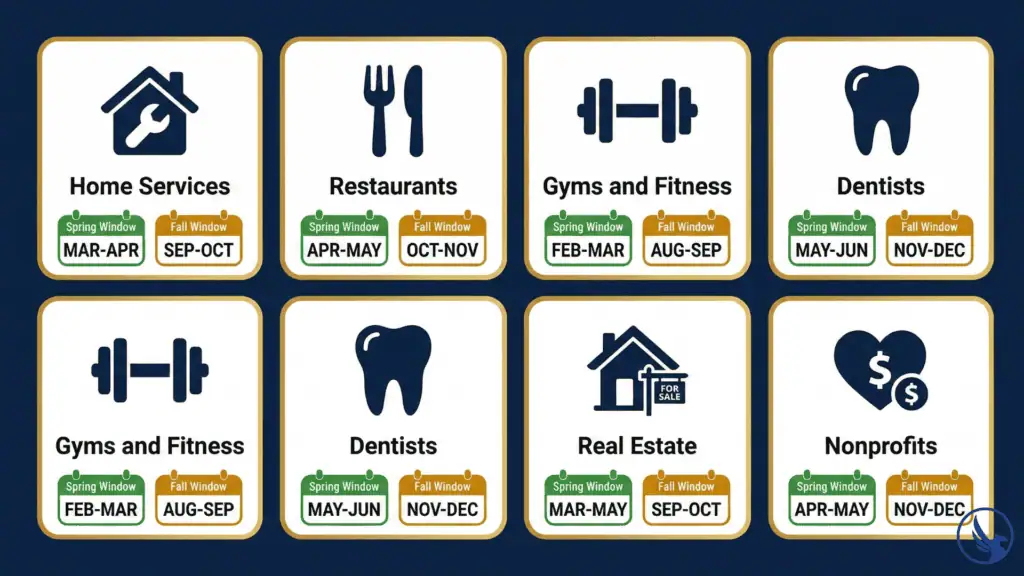
The two highest-impact windows for home services EDDM are spring (March 15–April 30 in-home) and fall (September 15–October 15 in-home). Both align with pre-peak demand periods — the moment homeowners are thinking about their systems and properties but haven’t yet called a competitor. For a deeper home services campaign framework covering HVAC, plumbing, and roofing, EDDM for Home Services provides category-specific guidance paired with timing strategy.
For new businesses establishing local presence, mailing during low-competition windows — January, February, and early March — builds brand recognition before competitors flood routes in the spring surge. This is particularly effective for businesses in EDDM for Small Business scenarios where budget efficiency matters as much as reach.
Restaurants, Retail, and Consumer Services
Restaurants benefit from year-round EDDM with peaks around Valentine’s Day (January drop for February in-home), Mother’s Day (April drop), summer patio season (May drop), and the holiday dining window (first two weeks of November in-home). Salons, gyms, and personal services follow a similar pattern tied to consumer life events — New Year’s resolutions, spring, and back-to-school.
For retail businesses, the pre-holiday window (October 15–November 10 in-home) offers the best blend of high consumer spending intent and manageable mailbox competition. Dropping later than mid-November risks being buried in catalog and holiday mail volume. See EDDM Design Tips and EDDM Postcard Design for seasonal design adjustments that help retail pieces stand out in heavy-mail periods.
Professional Services and B2C Outreach
For professional services — financial advisors, insurance agents, law firms, and healthcare providers — the best time to send EDDM tends to align with enrollment and decision cycles rather than pure seasonality. Health insurance open enrollment (October–December), tax season (January–February), and benefits renewal periods create natural windows where recipients are already in a decision-making mindset.
Dentists and healthcare providers benefit particularly from September–October drops timed to coincide with fall preventive care season and year-end deductible utilization. Patients in that window are motivated to use remaining benefits before they reset in January. EDDM for Dentists covers this cycle in detail. For political and advocacy campaigns operating on election-cycle timing, EDDM Political Campaigns provides the full framework for compliance-focused time-sensitive drops.
Building Your Annual EDDM Campaign Calendar
Mapping Drops to Business Revenue Cycles
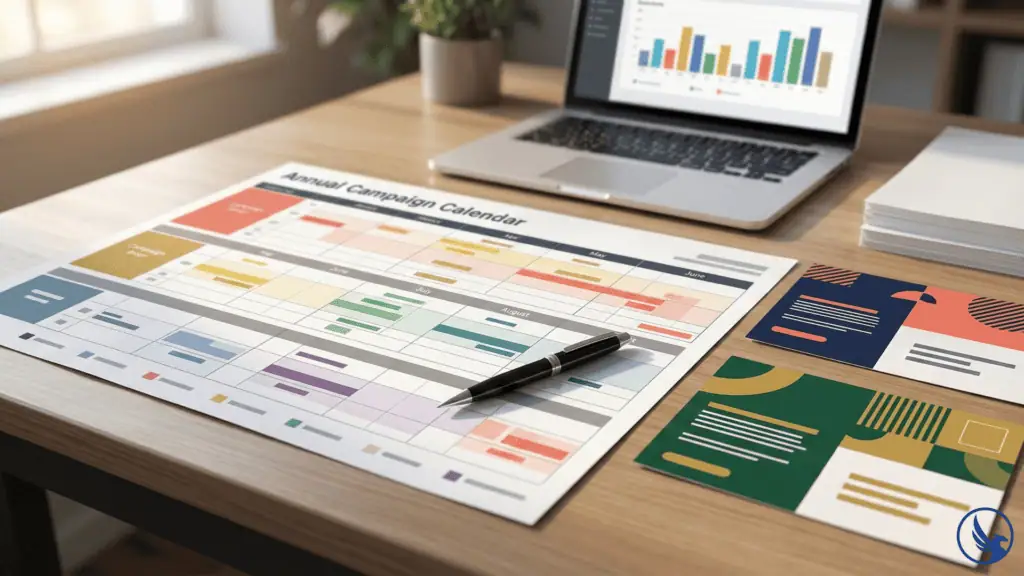
The most effective EDDM programs don’t react to the calendar — they’re built around it in advance. Start by mapping your business’s revenue seasonality: which months generate the most revenue, which generate the least, and what decisions are customers making in the weeks before each peak. Your EDDM drops should land 2–4 weeks before your highest-demand periods, priming awareness and generating leads that convert during the peak.
For businesses running EDDM Bulk Mailing across multiple routes or markets, a phased drop calendar allows you to manage inbound call volume and production schedules without a single overwhelming surge. Additionally, pairing your calendar planning with EDDM Tracking Results infrastructure from the first drop means each campaign informs the timing of the next.
When to Test vs. When to Scale
New campaigns should test timing assumptions before committing to large-volume drops. A small test run — 2,000–3,000 pieces on a single route cluster — timed to your hypothetical peak window gives you response rate data before you scale. If the test performs, scale. If it underperforms, adjust timing or creative before investing in a larger run.
For full-service support on building and executing an annual EDDM campaign calendar, contact CRST or request a campaign estimate. CRST’s production team has worked across dozens of industries and can identify the highest-leverage drop windows for your specific campaign goals. Learn more at CRST and our EDDM printing services.
For businesses newer to the channel, EDDM First Campaign Guide and EDDM Mistakes to Avoid both include timing pitfalls that first-time mailers most commonly encounter.
Start Your EDDM Campaign with CRST
Choosing the best time to send EDDM — and planning drops backward from your target in-home dates with enough production lead time — is the single most cost-free way to improve campaign performance without changing a single element of your creative or offer.
CRST handles EDDM printing from file setup through postal delivery, with a team that knows USPS compliance inside out and a track record across industries. Explore our full EDDM printing services to see how we support campaigns from first template to final delivery. Ready to move forward? Request an estimate or contact our team with your project details.
For the complete breakdown of how the program works, see our EDDM Guide.