

EDDM for nonprofits solves one of the most persistent tensions in mission-driven marketing: how do you reach a broad local audience when every dollar spent on outreach is a dollar not going to your programs? Every Door Direct Mail offers a cost structure that makes physical, high-impact fundraising mail genuinely accessible. Even organizations operating on shoestring budgets can make it work.
This guide covers how nonprofits can use EDDM for fundraising campaigns, donor acquisition drives, event promotions, and community awareness efforts. It includes practical guidance on design, targeting, timing, and measuring impact. For the complete EDDM system overview, start with the EDDM Guide at CRST before planning your campaign.
- ✓QR code → UTM-tagged donation landing page
- ✓Dollar amount ladder (“$25 feeds a family · $50 keeps shelter open”)
- ✓501(c)(3) status + EIN — tax-deductible donation callout
- ✓Mailing address for check donors — never skip this
- ✓Two-sentence mission statement for first-time recipients
Why EDDM Makes Sense for Nonprofit Organizations
The Cost Advantage Over Traditional Direct Mail
Traditional targeted direct mail is expensive. List acquisition alone can cost $100–$300 per thousand names. Add personalized printing, envelope inserting, and First-Class postage, and a modest campaign quickly reaches $1.50–$3.00 per piece — before a single dollar is raised.
EDDM, by contrast, eliminates most of that cost structure. There are no lists to purchase, no envelopes, and no personalization overhead. The flat-rate postage — currently $0.247 per piece through USPS EDDM Retail — applies to every household on a carrier route regardless of volume. Furthermore, EDDM Retail requires no mailing permit, which removes yet another barrier for smaller organizations. Always verify the current rate at usps.com/business/every-door-direct-mail.htm before finalizing any campaign budget.
Advisory: USPS EDDM Retail postage rates are subject to change. The $0.247 rate cited here reflects pricing at time of publication. Verify the current rate at usps.com/business/every-door-direct-mail.htm before building a campaign budget.
The result is significant: a nonprofit can reach 5,000 local households with a professionally printed 8.5″ × 11″ postcard for a total cost — print plus postage — that often falls between $800 and $1,400. That range depends on print vendor, paper stock, and run size. For a full cost breakdown, both EDDM Cost and Pricing and EDDM Postcard Printing Cost provide detailed estimates for budget planning.
Why Physical Mail Works for Charitable Appeals
Nonprofit fundraising research has long established that physical mail outperforms digital channels for charitable giving. According to the Association of Fundraising Professionals, direct mail consistently generates higher average gift amounts than email appeals. This is especially true among donors aged 45 and older, who represent the majority of charitable giving in the United States.
Advisory: The AFP citation above reflects the organization’s published fundraising effectiveness research but does not reference a specific study or year. The AFP’s Fundraising Effectiveness Project (afpfep.org) is the most relevant named publication for verifying current direct mail vs. digital giving benchmarks. Confirm specific figures against the most recent edition before using them in board presentations or grant materials.
Physical mail also creates a different cognitive experience than a digital solicitation. A well-designed fundraising postcard sits on a kitchen counter, gets picked up again, and gets shown to a spouse. It doesn’t disappear into a spam folder or get scrolled past in seconds. For nonprofits making an emotional appeal — for a food bank, an animal shelter, or a youth mentorship program — the physical format carries persuasive advantages that digital simply can’t replicate.
Additionally, the USPS Household Diary Study reports that 57% of people feel more valued by organizations that communicate via physical mail.
Advisory: The 57% figure is drawn from the USPS Household Diary Study. This study is updated periodically and specific figures may have shifted in more recent editions. Verify the current edition at postalpro.usps.com before citing this statistic in donor communications or grant applications.
For a nonprofit whose brand is built on community connection and human impact, that perception gap is significant.
How Nonprofits Can Use EDDM Strategically
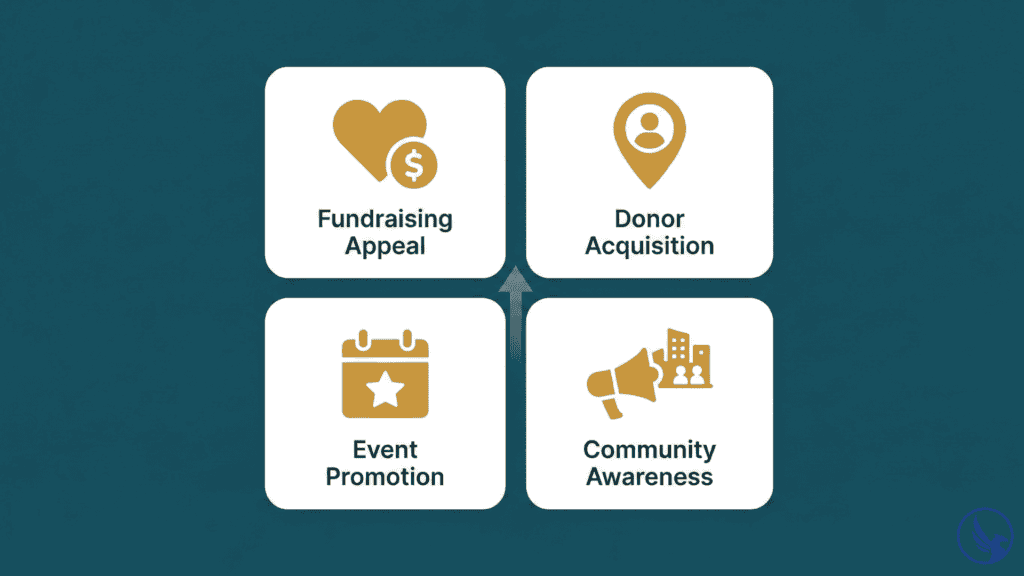
Fundraising Campaigns and Annual Giving Appeals
The most direct application of EDDM for nonprofits is a fundraising appeal — a postcard that tells your story, communicates impact, and asks recipients to donate. Unlike a letter-style mailer, an EDDM postcard must make its case in a compressed format: one powerful image, a single human impact statement, a specific ask, and a clear response mechanism.
The most effective nonprofit fundraising postcards follow a clear formula: one person’s story, one specific need, one dollar amount ask. “Help us feed 50 families this Thanksgiving — donate $25 at [URL]” consistently outperforms “Support our mission to fight hunger in our community.” Specificity creates accountability, and accountability drives action.
For seasonal giving campaigns — end-of-year appeals, Giving Tuesday drives, spring fundraising pushes — timing your drop to arrive 10–14 days before your campaign deadline gives recipients enough decision time while maintaining urgency.
Advisory: The 10–14 day pre-deadline arrival window reflects widely cited direct mail fundraising best practice. Actual optimal timing varies by audience, campaign type, and postal delivery timelines in your area. Build in extra lead time during peak mailing seasons (November–December) when postal volume is highest. Confirm current delivery estimates with your print vendor and USPS before scheduling a drop.
Best Time to Send EDDM covers the full calendar strategy.
Donor Acquisition in New Neighborhoods
One of EDDM’s most underused applications for nonprofits is donor acquisition in geographically adjacent neighborhoods — areas where your organization does work but hasn’t yet built a donor base. Rather than paying for a cold prospect list, EDDM lets you saturate entire residential routes in target ZIP codes for a fraction of the cost.
The targeting strategy here differs from a standard fundraising appeal. An acquisition mailer needs to introduce the organization, establish credibility, and motivate a first-time gift — all from someone with no prior relationship with you. Therefore, the design should lead with community impact and local presence — “Serving [Your City] Since 1998” — rather than assuming any pre-existing emotional connection.
EDDM Mailing Routes explains how to filter routes by demographic profiles that match your existing donor base — median income, household size, and age distribution. In practice, using your existing donor data to build a target profile and then applying it to route selection is the closest EDDM gets to the precision of targeted list mail — without the list cost. For a broader comparison of these two approaches, see EDDM vs. Targeted Mail.
Event Promotion and Community Awareness
Beyond fundraising, EDDM excels at event promotion. Galas, 5K runs, community dinners, open houses, and volunteer recruitment drives — any event that benefits from high local awareness is a strong EDDM use case. A postcard arriving 2–3 weeks before the event, mailed to routes within a 5–10 mile radius of the venue, generates awareness cost-effectively. Importantly, it does so without requiring any existing relationship with recipients.
For awareness campaigns — informing a community about your services or building recognition ahead of a capital campaign — EDDM lets you blanket a geographic area at a cost that fits a nonprofit budget. As a result, organizations that previously couldn’t afford broadcast reach now have a scalable, measurable alternative.
Designing EDDM Postcards for Nonprofit Fundraising
Emotional Storytelling in a Compressed Format
Nonprofit fundraising lives or dies on emotional resonance, and an EDDM postcard has approximately three seconds to create it. The design principles for a nonprofit EDDM piece differ meaningfully from a commercial direct mail piece — where the hook is an offer, here the hook is a human moment.
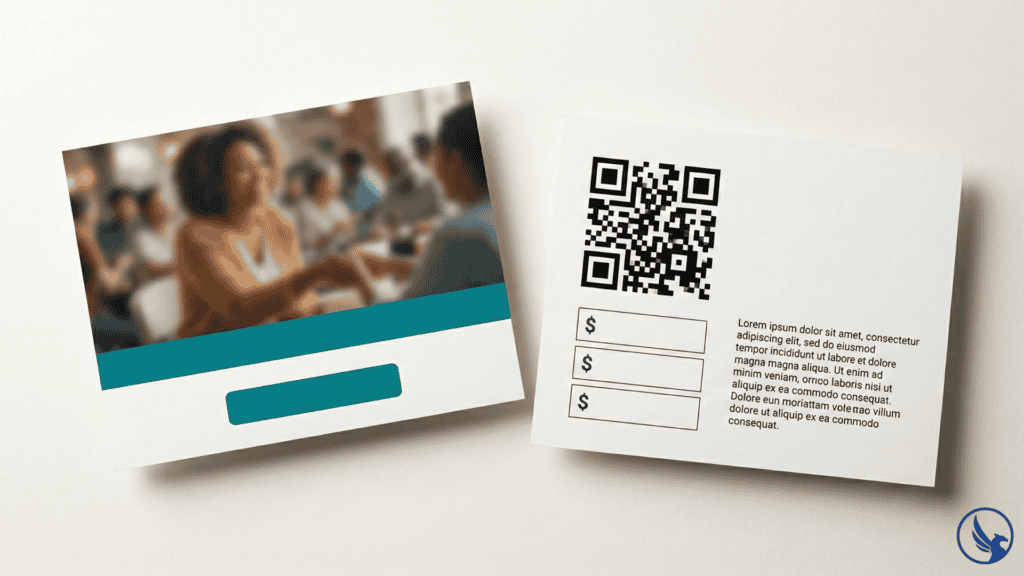
The single most powerful element on a nonprofit fundraising postcard is a photograph of a real person — a child receiving a meal, a senior at a meal program, an animal in your shelter — making direct eye contact with the camera. Eye contact in photography creates involuntary emotional engagement. Combine that image with a single, human-scale statistic (“Last year, we served 12,400 meals in [City]”) and a specific, manageable ask, and you have the core of a high-performing appeal.
For detailed design guidance applicable to nonprofit contexts, EDDM Postcard Design and EDDM Design Tips both cover visual hierarchy and emotional design principles. Use EDDM Postcard Templates to find a pre-built layout you can adapt without starting from scratch — this is especially valuable for organizations without a dedicated designer.
Choosing the Right Size for Your Budget and Message
For most nonprofit EDDM campaigns, the 8.5″ × 11″ postcard represents the best balance of impact and cost efficiency. It’s large enough to feature a strong photograph and tell a compelling story without feeling crowded. At the volumes most nonprofits require, the per-piece cost also remains manageable.
If budget is extremely tight — particularly for a small community organization testing EDDM for the first time — a 6.5″ × 9″ postcard can still carry an effective emotional message at a lower print cost. The trade-off is reduced visual real estate, which places even greater pressure on the headline and lead image.
For larger capital campaign launches or gala invitations where impression matters as much as message, stepping up to 9″ × 12″ signals organizational stature and invites a different level of engagement. EDDM Postcard Sizes covers the full range with cost comparisons. Additionally, EDDM Paper Stock Options explains how finish choices — matte vs. gloss, soft-touch coatings — affect the perceived quality of a nonprofit piece.
Back Panel: The Donation Response Zone
The back panel of a nonprofit EDDM postcard deserves as much strategic attention as the front. This is where conversion happens. The back panel should include: a QR code linking to your donation page with a UTM-tagged URL for tracking, a typed-out donation URL for those who prefer not to scan, your organization’s 501(c)(3) designation and EIN, a brief two-sentence mission statement for new audiences, and your mailing address for donors who prefer to send a check.
Critically, the back panel should also include a specific dollar amount ladder. “A gift of $25 feeds a family for a week. $50 keeps our shelter open for a day. $100 sponsors a youth program session” — suggested amounts dramatically increase average gift size compared to open-ended requests. This is one of the highest-ROI copywriting decisions on any fundraising piece.
For tracking donation response back to your EDDM campaign, EDDM Tracking Results covers the full attribution setup — QR code UTM parameters, dedicated phone lines, and connecting donation data to campaign source in your CRM or donor management platform.
Compliance, Budget Planning, and Working With a Print Partner
USPS Requirements Nonprofits Need to Know
EDDM Retail does not offer a nonprofit postage discount — the flat rate applies universally regardless of the sender’s tax status. However, nonprofits that mail at higher volumes and qualify for a permit can access significantly reduced postage rates through the USPS Nonprofit Marketing Mail program, which is separate from EDDM entirely.
For most smaller nonprofits, the Retail pathway — no permit required, drop at your local post office — remains the simplest and most accessible option. Larger organizations mailing above 5,000 pieces per drop should evaluate USPS BMEU submission for operational efficiency. Before any bulk print order, consult EDDM Printing Requirements to confirm dimensional compliance. Always verify current postage rates and program details directly at usps.com/business/every-door-direct-mail.htm before budgeting a campaign.
Building a Realistic Nonprofit EDDM Budget
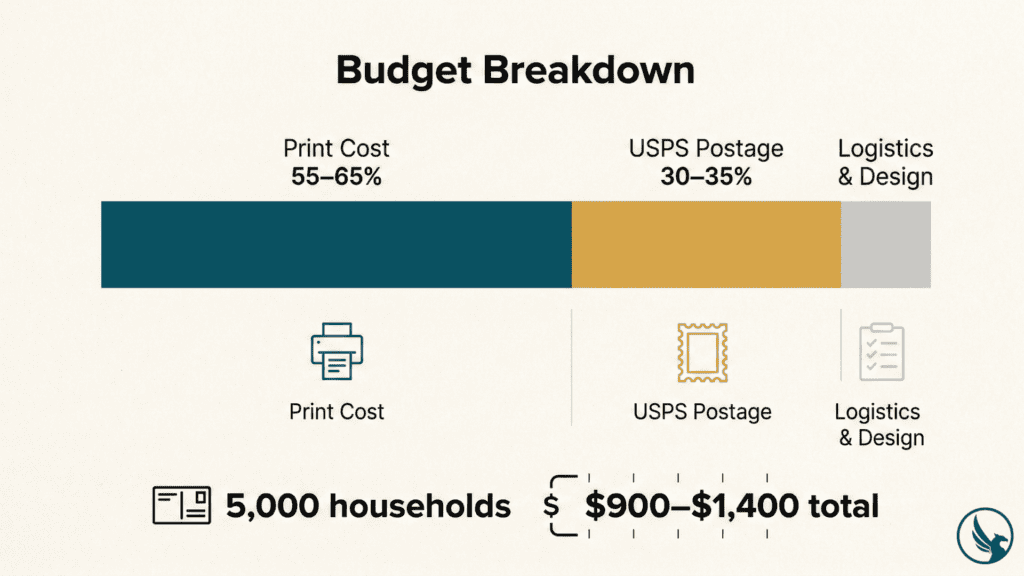
A realistic EDDM campaign budget for a small nonprofit targeting 3,000–5,000 households on an 8.5″ × 11″ postcard typically breaks down as follows: print cost (design, plates, press run, and finishing) represents roughly 55–65% of total campaign cost; USPS postage represents 30–35%; and miscellaneous costs — drop-off logistics and any design fees — account for the remainder.
At 5,000 pieces, total campaign cost commonly falls in the $900–$1,400 range depending on print vendor and paper stock. Using the EDDM ROI Calculator, a nonprofit can model the required response rate and average gift size needed to cover campaign cost and generate a positive return. For an organization with an average first gift of $45, breaking even requires roughly 22–31 first-time donors from a 5,000-piece mailing — a response rate of 0.44–0.62%, well below the industry benchmark for direct mail fundraising.
Advisory: The $45 average first gift figure is used here as an illustrative example, not a published benchmark. Average first gift size varies significantly by organization type, cause category, audience demographics, and ask structure. Use your own organization’s donor data — or sector benchmarks from the AFP Fundraising Effectiveness Project — to model your specific break-even scenario before committing to a campaign.
Partnering With a Full-Service EDDM Printer
Nonprofits benefit particularly from working with a full-service EDDM partner rather than self-managing print production and postal submission. The operational complexity of preparing USPS-compliant bundles, completing EDDM paperwork, and coordinating multi-route drops is real. Moreover, staff time spent on logistics is staff time not spent on programs or donor relations.
CRST provides end-to-end EDDM services including file setup review, USPS-compliant print production, and postal submission — with a team experienced in the specific requirements nonprofits face when scaling outreach on a constrained budget. Request an estimate to get a detailed campaign proposal, or contact the team for guidance on structuring a first nonprofit EDDM campaign. To see the full service offering, visit our EDDM printing services.
For organizations new to direct mail entirely, EDDM First Campaign Guide and EDDM Mistakes to Avoid are both essential reading before committing to a print order. If your board is weighing EDDM against a digital fundraising push, EDDM vs. Digital Ads provides the channel comparison data that makes the case for physical mail in a donor-acquisition context.
Start Your EDDM Campaign with CRST
For nonprofits, EDDM offers a rare combination: the emotional power of physical mail, the geographic reach of mass outreach, and a cost structure that keeps more of every dollar in your programs rather than your marketing budget.
CRST handles EDDM printing from file setup through postal delivery, with a team that knows USPS compliance inside out and a track record across industries. Explore our full EDDM printing services to see how we support campaigns from first template to final delivery. Ready to move forward? Request an estimate or contact our team with your project details.
For the complete breakdown of how the program works from start to finish, see our EDDM Guide.