
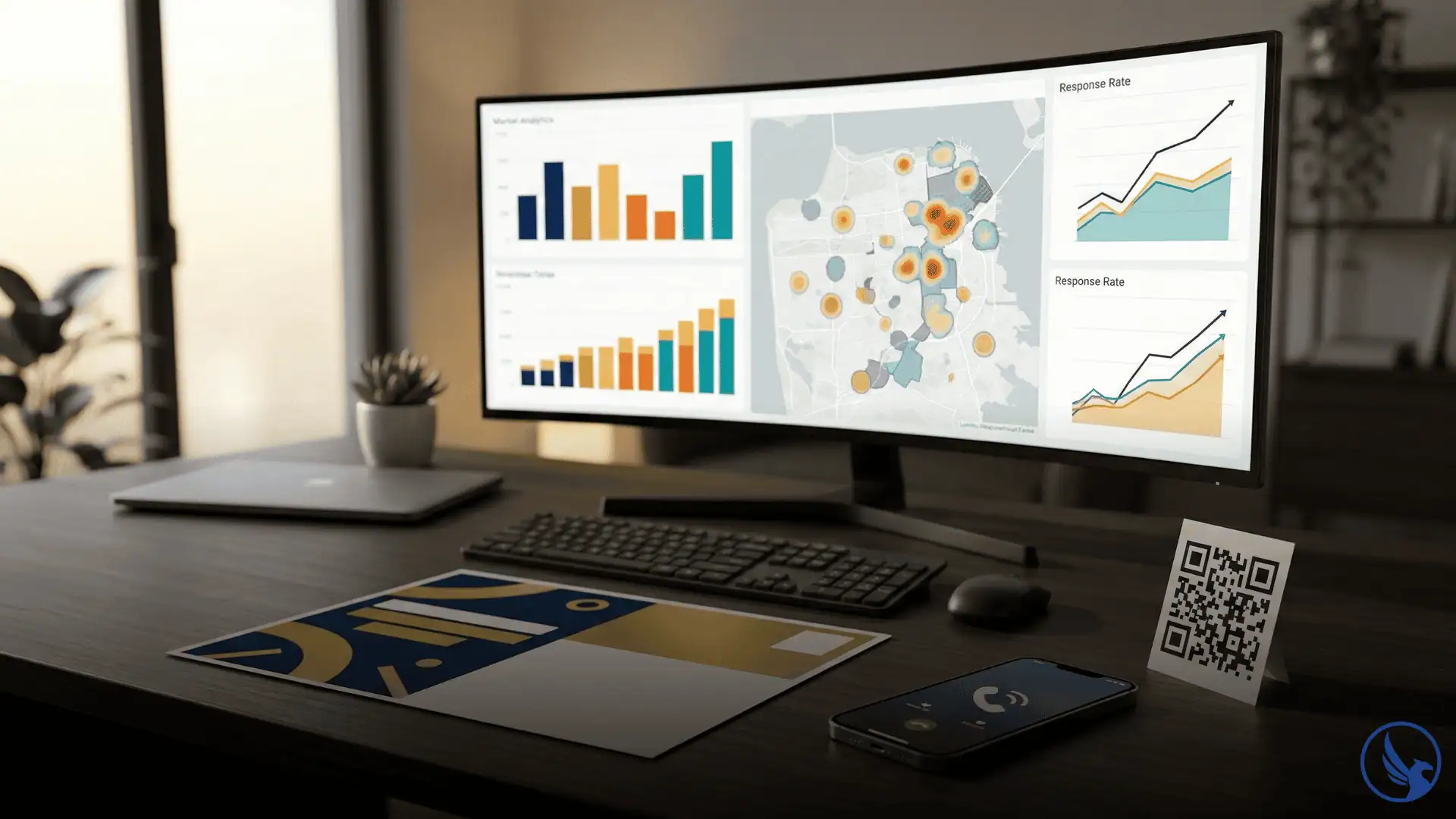
EDDM tracking results is the piece of direct mail strategy most businesses skip — and it’s the reason so many campaigns get written off as “hard to measure” rather than optimized and scaled. The truth is that Every Door Direct Mail is entirely measurable. It just requires building the tracking infrastructure into the campaign before the postcards hit mailboxes, not after.
This guide covers every practical method for tracking EDDM campaign performance — from dedicated phone numbers and QR codes to landing page attribution, Informed Delivery integration, and the reporting frameworks that turn raw response data into decisions. For the full EDDM system overview, start at CRST and the EDDM Guide.
Why EDDM Tracking Results Are Harder to Ignore Than You Think
The Cost of Not Measuring
Every business that mails without tracking is making the same gamble: spending on print and postage, then hoping the phone rings more than usual. Without attribution, there’s no way to know whether the campaign drove ten calls or zero. There’s also no way to know whether the 8.5″ × 11″ postcard outperformed the 6.5″ × 9″, or whether the spring drop converted better than the fall one.
The absence of data doesn’t just prevent optimization — it actively erodes confidence in direct mail as a channel. Campaigns without tracking get cut at the first budget review because no one can defend them with numbers. In contrast, campaigns that are tracked, even modestly, generate the data needed to argue for larger budgets and better creative. As a result, measurement isn’t a nice-to-have. It’s the mechanism that keeps direct mail funded.
For context on what measurable EDDM performance actually looks like, EDDM Response Rates provides industry benchmarks. According to the ANA Response Rate Report, direct mail achieves response rates of 4–9% for house lists and 1–5% for prospect lists — both significantly higher than email or digital display at comparable spend levels.
Advisory: The ANA response rate ranges distinguish between house lists (existing customers) and prospect lists (cold audiences). EDDM campaigns targeting unsegmented carrier routes function as prospect mailings. The 1–5% prospect range is the more applicable benchmark for most EDDM campaigns. The Data & Marketing Association reports a 0.5%–2% range for prospect direct mail as a broader baseline. Response rates vary significantly by offer quality, creative, and industry — use the EDDM ROI Calculator to model scenarios before committing to a campaign.
What “Tracking” Actually Covers
Tracking an EDDM campaign means capturing data at every point where a recipient moves from passive mail recipient to active lead or customer. Specifically, that includes the first call or contact, the method they used to reach out, which campaign or drop they responded to, and whether they ultimately converted to a sale.
Done well, EDDM tracking results tell you cost per lead, cost per acquisition, and response rate by route and drop date. They also give you return on ad spend — the same metric used to evaluate any digital channel. Direct mail can deliver all of these just as cleanly as digital when the right systems are in place.
The Core EDDM Tracking Methods
Dedicated Tracking Phone Numbers
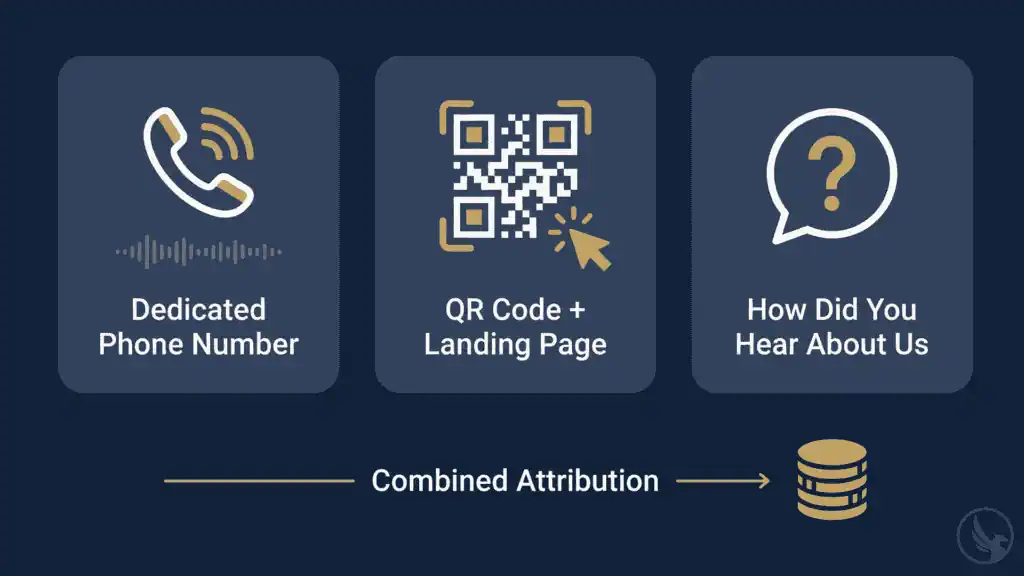
The single most reliable EDDM tracking method is a dedicated phone number printed exclusively on each campaign’s postcards. When a recipient calls that number, the call is attributed to that specific mailing with certainty — no survey, no guesswork, no modeling required.
Platforms like CallRail and CallTrackingMetrics let you provision unique numbers for each campaign drop, route cluster, or creative variation. Calls are logged with timestamp, duration, and recording where legally permitted.
Advisory: CallRail and CallTrackingMetrics are named here as examples of established call tracking platforms at time of publication. These are not endorsements. Pricing, features, and availability change — evaluate current options and confirm compatibility with your existing systems before selecting a platform.
As a result, you can compare call volume across routes, identify which areas responded most strongly, and calculate cost per inbound lead with precision.
For EDDM bulk mailing campaigns spanning multiple routes, dedicated numbers per route cluster enable route-level attribution — the most granular measurement available in direct mail. In practice, this means you can cut underperforming routes from subsequent drops and reallocate budget to routes with proven response. The core insight is straightforward: which neighborhoods called, and which didn’t.
QR Codes and Campaign Landing Pages
QR codes have genuinely transformed EDDM measurement. A QR code on your postcard links to a campaign-specific landing page — one with a UTM parameter or unique URL slug that identifies traffic as coming from that specific mailing. When a recipient scans the code, visits the page, and fills out a form or books an appointment, that conversion is captured in your analytics platform with full attribution.
The key distinction is building a dedicated landing page for each campaign rather than linking to your homepage. A homepage visit from a QR scan is nearly impossible to attribute reliably. In contrast, a landing page at yourbusiness.com/spring-hvac-special with a tag like ?utm_source=eddm&utm_campaign=spring-2026 is clean, countable, and reportable.
According to the USPS Household Diary Study, combining physical mail with a digital response mechanism increases overall campaign response rates. QR codes provide exactly this bridge — giving tech-comfortable recipients a frictionless path from physical piece to digital conversion.
For design guidance on incorporating QR codes without cluttering your layout, see EDDM Postcard Design and EDDM Design Tips.
Manual Attribution: “How Did You Hear About Us?”
For businesses without call tracking software, the simplest system is asking every new lead or customer how they found you. Consistency is essential here: every person who answers the phone, responds to a web inquiry, or completes a sale should ask the question and record the answer.
Manual attribution undercounts direct mail response — many customers won’t remember or mention the postcard. Still, it provides useful directional data. If your baseline direct mail response was zero before a campaign and suddenly 15% of new callers mention a postcard over a six-week window, that’s a meaningful signal. Think of it as a supplement to harder tracking methods rather than a standalone system.
Advanced EDDM Tracking: Informed Delivery and Omnichannel Attribution

USPS Informed Delivery Integration
USPS Informed Delivery is a free service that sends participating households a daily email digest showing grayscale scans of incoming mail. For marketers, it includes a Ride-Along feature: you can attach a full-color digital image and a clickable link to your EDDM mailing’s Informed Delivery notification. That way, recipients see your postcard digitally before it arrives physically.
This creates a measurable digital touchpoint alongside your physical mail piece. The click-through rate on your Informed Delivery ride-along — trackable via UTM parameters — becomes an additional data stream for your EDDM tracking results. Moreover, recipients who click through the email before the physical card arrives tend to be the highest-intent prospects in your mailing.
For a full setup guide, EDDM vs. Informed Delivery walks through the enrollment process, ride-along image specs, and how to integrate click data with your campaign reporting. You can also learn more directly from the USPS Informed Delivery business portal.
Multi-Drop Attribution and Campaign Sequencing
One of the most valuable applications of EDDM tracking data is understanding how response accumulates across multiple drops to the same routes. Most businesses see their strongest response on the second or third mailing to a given neighborhood — brand recognition from the first mailer primes recipients to act on the next one.
Tracking this pattern requires maintaining consistent campaign identifiers across drops and comparing response rates drop-over-drop for the same route set. When response increases from drop 1 to drop 2, you have data-backed justification for continuing the cadence. When it plateaus or declines, you have a clear signal to refresh creative or adjust the offer.
For timing strategy, see Best Time to Send EDDM. Additionally, EDDM Mailing Routes covers how route-level performance data should shape your next round of route selection.
Building a Simple EDDM Reporting Dashboard
The Metrics That Matter
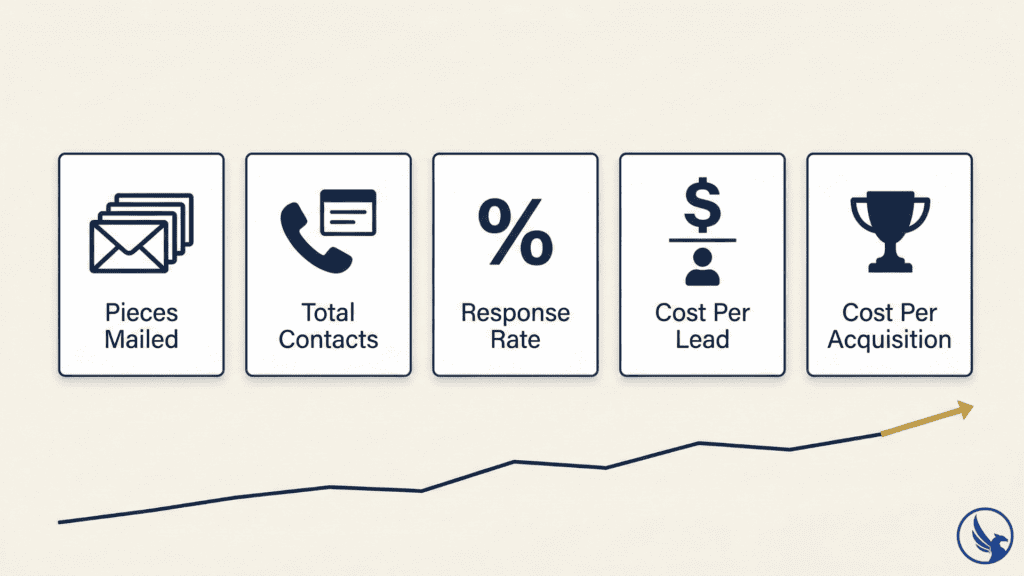
For most small and mid-sized businesses, a simple reporting structure tracks five core metrics per drop: total pieces mailed, total inbound contacts attributed (calls plus form fills plus walk-ins), response rate, cost per lead, and cost per acquired customer.
These five numbers — tracked consistently across every drop — build a dataset that enables genuine optimization over time. You’ll see which routes outperform, which offers generate stronger response, and whether your cost per acquisition is trending toward profitability or away from it. Ultimately, this discipline is what separates an EDDM program that grows from one that gets cut at the next budget meeting.
Before each campaign drops, use the EDDM ROI Calculator to model expected performance against your cost structure and average customer value. Then compare projections to actuals after each drop to refine your assumptions over time.
Connecting EDDM Data to Your CRM
The final step in a mature tracking system is connecting campaign attribution data to your CRM or customer database. When a lead from a specific postcard campaign converts, that customer record should carry the campaign source. Over time, this lets you calculate true lifetime value by acquisition channel.
That data answers the most important question in any marketing budget conversation: what is a direct mail-acquired customer worth compared to one from search, social, or referral? For many service businesses, direct mail customers show higher average transaction values and stronger retention — because the channel tends to attract homeowners rather than impulse buyers.
For broader channel comparisons, EDDM vs. Digital Ads and EDDM vs. Targeted Mail are most useful once you have your own tracking data to benchmark against. If you’re newer to the channel, EDDM First Campaign Guide and EDDM for Small Business both include tracking setup guidance for first-time mailers. To put the full economics in context, see EDDM Cost and Pricing. Finally, contact CRST to discuss building tracking into your next campaign from the start, or request a campaign estimate that includes tracking recommendations.
Start Your EDDM Campaign with CRST
When EDDM tracking results are built into a campaign from the start — dedicated phone numbers, QR landing pages, Informed Delivery integration, and route-level attribution — every drop becomes a learning event that makes the next one more profitable.
CRST handles EDDM printing from file setup through postal delivery, with a team that knows USPS compliance inside out and a track record across industries. Explore our full EDDM printing services to see how we support campaigns from first template to final delivery. Ready to move forward? Request an estimate or contact our team with your project details.
For the complete breakdown of how the program works from start to finish, see our EDDM Guide.