
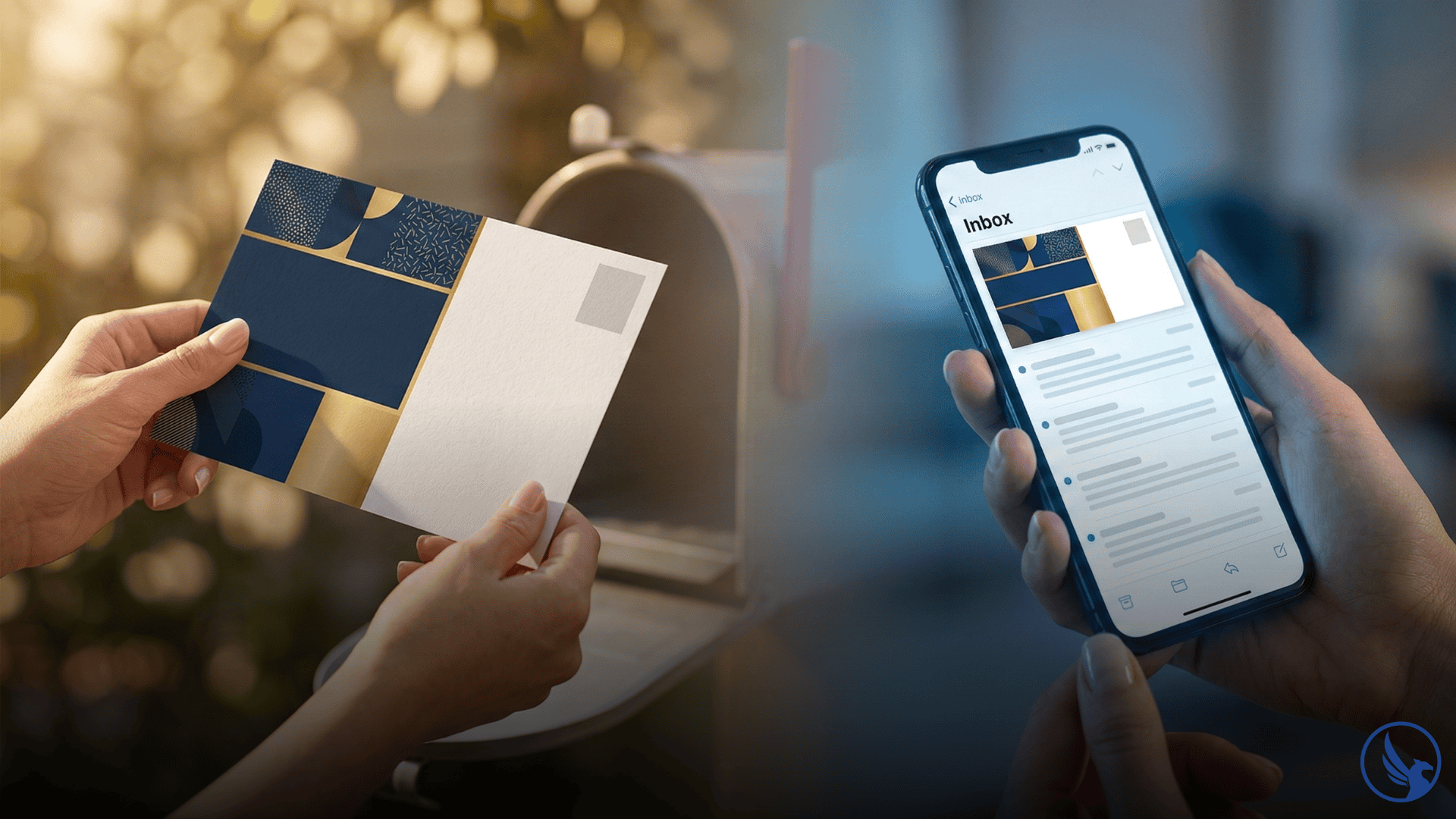
When marketers talk about EDDM vs Informed Delivery, they’re often framing the question incorrectly — as a choice between two competing approaches when the most effective campaigns use both simultaneously. Every Door Direct Mail and USPS Informed Delivery are not substitutes for one another. They are complementary layers of the same mail campaign, one physical and one digital, that together create a multi-touchpoint customer contact that neither achieves alone.
Why the Combined Approach Changes the Equation
Understanding how Informed Delivery works, how it integrates with EDDM, and what the combined strategy delivers for response rates and attribution is the difference between running a postcard campaign and running an omnichannel direct mail campaign. For the foundational overview, see the EDDM Guide at CRST before building your first integrated campaign.
- 100% household coverage on selected routes
- $0.260 flat-rate postage per piece (EDDM Retail)
- No voter/customer list required
- Arrives in physical mailbox
Strategy
- Reaches ~30–40% of households (enrolled)
- Full-color Ride-Along image + clickable URL
- Arrives morning of delivery — hours early
- UTM-trackable click-through data
What Informed Delivery Is and How It Works
The USPS Digital Mail Preview Service
Informed Delivery is a free USPS consumer service that sends participating households a daily email digest each morning. That digest shows grayscale scans of incoming letter-sized mail pieces — along with package tracking updates — before those pieces arrive in the physical mailbox. As of recent USPS data, more than 60 million consumers have enrolled in Informed Delivery. Enrollment is concentrated among homeowners, higher-income households, and the 35–65 age demographic — precisely the audiences most valuable to a wide range of local businesses.
According to the USPS Informed Delivery program overview, the service is free for consumers and is designed to help recipients plan for and anticipate incoming mail. For businesses, this creates an entirely new touchpoint: the digital preview of your physical mail piece, seen in an email inbox before the postcard arrives at the door.
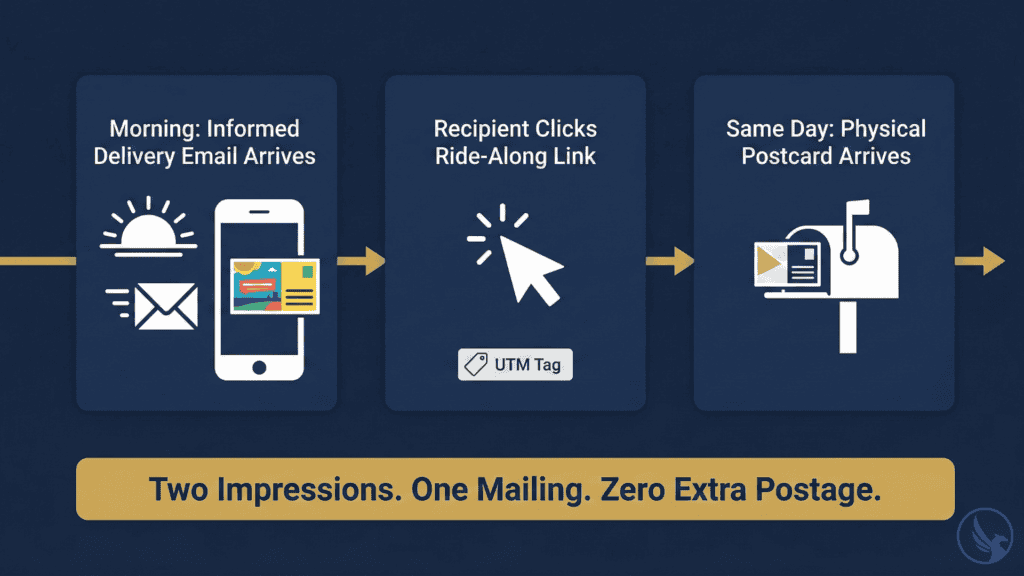
The critical distinction is timing. An Informed Delivery email arrives the morning of the day the mail is delivered. Specifically, this means a recipient sees a digital preview of your EDDM postcard hours before it lands in their mailbox — creating two separate impressions from a single physical mailing without any additional postage cost.
The Ride-Along Feature: Your Digital Add-On
The Informed Delivery marketing capability that matters most for EDDM campaigns is the Ride-Along. When a business registers a campaign through the USPS Mailer Portal and links it to a physical mailing, USPS includes a full-color digital image — the Ride-Along — alongside the grayscale scan of the physical piece in the Informed Delivery email. This Ride-Along image can include a clickable URL. As a result, a passive email preview becomes an active digital touchpoint with measurable click-through data.
The Ride-Along capability transforms the EDDM vs Informed Delivery conversation entirely. Your physical postcard and your digital Ride-Along image arrive in the same Informed Delivery email, on the same morning, reinforcing each other before either has reached the recipient’s hands. Consequently, a motivated recipient can click through from the email directly to your website, landing page, or booking page — hours before the physical postcard even arrives.
Furthermore, the Ride-Along click data is trackable via UTM parameters on the linked URL. This creates a measurable digital attribution stream from what would otherwise be a purely physical campaign. That attribution stream is the integration point that converts EDDM from a one-channel campaign into a genuinely omnichannel one.
EDDM vs Informed Delivery: Understanding the Differences
Coverage, Targeting, and Reach
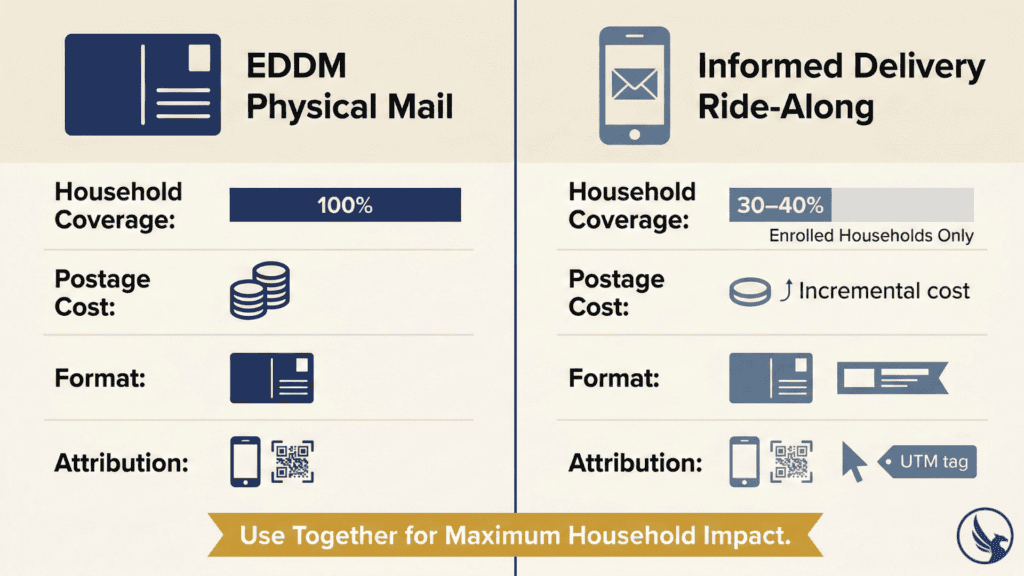
EDDM delivers a physical postcard to every residential and business address on a selected carrier route — regardless of whether the household participates in Informed Delivery. Informed Delivery, by contrast, only reaches households where at least one member has enrolled in the service. As a result, the digital Ride-Along touchpoint reaches a subset of your physical mailing list — not a replacement for it.
This distinction has practical implications for campaign strategy. The physical EDDM piece remains the primary campaign vehicle — it reaches 100% of households on the selected routes. The Informed Delivery Ride-Along is an amplification layer. It adds a digital preview touchpoint for the enrolled portion of those households, which USPS estimates at approximately 30–40% of eligible addresses in actively enrolled markets.
Consequently, the right way to think about EDDM vs Informed Delivery is not as competing choices but as sequential layers: EDDM provides universal household coverage, and Informed Delivery adds a digital pre-touch for the enrolled subset. For a broader comparison of EDDM against digital-only alternatives at equivalent spend, EDDM vs. Digital Ads provides the full channel comparison framework.
Cost Structure Comparison
EDDM costs include print production and flat-rate USPS postage — currently $0.260 per piece through EDDM Retail. For the most current rate, always verify at usps.com/business/every-door-direct-mail.htm before finalizing budget projections. Informed Delivery Ride-Along campaigns have a separate cost structure through the USPS Mailer Portal. As of recent USPS pricing guidance, Ride-Along campaigns for EDDM are available at approximately $0.03–$0.05 per piece for enrolled households reached. However, pricing is subject to change — always verify current rates directly at the USPS Mailer Portal.
The incremental cost of adding an Informed Delivery Ride-Along to an existing EDDM campaign is therefore modest relative to the additional touchpoint value. For a 5,000-piece EDDM campaign with 35% Informed Delivery enrollment in the targeted routes, the Ride-Along reaches approximately 1,750 households at an incremental cost of roughly $52–$87. That is a cost-per-additional-impression that rivals the most efficient digital display options. For full campaign cost modeling, EDDM Cost and Pricing and EDDM Postcard Printing Cost cover the print side of the budget equation.
How to Set Up an EDDM + Informed Delivery Campaign
Step 1 — Register in the USPS Business Customer Gateway
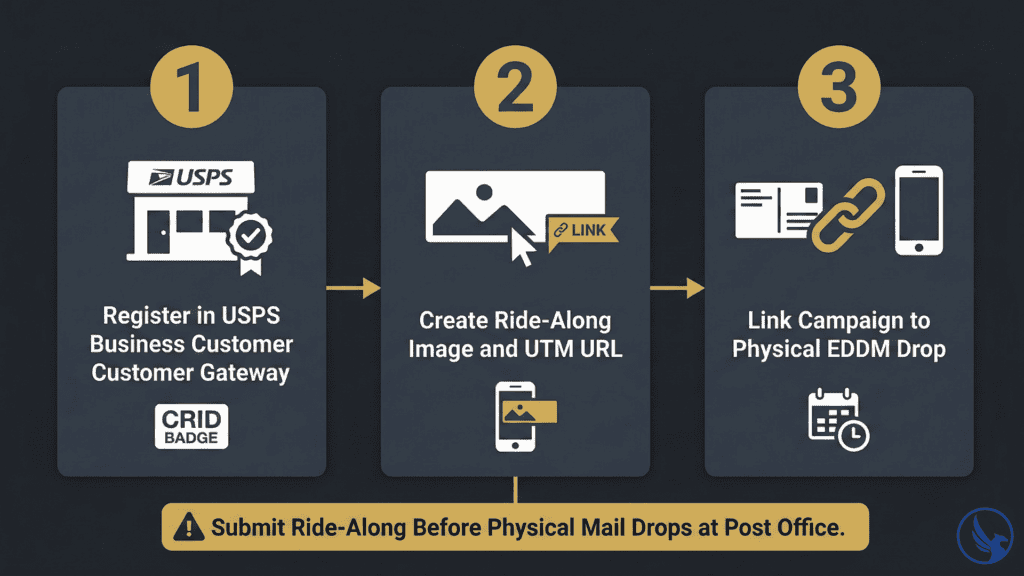
To activate Informed Delivery Ride-Along for your EDDM campaign, you must register as a mailer in the USPS Business Customer Gateway. This is a free registration that gives you access to the Mailer Portal, where Informed Delivery campaigns are created and managed. The process requires a USPS Customer Registration ID (CRID), which is issued during registration.
The USPS Business Customer Gateway registration process and the specific steps for creating an Informed Delivery campaign are subject to update by USPS. Therefore, always follow the current instructions at the official USPS portal rather than third-party setup guides, which may be outdated. If working with a full-service EDDM printer like CRST, confirm whether they manage the Informed Delivery campaign setup as part of their service or whether it requires separate client-side registration. Contact CRST for current guidance on Informed Delivery integration for campaigns managed through CRST.
Step 2 — Create Your Ride-Along Image and URL
Your Ride-Along image is a full-color digital graphic displayed in the Informed Delivery email alongside the grayscale scan of your physical postcard. USPS specifies exact pixel dimensions and file format requirements for Ride-Along images — typically a horizontal banner format. Consult current USPS specifications at the Mailer Portal for exact requirements, as these are updated periodically.
The Ride-Along image should complement your physical postcard — matching the offer, the visual palette, and the headline — while being optimized for email display rather than print. Specifically, the image must work at small display sizes within the email digest layout. Text must be large enough to read on a mobile screen. Additionally, the color version should reinforce what recipients will see moments later as a grayscale scan. For EDDM postcard design principles that translate effectively to Ride-Along image creation, EDDM Postcard Design and EDDM Design Tips cover the visual hierarchy framework relevant to both formats.
The Ride-Along URL should be a campaign-specific landing page with UTM parameters — for example, ?utm_source=informed-delivery&utm_campaign=spring-2026 — that allow you to track click-through traffic from the Informed Delivery email separately from other sources. This is the attribution data point that makes the Informed Delivery layer measurable.
Step 3 — Link the Campaign to Your Physical EDDM Drop
Once your Ride-Along image and URL are set up in the Mailer Portal, you link the Informed Delivery campaign to the specific EDDM mailing using its postage statement or mailing ID. USPS then automatically associates the Ride-Along with the physical piece across all enrolled households on the targeted routes.
The timing of this linkage matters. The campaign must be submitted and approved in the Mailer Portal before the physical mailing is accepted at the post office — not after. Therefore, plan for additional lead time when incorporating Informed Delivery into your campaign timeline. For the full production lead-time planning framework, Best Time to Send EDDM covers the backward-planning calendar approach that accommodates the added Informed Delivery setup step.
What the Combined Strategy Delivers
Two Touchpoints, One Mailing Cost Structure
The core value proposition of combining EDDM with Informed Delivery is two-touchpoint coverage from a single physical campaign investment. The digital Ride-Along arrives first — in the morning email digest — creating initial brand awareness and an opportunity for immediate digital action. The physical postcard arrives hours later, reinforcing the message in a tangible format that stays in the home.
Research on multi-touchpoint marketing consistently shows that campaign effectiveness increases with each additional relevant impression. According to the USPS Household Diary Study, combining physical mail with a digital component increases household response rates compared to physical mail alone. The Informed Delivery Ride-Along is consequently the most cost-efficient way to add a digital layer to an EDDM campaign without building a separate email list or paying for digital display impressions.
Furthermore, for businesses already running EDDM Tracking Results systems — dedicated phone numbers, QR codes, UTM landing pages — the Informed Delivery click data adds a third measurable attribution stream. In turn, that makes the combined campaign more analytically complete than EDDM alone.
Response Rate Implications
The direct response rate impact of adding Informed Delivery to an EDDM campaign varies by industry, offer, and enrolled household rate on the targeted routes. However, campaigns that incorporate Informed Delivery Ride-Alongs consistently report incremental response from the digital touchpoint — particularly among the 35–55 age demographic. That group has among the highest Informed Delivery enrollment rates and also represents a high-value audience for most local service businesses.
The most meaningful response rate data comes from your own campaign tracking. A properly structured combined campaign — with separate UTM parameters for Ride-Along clicks and QR code scans from the physical piece — allows you to measure the incremental response attributable to Informed Delivery independently. This is the data that justifies the incremental Ride-Along investment for future campaigns. For industry benchmark response rate data that contextualizes what to expect from a combined campaign, EDDM Response Rates covers the full range of direct mail performance data across categories.
Practical Considerations for the Combined Approach
Industries That Benefit Most
The EDDM plus Informed Delivery combination delivers its strongest incremental value in categories where the decision-making process involves multiple impressions before conversion. Home services, dental and medical practices, real estate, financial services, and restaurants with reservation-based dining all fall into this group. In these categories, the morning digital preview plants the initial impression. The physical postcard then reinforces it. Together they create the repetition effect that single-touchpoint campaigns achieve only through multiple drops.
For home services specifically — where a homeowner may need weeks to move from awareness to a service appointment — the two-touchpoint approach increases the probability that one of the impressions lands at the moment the recipient is actively thinking about the service category. See EDDM for Home Services and EDDM for Dentists for category-specific campaign frameworks that benefit most from Informed Delivery integration.
For nonprofits running fundraising appeals, the Informed Delivery Ride-Along can include a direct link to a donation page. Consequently, it converts an awareness touchpoint into an immediate giving opportunity before the physical appeal arrives. EDDM for Nonprofits covers the full fundraising campaign framework relevant to this strategy.
When the Combination Adds Less Value
The Informed Delivery layer adds the least incremental value in campaigns where the physical postcard already generates immediate response without a digital pre-touch. Flash sales, time-limited local offers with very short expiration windows, and high-frequency recurring campaigns where brand recognition is already established are all examples. In these cases, the Ride-Along setup overhead may not justify the incremental response it generates.
Additionally, businesses targeting routes with lower Informed Delivery enrollment rates — rural routes, lower-income urban areas, and older residential markets — will reach a smaller enrolled percentage. This reduces the Ride-Along’s practical reach. Therefore, for campaigns where the targeted routes have demonstrably low enrollment, the resource investment in setting up an Informed Delivery campaign may be better allocated toward additional physical mail volume or creative optimization.
For guidance on choosing between EDDM volume scaling and omnichannel layering as competing uses of campaign budget, EDDM Bulk Mailing and the EDDM ROI Calculator together provide the cost-per-impact modeling needed to make that decision analytically rather than intuitively.
For businesses ready to build their first integrated EDDM plus Informed Delivery campaign, EDDM First Campaign Guide covers the foundational EDDM mechanics. Additionally, EDDM Mistakes to Avoid flags the production and setup errors most likely to disrupt a first combined campaign. Request an estimate to discuss how Informed Delivery integration fits into a CRST-managed campaign, or visit our EDDM printing services for the full service overview.
Start Your EDDM Campaign with CRST
Understanding EDDM vs Informed Delivery as a combined strategy — physical postcards providing universal household coverage, Informed Delivery Ride-Alongs adding a measurable digital pre-touch for enrolled households — gives every campaign a genuine omnichannel reach that neither channel achieves independently.
CRST handles EDDM printing from file setup through postal delivery, with a team that knows USPS compliance inside out and a track record across industries. Explore our full EDDM printing services to see how we support campaigns from first template to final delivery. Ready to move forward? Request an estimate or contact our team with your project details.
For the complete breakdown of how the program works, see our EDDM Guide.