

EDDM bulk mailing is what separates a one-time postcard experiment from a genuine customer acquisition engine. Sending to a single mail route tests the water. Scaling to dozens of routes — consistently, efficiently, and without ballooning cost per piece — is where direct mail becomes a competitive advantage.
This guide covers everything you need to scale an Every Door Direct Mail campaign: how bulk volume affects pricing, how to select and sequence routes strategically, how to manage print production at scale, and how to avoid the operational mistakes that erode margins when campaigns grow. For a foundational overview before diving in, see the EDDM Guide at CRST.
- Start close, expand outward in rings
- Re-mail proven zones at higher frequency
- Saturate routes near active job sites
- Offset printing wins above ~15K pieces
- 16pt matte stock: best quality/cost ratio
- Lock bleed + indicia zones in master template
What EDDM Bulk Mailing Actually Means
Volume Thresholds and What Changes at Scale
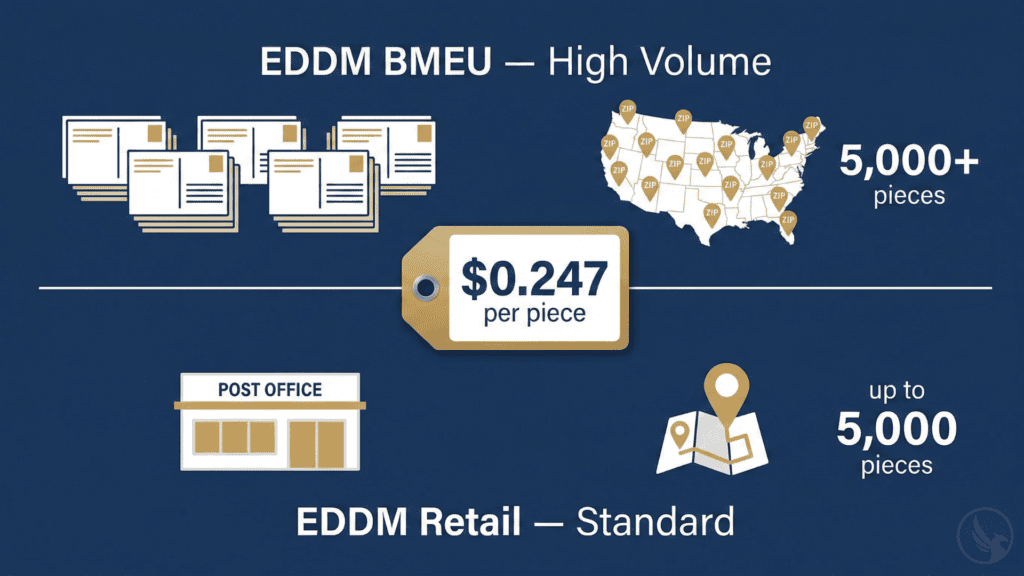
The term “bulk mailing” in the EDDM context doesn’t have a single official threshold — it’s relative. However, in practical terms, campaigns start behaving differently once you exceed roughly 5,000 pieces per drop. Below that level, most businesses are handling drop-off logistics manually, printing smaller runs, and targeting a handful of local routes. Above it, production economics, postal logistics, and targeting strategy all require a more systematic approach.
According to USPS EDDM program guidelines, there is no upper limit to how many pieces you can mail through the EDDM Retail or Business Mail Entry Unit (BMEU) programs. Furthermore, the flat-rate postage structure — currently $0.260 per piece for EDDM Retail — remains consistent regardless of volume, which is one of the strongest arguments for scaling.
Advisory: USPS EDDM Retail postage rates are subject to change. Always verify the current rate at usps.com/business/every-door-direct-mail.htm before finalizing any campaign budget. The rate cited here reflects pricing at time of publication.
You’re not paying a premium for reach — you’re paying the same rate per door whether you mail 500 pieces or 500,000. For a full breakdown of current pricing, see EDDM Cost and Pricing.
That said, the mechanics of submitting, bundling, and delivering large-volume EDDM campaigns are more complex than simply printing more postcards. Understanding those mechanics is what allows you to scale without friction.
EDDM Retail vs. EDDM BMEU for Bulk Campaigns
There are two pathways for submitting EDDM mailings, and the choice matters significantly at scale. EDDM Retail allows businesses to submit up to 5,000 pieces per day per ZIP code at their local post office. It’s accessible, requires no mailing permit, and works well for smaller campaigns or businesses mailing a single market.
EDDM BMEU (Business Mail Entry Unit) removes the 5,000-piece daily cap and is designed for high-volume mailers. It requires working with a commercial printer or mailing service that has a Business Mailer Account, but it allows you to submit entire regional campaigns — tens of thousands of pieces across multiple ZIP codes — in a single coordinated drop. For any campaign exceeding 5,000 pieces per mailing cycle, BMEU is the operationally correct choice.
CRST operates as a full-service EDDM provider with BMEU capabilities. Request an estimate to understand how BMEU submission can be structured for your volume and geography.
Strategic Route Selection at Scale
Moving From Neighborhoods to Markets
When you’re mailing 500 pieces, you pick the streets closest to your business and hope for the best. When you’re scaling EDDM bulk mailing across 50,000 households, route selection becomes a strategic discipline.
The USPS route selection tool allows you to filter routes by demographic data — average household income, median age, household size, and urbanicity. At scale, these filters become the foundation of a targeting model. A home services company expanding from one city to a metropolitan region should be selecting routes based on home ownership rates, median home age, and income bands — not just geographic proximity.
For a deeper breakdown of how to use route data effectively, EDDM Mailing Routes covers the selection methodology in detail. Pair this with EDDM for Small Business if you’re scaling from a local base to a broader market, or EDDM vs. Targeted Mail for a comparison of EDDM route saturation versus list-based demographic targeting at high volumes.
Sequencing Routes for Maximum Market Penetration
One of the most underused strategies in EDDM bulk mailing is phased geographic sequencing — mailing routes in a deliberate pattern rather than saturating an entire market simultaneously. There are two primary approaches:
Concentric expansion: Start with the routes closest to your business or highest-converting existing customers, then mail progressively outward in rings over 6–8 week intervals. This approach builds brand recognition in proven territory before investing in more distant, untested routes. Consequently, it preserves budget for re-mailing your best-performing zones at higher frequency while testing the edges of your market.
Competitor displacement: Identify neighborhoods where a competitor has strong market presence and deliberately saturate those routes with a superior offer during the same mailing window. This is particularly effective in categories like roofing, HVAC, and pest control where local reputation is the primary decision factor.
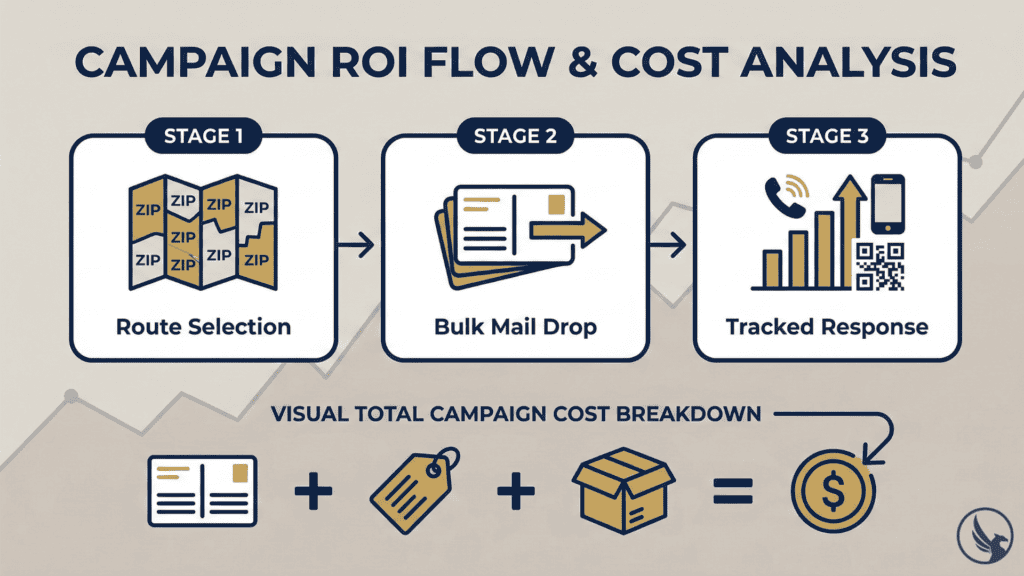
Both approaches benefit from tracking which routes produce inbound calls and which underperform. EDDM Tracking Results details the measurement systems — dedicated phone numbers, QR codes, landing page UTMs — that make route-level performance data actionable.
Print Production at Scale
Learn how EDDM bulk mailing works at scale — from route selection and print volume to postage savings and campaign sequencing that drives real results.

How Volume Affects Unit Cost
Print economics shift dramatically at bulk volumes, and understanding the break points can significantly reduce your cost per piece. Digital printing (used for smaller runs) typically becomes cost-inefficient above 5,000–10,000 pieces. Offset printing — the standard for true bulk EDDM campaigns — delivers substantially lower per-unit costs at 25,000 pieces and above, with further savings at 50,000, 100,000, and beyond.
The trade-off is minimum quantities and setup costs. Offset printing has higher upfront plate costs but the per-piece rate drops fast enough that most campaigns above 15,000 pieces see better economics on offset. Your printer should be able to provide a clear cost curve showing where the crossover point falls for your specific postcard size and paper stock.
Advisory: Print cost break points vary by vendor, press type, and current material costs. The thresholds cited above (5,000–10,000 for digital crossover; 15,000+ for offset advantage) reflect typical commercial print industry ranges at time of publication. Request a current cost curve from your vendor before making production method decisions.
For a full cost breakdown across sizes and volumes, see EDDM Postcard Printing Cost and EDDM Cost and Pricing. Use the EDDM ROI Calculator to model how volume-driven savings affect your cost-per-acquisition at different campaign scales.
Paper Stock and Finish Decisions for High-Volume Runs
At small volumes, paper and finish choices are largely aesthetic. At bulk scale, they have meaningful cost and performance implications. Heavier stock (16pt or above) performs better in the mailbox — it doesn’t bend or curl during postal handling, which preserves the visual impression of the piece — but it adds cost per unit. At 100,000 pieces, the difference between 14pt and 16pt stock can represent thousands of dollars.
However, the reverse is also true: cutting to the lightest allowable stock to save money can undermine the premium impression you’re paying to deliver. The sweet spot for most EDDM bulk mailing campaigns is 16pt coated stock with a matte or soft-touch finish — substantial enough to command attention without pushing into premium territory unnecessarily.
For a detailed guide on stock options, finish types, and how they interact with print method at scale, EDDM Paper Stock Options covers the full range of decisions. Additionally, review EDDM Printing Requirements before finalizing any bulk print order to confirm your file and stock specifications meet postal compliance standards.
File Preparation and Version Control at Scale
One of the most operationally painful aspects of EDDM bulk mailing is managing print files when running multiple versions across dozens of routes. A campaign targeting 40 ZIP codes may involve seasonal offer variations, regional phone number swaps, or different creative versions for different audience segments. Without a disciplined file management system, the risk of printing the wrong version — or printing a file with a prepress error — increases with every additional version.
Best practices at scale include: maintaining a master template with locked compliance zones (bleed, safe area, indicia placement), building variations as linked layers rather than duplicate files, and requiring a proofing sign-off for every version before press. EDDM Postcard Templates covers the template infrastructure that makes version control manageable. See also EDDM Mistakes to Avoid for the production errors most likely to surface when scaling. For technical file preparation and color profile requirements, the USPS Domestic Mail Manual is the authoritative compliance reference.
Postage, Submission, and Logistics at Scale
Calculating Total Campaign Cost Accurately
EDDM bulk mailing costs have three components that must all be modeled before committing to a campaign budget: print cost (per-piece plus setup), postage (per-piece, flat-rate), and fulfillment/mailing service fees if you’re working with a vendor rather than self-submitting.
At scale, vendor fulfillment fees — bundling, labeling, transporting to BMEU facilities, coordinating with multiple post offices across ZIP codes — can represent a meaningful portion of total campaign cost.
Advisory: Vendor fulfillment fee structures vary significantly by provider, campaign volume, geographic complexity, and current logistics costs. The percentage ranges cited in this section are directional estimates based on industry norms at time of publication. Always request an itemized quote from your fulfillment vendor before budgeting. For CRST-specific fulfillment pricing, request an estimate.
However, the operational complexity of self-managing a 50,000-piece EDDM submission across multiple markets is significant enough that most businesses above that threshold find vendor fulfillment cost-effective even accounting for the markup.
CRST provides full end-to-end EDDM fulfillment including BMEU submission. Visit our EDDM printing services for a breakdown of what’s included in full-service campaign management, or contact the team directly to discuss logistics for a specific campaign volume and geography.
Managing Multi-ZIP and Multi-Drop Campaigns
Large EDDM bulk mailing campaigns frequently span multiple ZIP codes and multiple drop dates — either because the campaign is rolling out market by market, or because the business wants to stagger delivery to manage inbound call volume. Both are legitimate strategies; the execution requires coordination between your printer, your mailing service, and the postal facilities receiving the material.
Key logistical considerations for multi-drop campaigns: each BMEU submission requires its own paperwork and bundle preparation sorted by carrier route; lead times for large volume jobs typically require 7–14 business days from approved file to in-home delivery; and coordinating multiple drop dates requires confirming postal acceptance windows in advance, as post office capacity varies by region and season.
Advisory: The 7–14 business day lead time estimate reflects typical production and postal processing timelines at time of publication. Actual timelines vary by print vendor capacity, campaign volume, postal facility workload, and seasonal demand peaks. Confirm current lead times directly with your print vendor and BMEU facility before scheduling campaign drops, especially around major holidays or peak mailing seasons.
For timing strategy — including how to sequence drops to align with seasonal demand peaks — Best Time to Send EDDM provides a calendar framework applicable to both single-market and multi-market bulk campaigns.
Measuring ROI on Bulk EDDM Campaigns
Route-Level Attribution
The investment in a bulk EDDM campaign is only defensible if you can measure what’s working. At scale, route-level attribution — knowing which geographic areas are producing calls, conversions, and revenue — allows you to optimize each subsequent drop. This means assigning a unique tracking phone number or QR destination per route cluster, then mapping inbound activity back to the corresponding ZIP codes and routes.
According to the ANA Response Rate Report, direct mail consistently achieves a 4–9% response rate for house lists and 1–5% for prospect lists — significantly higher than email or digital display at comparable budget levels.
Advisory: The ANA response rate ranges cited above distinguish between house lists (existing customers) and prospect lists (cold audiences). EDDM campaigns targeting unsegmented carrier routes function as prospect mailings. The 1–5% prospect range is the more applicable benchmark for most EDDM campaigns. The Data & Marketing Association reports a 0.5%–2% range for prospect direct mail as a broader benchmark. Response rates vary significantly by offer quality, creative, and industry. Use the EDDM ROI Calculator to model conservative, base, and optimistic scenarios before committing to a bulk run.
At bulk EDDM volumes, even a 2% response rate on 50,000 pieces generates 1,000 inbound leads. The math rewards scale — but only if the tracking infrastructure exists to capture it. For a complete measurement framework, EDDM Response Rates and EDDM Tracking Results together cover both benchmark expectations and the tactical attribution systems needed to hit them.
When to Increase Volume vs. Optimize First
A common mistake in EDDM bulk mailing is scaling volume before the single-route economics are proven. If a 2,000-piece test mailing to one ZIP code produced three calls and zero booked jobs, the problem is not insufficient reach — it’s offer, design, or targeting. Mailing 50,000 pieces with the same underperforming creative will produce proportionally larger losses, not proportionally larger returns.
The right sequencing is: test one or two routes with a small run, measure response, iterate on creative and offer, then scale. See EDDM First Campaign Guide if you’re still in the validation stage, and EDDM vs. Digital Ads for context on how bulk direct mail ROI compares to digital channel benchmarks at equivalent spend levels.
Start Your EDDM Campaign with CRST
Scaling EDDM bulk mailing successfully means combining smart route sequencing, volume-optimized print production, and disciplined measurement — so every additional piece you mail delivers a lower cost per acquisition, not a larger gamble.
CRST handles EDDM printing from file setup through postal delivery, with a team that knows USPS compliance inside out and a track record across industries. Explore our full EDDM printing services to see how we support campaigns from first template to final delivery. Ready to move forward? Request an estimate or contact our team with your project details.
For the complete breakdown of how the program works from start to finish, see our EDDM Guide.