

You’ve got a marketing budget, a deadline, and a neighborhood full of potential customers. The question isn’t whether direct mail works — it does. The real question is: should you go with EDDM vs targeted mail? One floods every mailbox on a route. The other surgically finds your ideal prospect. Both have a place in 2026 marketing strategy, but only one is right for your specific situation.
This article breaks down the core differences so you can stop guessing and start sending.
- Service area is local / geographic
- Offer has broad neighborhood appeal
- You want lowest cost per impression
- Grand opening or seasonal push
- No existing customer list
- Product has a narrow buyer profile
- Reactivating past customers
- Personalization drives conversion
- Long sales cycle, high ticket value
- You have a data-rich list already
EDDM vs Targeted Mail: Understanding the Core Difference
Every Door Direct Mail — EDDM — is a USPS program that lets businesses mail to every address on a postal route without a mailing list. No demographics, no list broker, no data purchase. You pick a ZIP code or carrier route, print your postcards, and USPS delivers to every door.
Targeted direct mail, by contrast, is list-based. You purchase or build an audience — filtered by age, income, homeownership status, purchasing behavior — and mail only to those specific households.
Both approaches are legitimate and both can drive results. The cost structure, use case, and execution process, however, are fundamentally different. Understanding EDDM vs targeted mail at this level is the first step toward a smart budget decision.
For a deeper look at how EDDM fits into a broader print strategy, visit CRST’s EDDM printing services. You can also explore the complete EDDM Guide for a full program walkthrough before deciding which approach fits your business.
When EDDM Wins: Saturation Over Precision
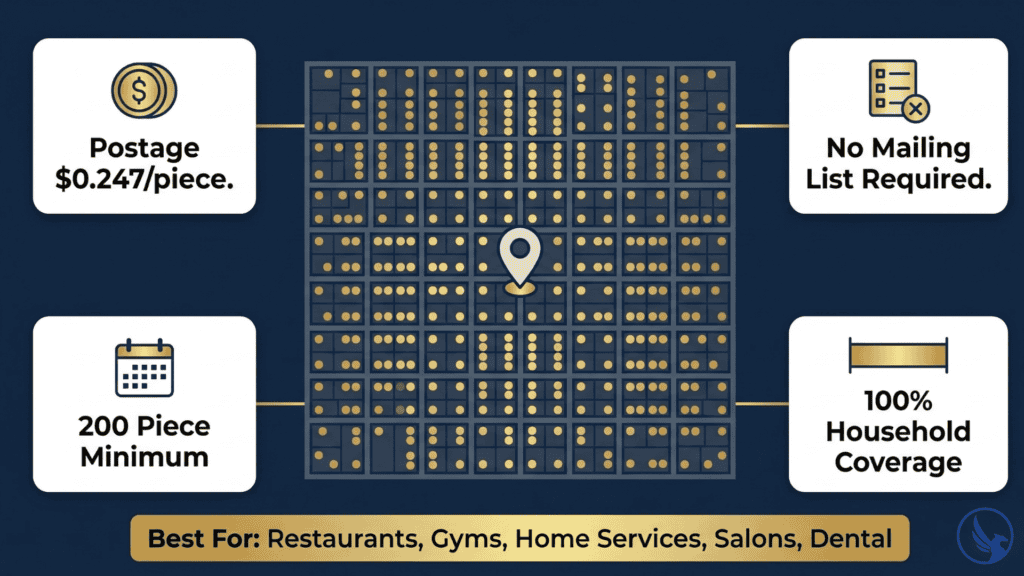
EDDM is purpose-built for local businesses whose best customers live nearby. Restaurants, gyms, home service companies, salons, dental practices — if your service area is geographic and your offer is broadly appealing, EDDM is almost always the more efficient choice.
Here’s why. With EDDM, postage runs $0.260 per piece. With targeted mail, you’re often paying $0.40–$0.75 per piece once you factor in list acquisition, data hygiene, and variable printing. For a 5,000-piece campaign, that gap is significant — sometimes $1,000 or more in hard costs before you’ve touched design or paper stock.
Advisory: The $0.260 EDDM Retail postage rate reflects pricing at time of publication. Verify the current rate at usps.com/business/every-door-direct-mail.htm before finalizing any budget comparison. The targeted mail rate range of $0.40–$0.75 is directional and varies by mail class, piece size, list cost, and vendor — verify current USPS Marketing Mail rates at pe.usps.com/DMM300 and obtain vendor quotes for list costs before using these figures in client-facing materials.
Additionally, EDDM eliminates list maintenance entirely. There’s no scrubbing for bad addresses, no NCOA processing, no privacy compliance headaches. You select your routes on the USPS mapping tool, print to spec, and drop at the post office.
For businesses running EDDM for Small Business marketing, the low barrier to entry is a genuine competitive advantage. You don’t need a marketing department — you need a good postcard and the right ZIP code. It’s also worth reviewing common EDDM Mistakes to Avoid before your first drop, because small errors in setup cost more than people expect.
When Targeted Mail Wins: Precision Over Volume
Targeted direct mail earns its premium when your product or service is genuinely niche. A luxury financial planner, a B2B software company, a high-ticket home remodeler targeting homeowners above a certain equity threshold — these businesses cannot afford to mail to everyone. The message only resonates with a specific subset, and saturation would be wasteful.
Targeted mail also wins when your sales cycle is longer and personalization drives conversion. Variable data printing lets you customize each piece — name, specific offer, localized imagery — which can significantly lift response rates for the right campaigns.
Furthermore, if your goal is reactivation of past customers, targeted mail is the obvious choice. You already have the list. EDDM doesn’t factor in.
That said, businesses often overcomplicate this decision. They assume targeted mail is more sophisticated and therefore better. It isn’t — it’s just different. A pizza shop targeting 50,000 households in a 3-mile radius has no reason to pay for demographic filtering. Saturation is the strategy.
Understanding EDDM Response Rates in your specific vertical is key to setting the right expectations before you commit to either approach. If you’re in a service-heavy industry, EDDM for Home Services gives you a concrete benchmark to work from.
Real Cost Comparison: EDDM vs Targeted Mail in 2026
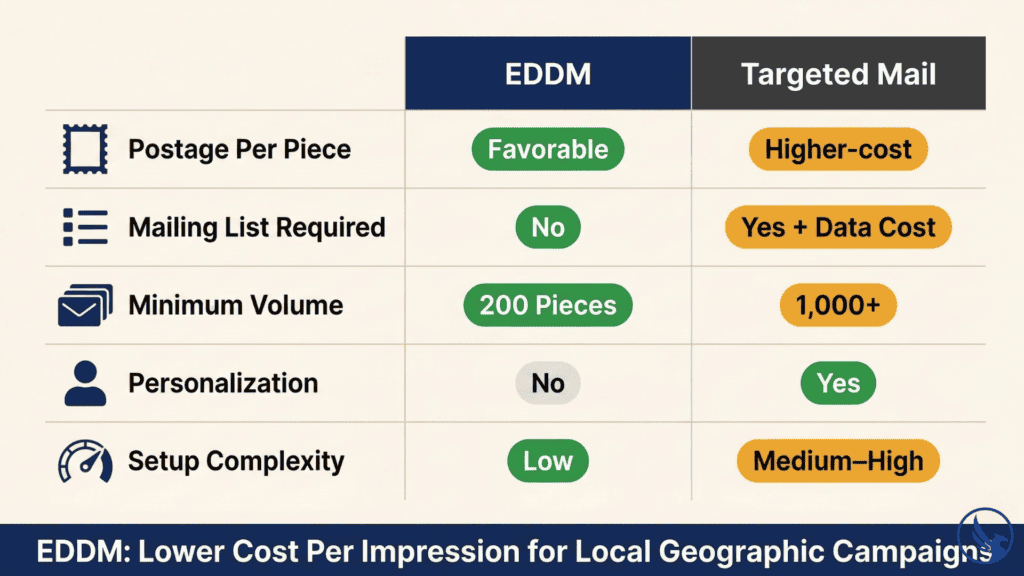
| EDDM | Targeted Direct Mail | |
|---|---|---|
| Postage per piece | $0.260 | $0.40–$0.75+ |
| Mailing list required | No | Yes ($0.05–$0.15/record) |
| Minimum volume | 200 pieces | Varies (often 1,000+) |
| Personalization | No | Yes |
| Setup complexity | Low | Medium–High |
| Best for | Local saturation | Niche audiences |
The cost case for EDDM is compelling for most small and mid-size businesses. When you layer in EDDM Postcard Printing Cost and USPS postage, a complete 5,000-piece campaign typically lands between $1,800–$2,200 all-in. A comparable targeted mail campaign to a filtered list of 2,000 households could easily exceed that — with fewer total impressions.
Advisory: The all-in EDDM cost range reflects the current $0.260 postage rate plus typical print and design costs at time of publication. Verify the current postage rate before budgeting. Targeted mail cost estimates are directional and vary by vendor, mail class, and list source.
Want to model your own numbers? The EDDM ROI Calculator lets you plug in your route size, cost per piece, and expected response rate to see projected returns before you commit a dollar. According to ANA/DMA direct mail research, prospect mail response rates consistently outperform most digital display benchmarks for local campaigns — useful context when building a channel comparison for stakeholders.
EDDM vs Targeted Direct Mail: Which Fits Your Business?
Rather than choosing one as universally superior, match the method to the mission.
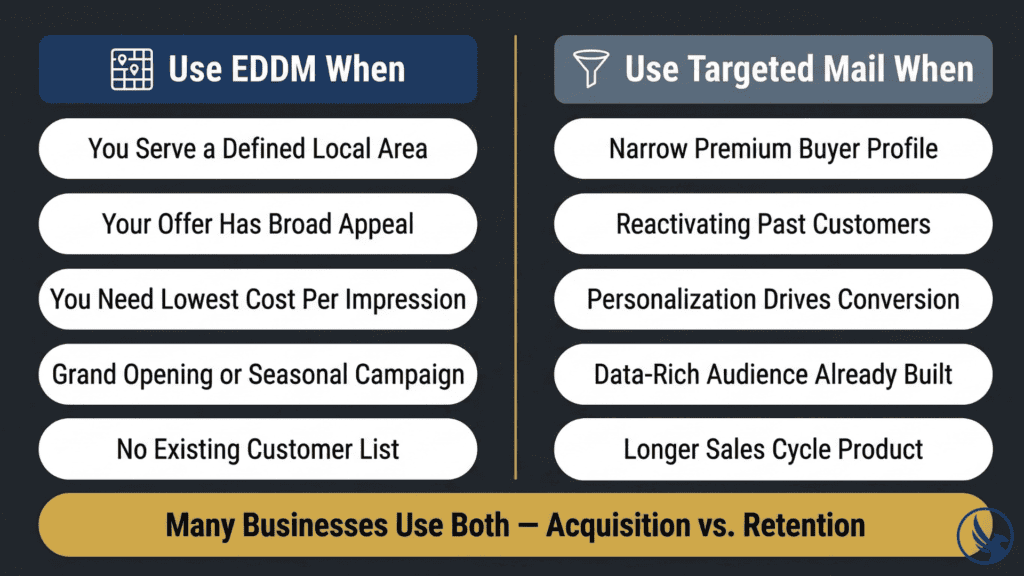
Use EDDM if you:
- Serve a defined geographic area
- Have broad appeal (food, fitness, services, healthcare)
- Want the lowest cost per impression
- Are running a grand opening, seasonal promotion, or awareness campaign
- Don’t have an existing customer list
Use targeted direct mail if you:
- Sell a premium product with a narrow buyer profile
- Are reactivating past customers
- Need personalization to drive conversion
- Have a data-rich audience you’ve already built
Many businesses use both — EDDM for awareness and new customer acquisition, targeted mail for retention and reactivation. The EDDM vs targeted mail distinction, in other words, becomes less about picking a winner and more about deploying the right tool at the right stage of the customer journey.
If you want to push further on channel comparisons, the EDDM vs. Digital Ads breakdown adds another useful layer to this decision. And if you’re weighing USPS options specifically, the EDDM vs. Informed Delivery comparison covers how digital overlays can work alongside physical mail to increase campaign visibility.
Start Your EDDM Campaign with CRST
EDDM is one of the most cost-efficient local marketing channels available in 2026 — especially when your postcard is printed right. At CRST, we handle printing to USPS spec so your campaign clears compliance and hits every door on your route. Whether you’re comparing options or ready to pull the trigger, we can help you move fast without cutting corners.
Request an estimate or contact our team to get started.
For the complete breakdown of how the program works, see our EDDM Guide.