
Buying mailing lists is expensive, unreliable, and often outdated before the ink dries. For small business owners who need local reach without a six-figure marketing budget, that’s a real problem. Every Door Direct Mail — EDDM — solves it by eliminating the list entirely and delivering your message to every door in a neighborhood you choose. This guide breaks down exactly how EDDM for small business works in 2026, what it costs, and how to run a campaign that drives foot traffic. For the complete program overview, start with the EDDM Guide at CRST.
Why EDDM for Small Business Delivers Results in 2026
Small businesses don’t need to reach everyone. They need to reach the right ZIP codes — the neighborhoods closest to their storefront, their service area, or their target demographic. That’s precisely where EDDM for small business excels.
Through the USPS Every Door Direct Mail program, you select your routes by carrier zone, drop off your printed postcards at the local post office, and USPS handles delivery. No mailing list, no data broker fees, no guessing. Every household on your chosen route receives your piece at $0.247 per piece in postage.
For restaurants, salons, dental practices, gyms, and home service companies, that kind of blanket coverage is hard to beat. See how other local businesses are using neighborhood saturation with EDDM for Restaurants, EDDM for Gyms, and EDDM for Home Services to understand how the same strategy scales across industries.
According to ANA/DMA direct mail research, direct mail prospect mail response rates consistently outperform email and digital display benchmarks for local campaigns. For a small business spending $900–$1,200 on a 2,500-piece EDDM run, even a 2% response rate means 50 new customers walking through the door.
Advisory: ANA/DMA figures show house list direct mail averaging around 4.4% response — but EDDM routes to cold geographic audiences, so the prospect mail range of 1%–5% is the applicable benchmark for most campaigns. The email figure of 0.12% cited in some industry comparisons reflects a conversion metric rather than a direct response rate equivalent and is not directly comparable. Verify current benchmarks at thedma.org before using in client-facing materials.
Before you launch, the EDDM First Campaign Guide is worth reading to avoid the setup mistakes that eat into early ROI.
EDDM for Small Business: Design and USPS Requirements
Getting your design right matters as much as route selection. USPS has specific size and format requirements for EDDM pieces, and going outside those specs means your mailers get rejected before they ever reach a mailbox.
Small Business Design Elements That Convert
EDDM for small business works best when the postcard leads with a single, clear offer. Grand opening discounts, seasonal promotions, referral incentives — one message per mailer outperforms cluttered designs every time.
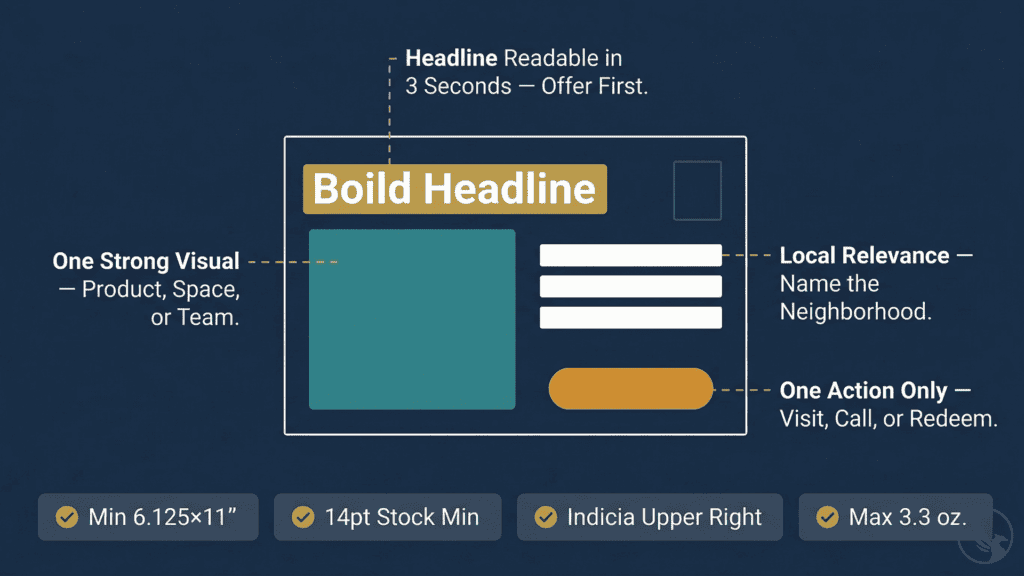
Key design principles that drive response: Lead with your headline — your offer should be readable in under three seconds, from a distance. Use one strong visual — a high-quality image of your product, space, or team builds instant trust. Give one clear call to action — tell recipients exactly what to do: visit, call, redeem, or book. Add local relevance — mentioning the neighborhood by name creates an immediate connection that generic campaigns miss.
For a deeper look at what works visually, the EDDM Design Tips guide and EDDM Postcard Design breakdown are solid starting points — especially if you’re designing your first campaign. Need a shortcut? EDDM Postcard Templates offer ready-to-customize formats built around USPS compliance.
USPS Compliance Requirements for EDDM Small Business Mailers
EDDM pieces must fall within USPS size requirements to qualify for the discounted postage rate:
- Minimum size: 6.125″ × 11″
- Maximum size: 15″ × 12″
- Maximum thickness: 0.75″
- Stock: Cover-weight required — 14pt minimum recommended
- Maximum weight: 3.3 oz
Advisory: Verify current EDDM dimensional requirements at pe.usps.com/DMM300 before finalizing design file dimensions. Pieces outside these specs default to standard postage rates, significantly increasing your per-piece cost.
Your mailer also needs an EDDM indicia in the upper right corner, a “Postal Customer” recipient line, and your business return address. Full USPS specs are covered in the EDDM Printing Requirements guide. The EDDM Postcard Sizes breakdown is particularly useful if you’re deciding between a standard postcard and a larger saturation mailer, and the EDDM Paper Stock Options article walks through durability versus cost trade-offs for different print runs.
Real-World EDDM Small Business Cost and ROI Breakdown
One of the biggest advantages of EDDM for small business is cost predictability. Unlike pay-per-click advertising where costs fluctuate daily, EDDM pricing is stable and straightforward.
Here’s a realistic budget range for a small business EDDM campaign:
| Cost Component | Estimated Range |
|---|---|
| Postage (USPS EDDM Retail) | $0.247 per piece |
| Postcard printing (full color) | $0.08–$0.15 per piece |
| Design (if outsourced) | $75–$200 one-time |
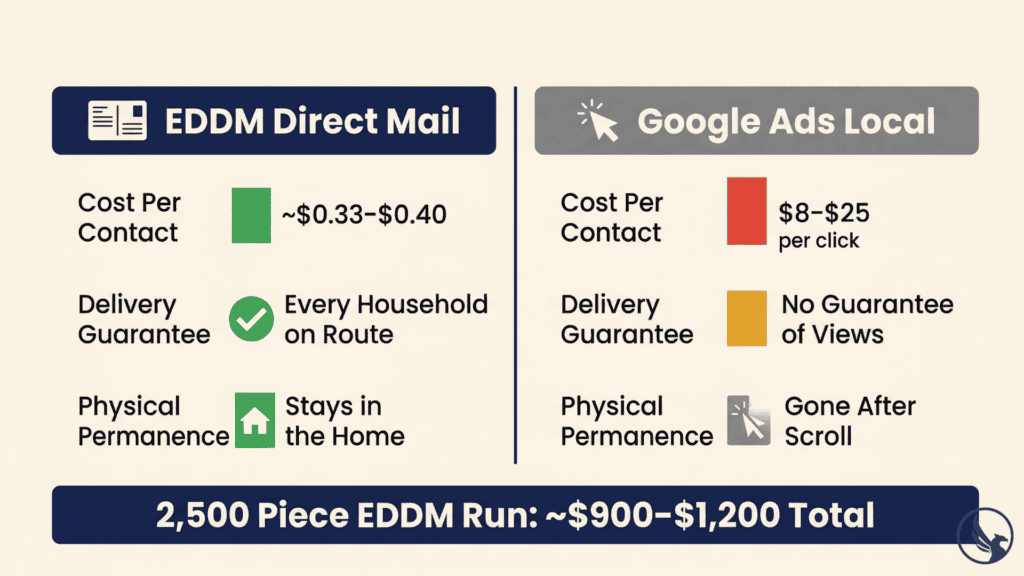
| Total per piece | ~$0.33–$0.40 |
Advisory: The $0.247 EDDM Retail postage rate reflects pricing at time of publication. Verify the current rate at usps.com/business/every-door-direct-mail.htm before finalizing your budget. Print costs are directional estimates that vary by vendor, stock, and quantity.
For a 2,500-piece run, total campaign cost typically falls between $900 and $1,200. Compare that to Google Ads, where local service keywords can run $8–$25 per click with no delivery guarantee — and EDDM’s cost-per-contact becomes difficult to argue against.
Advisory: Google Ads CPC ranges change with competition, season, and market. Verify current local service keyword CPCs via Google Ads Keyword Planner before using these figures in client-facing comparisons.
The EDDM Postcard Printing Cost guide breaks down how print volume, paper stock, and finishing affect your final per-piece number. A complete EDDM Cost and Pricing breakdown covers how route volume affects your postage. If you’re weighing EDDM against digital alternatives, the EDDM vs. Digital Ads comparison lays out the ROI side by side, and the EDDM ROI Calculator lets you plug in your own numbers before committing to a campaign budget.
EDDM Small Business Strategy: What a Winning Campaign Actually Looks Like
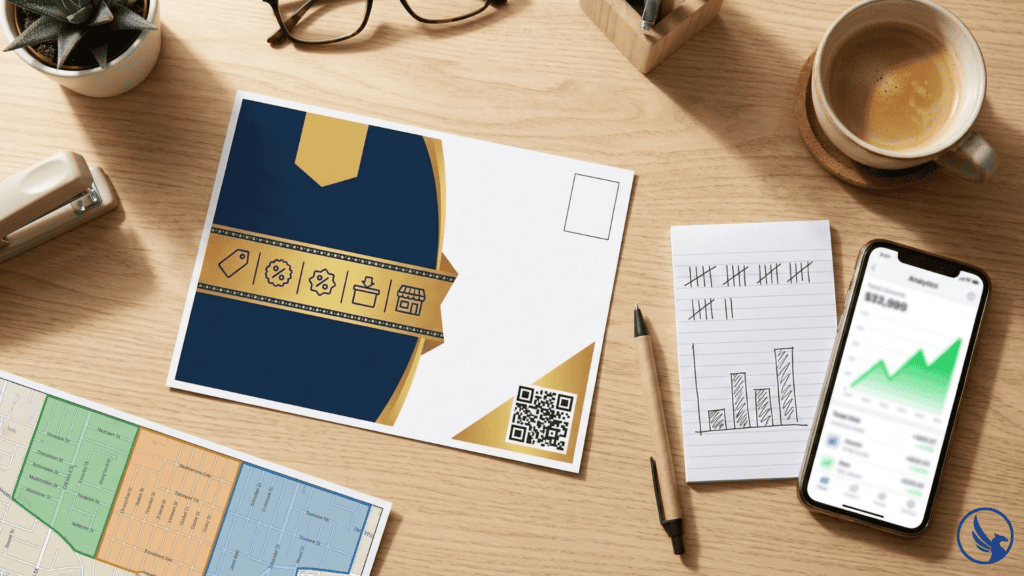
A pizza restaurant in a Hudson Valley suburb ran a 3,000-piece EDDM campaign targeting three carrier routes within two miles of their location. Total spend: $870. Offer: “Buy one large, get one free — this week only.” Results: 94 redemptions in seven days, with roughly 40% of those customers returning at full price within 30 days. Net revenue attributable to the campaign exceeded $3,200.
Advisory: These figures are illustrative of strong EDDM campaign performance rather than a verified published case study. Actual results vary by market, offer, route demographics, and execution quality. Editor should also reconcile this scenario with the similar pizza restaurant case study in the EDDM for Restaurants article before publishing, as the two use different figures for comparable campaigns.
That kind of return isn’t unusual when the targeting is tight, the offer is compelling, and the timing is right. The Best Time to Send EDDM guide covers seasonality and delivery timing in detail — a factor most small businesses underestimate on their first run. Understanding your EDDM Mailing Routes is equally important; selecting carrier zones by household income, proximity, and density can significantly improve response rate before a single postcard gets printed.
If you want to track results beyond coupon redemptions, EDDM Tracking Results outlines how to measure response rates, attribute revenue, and optimize future campaigns. Small businesses that run EDDM consistently — two to four campaigns per year — compound the brand recognition effect over time. Before you go to print, also review EDDM Mistakes to Avoid to sidestep errors that cost first-time mailers both time and money.
For a side-by-side comparison of EDDM versus a purchased list, EDDM vs. Targeted Mail breaks down when blanket coverage wins and when a segmented list makes more sense.
Start Your EDDM Campaign with CRST
EDDM for small business is one of the highest-ROI local marketing channels available in 2026 — low barrier to entry, predictable costs, and full neighborhood coverage with no list required. CRST handles printing, USPS compliance, and campaign setup so you can focus on being ready for the customers who walk in.
Explore our full EDDM printing services, request an estimate, or contact our team to get started.
For the complete breakdown of how the program works, see our EDDM Guide.