

EDDM political campaigns give candidates at every level — from city council to state legislature — a cost-effective, USPS-compliant path to putting a physical piece of campaign mail in the hand of every registered household in their district. Digital advertising in political races grows more expensive and more fragmented each cycle. By contrast, Every Door Direct Mail provides saturation coverage of a defined geographic area at a flat per-piece rate. That rate doesn’t fluctuate based on targeting competition or platform algorithms.
The Strategic Case for EDDM in Political Races
For local candidates in particular — races decided by hundreds or low thousands of votes — EDDM’s ability to reach every residential address on a carrier route without purchasing a voter file represents a genuine strategic and cost advantage. For the complete EDDM foundation, see the EDDM Guide at CRST before building your campaign mail plan.
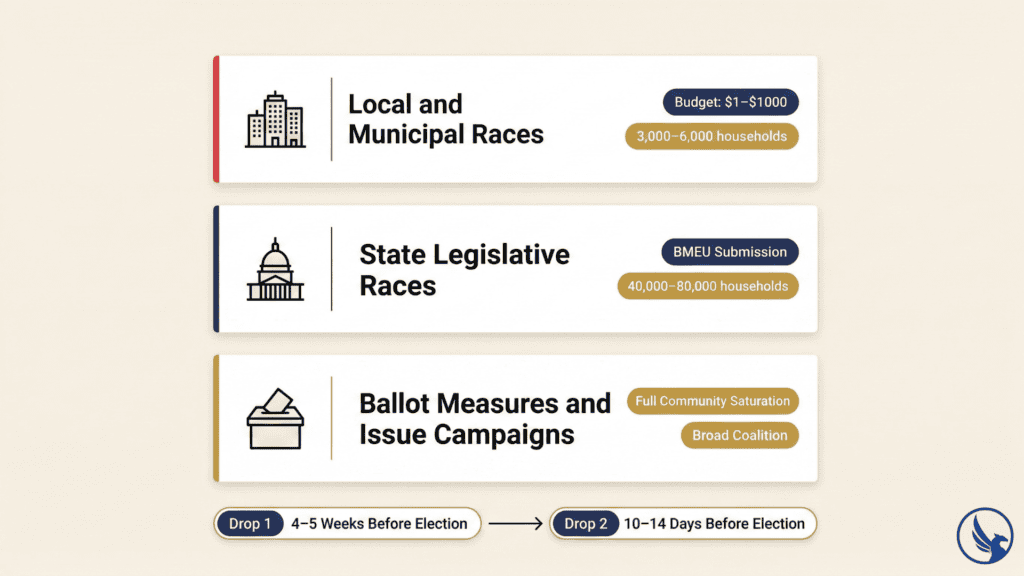
- City council, school board, water district
- 3,000–6,000 households — $800–$1,500 total
- No voter file needed — full saturation
- 40K–80K households — use BMEU submission
- Combine EDDM + voter file for best coverage
- Persuasion precincts + low-propensity routes
- Bond, referenda, initiative campaigns
- Saturation beats targeted for issue awareness
- Reaches unregistered & low-propensity voters
4–5 wks before E-Day
10–14 days before
Why EDDM Works for Political Voter Outreach
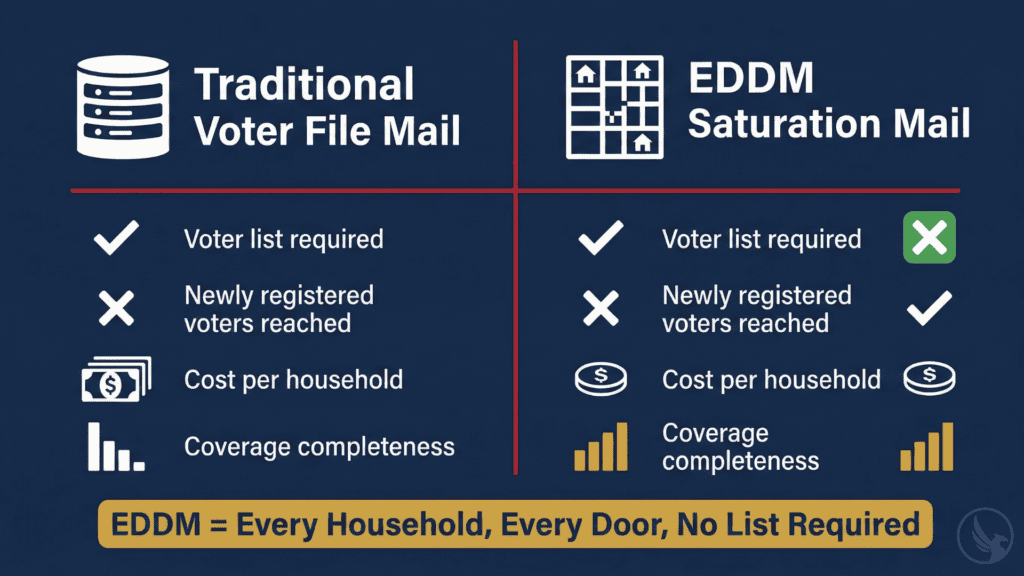
Geographic Saturation Without a Voter File
Traditional political direct mail depends on voter file data — purchased lists of registered voters with addresses, party affiliation, voting history, and demographic overlays. Voter files are expensive and require data vendor relationships. They also have accuracy limitations: outdated addresses, missing newly registered voters, and incomplete coverage of low-propensity voters who may still be persuadable.
EDDM bypasses the voter file entirely. The program delivers to every residential address on a selected carrier route — regardless of whether the resident is registered, which party they affiliate with, or how often they vote. As a result, it achieves true household saturation in a way that list-based mail cannot. For campaigns focused on name recognition, ballot measure awareness, or persuasion in mixed-registration precincts, this saturation model is a structural advantage.
Furthermore, the USPS EDDM route selection tool allows campaigns to select routes by ZIP code, precinct-adjacent geography, or radius. It filters by household income, median age, and residential density. Consequently, a campaign can prioritize high-density residential routes in persuasion-heavy precincts while staying within a defined geographic district boundary.
For context on EDDM’s cost structure versus alternative outreach channels, EDDM vs. Digital Ads provides the comparison framework that campaign budget managers find most useful when allocating between print and digital voter contact.
Physical Mail in a High-Stakes Decision Context
Political mail has a long-documented history of effectiveness in voter contact. According to research cited by the American Association of Political Consultants, direct mail remains one of the highest-recall voter contact methods available — particularly among older voters aged 45 and above. That demographic represents a disproportionate share of actual turnout in most local and mid-term elections.
Physical mail creates a different cognitive experience than a digital political ad. A campaign postcard sits on a kitchen table. It gets seen multiple times. It communicates organizational credibility — the investment required to print and mail thousands of pieces signals seriousness in a way that a Facebook ad cannot. Consequently, in down-ballot races where name recognition is the primary barrier to a vote, a well-designed physical mailer carries outsized persuasive weight relative to its cost.
EDDM Political Campaign Strategy by Race Type
Local and Municipal Races: Maximum Coverage, Minimum Budget
For city council, school board, water district, and other hyper-local races, EDDM political campaigns offer the most favorable economics in direct voter contact. A local race covering 3–5 carrier routes — representing 3,000–6,000 households — can be fully saturated for $800–$1,500 in print and postage. That brings professional-grade campaign mail within reach of candidates running on volunteer-driven budgets.
In these races, the EDDM model’s lack of voter file dependency is particularly valuable. Many residents in local races are unregistered, recently registered, or irregular voters whom a standard voter file would exclude. However, these residents may still be motivated to participate by a ballot measure directly affecting their neighborhood. Reaching every household ensures no persuadable voter is missed by a data gap.
For timing in municipal races — particularly those with a single Election Day — the optimal EDDM strategy is a two-drop calendar. The first drop is a name-introduction piece arriving 4–5 weeks before Election Day. The second is a closing argument or GOTV (Get Out the Vote) piece arriving 10–14 days before the election. See Best Time to Send EDDM for the production lead-time planning framework that makes tight pre-election timelines manageable.
State Legislative and Congressional Districts
For state house, state senate, and congressional district races, EDDM political campaigns operate at higher volume and require more strategic route prioritization. A state legislative district may encompass 40,000–80,000 households across dozens of carrier routes. Full saturation mailing at EDDM Retail’s 5,000-piece daily per-ZIP limit would therefore require extended production and submission timelines.
For campaigns at this scale, EDDM BMEU (Business Mail Entry Unit) submission becomes the operationally practical pathway. BMEU removes the 5,000-piece daily cap. In return, it allows a campaign to submit tens of thousands of pieces across multiple ZIP codes in a single coordinated drop. BMEU requires working with a commercial printer or mailing service that has a Business Mailer Account. CRST operates with full BMEU capabilities. Contact the team to discuss high-volume political campaign logistics.
Furthermore, at legislative district scale, EDDM is most powerful when combined with voter file targeting rather than replacing it. Specifically, EDDM saturates persuasion precincts and low-propensity-voter-heavy routes where list coverage is incomplete. Targeted mail, in contrast, handles known high-propensity voters and base mobilization. The two approaches are complementary, not competing. For bulk campaign volume logistics, EDDM Bulk Mailing covers the full production and submission framework.
Ballot Measures and Issue Campaigns
EDDM political campaigns are exceptionally well-suited to ballot measure advocacy — bond measures, referenda, initiative campaigns, and local ballot questions where the goal is broad community awareness rather than candidate-specific persuasion. Because EDDM reaches every household in a geographic area, it is uniquely effective at building awareness of a ballot question among residents who may not be active political participants but whose vote still counts equally.
Issue campaigns also tend to have broader coalition support. That support makes saturation mailing more strategically appropriate than highly targeted partisan voter contact. A school bond measure, a parks funding initiative, or a local zoning question benefits from every household in the affected area being informed — not just registered voters of a particular party.
Designing EDDM Postcards for Political Campaigns
Candidate Introduction Pieces
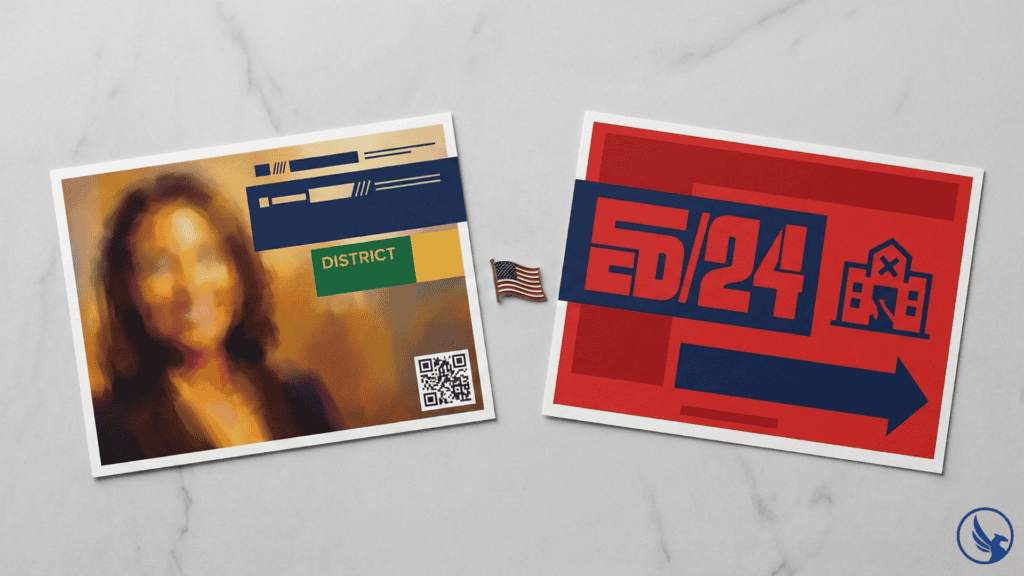
The first piece in a two-drop EDDM political campaign is a name-recognition and introduction mailer. Its job is simple: make the candidate’s name memorable, establish their face and community connection, and communicate one to two key biographical or issue points. This is not the place for a comprehensive policy platform. Instead, it is a first impression delivered to households that may have no prior awareness of the candidate.
The design hierarchy for a candidate introduction postcard follows a clear structure. Use a large, high-quality photograph of the candidate — a professional headshot or community-engagement photo, not a stock image. Place the candidate name in the largest type on the card. Add a one-line position title or district identifier (“Running for [City] City Council — District 4”). Then include one or two brief issue statements that establish relevance to the recipient’s neighborhood.
Additionally, the candidate’s website URL and a QR code linking to the campaign site give motivated recipients an immediate path to learn more. For the design principles governing political mail specifically, EDDM Postcard Design and EDDM Design Tips provide the foundational framework.
GOTV and Closing Argument Pieces
The second drop in a pre-election EDDM campaign is the closing argument and Get Out the Vote piece. Arriving 10–14 days before Election Day, this piece has a different function: it speaks to households that have already been introduced to the candidate and now need a reason to vote. The design shifts from introduction to activation — clear endorsements if available, a specific ask (“Vote [Candidate Name] on [Date]”), voting location or early voting information, and a direct response element.
For GOTV pieces, practical voting information is a conversion element, not just a courtesy. Specifically, polling location, Election Day date and hours, and early voting options should all appear clearly on the card. A voter who might otherwise stay home because they’re unsure where to go becomes a confirmed voter when the postcard answers that question directly. For paper stock and production recommendations for tight pre-election timelines, EDDM Paper Stock Options and EDDM Postcard Sizes cover the format decisions that balance impact with fast-turnaround production requirements.
Required Political Mail Disclaimers
All political mail in the United States is subject to disclaimer requirements under Federal Election Commission regulations and applicable state law. At minimum, federal campaign mail must include a “paid for by” disclaimer identifying the campaign committee — typically formatted as “Paid for by [Committee Name].” State and local races are subject to their own disclaimer requirements, which vary by jurisdiction.
Political disclaimer requirements are jurisdiction-specific and change with election law updates. Therefore, always verify current FEC and applicable state disclaimer requirements directly with a campaign attorney or your state’s election authority before submitting any political mail to press. CRST can produce compliant print files but does not provide legal compliance review. Confirm all disclaimer language independently before finalizing your print-ready file.
For the complete USPS compliance specifications covering size, bleed, safe zones, and indicia placement, EDDM Printing Requirements is the essential pre-production reference.
Budget, Timing, and Scaling Political EDDM
Building a Two-Drop Campaign Budget
A complete two-drop EDDM political campaign for a local race covering 4,000 households on 8.5×11 postcards typically runs between $1,400 and $2,200 total across both drops (print plus postage for each). For state-level campaigns mailing to 20,000–50,000 households across multiple drops, offset printing economics and BMEU submission reduce the per-piece cost meaningfully. EDDM Cost and Pricing and EDDM Postcard Printing Cost both provide the volume-based cost modeling needed for campaign budget planning at any scale.
Additionally, use the EDDM ROI Calculator to model cost per household reached and cost per voter contact at different volume and size combinations. That calculation is a useful tool for presenting direct mail investment to campaign committees and donors accustomed to digital cost-per-impression metrics.
Production Lead Times in a Campaign Calendar
Political campaigns operate on fixed, non-negotiable deadlines — Election Day does not move. Therefore, production lead time planning is critical. Standard EDDM production requires 10–14 business days from approved file to in-home delivery. During peak election periods — October and early November in general election years — print vendors experience surge demand. Consequently, campaigns should plan for 15–18 business days of lead time for any drop scheduled within 30 days of a major election date.
For full production timeline planning and the backward-calendar methodology that prevents last-minute drop failures, EDDM Tracking Results and EDDM First Campaign Guide together provide the operational framework most useful for first-time political mailers. Request a campaign estimate early in your campaign calendar to lock in production slots before peak season demand reduces availability. Visit our EDDM printing services for the full service overview.
Start Your EDDM Campaign with CRST
For candidates and issue campaigns at every level, EDDM political campaigns offer true household saturation within a defined district — reaching every voter, every potential voter, and every household in a community for a cost structure that fits budgets from city council to congressional races.
CRST handles EDDM printing from file setup through postal delivery, with a team that knows USPS compliance inside out and a track record across industries. Explore our full EDDM printing services to see how we support campaigns from first template to final delivery. Ready to move forward? Request an estimate or contact our team with your project details.
For the complete breakdown of how the program works, see our EDDM Guide.