

Most business owners launch their first Every Door Direct Mail campaign expecting instant results — and then feel deflated when the phone doesn’t ring off the hook on day one. The truth is, EDDM response rates follow a predictable pattern, and understanding that pattern is what separates campaigns that convert from campaigns that collect dust. EDDM remains one of the most cost-efficient ways to saturate a neighborhood with your message — but only if you set realistic expectations from the start. This article breaks down what EDDM response rates look like across industries, what drives them up, and how to measure success the right way. For the complete program overview, start with the EDDM Guide at CRST.
EDDM Response Rates Explained: What the Numbers Actually Mean
Here’s the benchmark that matters: average EDDM response rates fall between 1% and 5%, depending on your industry, design, offer, and timing. For context, that range is significantly higher than most digital display advertising — though it’s worth noting that email click-through rates and direct mail response rates measure different things and aren’t directly equivalent metrics.
Advisory: The 1%–5% EDDM response rate range reflects prospect mail benchmarks consistent with ANA/DMA direct mail research. Because EDDM routes to cold geographic audiences with no prior relationship, the prospect mail range (rather than house list rates, which run higher) is the appropriate baseline. Verify current benchmarks at thedma.org before using these figures in client-facing materials or business planning.
When you’re mailing to 5,000 households and converting even 2% of recipients, that’s 100 new leads from a single campaign run. EDDM response rates aren’t a fixed number you can plug into a spreadsheet and call it done, though — they move based on factors you control and factors you don’t. Understanding the difference is where strategy begins.
Why Industry Vertical Drives EDDM Response Rates More Than Anything Else
Not all businesses see the same return from EDDM campaigns, and that’s not a flaw in the system — it’s a function of how well the offer matches the audience. Businesses that rely on local, recurring customers tend to see the highest EDDM response rates. Those with longer sales cycles or higher-consideration purchases, in contrast, tend to see lower but still valuable returns.
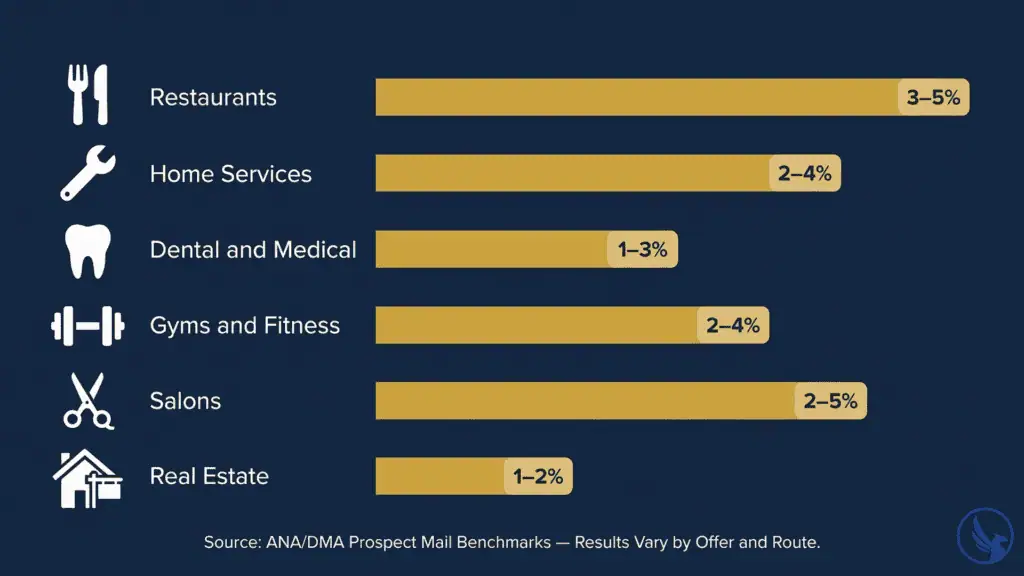
Here’s how response rates typically break down by vertical:
Restaurants and food businesses: 3%–5%. High-frequency purchases make every converted household worth repeat revenue. EDDM for Restaurants digs into menu promotion strategies that push response rates toward the top of that range.
Home services (HVAC, plumbing, landscaping): 2%–4%. Seasonal urgency and neighborhood relevance drive strong responses in this category. EDDM for Home Services covers timing and offer structure in detail.
Real estate agents: 1%–2%. Response volume is lower, but each converted lead carries high lifetime value. EDDM for Real Estate breaks down the neighborhood farming strategies that compound over multiple drops.
Dental and medical practices: 1%–3%. Notably, patient reactivation campaigns tend to outperform new patient acquisition mailings in this vertical. EDDM for Dentists outlines the specific messaging that drives reactivation.
Gyms and fitness studios: 2%–4%. Grand opening offers and seasonal promotions spike response rates considerably in this category. See EDDM for Gyms for campaign structures built around membership conversion.
Salons and personal care: 2%–5%. First-visit discount offers consistently outperform brand-only messaging here. EDDM for Salons covers grand opening and relaunch campaign tactics in detail.
Advisory: These vertical benchmarks reflect practitioner guidance and general ANA/DMA prospect mail data rather than published per-industry studies. Actual response rates vary significantly by offer quality, route demographics, creative execution, market density, and campaign frequency. Use the EDDM ROI Calculator to model your specific scenario before committing to a budget.
Route selection also plays a major role. EDDM Mailing Routes directly affect delivery density and demographic alignment — because who receives your postcard matters as much as what’s on it.
EDDM Response Rates and Design: The Variables You Control
One of the most consistent findings in direct mail research is that design quality directly impacts response rates. A postcard that’s visually cluttered, light on offer clarity, or printed on thin stock underperforms — not because EDDM doesn’t work, but because the piece didn’t earn a second look.
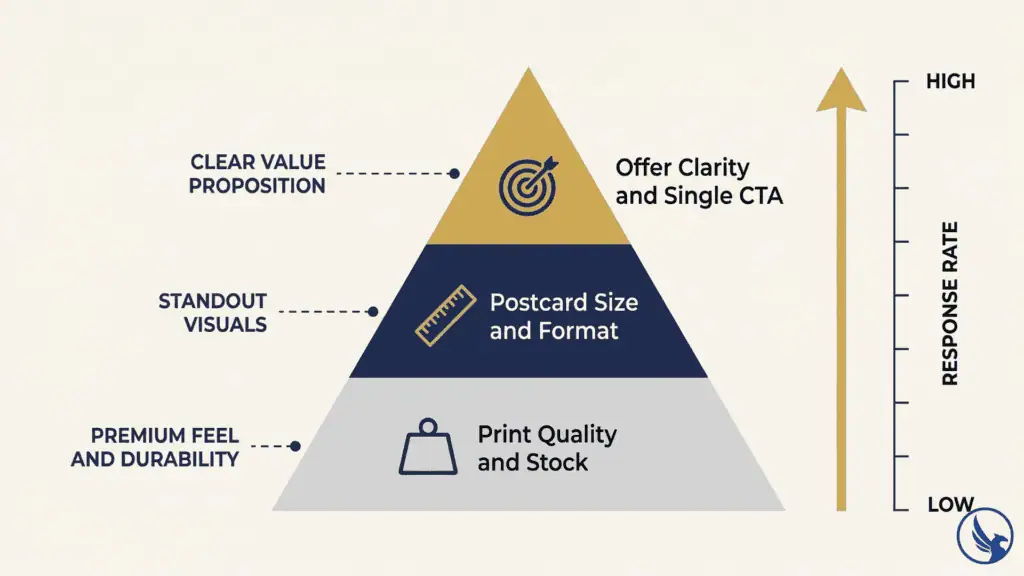
Design Elements That Lift EDDM Response Rates
The strongest-performing EDDM postcards lead with a clear offer — a discount, a free consultation, a limited-time promotion — within the first visual sweep. They use a single dominant image that connects emotionally with the target neighborhood, and they include a call to action that’s impossible to miss.
Oversized formats also tend to outperform standard sizes. When a postcard physically stands out from the mail stack, it gets looked at longer. Understanding your EDDM Postcard Size options and how USPS dimensions affect visual impact is therefore a practical step before finalizing your design. For layout strategies with proven track records, EDDM Design Tips covers contrast, offer placement, and QR code integration. If you want ready-to-use formats, EDDM Postcard Templates can cut your production timeline significantly.
USPS Compliance and Print Quality
Meeting EDDM Printing Requirements governs size, weight, and indicia placement — not design creativity. You can still use full bleeds, bold typography, and high-impact imagery while staying fully compliant. Paper stock also affects perception: a heavier card stock signals quality before the recipient reads a single word. EDDM Paper Stock Options breaks down the cost-versus-durability tradeoffs worth knowing before you go to press.
Real EDDM Response Rate ROI: Cost vs. Return
Here’s where the math starts to work clearly in EDDM’s favor. At $0.247 per piece for USPS EDDM Retail postage plus printing costs, a 5,000-piece campaign typically runs $1,635–$2,235 all-in. At a 2% response rate, that produces 100 inquiries. If your average customer value is $200 — for example — that’s $20,000 in potential revenue from that investment.
Advisory: The $0.247 EDDM Retail postage rate reflects pricing at time of publication. Verify the current rate at usps.com/business/every-door-direct-mail.htm before finalizing your campaign budget. The $200 average customer value used here is illustrative — substitute your actual figure when modeling ROI to get meaningful projections.
That math holds even when response rates stay on the lower end, which is why EDDM for Small Business marketing consistently outperforms higher-cost alternatives for local audience reach. To pressure-test your own numbers before committing to a campaign, the EDDM ROI Calculator lets you model different response rate scenarios against your actual customer value. For deeper cost-per-piece math, EDDM Cost and Pricing and EDDM Postcard Printing Cost both break down volume tiers and format variables that affect total spend.
How to Track EDDM Response Rates So the Data Is Actually Useful
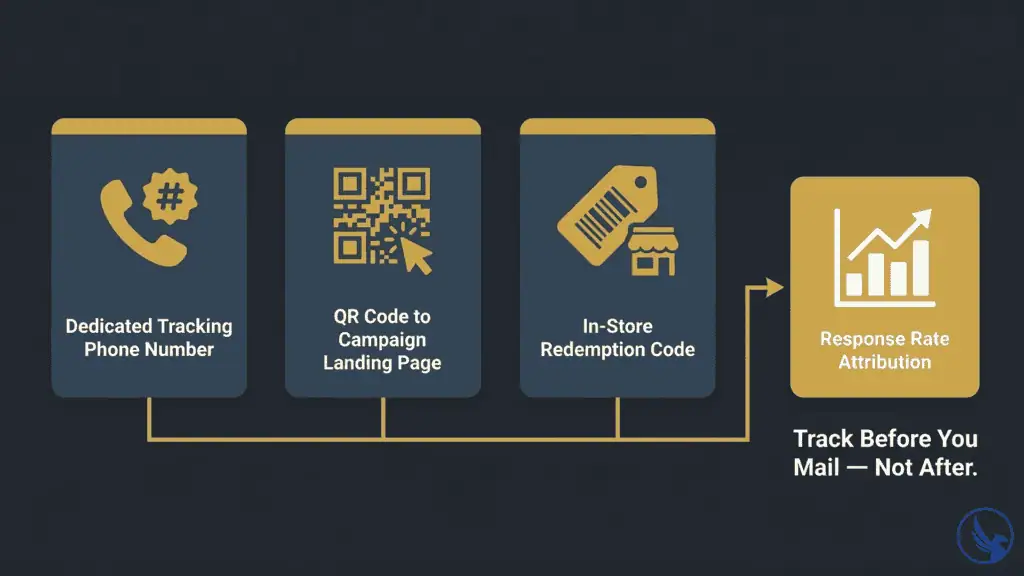
Knowing your EDDM response rates after a campaign ends is one thing. Building a tracking system before you mail, however, is what separates businesses that iterate and improve from those that guess. The three most reliable tracking methods are unique phone numbers, QR codes that lead to dedicated landing pages, and in-store redemption codes printed on the postcard.
Each method gives you direct attribution. When someone calls the number on the postcard, you know EDDM drove that call. When someone scans the QR code, you see it in your analytics. For a structured approach to campaign measurement, EDDM Tracking Results walks through each method in detail.
It’s also worth knowing what common missteps look like before you mail. EDDM Mistakes to Avoid covers the errors that quietly suppress response rates — from wrong route selection to weak offer framing — so you don’t learn them the expensive way. Additionally, if timing is still a variable you’re working through, Best Time to Send EDDM gives you seasonal and day-of-week guidance that meaningfully affects response.
The best campaigns, furthermore, compare response rates across mailing cycles — tracking whether a second drop to the same route performs better than the first, or whether adjusting the offer improved conversion. That kind of data compounds over time and turns a good first campaign into a reliable growth engine.
Start Your EDDM Campaign with CRST
EDDM response rates reward preparation — the right routes, the right design, the right offer, and the right print quality all working together. CRST handles every piece of that process, from USPS-compliant printing to route selection support, so your campaign goes out ready to perform.
Explore our full EDDM printing services, request an estimate, or contact our team to get started.
For the complete breakdown of how the program works, see our EDDM Guide.