
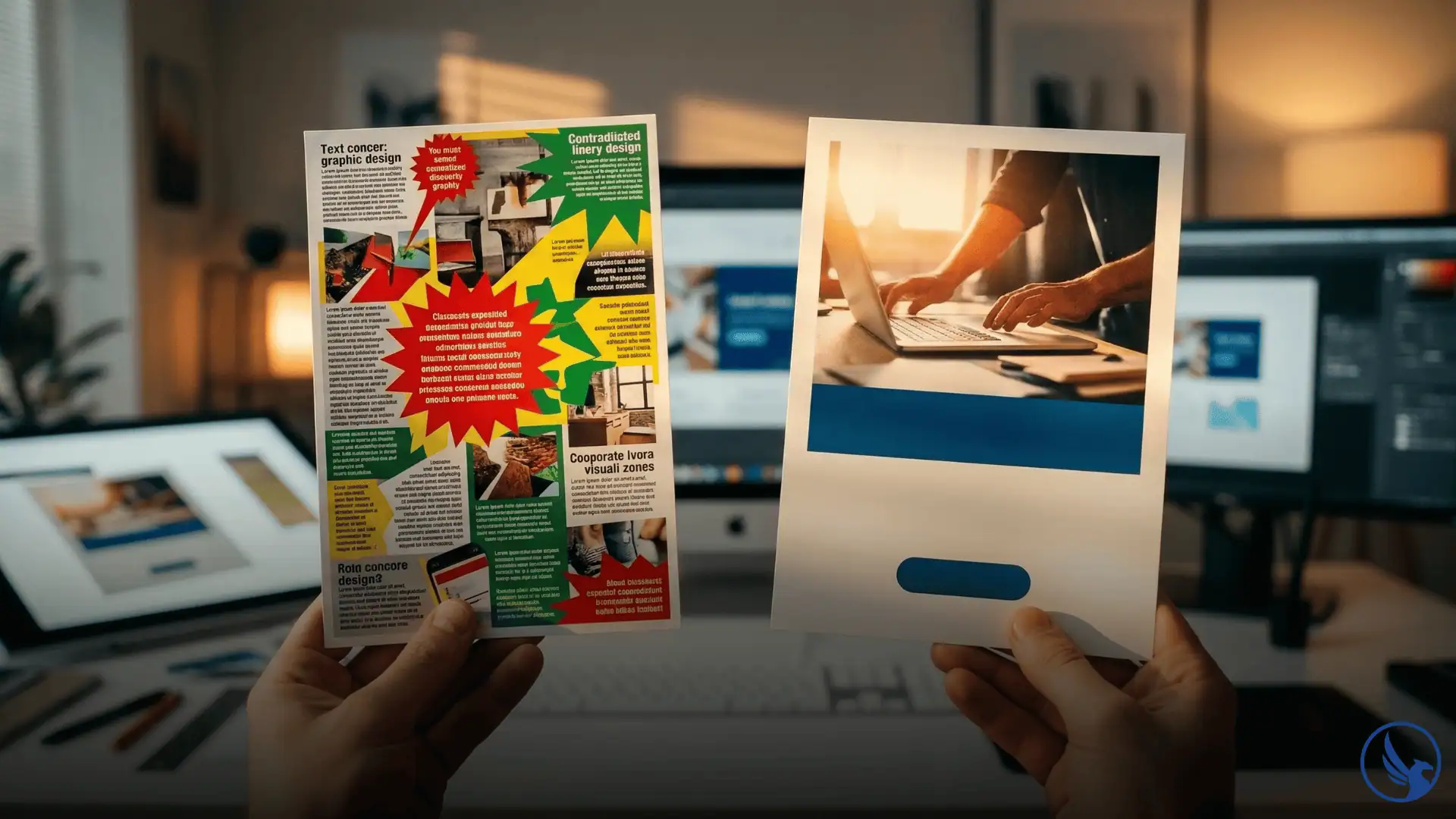
Most local businesses waste money on direct mail because their postcards look like everyone else’s. Cluttered layouts, forgettable headlines, and tiny text that no one reads — dropped straight into the recycling bin without a second glance. Every Door Direct Mail gives you a powerful, low-cost way to reach every household in a neighborhood without a mailing list, but only if your design does its job. In a competitive mailbox environment, great EDDM postcard design isn’t optional — it’s the difference between a campaign that pays for itself and one that doesn’t. This guide breaks down exactly what goes into a postcard that gets noticed, gets read, and gets action. For the complete EDDM program overview, start with the EDDM Guide at CRST.
- Single dominant headline with offer
- One hero image — full bleed
- High-contrast color scheme
- Brand logo — corner only
- 3-second readability test
- Offer restated clearly
- Hours, address, service area
- Phone number in large type
- QR code → landing page
- EDDM indicia — upper right
Why EDDM Postcard Design Is Different from Other Direct Mail
EDDM isn’t targeted mail. You’re not sending to a curated list of high-income households or previous customers — you’re blanketing entire carrier routes, every door and every household on a given street. That changes everything about how your design needs to work.
Because your audience is broad, your postcard has to earn attention fast. Recipients don’t know your brand. They didn’t opt in. They’re flipping through a stack of mail with zero loyalty to anything in it, and your design has maybe two seconds to stop them — and perhaps five more to give them a reason to keep reading.
That’s why EDDM postcard design leans heavily on visual hierarchy, clear messaging, and a single, compelling call to action. There’s no room for a paragraph of brand history or a laundry list of services. The best EDDM postcards are blunt, beautiful, and impossible to ignore.
If you’re comparing campaign approaches, it’s worth understanding how EDDM stacks up against targeted direct mail before committing to a design direction — because the creative strategy shifts depending on who you’re trying to reach.
EDDM Postcard Design: USPS Size Requirements and What They Mean for Your Layout
Before you open a design file, you need to know what you’re designing. USPS has specific size requirements for EDDM mailers, and getting them wrong means your postcards won’t qualify — you’ll be stuck reprinting at your own expense.
EDDM Postcard Design Starts With the Right Dimensions
To qualify for EDDM postage rates, your postcard must meet all of the following criteria:
- Minimum size: 6.125″ × 11″
- Maximum size: 15″ × 12″
- Stock: Cover-weight required — 14pt minimum recommended
- Weight: Under 3.3 oz
Advisory: The minimum dimension of 6.125″ × 11″ reflects current USPS EDDM flat-mail requirements as cited consistently throughout this series. However, 6.5″ × 9″ also appears as a widely used EDDM format in published series articles — if both are accurate, they reflect different USPS dimension categories (flat vs. card). Verify current EDDM dimensional requirements at pe.usps.com/DMM300 or with the CRST production team before finalizing design file dimensions.
The most popular EDDM formats are 6.5″ × 9″ and 8.5″ × 11″. Larger postcards stand out in a stack of mail, command more visual real estate, and feel more substantial in someone’s hand. For a full breakdown of your options, the EDDM Postcard Sizes guide covers every standard dimension with cost and impact comparisons.
Safe Zones, Bleed Areas, and USPS Compliance
When setting up your design file, always work with:
- Bleed: 0.125″ on all sides so your background extends beyond the trim edge
- Safe zone: Keep all critical text and logos at least 0.25″ inside the trim line
Text or design elements too close to the edge risk being cut off during production — one of the most common and most frustrating print errors first-time EDDM designers encounter. Before sending files to your printer, cross-reference your setup against the full EDDM Printing Requirements to confirm compliance on every spec.
The Indicia Block
EDDM mailers require a postal indicia on the address side — the pre-printed postage mark that replaces a stamp. Your printer will typically provide this, but you need to leave a dedicated, unobstructed space for it in your layout. Standard placement is the upper right corner of the address side, and nothing should overlap with this block.
Address Block
You don’t need a specific recipient name or address — that’s the beauty of EDDM. You do, however, need a standardized delivery address block reading “Local Postal Customer” with your return address. This block must be correctly positioned on the address side and kept clear of design clutter.
File Setup for Print
Submit files as high-resolution PDFs at 300 DPI minimum. Use CMYK color mode, not RGB — the color shift during conversion can alter your brand palette in ways that look unprofessional in print. Embed all fonts or convert them to outlines before exporting. For the full USPS technical checklist, the EDDM Printing Requirements article covers every spec in plain language.
According to ANA direct mail research, print quality and compliance correlate with reader perception of brand credibility.
Advisory: The specific ANA/DMA finding linking print-quality compliance to brand credibility perception should be verified in the current Response Rate Report at thedma.org before publishing with direct attribution.
EDDM Postcard Design: Visual Elements That Drive Response
Now that your file is set up correctly, let’s talk about what actually goes on it. EDDM postcard design is equal parts psychology and aesthetics — here’s what consistently separates high-performing mailers from forgettable ones.
Lead With a Headline That Does the Work
Your headline is the single most important element on the front of your postcard. It needs to communicate your offer — or at minimum your value proposition — without any supporting context. Assume the reader will see nothing else.
Strong EDDM headlines are specific (“Save 20% on Your First Month of Gym Membership”), benefit-driven (“Your Neighborhood’s Best Pizza, Delivered in 30 Minutes”), and urgency-coded (“Offer Ends March 31st”). Weak headlines, in contrast, are vague (“Quality You Can Trust”), brand-centric (“Introducing Our New Location”), or buried under a logo.
For industry-specific headline strategies, it’s worth looking at how EDDM campaigns work for restaurants and home services — both are high-volume verticals with proven headline formulas you can adapt.
One Dominant Image, Used Intentionally
EDDM postcards work best with a single, high-resolution hero image that reinforces the headline offer. A pizza restaurant leads with a photograph of their best dish — not their storefront. A gym leads with people actually working out — not equipment in an empty room. A real estate agent, meanwhile, leads with a home they recently sold in the neighborhood — not a headshot.
The image should fill most of the front face of the postcard. White space is fine; clutter is not. Every visual element should support the headline, not compete with it. Research on direct mail recall and response consistently shows that pieces with a dominant visual element outperform text-heavy designs — a finding supported by USPS consumer mail research and direct mail industry studies.
Advisory: The claim that direct mail with a dominant visual element “outperforms text-heavy designs by a significant margin in recall and response” reflects general direct mail design research consensus. This specific finding does not come from the USPS Household Diary Study, which documents consumer mail behavior and attitudes rather than postcard design variable testing. Editor should identify a specific design-variable study source before publishing this claim with attribution.
White Space Is Not Wasted Space
Designers know this instinctively. Business owners, however, often fight it. Giving your message room to breathe makes the hierarchy legible and the design feel trustworthy. A cluttered postcard signals a cluttered business.
Color, Contrast, and Visual Hierarchy in EDDM Postcard Design
Direct mail gets sorted quickly, so high contrast between your headline text and background is non-negotiable. Use light text on dark backgrounds or dark text on light backgrounds. Avoid gradient backgrounds behind small text, all-caps paragraphs, and multiple font sizes competing for dominance.
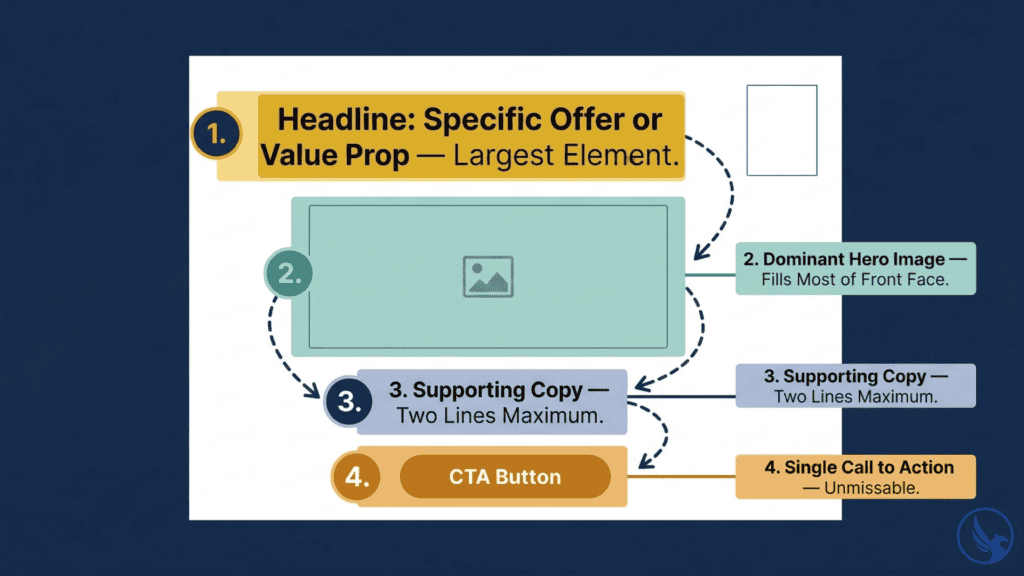
Your visual hierarchy should guide the eye in this order: Headline → Image → Supporting copy → CTA. If a stranger can’t identify your offer within three seconds of looking at the front of your card, the design needs to be simplified. For practical guidance on this, EDDM Design Tips breaks down hierarchy principles with real postcard examples.
For pre-built layouts that already follow these rules, EDDM Postcard Templates give you a tested starting point so you’re not building from scratch.
The Back Side: Where Conversions Happen
Most designers underinvest in the back of the postcard — and that’s a mistake. Once someone flips the card over, they’re engaged and want more information. This is where you close.
The back should include your offer restated clearly, key business information (hours, address, service area), a single direct call to action with urgency, your phone number in large readable type, and a QR code linking to your landing page or offer. Keep the back clean — two or three short paragraphs maximum. The goal isn’t to explain everything; it’s to get them to act.
The Offer: The EDDM Design Tip Most Guides Miss
You can have a beautifully designed postcard that still performs terribly because the offer is weak. Great EDDM design tips must address copy and offer construction, not just visuals. The strongest EDDM offers share four qualities.
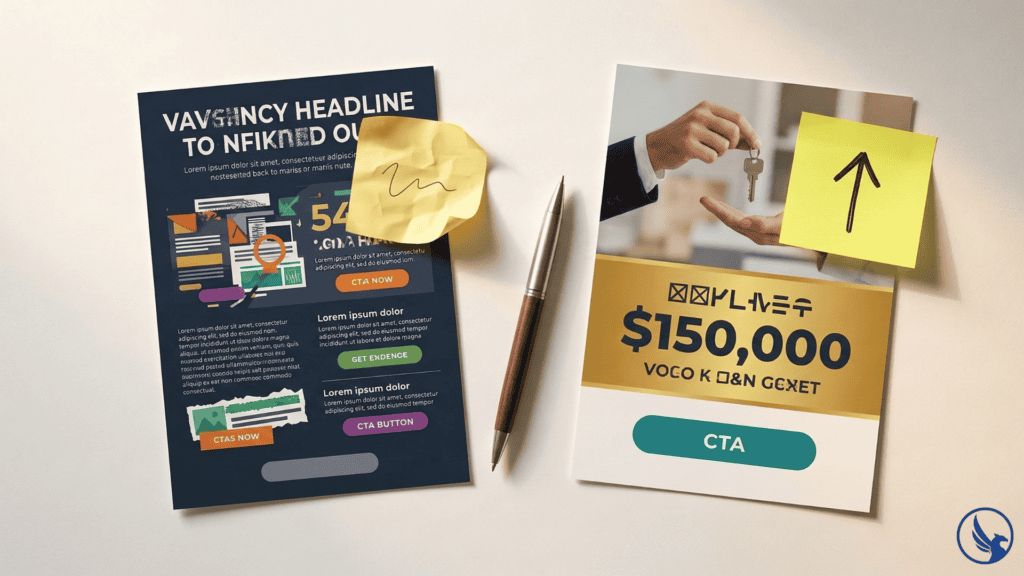
Specificity. “Save money on your next visit” is forgettable. “Save $35 on any service call over $150” is actionable. Specific offers feel more credible and are easier to act on.
Urgency. “Valid through March 31, 2026” works. “Limited to the first 50 customers” works even better. Without urgency, the postcard gets set on a counter and forgotten. The Best Time to Send EDDM guide pairs well here — aligning your offer with seasonal demand cycles multiplies urgency naturally.
Low barrier to entry. Free consultations, free first services, and free inspections all dramatically increase response rates. They remove the financial risk of trying something new.
One clear CTA. Pick one: call the phone number, visit the website, or bring in the postcard. The moment you list two or three options with equal visual weight, attention fragments and nobody acts. Once your campaign runs, use EDDM Tracking Results methods to measure which CTA format drove the most response.
EDDM Postcard Design: Cost, Paper Stock, and Print Quality
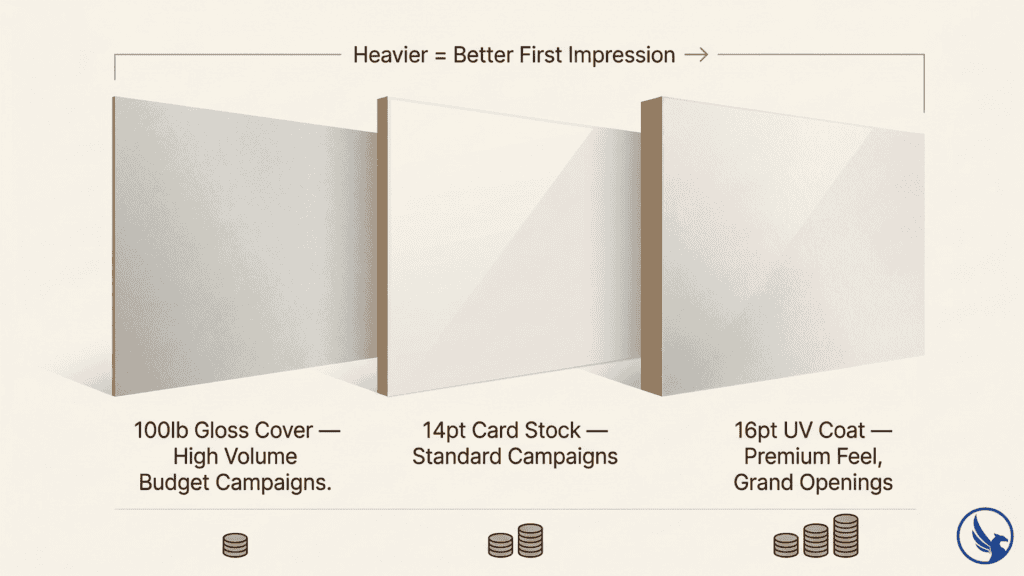
Great design on cheap paper undermines itself. The tactile experience of your postcard matters more than most marketers admit — when someone pulls your card from the mailbox, the weight and finish of the paper communicates quality before they’ve read a single word.
Paper Stock Options for EDDM Postcards
| Stock | Weight | Finish | Best For |
|---|---|---|---|
| 14pt Card Stock | Standard | Gloss or Matte | Most campaigns |
| 16pt Card Stock | Heavy | Gloss UV | Premium feel — restaurants, real estate |
| 100lb Gloss Cover | Light | Gloss | High-volume, budget-sensitive runs |
For campaigns where first impressions matter most — grand openings, luxury services, real estate — invest in 16pt with a UV coating. For high-volume saturation campaigns on tighter budgets, 14pt gloss card stock is a reliable standard. The full EDDM Paper Stock Options guide walks through each option with cost and durability comparisons.
What EDDM Printing Costs Per Piece
Printing costs vary based on quantity, size, and stock — but here’s a realistic range for standard EDDM campaigns:
- Printing: $0.07–$0.18 per piece (larger quantities drive cost down)
- USPS postage: $0.260 per piece
- Total delivered cost: Approximately $0.33–$0.44 per piece at scale
Advisory: The $0.260 USPS EDDM Retail postage rate reflects pricing at time of publication. Verify the current rate at usps.com/business/every-door-direct-mail.htm before finalizing your campaign budget. Print costs are directional estimates that vary by vendor, stock, coating, and run size.
For a 5,000-piece campaign, you’re typically looking at $1,800–$2,200 total — including print and postage. The EDDM Postcard Printing Cost breakdown covers pricing at different volume tiers in detail. You can also use the EDDM ROI Calculator to model your expected return before committing to a print run.
Common EDDM Postcard Design Mistakes (and How to Avoid Them)
Even experienced marketers make avoidable design errors that suppress campaign performance. Here are the most common — and what to do instead.
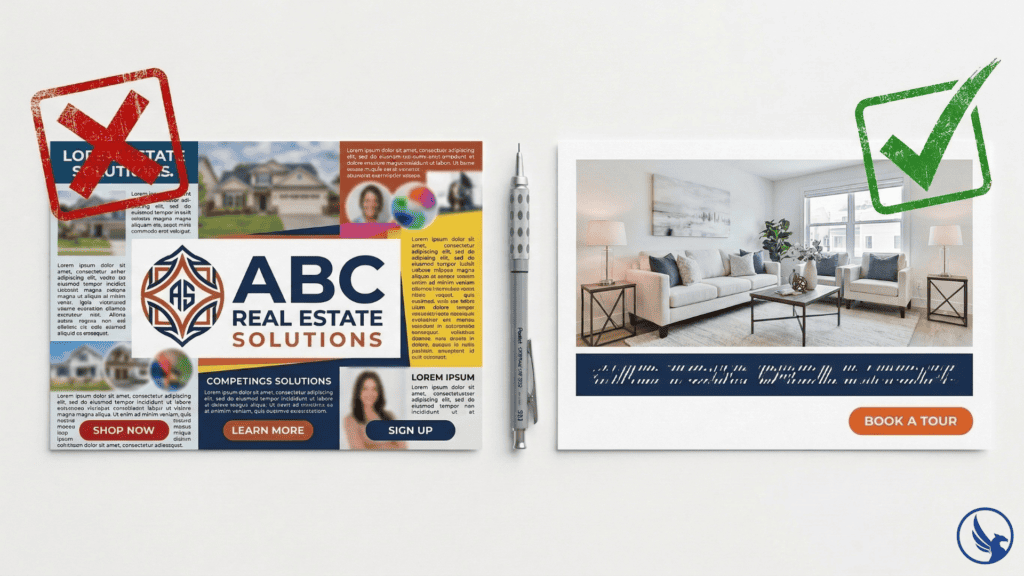
Too much text. EDDM postcards aren’t brochures. If your copy requires more than 30 seconds to read, cut it in half — lead with the offer, support with two or three bullet points max, and let the CTA close.
Weak or missing call to action. “Visit us today” is not a CTA. “Call before March 31 for 15% off your first service” is — be specific, add urgency, and make the next step obvious.
Using a logo as the hero. Your logo doesn’t drive response; your offer does. The logo belongs in the corner, not the center of the front face.
Ignoring response rate benchmarks. EDDM consistently outperforms digital channels for local reach, but design directly affects your numbers. The EDDM Response Rates guide shows what top-performing campaigns achieve and which design variables correlate with higher returns. According to the ANA’s direct mail response rate research, direct mail response rates for prospect lists average around 2.9% — well above most digital benchmarks, and a realistic target for well-designed EDDM campaigns.
Advisory: The ANA figures cited here (4.9% house list, 2.9% prospect list) apply to direct mail broadly, not exclusively to EDDM. Because EDDM routes to cold geographic audiences, the prospect list range is the more applicable benchmark. Verify the current edition of the ANA/DMA Response Rate Report at thedma.org before citing in client materials.
Not tracking results. A beautiful postcard with no tracking mechanism is a missed learning opportunity. Use unique phone numbers, QR codes, or promo codes so you know exactly which design and which route drove conversions. EDDM Tracking Results covers the most practical measurement methods without overcomplicating your setup.
For a comprehensive checklist across the entire campaign process, EDDM Mistakes to Avoid is worth reading before you go to print.
Real-World EDDM Postcard Design in Action: A Case Study
A home services company ran a spring EDDM campaign targeting three carrier routes near a suburban development. Their original postcard was text-heavy, featured a company group photo, and had three different calls to action — call, visit the website, or fill out a form. Response rate: under 0.5%.
They redesigned with a single hero image of a finished deck installation, one headline (“Free Estimate for Deck Installations in [Town Name]”), and one CTA — a phone number in 24pt type. The back restated the offer with a short bullet list of services and a QR code linking to a mobile estimate form. Before the second drop, they also used the EDDM Mailing Routes guide to tighten their zone targeting. Response rate on the second drop: 2.8%.
Advisory: The response rate figures in this case study — under 0.5% on the first drop, 2.8% on the second — are illustrative of the design optimization principle rather than a verified published case study. Actual results vary by market, offer, route demographics, and campaign structure. These figures are consistent with the series-standard 1%–5% prospect mail response range.
Same neighborhood, postage. Same printing cost. The only variable was design — and that’s the leverage point EDDM postcard design gives you when it’s executed with intention. If you’re planning your first campaign and want a structured walkthrough before going to print, the EDDM First Campaign Guide covers the full sequence from file setup to USPS drop-off. Small businesses in particular tend to see the biggest lift from design optimization — if that’s your situation, EDDM for Small Business covers campaign structure and budget management alongside design strategy.
Start Your EDDM Campaign with CRST
EDDM gives local businesses one of the most cost-effective tools in direct marketing — but the design has to earn it. From USPS-compliant file setup to print-ready artwork that gets noticed in a crowded mailbox, every decision in your design process affects your response rate. CRST has helped businesses across industries build EDDM campaigns that deliver real, measurable results — from restaurants and gyms to home services and real estate professionals.
Explore our full EDDM printing services, request an estimate, or contact our team to get started.
For the complete breakdown of how the program works, see our EDDM Guide.