
The best postcard size for direct mail isn’t the biggest or the cheapest—it’s the one that maximizes USPS® postage savings while giving your design enough room to convert. Choose the wrong postcard size, and you’ll overpay for postage or lose your message in cramped layouts. In 2026, professional direct mail campaigns depend on precision: dimensions that fit USPS postcard printing requirements, paper weight that survives transit, and sizes that stand out without triggering junk mail reflexes. Here’s exactly which postcard sizes deliver results and why paper stock matters just as much.
This article is part of our guide to postcard printing with mailing.
📮 Choose Your Postcard Campaign Size
Lowest postage rate
45% more space
Luxury feel
Geographic targeting
📊 Best Use Cases by Campaign Type
Why the Best Postcard Size for Direct Mail Matters
USPS® pricing tiers reward specific dimensions. Mail a postcard that’s too small, and it gets lost in the stack. Too large, and you pay letter rates instead of postcard rates—sometimes double the cost per piece.
The best postcard size for direct mail balances three factors: postal regulations, design space, and recipient impact. A 4″ × 6″ postcard saves money but limits your message. A 6″ × 11″ postcard commands attention but exceeds the maximum postcard dimensions—forcing it into letter-rate pricing at $0.82 for First-Class® single-piece mail (versus $0.65 for postcards). Your industry, offer complexity, and budget determine which size wins.
Paper thickness affects durability and perceived value. Thin stock bends during sorting, arriving crumpled and unprofessional. Heavy stock feels premium but can push you into non-machinable surcharges. Direct mail lives or dies in the three seconds between mailbox and recycling bin—postcard size and quality make that decision for recipients before they read a single word.
USPS®-Approved Postcard Sizes: Finding the Best Size for Direct Mail
USPS® defines postcard mail by minimum and maximum dimensions. Stay within these ranges to qualify for First-Class Mail® or Marketing Mail® postcard rates (rates current as of 2025-2026; verify at usps.com/business):
Postcard Rate Eligibility:
- Minimum: 3.5″ × 5″ × 0.007″ thick
- Maximum: 6″ × 9″ × 0.016″ thick
- Must be rectangular with corner radius not exceeding 0.125″
Letter-Size Mail (higher postage):
- Pieces exceeding 6″ × 9″ up to 6.125″ × 11.5″ × 0.25″ thick
- Mailed at letter rates: $0.82 First-Class® single-piece, higher Marketing Mail® rates
4″ × 6″ Postcards: Budget-Friendly Direct Mail
The most common postcard size for direct mail campaigns. USPS® recognizes 4″ × 6″ as the standard postcard, which means it automatically qualifies for the lowest postcard postage rates—$0.65 for First-Class® Mail single-piece or approximately $0.43 for Marketing Mail® presort (2025-2026 rates). See design examples for 4″×6″ postcards.
Best for:
- Appointment reminders (dentists, salons, auto service)
- Event announcements with simple details
- Thank-you notes and customer touchpoints
- Quick promotional offers (limited-time discounts)
Design space is tight. You’ll fit a headline, one hero image, 50–75 words of body copy, and a clear call to action. Nothing more. This size works when your message is singular and your goal is frequency over complexity. Budget-conscious campaigns love 4″ × 6″ postcards because they maximize reach per dollar.
5″ × 7″ Postcards: The Best Postcard Size for Most Campaigns
Many marketers consider 5″ × 7″ the best postcard size for direct mail campaigns that need more design flexibility without breaking the budget. This size offers 46% more surface area than 4″ × 6″ (35 square inches vs 24 square inches), which translates to room for multiple images, longer copy, and more breathing space in your layout. For design inspiration, see 5″×7″ real estate examples.
Still qualifies for postcard rates if you stay within weight limits (typically 14 pt cardstock works perfectly).
Best for:
- Real estate listings (multiple property photos, agent headshot, sold data)
- Restaurant menu mailers with food photography
- Nonprofit donation appeals with impact stories
- Product launch announcements requiring detail
This size hits the balance between cost and impact. It’s noticeable in a mailbox but doesn’t trigger the “oversized junk mail” filter. Most professional direct mail campaigns default to 5″ × 7″ for good reason—it works.
6″ × 9″ and 6″ × 11″ Postcards: Premium Direct Mail Sizes
Jumbo postcards are impossible to ignore. A 6″ × 9″ piece stands out in any mailbox—and represents the maximum size for USPS® postcard rates. A 6″ × 11″ postcard mimics a magazine page but exceeds postcard dimensions, forcing it into letter-rate pricing per USPS dimensional standards. See premium 6″×9″ designs.
Critical sizing rule: Postcards larger than 6″ × 9″ (such as 6″ × 11″, 6.25″ × 11″, or any dimension exceeding the 6″ × 9″ maximum) automatically qualify as letter-size mail, resulting in higher postage: $0.82 per piece for First-Class® single mail versus $0.65 for postcards—a 26% increase.
Use jumbo sizes when:
- Targeting high-value prospects (luxury real estate, $10K+ services)
- Design requires visual storytelling (before/after images, detailed menus, portfolio work)
- Brand perception demands premium materials
The best postcard size for direct mail to affluent audiences is often 6″ × 9″ or larger. Recipients associate size with importance. A jumbo postcard signals that your business invests in quality, which subconsciously elevates brand perception.
Paper Weight: Choosing the Best Cardstock for Direct Mail Postcards
Choosing the best postcard size for direct mail is only half the decision. Paper stock determines whether your piece arrives intact and how recipients perceive your brand. For an in-depth look at cardstock options, read our guide on thick postcard printing for durability.
14 pt Cardstock (≈100–111 lb Cover): Professional Standard
The default choice for most direct mail postcards. Thick enough to feel substantial, thin enough to stay within postcard postage rates. Won’t curl or bend during USPS® sorting and delivery.
Recommended for:
- Business postcards across all industries
- EDDM® campaigns (Every Door Direct Mail®)
- High-volume mailings where durability matters
Finish options: Gloss (vibrant colors, photo-friendly) and matte (upscale, writable surface for handwritten notes).
16 pt Cardstock (≈120–130 lb Cover): Premium Thickness
A 16 pt postcard feels expensive in hand. It resists bending completely, which makes it ideal for luxury brands, high-end real estate, upscale restaurants, and nonprofit galas.
Caution: 16 pt stock on larger sizes (6″ × 9″ or bigger) may push you into letter-rate pricing instead of postcard rates depending on total piece weight. Always calculate postage before committing to this thickness on jumbo sizes.longevity matters (gym passes, loyalty programs).
Coatings and Finishes for Direct Mail Postcards
Silk laminate: Ultra-smooth, soft-touch finish. Creates a luxurious tactile experience. Often used for wedding announcements, high-end retail, and spa services.
Recycled stock: Eco-friendly option with slightly rougher texture and earthy appearance. Appeals to environmentally conscious audiences. Works well for nonprofits, organic brands, and sustainability-focused businesses. Learn more about eco-friendly postcard printing options.
Plastic postcards: Waterproof, tear-proof, unforgettable. Expensive but durable. Reserved for VIP programs, membership cards, or campaigns where longevity matters (gym passes, loyalty programs).
Matching the Best Postcard Size to Your Campaign Goals
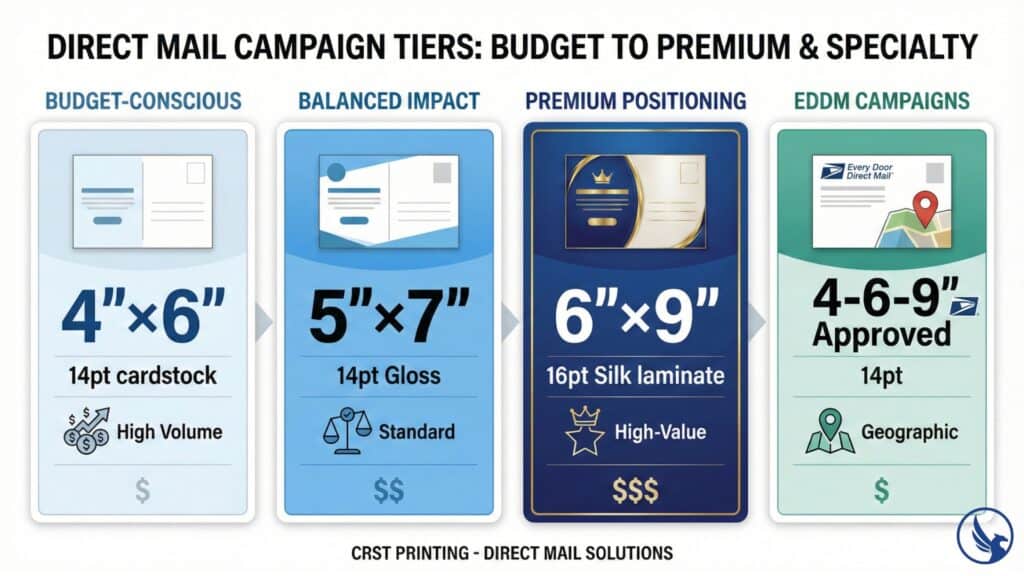
Budget-conscious campaigns: 4″ × 6″ postcards on 14 pt cardstock. Lowest postage ($0.65 First-Class®, ~$0.43 Marketing Mail®), lowest printing cost, maximum reach per dollar. Ideal for testing new markets or high-frequency mailings (monthly customer touchpoints). See affordable postcard printing for startups for cost optimization strategies.
Balanced impact campaigns: 5″ × 7″ postcards on 14 pt cardstock with gloss finish. The best postcard size for direct mail when you need design space without premium costs. Works for most business-to-consumer campaigns.
Premium positioning campaigns: 6″ × 9″ postcards on 16 pt cardstock with silk laminate. High cost per piece, but recipients remember them. Use for targeted lists, high-value prospects, or brand-building mailings to affluent zip codes.
EDDM® campaigns: Stick with USPS®-preferred flat-size dimensions and 14 pt stock. EDDM® requires flat-size mail—pieces must exceed letter dimensions on at least one measurement (minimum 6.125″ height OR 11.5″ length OR 0.25″ thick). Common EDDM® sizes: 6.25″ × 9″, 8.5″ × 11″, 9″ × 12″. EDDM® Retail pricing ($0.260 per piece in 2025-2026) already saves money on targeting—don’t lose those savings to nonstandard dimensions or weight surcharges. For full pricing breakdown, read our EDDM postcard printing cost analysis.
Ready to print your campaign? Request a quote at CRST.NET for custom postcard sizes, paper stock options, and volume pricing. Professional printing ensures your direct mail pieces arrive crisp, vibrant, and ready to convert.
Practical Tips for Choosing the Best Direct Mail Postcard Size
Test before committing to bulk orders. Print 50–100 postcards in your top two size options. Mail them to yourself, colleagues, and a handful of real prospects. Evaluate how they look in a real mailbox, how they feel in hand, and whether your design scales properly at each size.
Run USPS® postage calculators. Postage isn’t just about size—it’s about size and weight combined. A 6″ × 11″ postcard on 16 pt stock might cost as much to mail as a letter. Run the numbers at the USPS postage calculator before you finalize design specs.
Match finish to content type. Gloss finish makes photos pop—critical for real estate, restaurants, travel services. Matte finish looks sophisticated and allows handwritten notes—better for personal services, nonprofits, professional firms like law or accounting.
Plan for bleed and safe zones. Printers trim postcards after printing. Leave 0.125″ bleed on all edges, and keep text, logos, and critical elements at least 0.25″ from the trim line. Ignore this, and your design gets cut off at the edges. For more design guidance, see our article on postcard design mistakes to avoid.
Start Your Direct Mail Postcard Campaign
The best postcard size for direct mail is the one that fits your message, your budget, and USPS® standards without compromise. Choose dimensions strategically, pair them with professional paper stock, and design for the mailbox—not the screen. As USPS research demonstrates, physical mail still works in 2026 because postcards can’t be scrolled past or blocked by ad filters. Direct mail generates measurable ROI when sized, designed, and targeted correctly—learn more about postcard printing response rate statistics. Make yours impossible to ignore.
See our Postcard Printing Guide for full specs, size templates, and cost breakdowns by quantity.