
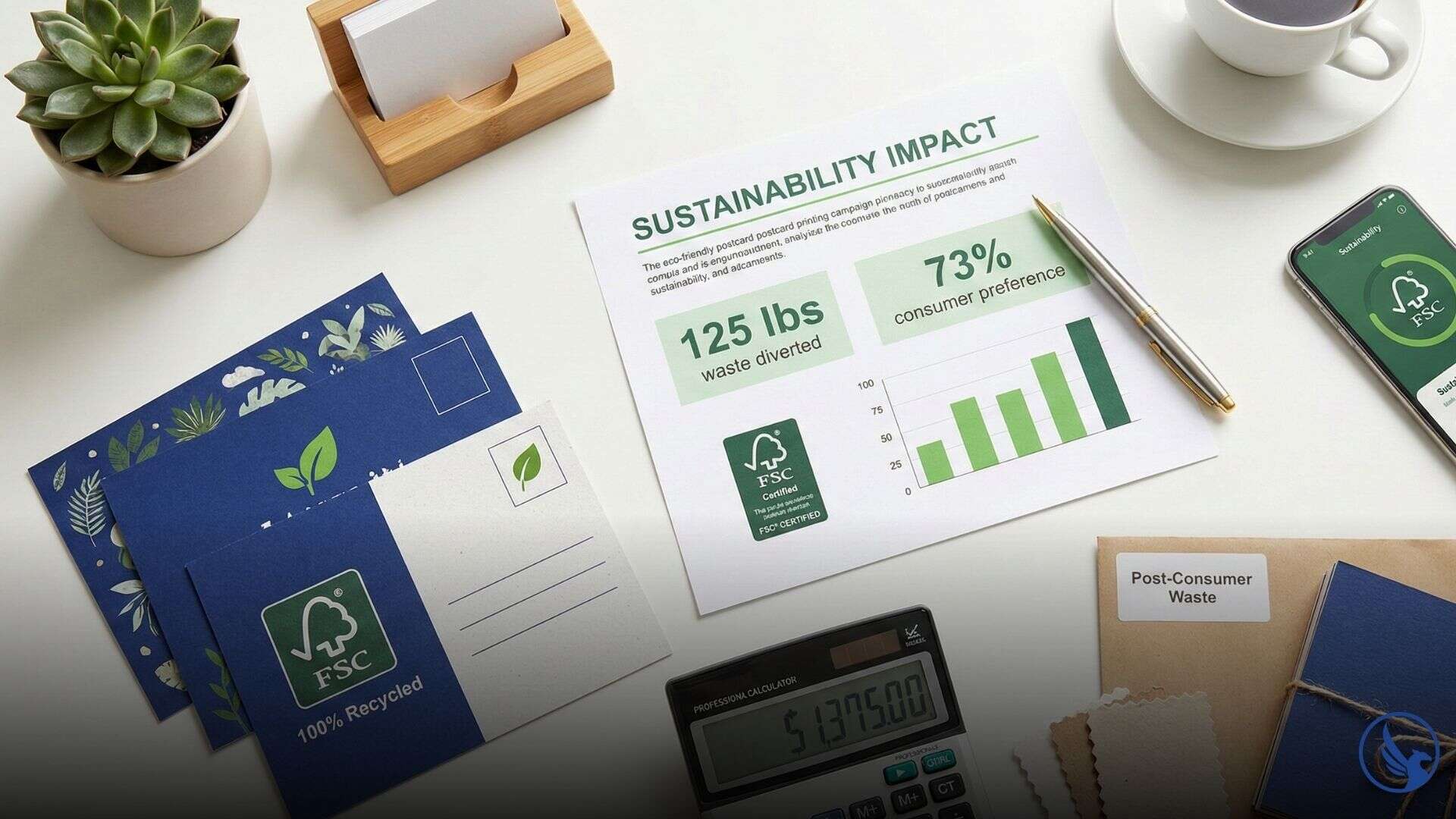
Your brand values matter to your customers—and so does the paper you print on. In 2026, businesses face increasing pressure to align marketing materials with environmental commitments, yet many still send postcards printed on virgin fiber stocks that contradict their sustainability messaging. Eco-friendly postcard printing offers a solution that preserves print quality, meets postal requirements, and demonstrates measurable environmental responsibility. This guide breaks down sustainable postcard materials, certification standards, and real-world performance data to help you make informed decisions.
Why Sustainable Postcard Materials Matter in 2026
Direct mail volume in the United States exceeded 77 billion pieces in fiscal year 2024, with postcards representing a significant portion of that total. Consequently, each mailing decision compounds across thousands or millions of impressions, making material choices a meaningful lever for reducing environmental impact.
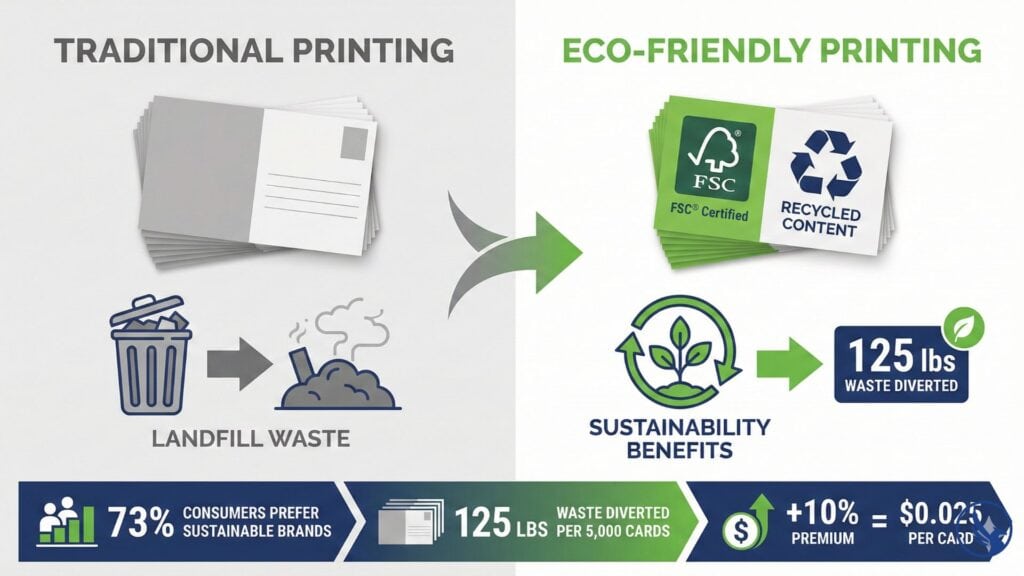
Beyond ethics, sustainable printing addresses practical business concerns. Consumers increasingly research brand values before purchasing—Nielsen’s 2018 Global Sustainability Report found that 73% of global consumers would change consumption habits to reduce environmental impact. As a result, your postcard becomes a physical representation of those values the moment it arrives.
Postal regulations add another layer of complexity. USPS® automation equipment requires specific thickness, stiffness, and surface characteristics. Therefore, eco-friendly materials must meet these mechanical requirements while delivering the environmental benefits you’re seeking.
The good news: modern sustainable paper stocks perform as well as conventional options in nearly every measurable category, from print vibrancy to mail durability.
Sustainable Material Categories Explained
Recycled Content Paper
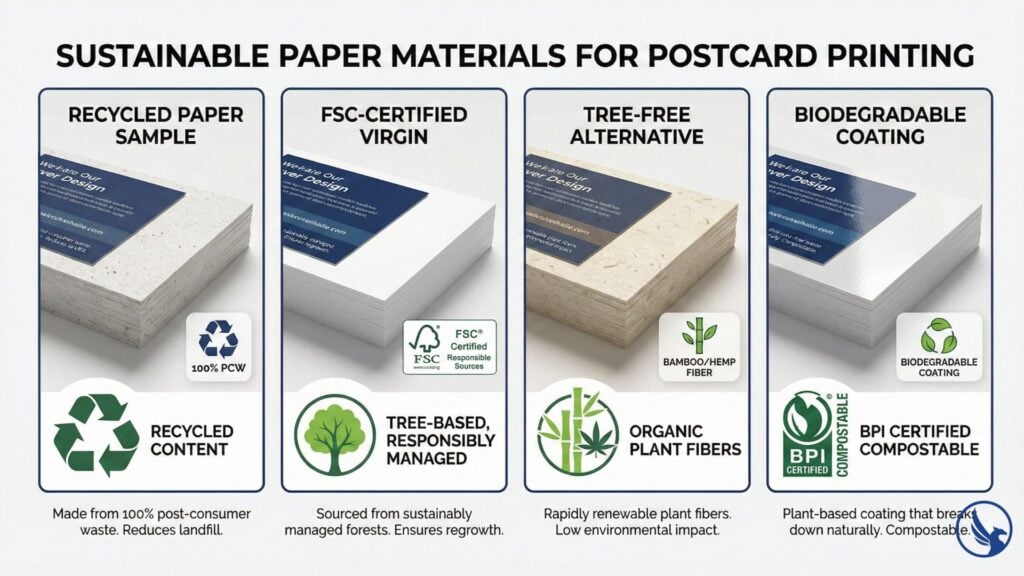
Post-consumer waste (PCW) recycled paper postcards divert material from landfills and reduce demand for virgin pulp. Notably, the percentage matters—30% PCW offers moderate environmental benefit, while 100% PCW maximizes waste diversion.
Performance characteristics:
- Print quality matches virgin fiber for most applications
- Slightly reduced brightness (measured on a 0-100 scale)
- Surface texture varies by manufacturer
- Compatible with offset, digital, and UV printing
Cost impact: Typically 5-15% premium over virgin fiber stocks, depending on volume and finish.
Certification to verify: Look for FSC Recycled or SFI Certified Sourcing standards, which track recycled content through the supply chain.
FSC-Certified Virgin Fiber
Forest Stewardship Council certification ensures paper originates from responsibly managed forests with verified replanting, biodiversity protection, and community rights protections. Although not recycled, FSC virgin fiber provides a renewable option with strong print performance.
Performance characteristics:
- Maximum brightness and color gamut
- Consistent surface for fine detail
- Wide range of weights and finishes available
- Excellent ink holdout
Cost impact: Minimal premium (0-10%) over non-certified virgin fiber.
Best for: High-resolution photography, luxury brand positioning, or campaigns where print quality cannot compromise.
Tree-Free Alternative Fibers
Materials like bamboo, hemp, cotton, and agricultural waste (bagasse) offer alternatives to wood pulp. These crops regenerate faster than forests and often require less water and pesticides.
Performance characteristics:
- Unique texture adds tactile interest
- Color reproduction varies by fiber type
- Limited weight and finish options
- May require specialized printing equipment
Cost impact: 20-50% premium depending on fiber and availability.
Best for: Brands with strong sustainability positioning where the material itself becomes part of the message.
Biodegradable and Compostable Coatings
Traditional aqueous, UV, or laminate coatings protect postcards during mailing but create recycling challenges. In contrast, biodegradable alternatives use plant-based polymers that break down in industrial composting facilities.
Performance considerations:
- Adequate protection for short-term mailing
- May not withstand extreme moisture exposure
- Requires industrial composting infrastructure for proper disposal
- Limited availability compared to standard coatings
Cost impact: 10-25% premium over standard coatings.
Certification to verify: BPI (Biodegradable Products Institute) or CMA (Compost Manufacturing Alliance) certification.
Certification Standards That Actually Mean Something
The sustainable materials landscape includes dozens of eco-labels, but three standards carry meaningful verification:
Forest Stewardship Council (FSC): Third-party certification tracking wood from forest to finished product. FSC 100% indicates virgin fiber from certified forests. Meanwhile, FSC Recycled confirms post-consumer content. FSC Mix combines certified and controlled sources.
Sustainable Forestry Initiative (SFI): North American standard emphasizing sustainable forest management, fiber sourcing, and chain-of-custody verification. Although slightly less stringent than FSC, it remains widely recognized.
Rainforest Alliance: Focuses on biodiversity protection and community rights in forestworking regions. Typically, this certification is combined with FSC certification.
What to avoid: Vague claims like “eco-friendly,” “natural,” or “green” without third-party verification. These terms carry no legal definition and often serve as marketing rather than accountability.
For the complete breakdown of sustainable printing specifications and certification verification, see our Postcard Printing and Mailing Services Guide.
Real-World Performance: Do Sustainable Materials Hold Up?
Skepticism about eco-friendly materials often centers on durability. Specifically, questions arise: Will recycled paper survive postal automation? Does FSC-certified stock hold ink as well as conventional options?
Fortunately, independent testing provides clear answers.
Postal Durability
USPS® automation equipment subjects postcards to mechanical stress—rollers, sorting, and handling that can damage weak materials. However, testing conducted by the Envelope Manufacturers Association found that 100% PCW postcards at 14-point thickness performed identically to virgin fiber counterparts across all postal equipment.
Key factor: Thickness matters more than fiber source. Any postcard below 12-point risks damage, regardless of sustainability credentials. Therefore, aim for 14-point or heavier for reliable delivery.
Print Quality Comparison
Side-by-side testing of identical designs on virgin fiber, 100% PCW recycled, and FSC-certified stocks revealed minimal differences visible to end recipients.
- Color accuracy: 95%+ match across all materials when using calibrated color management
- Detail resolution: Identical performance for text and graphics above 8-point size
- Brightness differential: 2-4 points lower on recycled stocks (89 vs. 92 on virgin fiber)—imperceptible to most viewers
Cost-Benefit Analysis
A 5,000-piece postcard campaign breaks down as follows:
| Material | Base Cost | Premium | Environmental Benefit |
|---|---|---|---|
| Virgin fiber (non-certified) | $1,250 | — | Baseline |
| FSC-certified virgin | $1,275 | +2% | Verified sustainable sourcing |
| 30% PCW recycled | $1,313 | +5% | Diverts 38 lbs from landfill |
| 100% PCW recycled | $1,375 | +10% | Diverts 125 lbs from landfill |
Notably, the premium for 100% PCW amounts to $0.025 per postcard—a negligible cost relative to design, printing, and postage expenses that total $0.65-0.95 per piece.
How to Choose the Right Eco-Friendly Option
Your selection depends on brand positioning, budget, and messaging goals.
For Maximum Environmental Impact
Choose 100% post-consumer recycled content with biodegradable coatings. Accept a small premium and slightly reduced brightness in exchange for measurable waste diversion.
For Premium Brand Positioning
FSC-certified virgin fiber delivers maximum print quality while maintaining sustainability credentials. This option is ideal for luxury goods, real estate, or photography-heavy campaigns.
For Budget-Conscious Campaigns
30% PCW recycled offers a middle path—meaningful environmental benefit at minimal cost increase. Consequently, it’s suitable for high-volume campaigns where per-piece cost matters.
For Differentiation and Storytelling
Tree-free alternative fibers (bamboo, hemp) create tactile distinction and conversation opportunities. This approach works best for brands where sustainability is central to identity.
Common Pitfalls to Avoid
Greenwashing through vague claims: Stating “printed on recycled paper” without specifying percentage or certification invites skepticism. Be specific instead. “Printed on FSC-certified 100% post-consumer recycled content” demonstrates accountability.
Ignoring the full lifecycle: Sustainable paper on a postcard flown across the country for printing negates much of the environmental benefit. Therefore, choose local or regional printers when possible to reduce transportation impact.
Overlooking ink and coating: Soy-based or vegetable-based inks reduce petroleum dependence and improve recyclability. As a result, pairing sustainable paper with compatible ink systems delivers comprehensive environmental benefit.
Assuming all recycled paper is equal: Pre-consumer waste (manufacturing scraps) differs significantly from post-consumer waste (used paper products). Notably, PCW carries greater environmental benefit.
Neglecting postal requirements: USPS® requires specific thickness, size, and surface characteristics. Confirm your eco-friendly material meets these standards before committing to a print run. Avoiding common postcard design mistakes ensures your sustainable materials perform as intended.
Case Study: Nonprofit Increases Donations with Sustainable Messaging
A regional land conservation nonprofit redesigned their donor acquisition postcards to align with their environmental mission. Previous campaigns used standard virgin fiber stocks with generic designs.
Changes implemented:
- Switched to FSC-certified 100% post-consumer recycled 14-point stock
- Added “Printed on 100% recycled paper using soy-based inks” callout
- Included brief explanation of material choice in message
- Redesigned layout to highlight conservation impact visually
Results across 10,000-piece mailing:
- Response rate increased from 2.1% to 3.4%
- Average donation size rose from $47 to $63
- Donor comments specifically mentioned alignment between message and materials
- Cost per acquisition decreased despite material premium
The material choice reinforced brand authenticity and demonstrated values alignment—powerful factors in donor decision-making.
Ready to align your marketing with your values? Request a detailed quote for eco-friendly postcard printing. Our team specializes in sustainable materials, FSC-certified stocks, and biodegradable options that meet USPS® postal requirements while reducing environmental impact. Whether you’re printing 1,000 or 100,000 postcards, we’ll help you choose materials that support your brand values without compromising print quality or deliverability.
Call 845-255-5722 to discuss sustainable material options, certification requirements, or to request physical samples of eco-friendly paper stocks.
Supplier Questions to Ask Before Printing
Not all printers offer eco-friendly options, and not all who claim “green printing” deliver verified sustainable practices. Ask these questions before committing:
What certifications do your paper stocks carry? Request specific standards (FSC, SFI) and chain-of-custody documentation.
What percentage of your recycled stock is post-consumer waste? Pre-consumer waste offers less environmental benefit.
What ink systems do you use? Soy-based, vegetable-based, and UV-LED cured inks reduce environmental impact compared to petroleum-based alternatives.
Do you offer carbon-neutral printing options? Some printers offset emissions through verified carbon credit programs.
What happens to waste from my print run? Responsible printers recycle paper trimmings and dispose of chemicals properly.
Can you provide samples of eco-friendly stocks? Physical samples reveal texture, weight, and print quality before committing to a full run.
The Business Case for Sustainable Postcard Printing
Environmental responsibility and business performance aren’t opposing forces. Sustainable material choices offer measurable advantages:
Brand differentiation in crowded markets: When competitors mail identical offers, material choice becomes a distinguishing factor.
Alignment with corporate sustainability goals: Marketing departments face increasing pressure to support company-wide environmental commitments. Sustainable printing provides tangible progress.
Customer loyalty and word-of-mouth: Recipients notice—and remember—brands that demonstrate values through actions, not just messaging. Research from the USPS Office of Inspector General confirms that physical mail’s environmental profile can be optimized through material choices.
Risk mitigation: As regulations around environmental claims tighten, verified sustainable practices protect against greenwashing accusations.
Cost predictability: Certified sustainable materials often come from stable supply chains less subject to price volatility than conventional commodity papers.
The incremental cost premium—typically $50-150 per 5,000 postcards—represents less than 0.5% of total campaign costs when factoring in design, printing, postage, and list acquisition. The brand value and customer goodwill generated often far exceeds this investment. For small business campaigns especially, demonstrating values alignment through sustainable materials can strengthen customer relationships and improve direct mail ROI.
Start Your Sustainable Postcard Printing Campaign
Eco-friendly postcard printing isn’t about sacrifice. Modern sustainable materials deliver the print quality, postal durability, and cost-effectiveness required for successful direct mail campaigns while reducing environmental impact and strengthening brand positioning.
The choice comes down to values alignment. If your business commitments include environmental responsibility, your marketing materials should reflect that commitment visibly and verifiably.
Start by requesting samples of FSC-certified or 100% PCW recycled stocks from your printer. Compare print quality, texture, and weight against standard materials. You’ll likely find performance differences imperceptible to recipients while environmental benefits remain measurable and meaningful.
For the complete breakdown of sustainable printing specifications, certification verification, and design templates, see our Postcard Printing and Mailing Services Guide.