
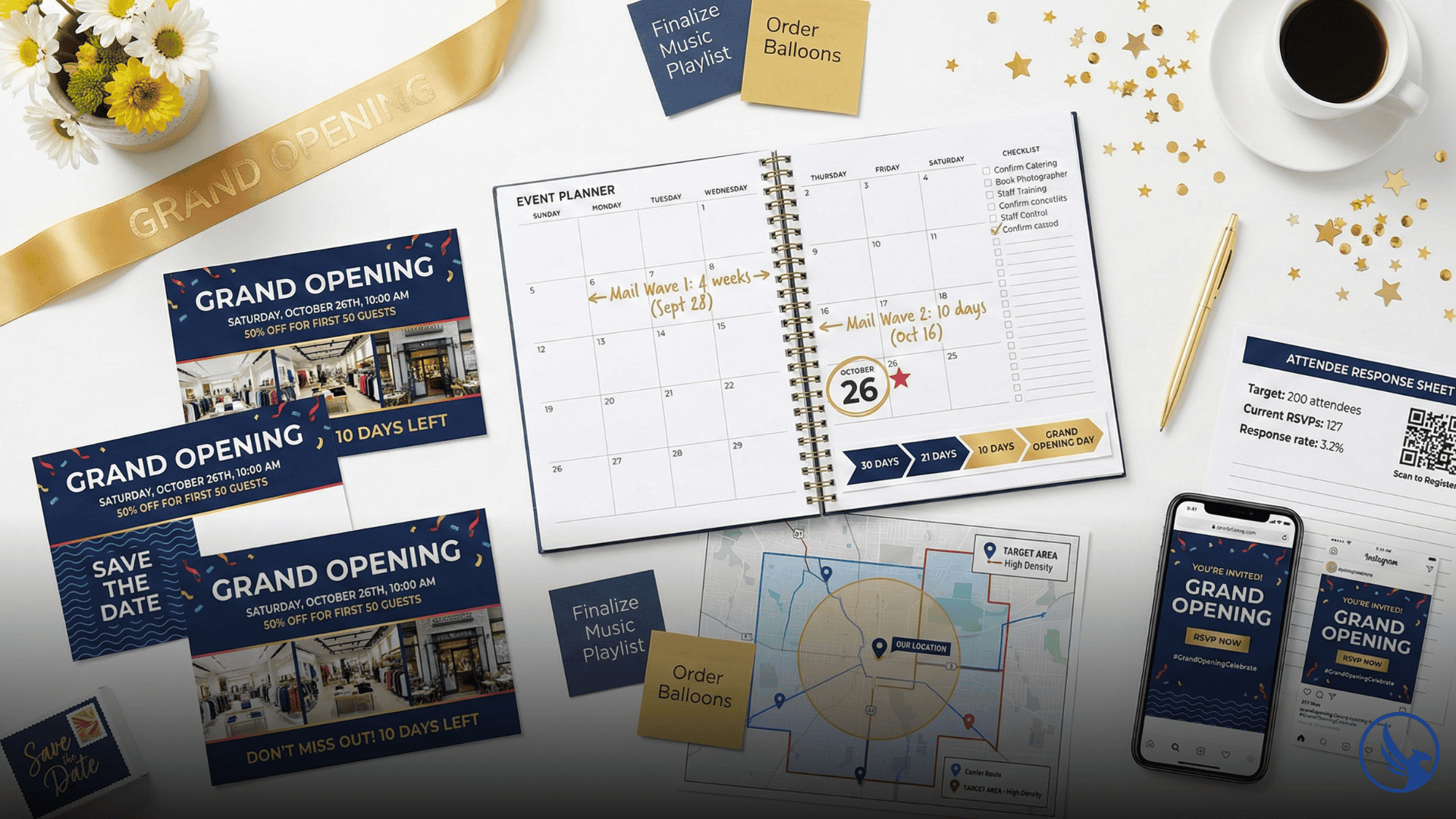
Your grand opening happens once. Digital ads disappear in feeds, but a well-designed postcard sits on kitchen counters and refrigerators for weeks. In 2026, successful event launches combine physical invitations with digital follow-up, creating multiple touchpoints that drive attendance. Well-executed postcard campaigns for grand openings can generate significantly higher turnout than digital-only strategies when executed with proper timing and targeting. Here’s the blueprint for filling your venue on opening day.
Why Postcards Outperform Digital for Event Marketing
Email open rates for promotional messages average 18-22% across industries. In contrast, postcard “open rates” hit 100%—every recipient physically handles your invitation. This tactile interaction creates psychological commitment that digital cannot match.
The retention advantage. People delete emails immediately. However, postcards remain visible until the event date approaches. A postcard on a refrigerator door serves as a daily reminder, building anticipation over weeks.
Local targeting precision. Grand openings need foot traffic from surrounding neighborhoods. Fortunately, EDDM® campaigns reach every address within walking or short driving distance. You’re not wasting impressions on people across town who’ll never visit.
Credibility signaling. A professionally printed invitation communicates permanence. Pop-up shops and fly-by-night businesses don’t invest in printed invitations. Consequently, the physical postcard itself proves you’re committed to the location.
Timeline Planning: When to Mail for Maximum Impact
Timing determines whether postcards drive attendance or get discarded. Therefore, the optimal schedule depends on your event type and audience.
Standard Grand Opening Timeline
4-6 weeks before: First announcement wave. This postcard introduces your business, highlights the opening date, and teases special offers. Specifically, the goal is awareness and calendar marking.
10-14 days before: Reminder wave. A second postcard with urgency language (“Only 2 weeks until…”) reinforces the date and includes additional incentives for early arrival.
48 hours before: Digital follow-up. For recipients who provided email or phone through early engagement, send last-minute reminders with directions and parking information.
Why multiple touchpoints matter: Marketing research shows people need 3-7 exposures before taking action. Consequently, a single postcard gets ignored. Two postcards with consistent messaging build momentum.
Event-Specific Variations
Restaurants and cafés: Mail 3 weeks out. Foodies plan less rigidly than other demographics. Therefore, closer timing maintains urgency. See our restaurant marketing guide for industry-specific strategies.
Retail stores: Mail 5-6 weeks out for weekend openings. Shoppers coordinate schedules with friends and family, requiring advance notice.
Service businesses (salons, gyms, medical offices): Mail 4 weeks out with appointment booking options. Additionally, include QR codes linking to scheduling software for immediate conversion.
Seasonal openings: Add 2 weeks to standard timelines during holidays when mailboxes flood with competing messages.
Geographic Targeting: Defining Your Postcard Radius
Not every address in your city matters. Instead, smart targeting concentrates budget on high-probability attendees.
The 3-Mile Rule for Retail and Dining
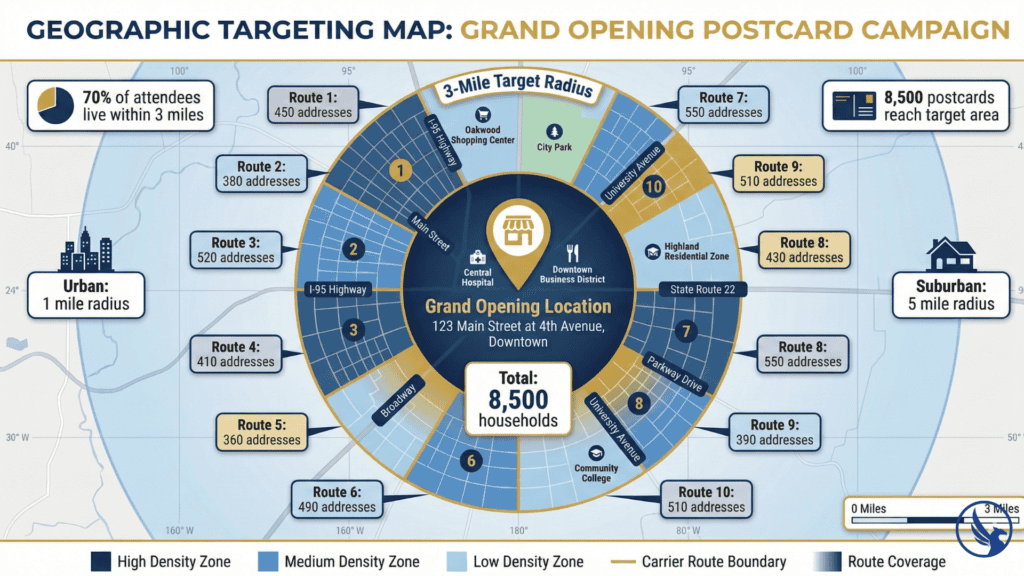
Consumer behavior patterns suggest the majority of grand opening attendees live within 3 miles of new restaurants and retail locations. Beyond this radius, attendance drops sharply unless you’re a destination business.
How to map your coverage:
Use USPS® EDDM® tools to select carrier routes within your target radius. Each route covers 300-500 addresses. For instance, for a 3-mile radius in suburban areas, expect to mail 8,000-12,000 postcards.
Urban density adjustment: In walkable city centers, reduce radius to 1 mile. Higher population density means sufficient volume in smaller geographic areas.
Suburban spread: For strip mall locations in car-dependent areas, extend to 5 miles. Customers routinely drive longer distances when parking is convenient.
Demographic Filters (When Available)
EDDM® doesn’t allow name-based targeting, but third-party direct mail services offer demographic overlays:
Income targeting. Premium retailers should target routes with median household incomes matching their customer profile. For example, a luxury spa mailing to budget neighborhoods wastes money.
Age targeting. Youth-focused businesses (gaming lounges, trendy boutiques) benefit from routes with higher concentrations of 18-34 year-olds.
Homeowner vs. renter. Service businesses requiring long-term customer relationships (lawn care, home improvement) should prioritize homeowner routes with lower turnover.
For detailed targeting strategies and carrier route selection, see our Postcard Printing and Mailing Services Guide.
Design Elements That Drive Attendance
Your postcard competes with bills, catalogs, and community flyers. Therefore, these design principles separate keepers from recycling bin rejects.
The Headline Formula
Grand opening postcards need immediate clarity. Specifically, recipients should understand what, where, and when within 3 seconds.
Weak headline: “We’re Opening Soon!”
Strong headline: “Grand Opening: Riverside Yoga Studio – March 15th”
The strong version includes business name, category, and date in one line. Consequently, no guesswork is required.
The Offer That Compels Action
Free admission to a grand opening isn’t an offer—it’s expected. Instead, create incentives that overcome inertia:
First 50 guests receive [gift/discount/bonus]. Scarcity triggers early arrival and word-of-mouth promotion.
Exclusive opening-day pricing. “50% off all services booked on March 15th” converts price-sensitive shoppers who might otherwise wait.
VIP early access. “Arrive 30 minutes before public opening for private preview.” Makes recipients feel valued and special.
Giveaway entry. “Register at the event for a chance to win [high-value prize].” Captures contact information for future marketing.
Visual Hierarchy and Information Architecture
Postcards have limited real estate. Therefore, prioritize information ruthlessly:
Front panel priorities:
- Eye-catching image (your location, product, or happy customers)
- “Grand Opening” in large, bold text
- Business name and category
- Date and time
- Primary offer
Back panel details:
- Full address with landmarks (“Next to Starbucks on Main Street”)
- Parking instructions if non-obvious
- Expanded offer details and terms
- Website and phone number
- Social media handles for pre-event engagement
Critical spacing rule: Keep text at least 0.25 inches from all edges per USPS® postcard requirements. Postcard cutters can shift slightly during production, trimming content placed too close to borders.
Messaging Strategy: Building Excitement Over Time
If you’re sending multiple postcards (recommended), each piece should advance the narrative rather than repeat identical information.
Wave 1: The Announcement
Tone: Exciting, welcoming, community-focused
Core message: “Something new is coming to your neighborhood. Mark your calendar.”
Content elements:
- Founder story or business mission (builds connection)
- Sneak peek images of interior or products
- Invitation to follow social media for updates
- Clear date and preliminary offer
Wave 2: The Reminder with Urgency
Tone: Urgent, exclusive, incentive-driven
Core message: “Only X days left. Here’s what you’ll experience.”
Content elements:
- Enhanced offer details (“First 100 guests receive…”)
- Specific event schedule (“Live music at 2pm, product demos at 3pm”)
- Testimonials or press mentions if available
- Stronger call-to-action (“Arrive early—limited quantities”)
The Consistency Imperative
Both postcards must share visual branding—same colors, fonts, logo placement. Recipients should instantly recognize the second piece as related to the first. Inconsistent design suggests disorganization. Avoid common postcard design mistakes that undermine your brand.
Tracking Response: Measuring What Works
You can’t optimize future campaigns without data. Therefore, build tracking mechanisms into your postcard design.
Unique URL or QR Code
Create a landing page specific to the postcard campaign: yourbusiness.com/grand-opening
Use Google Analytics UTM parameters to track traffic source: yourbusiness.com/grand-opening?utm_source=postcard&utm_medium=eddm&utm_campaign=march2026
QR codes eliminate typing barriers. Consequently, recipients scan and arrive directly at your event page.
Offer Redemption Tracking
If your postcard includes a discount or gift, require the physical postcard at redemption. Count postcards collected during the event to measure direct response.
Digital alternative: Use unique promo codes (“GRAND50”) tied to the postcard campaign. Track redemptions in your POS system.
Post-Event Survey
Ask attendees how they heard about the opening. Include “postcard” as an option alongside social media, word-of-mouth, and online ads. This self-reported data supplements tracking tools.
Integration with Digital Marketing
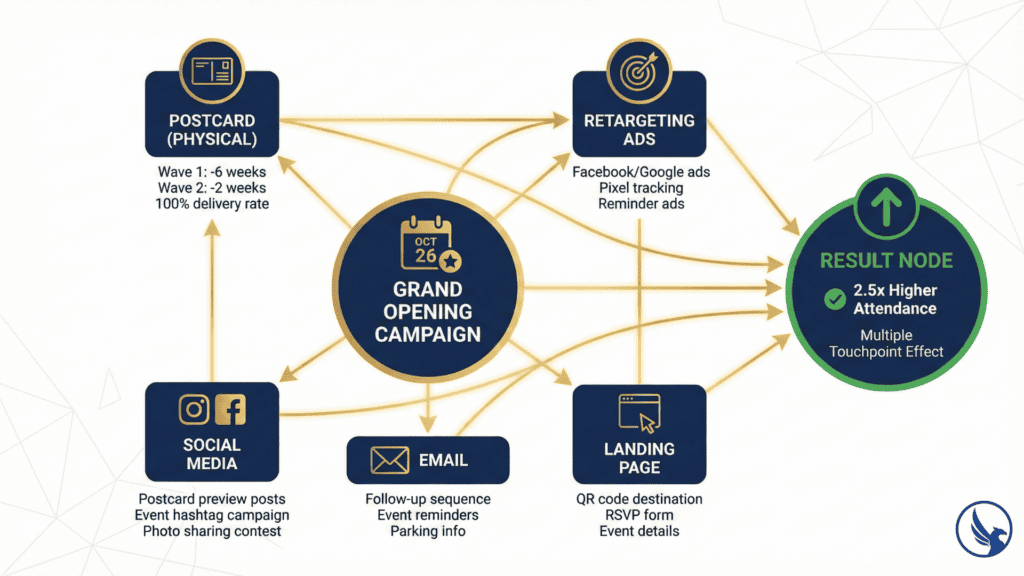
Postcards shouldn’t operate in isolation. Instead, coordinate with online channels for amplified reach.
Pre-Event Social Media Campaign
Post photos of postcard design on Instagram and Facebook. Create anticipation: “Watch your mailbox this week for an exclusive invitation.”
Additionally, encourage recipients to share postcard photos online with event hashtag. Offer entry into giveaway for social shares.
Email Follow-Up Sequence
For recipients who engage with your website via postcard QR code, capture emails and send:
- 1 week before: Detailed event schedule and featured activities
- 3 days before: Parking map and arrival tips
- Day of: “See you in 3 hours!” with final reminders
Retargeting Ads
Install Facebook and Google tracking pixels on your postcard landing page. Subsequently, serve reminder ads to people who visited but haven’t RSVPed or taken action.
The multiplier effect: Recipients who see postcards AND digital ads attend at higher rates than those exposed to only one channel. The combined approach reinforces your message across touchpoints.
Budget Planning: What Grand Opening Postcards Cost
Transparent pricing helps you allocate resources effectively. Here’s a realistic breakdown for a 5,000-piece campaign:
| Line Item | Cost Range | Notes |
|---|---|---|
| Design (freelancer) | $200–$500 | One-time fee for both waves |
| Printing (4×6, 14pt) | $200–$350 | $0.04–$0.07 per piece |
| Postage (EDDM®) | $1,300 | $0.260 per piece (EDDM® Retail rate) |
| Total (single wave) | $1,700–$2,150 | $0.34–$0.43 per postcard |
| Total (two waves) | $3,070–$3,920 | Double for reminder campaign |
ROI calculation: If your average customer lifetime value is $500 and postcards drive 50 attendees (1% response rate), the campaign generates $25,000 in potential lifetime value for under $4,000 investment. Therefore, the return on investment justifies the expense. For more detailed cost breakdowns, see our postcard printing costs guide.
Ready to fill your venue on grand opening day? Request a detailed quote for your grand opening postcard campaign. Our team specializes in event-driven direct mail strategies, geographic targeting optimization, and multi-wave campaigns that build anticipation and drive attendance. Whether you’re opening a restaurant, retail location, or service business, we’ll help you create momentum that carries beyond opening day.
Call 845-255-5722 to discuss your grand opening timeline, target audience, and campaign strategy.
Case Study: How a Brewery Packed Their Grand Opening
A craft brewery in a mid-sized college town used a two-wave postcard campaign for their grand opening. Here’s what they did and the results they achieved.
Strategy:
- Wave 1 (4 weeks out): Mailed 8,000 postcards to 3-mile radius featuring brewery story and opening date
- Wave 2 (10 days out): Mailed 8,000 reminders with “First 200 guests get free pint glass” offer
- Landing page with event RSVP form and merch pre-orders
- Social media campaign encouraging postcard photo shares
Results:
- 650+ attendees on opening day (8% response rate—exceptionally high compared to typical EDDM® response rates of 1-2%)
- 320 email addresses captured through RSVP and postcard QR codes
- $12,000 in opening-day sales
- 180 social media mentions with event hashtag
- Local news coverage mentioning “overwhelming turnout”
Key insight: The pint glass offer created urgency. Attendees arrived early and brought friends to ensure they were in the first 200. This created visible crowds that attracted walk-by traffic, compounding the postcard-driven attendance.
Common Mistakes That Tank Grand Opening Postcards
Avoid these errors that waste budget and reduce turnout:
Mailing too early. Postcards sent 8+ weeks before events get forgotten. Consequently, recipients lose or discard them before the date arrives.
Mailing too late. Postcards arriving 5 days before weekends don’t give recipients time to plan. They’ve already committed to other activities.
Vague offers. “Special grand opening discounts” means nothing. Instead, specify exact savings or gifts.
Missing critical details. Forgotten parking instructions or unclear address locations create friction that prevents attendance.
Ignoring back panel. Some businesses design beautiful front panels and leave backs nearly blank. However, every square inch should work toward conversion.
No follow-up plan. Collecting 300 email addresses at your event is worthless without nurture campaigns that convert one-time visitors into repeat customers.
Seasonal Considerations for Event Postcards
Timing your grand opening affects both postcard design and mailing logistics.
Spring launches: Emphasize fresh starts and renewal. Additionally, align with local events like farmers markets or festivals for cross-promotion.
Summer openings: Highlight outdoor elements or air conditioning (for retail). However, consider delays if targeting families during peak vacation weeks.
Fall campaigns: Leverage back-to-school momentum for family-focused businesses. Restaurant openings capitalize on holiday party bookings.
Winter events: Include weather contingency plans in postcard messaging. Moreover, highlight warm, welcoming interiors in imagery.
Start Your Grand Opening Postcard Campaign
Grand openings succeed when the right people know to attend. Specifically, postcard campaigns deliver that awareness with tangible urgency that digital channels struggle to match.
Start planning 8 weeks before your opening date. Design your first wave, select your carrier routes, and build the landing page that converts postcard recipients into attendees.
The businesses that launch strong don’t rely on word-of-mouth alone—they orchestrate multi-touchpoint campaigns where postcards anchor the strategy. For small business campaigns, this integrated approach maximizes opening day impact.
For full design specs, targeting strategies, and print specifications, see our Postcard Printing and Mailing Services Guide.