
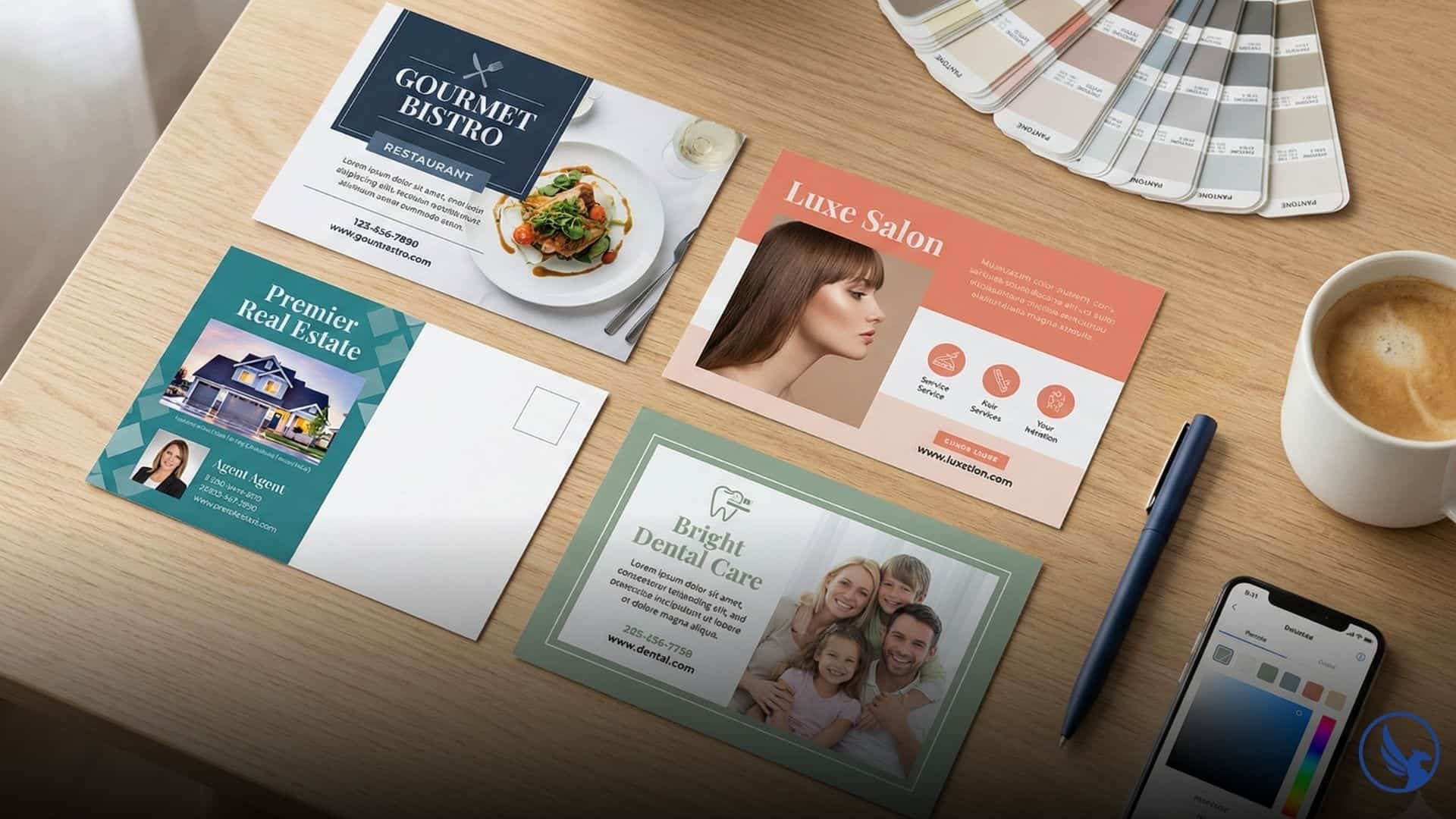
Most small businesses waste their first postcard campaign using generic templates that ignore local market dynamics. A coffee shop in Portland needs different messaging than one in Phoenix, yet most free templates offer identical layouts with placeholder text. In 2026, smart small business owners customize proven frameworks instead of starting from scratch, adapting templates to their specific audience, offer, and competitive landscape. Here’s how to use postcard printing for small business templates that actually convert without hiring a design agency.
Low engagement
High conversion
Why Small Businesses Still Win with Postcard Printing
Digital ads drain budgets with no guaranteed reach. Your Facebook campaign competes with infinite scroll and banner blindness. Email marketing fights spam filters and unread inboxes. Postcard printing for small business delivers guaranteed physical presence in your customer’s hands.
Local businesses thrive on geographic density. A three-mile radius around your location contains your highest-value customers, yet most small business marketing scatters attention across platforms where targeting costs surge. Postcards let you own a specific territory without bidding wars or algorithm changes.
The economics favor small operations. A 500-piece postcard mailing costs $300-400 including printing ($0.15-0.25 per piece for volume offset printing), First-Class Mail® postage ($0.61 per postcard as of July 2025; rates current as of February 2026), and list acquisition. That same budget buys three days of Facebook ads with uncertain reach. According to the ANA (Association of National Advertisers) 2018 Response Rate Report, direct mail achieves response rates of 4.9% for prospect lists, 9.0% for house lists, and 4.25% specifically for postcards when designed correctly, delivering 25-45 new customers per campaign. For comprehensive response rate statistics across industries, these benchmarks consistently outperform digital channels. If your average customer lifetime value exceeds $50, one mailing pays for six months of marketing.
Tangible marketing builds lasting memory. Recipients handle your postcard, place it on the counter, and see it multiple times before discarding. Digital impressions vanish instantly. Physical mail creates anchoring bias—people overvalue items they’ve physically touched, making them more likely to act on your offer.
Small businesses face trust barriers that postcards overcome. A new restaurant, salon, or service provider lacks reviews and reputation. A well-designed postcard with owner photos, local landmarks, and community involvement signals permanence and authenticity. You’re not a pop-up ad. You’re a neighbor.
Essential Postcard Templates Every Small Business Needs
Successful postcard printing for small business follows proven layouts that balance information density with visual impact. These templates work across industries with minor customization. See our template customization examples for visual inspiration.
The Grand Opening Announcement
Grand opening postcards require bold headlines, clear location details, and urgency-driven offers. Your template should include:
Front side: Business name in large type, “Grand Opening” or “Now Open” headline, hero image of storefront or signature product, opening date prominently displayed. Avoid cluttering with hours, full menu, or excessive detail. The front sells the visit, not the entire business.
Back side: Specific address with cross streets, Google Maps QR code, opening week special offer with expiration date, contact phone, and website. Include parking details if relevant—customers won’t visit if they can’t park.
Example headline: “Kingston’s Newest Coffee Roaster Opens March 15th—Free Espresso All Week.” The location, category, date, and offer appear in 10 words. Clarity converts.
For detailed strategies on using postcards for grand openings and events, including timeline planning and checklist resources, see our dedicated guide.
The Seasonal Promotion
Seasonal postcards leverage holidays, weather changes, and predictable consumer behavior. Your template needs flexibility for multiple annual campaigns while maintaining brand consistency. Browse seasonal promotion templates for campaign examples.
Front side: Seasonal imagery that avoids clichés (skip the stock photo Santa), your core offer in 5-7 words, price or discount percentage prominently displayed. The visual should trigger emotional association with the season without explaining the connection.
Back side: Offer details including qualifying conditions, expiration date, redemption instructions, contact information, and simple call-to-action. “Show this postcard for 20% off” works better than “Visit our website to print your coupon.”
Restaurants use seasonal templates for Mother’s Day brunch, summer patio openings, and holiday catering. Salons promote spring color updates and holiday party packages. HVAC companies mail air conditioning check-ups in April and furnace maintenance in September. The template stays consistent, images and offers rotate.
The Reactivation Campaign
Reactivation postcards target former customers who haven’t purchased in 60-180 days. These templates require personalization fields for names, last visit dates, and customized offers.
Front side: “We Miss You” or “It’s Been Too Long” headline, personalized greeting, emotional imagery showing happy customers or your team. Avoid guilt-based messaging—focus on positive reinforcement.
Back side: Personalized offer (10-20% higher value than acquisition offers), specific expiration creating urgency, multiple contact methods, and reference to their history with your business. “Your last visit was [date]. Come back and enjoy [offer].”
Dentists use reactivation templates for patients overdue for cleanings. Gyms target members whose check-ins dropped. Restaurants bring back diners who stopped visiting after menu changes or renovations.
For the complete breakdown of design specifications and downloadable templates, see our Postcard Printing and Mailing Services Guide.
Design Elements That Make Templates Work
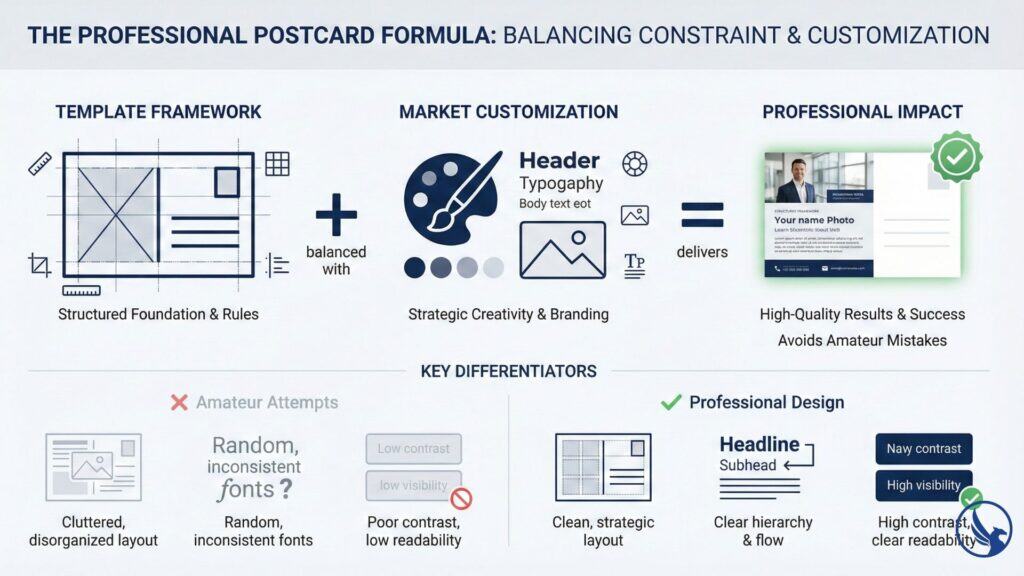
Templates succeed when they balance constraint with customization. These elements separate professional postcards from amateur attempts. Understanding common design mistakes that ruin campaigns helps you avoid costly errors before printing.
Typography Hierarchy
Small business postcards fail when every element shouts for attention. Your template needs three distinct type sizes: headline (36-48pt), subheadline or offer details (18-24pt), and body copy (10-14pt). Nothing smaller. If recipients need reading glasses to see your phone number, they won’t call.
Limit fonts to two families maximum. One for headlines (sans-serif for modern businesses, serif for traditional), one for body copy. Mixing three or more fonts signals amateur design and erodes trust.
Headlines should consume 30-40% of the front side visual space. If your headline doesn’t dominate, your postcard competes poorly against bills and magazines in the mailbox. Weak headlines get discarded unread.
Color Psychology for Local Businesses
Your template color scheme communicates brand personality before prospects read a word. Restaurants succeed with warm palettes (reds, oranges, earth tones) that stimulate appetite. Professional services (law, accounting, financial planning) need cool blues and grays that signal trust and stability. Health and wellness businesses use greens and light blues for calming association.
Avoid color combinations that reduce readability: red text on blue background, yellow on white, light gray on white. Your 60-year-old target customer won’t struggle to read your message. High contrast wins.
Limit templates to three colors maximum plus black and white. More colors increase printing costs without improving response. A two-color postcard (black + one brand color) often outperforms four-color designs by focusing attention rather than fragmenting it.
Image Selection and Placement
Stock photos destroy credibility. Recipients recognize generic smiling models and assume your business lacks authenticity. Use real photos of your location, team, products, or customers (with permission).
Images should occupy 40-50% of postcard space. Too much imagery crowds out essential information. Too little imagery fails to capture attention in a stack of mail. The balance depends on your offer complexity—simple promotions need more visual impact, complex services need more explanatory text.
Action shots outperform posed photos. Show your chef plating food, your stylist cutting hair, your trainer coaching a client. Movement implies busy, successful businesses. Static posed photos imply slow days and empty chairs. See small business postcard design examples for effective visual approaches.
Template Customization: From Generic to Converted
Free templates provide structure, but customization drives response. Here’s how to adapt any template to your specific market.
Local Market Adaptation
National templates ignore regional preferences. A postcard that works in Miami fails in Minneapolis. Customize imagery to reflect local architecture, landscapes, and seasonal timing. A beach-themed summer promotion makes no sense in landlocked regions.
Reference local landmarks, neighborhoods, or events in your copy. “Serving Downtown Kingston Since 2020” outperforms “Serving the Area Since 2020.” Specificity builds trust. Generic language triggers junk mail association.
Adjust timing based on local calendars. Ski resort towns need different seasonal campaigns than beach communities. College towns follow academic calendars, not standard holidays. Your template schedule should match when your specific customers make buying decisions.
Offer Engineering for Small Budgets
Small businesses can’t afford 50% off discounts that big chains use to buy market share. Your template offers need to drive action without destroying margins.
Value-add offers outperform percentage discounts. “Free Appetizer with Entree Purchase” costs you $4 in food cost but feels like a $12 value. “20% Off Entire Bill” costs you 20% of revenue. Both drive the same visit, but one protects profitability.
Tiered offers reward bigger purchases. “Spend $50, Get $10 Off / Spend $100, Get $25 Off” increases average transaction size. Single-tier discounts train customers to buy minimums.
Expiration dates create urgency, but 7-14 days works better than 30-60 days. Longer windows let recipients procrastinate and forget. Shorter windows create “act now” pressure that converts.
Real-World Template Performance: Small Business Case Studies
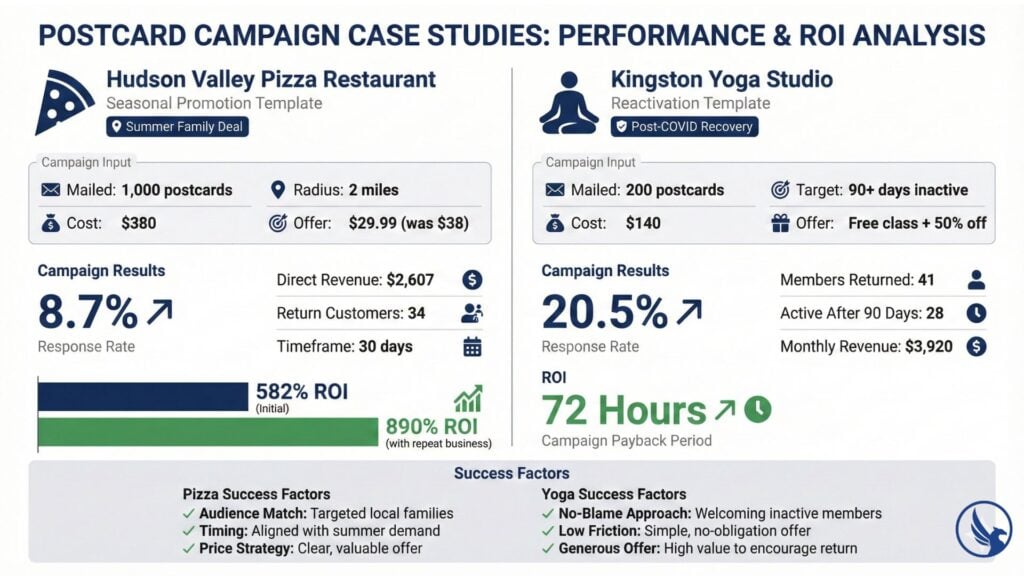
A Hudson Valley pizza restaurant used the seasonal promotion template for a summer family meal deal. They mailed 1,000 postcards to households within two miles, offering a large pizza, salad, and dessert for $29.99 (regular price $38). The mailing cost $380 including design, printing, and USPS® postage.
Results: 87 redemptions (8.7% response rate), $2,607 in direct revenue, plus 34 customers who returned within 30 days for full-price orders. Total campaign ROI: 582% from initial redemptions, 890% including repeat business. For more small business ROI benchmarks, similar performance patterns emerge across industries.
The template succeeded because it matched the audience (families within delivery radius), timed the offer to summer vacation when parents seek easy meals, and priced the promotion just below typical delivery orders.
A Kingston yoga studio used the reactivation template to bring back members who stopped attending after COVID. They mailed to 200 former members who hadn’t attended a class in 90+ days, offering one free class plus 50% off their first month back.
Results: 41 members returned (20.5% response rate), 28 remained active after 90 days. The mailing cost $140. Recovered monthly revenue: $3,920 (28 members × $140 average monthly membership). Campaign paid for itself in 72 hours.
The template worked because it acknowledged the gap without assigning blame, offered generous value for returning, and created low-friction reentry. Members didn’t need to commit to long-term contracts—just try one class.
Template Resources and Printing Specifications
Most small businesses start with Canva, Vistaprint, or Adobe Express for template access. These platforms offer hundreds of postcard layouts with drag-and-drop customization. Free templates work fine for testing concepts, but paid templates ($10-30) include higher-resolution images and more sophisticated layouts.
Postcard size matters for USPS® compliance and printing costs. According to USPS mailing standards, standard 4″×6″ postcards qualify for postcard postage rates (cheaper than letters) and fit most template platforms. As of the 2021 USPS postcard size update, postcards up to 6″×9″ also qualify for First-Class Mail® postcard rates ($0.61 as of July 2025). Postcards larger than 6″×9″ (such as 6″×11″) require letter-rate postage ($0.78), increasing mailing costs by 28%. For comprehensive guidance, see our best postcard size for direct mail analysis.
Paper thickness affects durability and perception. Budget campaigns use 10pt cardstock. Professional small business postcards use 14pt cardstock that survives postal handling and feels substantial. Premium 16pt stock signals high-value businesses but costs 25-30% more. For detailed comparisons, see our thick postcard printing for durability guide.
Print 100 postcards before committing to 1,000. Test your template with a small audience, measure response, adjust design or offer, then scale. Small-batch digital printing costs $0.40-0.60 per postcard. Volume offset printing drops to $0.15-0.25 per postcard for runs of 1,000+. For affordable printing options for startups, volume thresholds significantly impact per-piece costs.
When to Request Professional Printing Support
While DIY templates work for testing, high-volume campaigns or competitive markets benefit from professional production. If you’re planning 1,000+ postcards, targeting multiple demographics simultaneously, or launching in saturated markets where design quality determines response rates, professional printing ensures consistent color accuracy, proper bleed margins, and postal compliance.
Most small businesses hit a threshold around their third campaign where template customization becomes time-consuming. You’ve tested messaging, identified winning offers, and proven ROI. At that point, professional support accelerates execution while you focus on campaign strategy and customer conversion.
Ready to move beyond templates? Request a detailed quote for your postcard printing project. Our team reviews your campaign goals, audience size, and design requirements to provide accurate pricing and timeline estimates. Whether you’re printing 500 postcards for a local launch or 10,000 for a regional campaign, professional guidance ensures your templates translate to high-performing mail pieces.
Call 845-255-5722 to discuss your specific template customization needs, bulk pricing options, or to schedule a design consultation.
Start Your Small Business Postcard Printing Campaign
Templates don’t limit creativity—they accelerate it. You’re not designing from a blank canvas while your competitors mail monthly. You’re customizing proven frameworks that have generated millions in small business revenue.
Choose templates that match your campaign goal. Customize imagery, offers, and messaging to your specific local market. Test quickly, measure ruthlessly, and repeat what works.
Postcard printing for small business isn’t about perfect design. It’s about consistent presence in your customer’s mailbox. The template that you mail beats the perfect campaign you never launch.
For the complete breakdown of design specifications, templates, and printing guidelines, see our Postcard Printing and Mailing Services Guide.