
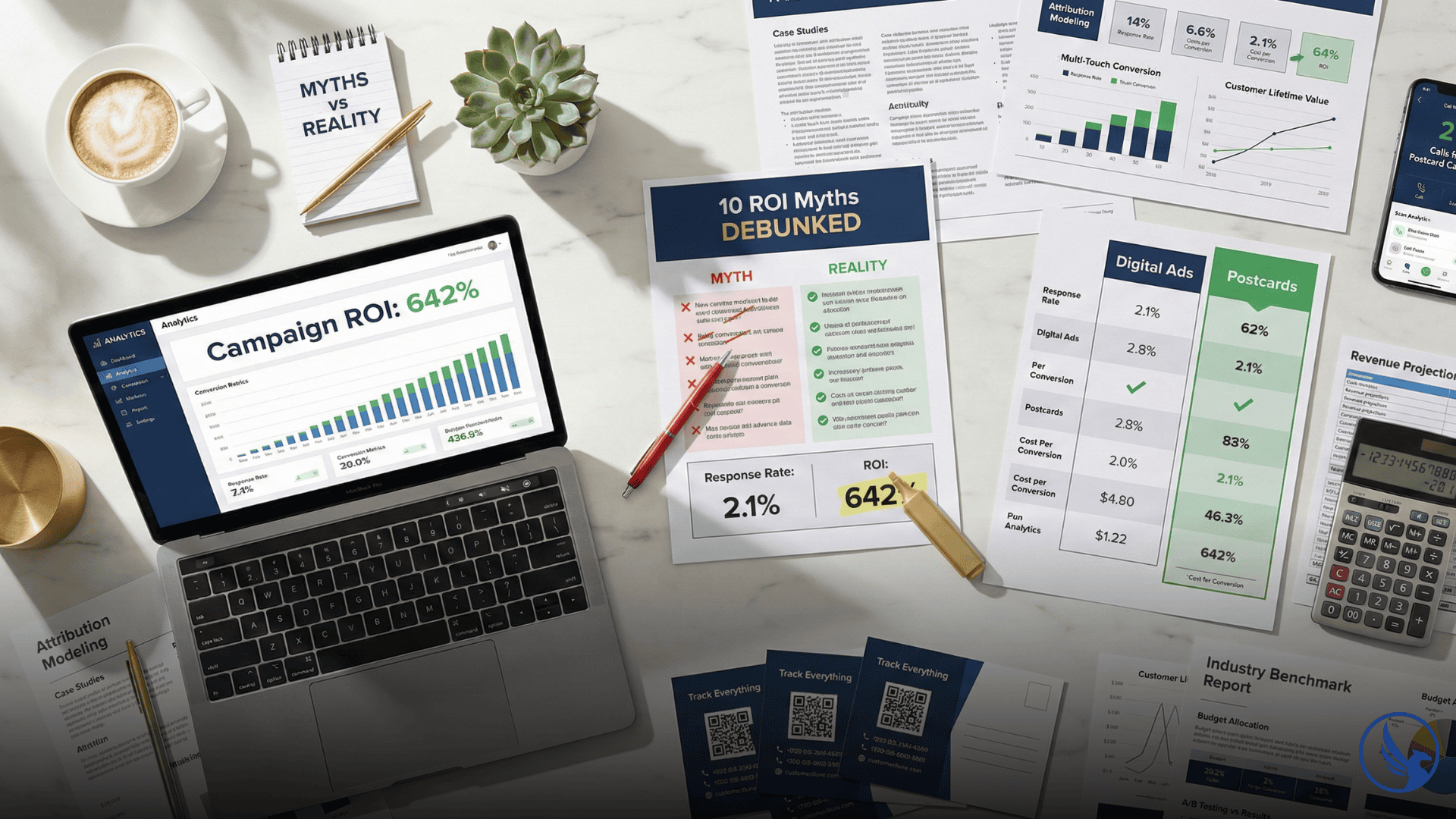
Most marketers dismiss postcard campaigns before testing them, convinced that response rates can’t justify costs. However, this thinking ignores how modern attribution actually works and misunderstands what “return on investment” means for direct mail in 2026. The businesses generating strong ROI from postcard campaigns aren’t lucky—they’re measuring correctly and avoiding the myths that cause others to abandon winning strategies prematurely. Here’s what the data actually shows when you track beyond first-click attribution.
Myth 1: “Digital Marketing Always Costs Less Than Direct Mail”
The surface comparison seems damning: Facebook ads cost $0.50-$2.00 per click while postcards cost $0.30-$0.50 each including postage. Digital wins, right?
What this myth ignores: Cost per impression means nothing. Consequently, cost per conversion is what matters.
A Facebook ad might generate 1,000 impressions for $20, but if conversion rate is 0.5%, you paid $20 for 5 conversions—$4 per conversion.
A postcard campaign mailing 1,000 pieces at $400 total cost with a 2% response rate generates 20 conversions—$20 per conversion initially. However, here’s where the myth collapses:
Digital ads disappear after the campaign ends. Once you stop spending, visibility vanishes.
Postcards persist. They sit on refrigerators, desks, and bulletin boards for weeks. Therefore, that initial $400 investment generates responses over 30-45 days without additional spend. Multiple household members see the postcard. Furthermore, recipients who weren’t ready to buy immediately convert weeks later when circumstances change.
Real-World Comparison from Marketing Industry Data:
| Channel | Initial Cost Per Conversion | 60-Day Cost Per Conversion | Explanation |
|---|---|---|---|
| Facebook Ads | $4 | $4 | Conversions stop when budget ends |
| Postcards | $20 | $12 | Conversions continue 4-6 weeks post-delivery |
When measured over campaign lifespan rather than initial week, postcards often deliver lower cost per acquisition than digital channels.
Myth 2: “Response Rates Under 5% Mean the Campaign Failed”
Marketing blogs obsess over response rate percentages, creating arbitrary benchmarks that discourage perfectly profitable campaigns.
The flaw in this thinking: Response rate means nothing without conversion value context.
A dental practice mailing 5,000 postcards at $0.40 each spends $2,000. A 1.5% response rate generates 75 appointments. Consequently, if average patient lifetime value is $2,800, that’s $210,000 in potential lifetime revenue.
Did a 1.5% response rate “fail”? Not when it generated substantial ROI.
Compare this to luxury retailers where average transaction is $15,000. A 0.3% response rate from 2,000 postcards costs $800 and generates 6 sales—$90,000 revenue.
The correct metric: ROI percentage, not response rate percentage.
Formula: (Revenue – Cost) / Cost × 100 = ROI%
A campaign generating 200% ROI at 0.8% response beats a campaign delivering 120% ROI at 3% response every single time.
Industry Benchmark Reality (Based on Industry Data):
- Real estate: 1-3% response rates, strong ROI potential
- Restaurants: 2-4% response rates, solid returns
- Professional services: 1-2% response rates, high-value conversions
- Retail: 0.5-2% response rates, varies by product value
Note: Individual results vary based on targeting, offer, and market conditions. These ranges represent typical industry performance.
Read more: Postcard Printing Response Rate Statistics.
Myth 3: “You Can’t Track Postcard Performance Accurately”
Digital marketers claim postcards are “untrackable” compared to click-through rates and pixel tracking. However, this objection reveals measurement ignorance, not postcard limitations.
Modern Postcard Tracking Methods:
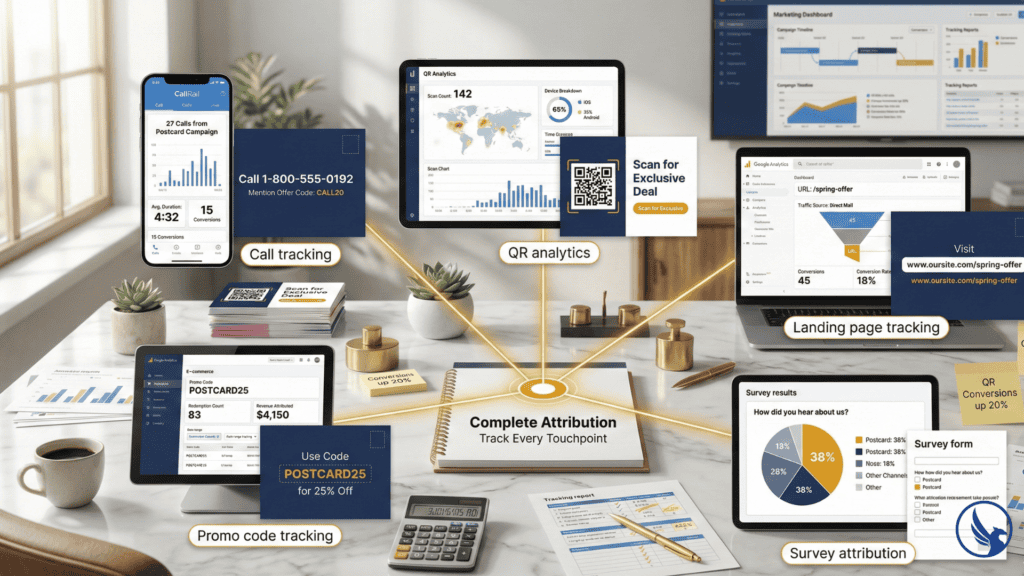
Unique phone numbers: Call tracking services like CallRail assign postcards dedicated numbers that forward to your main line while logging every call, duration, and outcome.
QR codes with analytics: Modern QR generators provide scan counts, device types, geographic data, and conversion tracking identical to digital ad platforms.
Custom landing pages: Create URLs appearing only on postcards (yoursite.com/spring-offer). Google Analytics shows exactly how many visitors came from postcard campaigns, what they did on-site, and whether they converted.
Promo codes: “Use code POSTCARD25” ties discounts directly to postcard campaigns. Your POS system or e-commerce platform tracks redemptions automatically.
Post-purchase surveys: Ask customers “How did you hear about us?” during checkout. Include “postcard” alongside digital options.
The multi-touch reality: Most conversions require 3-7 touchpoints. For instance, a customer might receive your postcard, visit your website, see a Facebook ad, then convert. Digital attribution tools credit the last click (Facebook), ignoring that the postcard initiated the journey.
Complete tracking guide: Direct Mail Postcard Tracking Methods
Myth 4: “Postcards Only Work for Older Demographics”
The “millennials don’t check mail” myth persists despite overwhelming contradictory data.
Research from USPS studies indicates:
- High percentages of younger adults engage with physical mail
- Millennials show preference for direct mail in purchasing decisions
- Gen Z recipients retain postcards from preferred brands
Why younger demographics respond: Digital ad blindness. People under 40 have spent their entire adult lives scrolling past ads. Consequently, they’ve developed trained immunity to banner ads, Instagram promotions, and sponsored content.
Physical mail stands out precisely because it’s less common. Therefore, a well-designed postcard in a pile of bills triggers curiosity. It’s novel in an age of digital saturation.
The smartphone integration factor: QR codes bridge physical and digital seamlessly. Younger recipients scan codes instantly, converting postcards into mobile experiences without friction.
Myth 5: “Email Marketing Has Replaced Postcard Campaigns”
Email marketing proponents cite near-zero marginal costs and instant delivery as decisive advantages.
What this ignores: Open rates and inbox competition.
- Average open rate across industries: ~21%
- Average click-through rate: ~2-3%
- Unsubscribe rate: ~0.1% per email
Translation: Approximately 79% of recipients never see your message. It’s filtered to promotions folders, deleted unread, or buried under other emails.
Postcard “open rate”: 100%. Every recipient physically handles your message. There’s no spam folder for mailboxes.
The complementary channel advantage: Smart marketers use both. Specifically, send postcards to email lists that haven’t engaged in 90+ days. Direct mail reactivates dormant contacts that email can’t reach.
Myth 6: “Postcard Design Doesn’t Affect ROI”
Some marketers believe content and offers drive results regardless of design quality. However, this thinking costs them significant potential conversions.
Design Elements Proven to Increase Response Rates:
Personalization: Variable data printing (inserting recipient names or addresses) can significantly increase response. “John, your neighborhood is eligible” outperforms generic messaging.
Color psychology: Blue and green generate trust for financial services. Red and orange create urgency for limited-time offers. Yellow attracts attention but can signal caution.
White space utilization: Cluttered postcards overwhelm recipients. Clean layouts with breathing room increase readability and perceived professionalism.
Before/after imagery: Transformation photos (home renovations, fitness results, landscape improvements) generate higher response than static product shots.
Professional photography: Stock images perform worse than authentic photos of your actual business, staff, or results. Recipients detect and distrust generic stock imagery.
A/B testing proof: A home services company tested two postcard designs to identical audiences. Design A (stock photos, crowded layout): 1.2% response. Design B (before/after client photos, clean layout): 3.1% response. Same offer, same list, 158% improvement from design alone.
Ready to optimize your postcard design for maximum ROI? Request a quote from CRST for professional design services that integrate proven response-boosting elements and A/B testing strategies.
Call 845-255-5722 to discuss ROI tracking infrastructure, attribution modeling, and campaign optimization strategies.
Myth 7: “One Postcard Campaign is Enough to Evaluate Effectiveness”
Marketers mail 5,000 postcards once, get disappointing results, then declare “direct mail doesn’t work for our business.”
The frequency principle: Marketing effectiveness compounds with repetition. Specifically, one exposure creates awareness. Multiple exposures build trust and trigger action.
Sequential Campaign Testing:
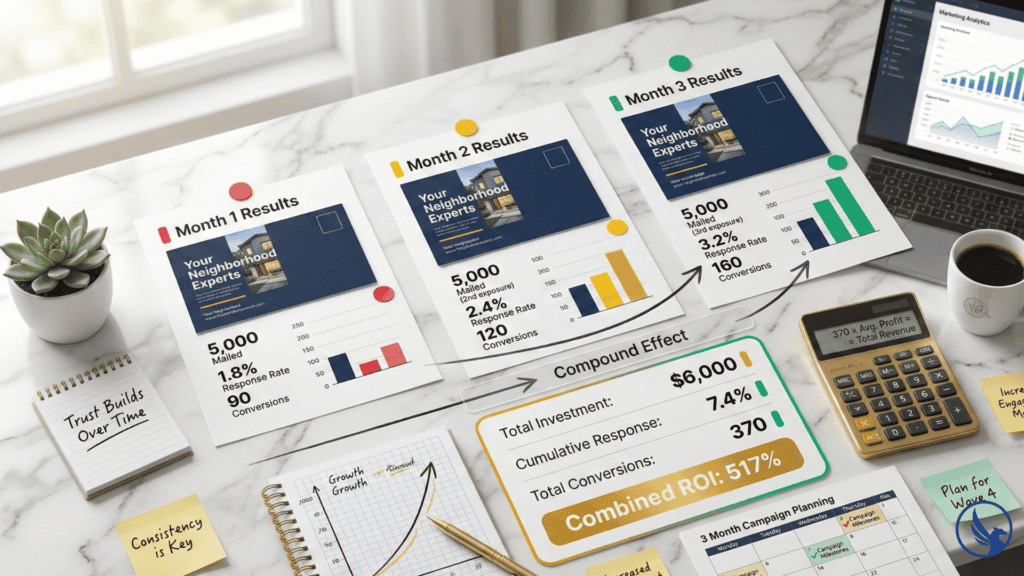
- Month 1: Mail 5,000 postcards, track 1.8% response
- Month 2: Mail to same 5,000 (second exposure), track 2.4% response
- Month 3: Mail to same 5,000 (third exposure), track 3.2% response
Total investment: $6,000. Cumulative response rate: 7.4% (370 conversions). Single-campaign evaluation would have shown 1.8% and been abandoned.
The trust-building timeline: Recipients need repeated exposure to move from “Who is this?” to “I’ve seen them before” to “They seem established and legitimate.”
Strategic approach: Commit to quarterly mailings for 12 months before evaluating channel viability. Therefore, one campaign tests creative and offer. Four campaigns test the channel itself.
Learn more about frequency marketing strategies.
Myth 8: “Postcard ROI is Immediate or Non-Existent”
Digital marketers expect instant conversions. Click the ad, buy the product, measure within 24 hours.
Postcard purchase cycles are longer—and that’s not a weakness.
Most Postcard Campaigns Generate Three Response Waves:
- First 1-2 weeks post-delivery: 30-40% of total responses from people with immediate needs
- Second 3-4 weeks: 30-35% of responses from people who needed time to decide
- Third 5-8 weeks: 25-35% of responses from people who kept the postcard until circumstances changed
Example: A landscaping company mails spring cleanup offers in March. Immediate responses come from homeowners already planning yard work. Week 3-4 responses come from people waiting for weather to improve. Consequently, Week 6-8 responses happen when homeowners realize they can’t do the work themselves and remember the postcard sitting on their counter.
Measuring at week 2 misses 60% of conversions.
Proper measurement window: Track for minimum 60 days. High-consideration purchases require 90-120 day tracking.
Myth 9: “Postcard Printing Isn’t Scalable”
Startups assume postcards work for local businesses but can’t scale to regional or national campaigns.
The scalability reality: Direct mail is infinitely scalable—it’s budget and logistics, not capability, that limit campaigns.
Scale Examples:
- Small scale (5,000-10,000 pieces): Local EDDM® targeting 3-5 mile radius at $0.260 per piece. Total cost: $2,000-$4,000.
- Medium scale (50,000-100,000 pieces): Regional targeting across metro areas. Total cost: $15,000-$35,000.
- Large scale (500,000+ pieces): National campaigns with purchased lists. Total cost: $150,000-$300,000.
Volume pricing advantage: Per-piece costs decrease dramatically at higher quantities. Therefore, printing 100,000 postcards might cost $0.04-$0.05 each vs. $0.08-$0.10 for 5,000.
Logistics infrastructure exists: National fulfillment houses manage million-piece campaigns routinely. You don’t need in-house capacity to scale.
Bulk options: Bulk Postcard Printing with Mailing Service
Myth 10: “You Need Big Budgets for Postcard ROI”
The assumption that direct mail requires $10,000+ minimum budgets keeps small businesses on the sidelines.
Minimum viable postcard campaign: 1,000 pieces at $0.30-$0.50 each = $300-$500 total investment.
Expected outcomes at 1.5% response: 15 conversions. If average transaction value is $100, that’s $1,500 revenue vs. $500 cost—200% ROI.
Budget-Optimized Strategies:
- Geographic micro-targeting: Instead of mailing entire zip codes, choose 3-5 highest-income carrier routes. Smaller volume, better targeting.
- Simplified design: Use templates instead of custom design. Save $200-$500 in creative costs.
- Standard sizes and finishes: 4×6 postcards with basic coating cost 40% less than 6×9 with UV coating. Start simple, upgrade with profit.
- Seasonal timing: Mail during off-peak seasons when printer demand is lower.
The bootstrap approach: Successful small-budget postcard marketers test with 1,000 pieces, measure religiously, optimize, then scale. Therefore, they don’t wait for big budgets—they create them through proven campaigns.
Budget-friendly options:
What Actually Drives Postcard ROI
Beyond debunking myths, here’s what the highest-ROI postcard campaigns have in common:
Targeting precision: They mail to audiences with demonstrated need or affinity rather than spray-and-pray approaches.
Compelling offers: “Free consultation” beats “call us to learn more.” Specific value propositions drive action.
Multi-touch integration: Postcards work alongside email, retargeting ads, and phone follow-up for compounding effects.
Persistent tracking: They measure for 60-90 days minimum and attribute conversions accurately across touchpoints.
Testing discipline: They A/B test designs, offers, and audiences systematically rather than running identical campaigns repeatedly.
Long-term commitment: They evaluate channel viability over 12 months, not single campaigns.
Ready to measure postcard ROI with precision? Request a detailed quote for professional postcard printing with comprehensive ROI tracking. Our team specializes in direct mail campaigns with built-in attribution systems, multi-touch tracking, and optimization based on real performance data. Whether you’re testing with 1,000 pieces or scaling to 100,000, we’ll help you measure what actually matters: profitable revenue per dollar invested.
Call 845-255-5722 to discuss ROI tracking infrastructure, attribution modeling, and campaign optimization strategies.
Start Your Postcard Printing Campaign
ROI myths persist because they’re easier to believe than testing. Consequently, digital-native marketers default to familiar channels rather than learning direct mail mechanics.
The businesses generating outsized returns from postcards aren’t doing anything magical—they’re measuring correctly, testing systematically, and committing to timelines that allow direct mail to prove its value.
Stop optimizing for vanity metrics like response rates. Start optimizing for the only number that matters: profitable revenue per dollar invested.
For full design specs, targeting strategies, and ROI calculation frameworks: Postcard Printing and Mailing Services Guide
Additional resources:
- Postcard Printing and Mailing Services Guide
- Postcard Printing ROI for Local Business
- Postcard Printing vs Flyers Conversion
- Postcard Printing for Grand Openings
- Postcard Printing for Event Invitations
- Eco-Friendly Postcard Printing