
Event attendance hinges on reminders that survive the delete button. Digital invitations vanish in crowded inboxes, but physical postcards occupy refrigerator doors and bulletin boards for weeks. In 2026, event planners using strategic multi-wave postcard campaigns can see significantly higher attendance rates than digital-only strategies. Consequently, the difference between empty venues and capacity crowds often comes down to timeline execution and strategic design. Here’s the complete system for turning postcard invitations into packed events.
Why Postcards Still Dominate Event Marketing
Event planners gravitate toward digital invitations because they’re free and instantaneous. However, this thinking ignores three psychological advantages postcards deliver:
Physical presence creates commitment. When recipients handle a tangible invitation, they’re more likely to mentally commit to attending. Furthermore, the act of placing it on a counter or calendar board reinforces the date in memory.
Household visibility extends reach. Email invitations reach one inbox. Meanwhile, postcards sit in common areas where spouses, roommates, and family members see them repeatedly. For instance, a yoga studio postcard about a weekend workshop might catch the eye of three household members, multiplying awareness.
Perceived value signals event quality. Recipients judge events by invitation quality. Consequently, a professionally printed postcard suggests the event itself will be well-organized and worth attending. Cheap Evite templates signal low-effort gatherings.
Physical direct mail consistently demonstrates strong engagement compared to digital channels across event marketing campaigns. Learn more about grand opening event strategies.
The 8-Week Timeline for Event Postcard Campaigns
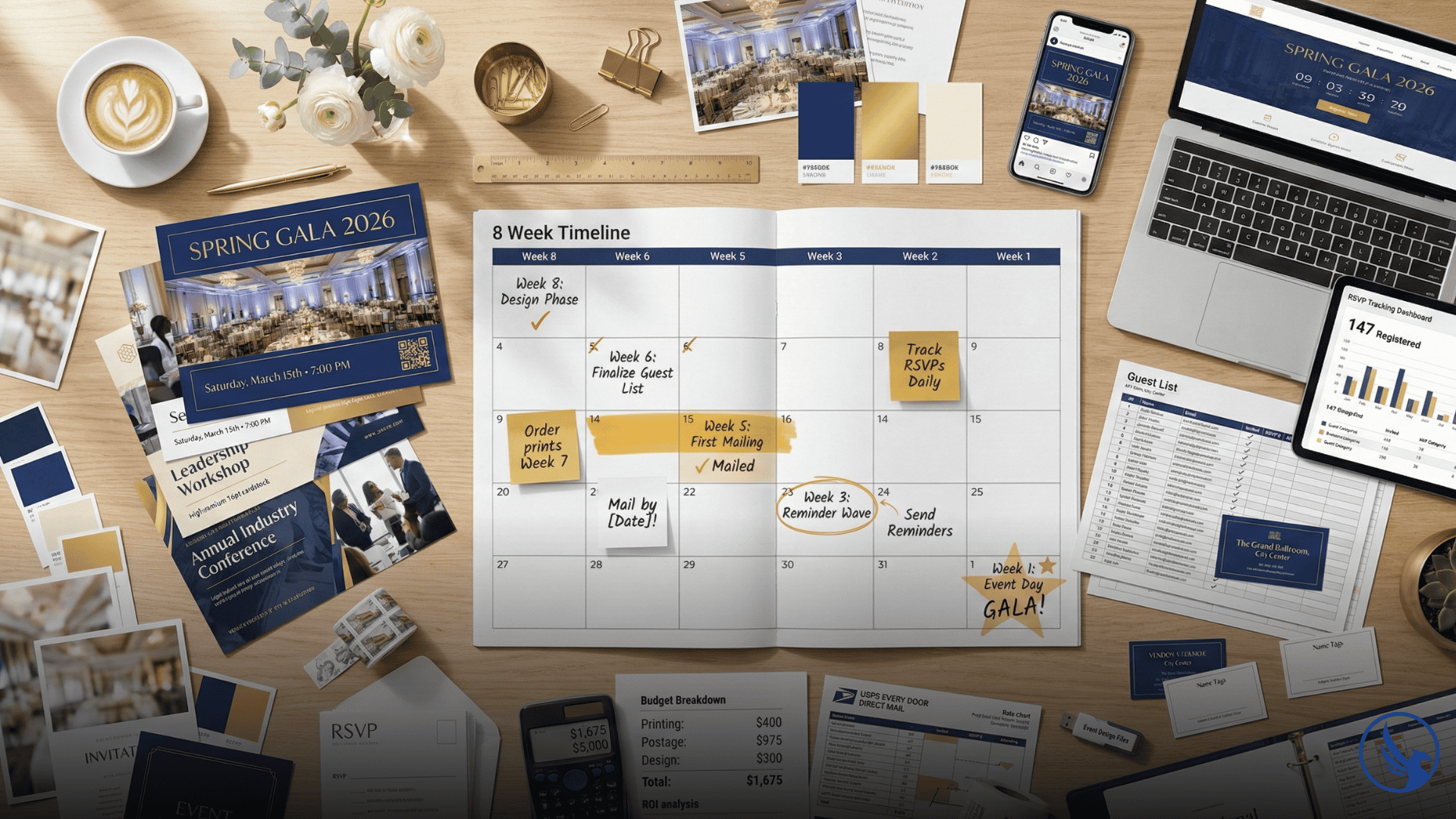
Event postcards require reverse-engineering from your event date. Here’s the proven schedule that maximizes attendance.
Week 8: Concept and Design Phase
Tasks:
- Define your target audience and event value proposition
- Create postcard design brief including messaging, offers, and brand elements
- Choose postcard size (4×6 for budget-conscious, 6×9 for premium events)
- Commission design from freelancer or use template software
Design deadline: Complete design files by end of week 8. Delays here cascade through the entire timeline.
Pro tip: Design two postcards simultaneously—the announcement and the reminder. Specifically, consistent visual branding across both waves improves recognition and response.
Week 7: Print Production Setup
Tasks:
- Finalize design with proper bleed areas and safe zones
- Convert files to CMYK color mode and embed all fonts
- Request digital proofs from printer
- Approve final files for production
Common bottleneck: File revisions. Build 3-4 days of buffer for corrections. Therefore, printers won’t start production until files meet specifications.
Quality check: Verify phone numbers, dates, addresses, and website URLs. Consequently, typos on 5,000 postcards cost more than reprinting—they damage credibility.
Design requirements: Postcard Design Mistakes to Avoid
Week 6: Printing and Delivery
Tasks:
- Printer produces postcards (typically 5-7 business days)
- Postcards ship to your location or mailing service
- Receive and inspect for quality issues
Inspection checklist:
- Color accuracy matches approved proof
- Text is sharp and readable
- Trimming is even without cropped elements
- No printing defects (streaks, smudges, misalignment)
If defects exist: Document with photos immediately and contact printer. Most reputable vendors reprint at no charge for quality failures.
Week 5: First Mailing Wave (Announcement)
Tasks:
- Prepare mailing lists or EDDM® carrier routes
- Apply postage (stamps, meter, or EDDM® indicia)
- Drop at post office or schedule USPS® pickup
USPS® delivery window: EDDM® takes 10-14 days from drop-off to delivery per USPS Marketing Mail® standards. Standard mail with purchased lists takes 7-10 days.
Target delivery: Recipients should receive postcards 4-5 weeks before the event. This gives them time to mark calendars while maintaining urgency.
Mailing requirements: Postcard Printing and Mailing Services Guide
Week 4: Monitor Initial Response
Tasks:
- Track website traffic from postcard landing page
- Monitor RSVP submissions or ticket sales
- Check phone inquiries and social media mentions
Metrics to watch:
- Landing page visits via unique URL or QR code
- Early bird ticket sales or registration completions
- Email captures from postcard-driven traffic
If response is weak: Adjust messaging or offers for the reminder wave. Don’t assume the second postcard should be identical to the first.
Tracking methods: Direct Mail Postcard Tracking Methods
Week 3: Second Mailing Wave (Reminder)
Tasks:
- Print reminder postcards (can often happen simultaneously with wave 1)
- Mail second wave targeting same audience
- Increase urgency language: “Only 2 weeks left,” “Limited spots remaining”
Why the second wave works: The first postcard creates awareness. However, the second postcard triggers action. People procrastinate until deadlines approach—give them that deadline.
Offer escalation: If the first postcard offered early bird pricing, the second might emphasize “Last chance for discount” or introduce scarcity (“First 100 registrants receive gift bag”).
Week 2: Digital Follow-Up Sequence
Tasks:
- Send email reminders to anyone who engaged with postcard landing page
- Post social media reminders with event hashtag
- Run retargeting ads to postcard landing page visitors
The multi-channel effect: Recipients who see both postcards and digital messages typically attend at higher rates than those exposed to only one channel. Coordinate channels for maximum impact.
Week 1: Final Push
Tasks:
- Send last-minute email and SMS reminders
- Post daily social media countdowns
- Reach out personally to VIP invitees who haven’t confirmed
For the complete breakdown of event marketing timelines and RSVP tracking systems: Postcard Printing and Mailing Services Guide.
The Complete Event Postcard Design Checklist
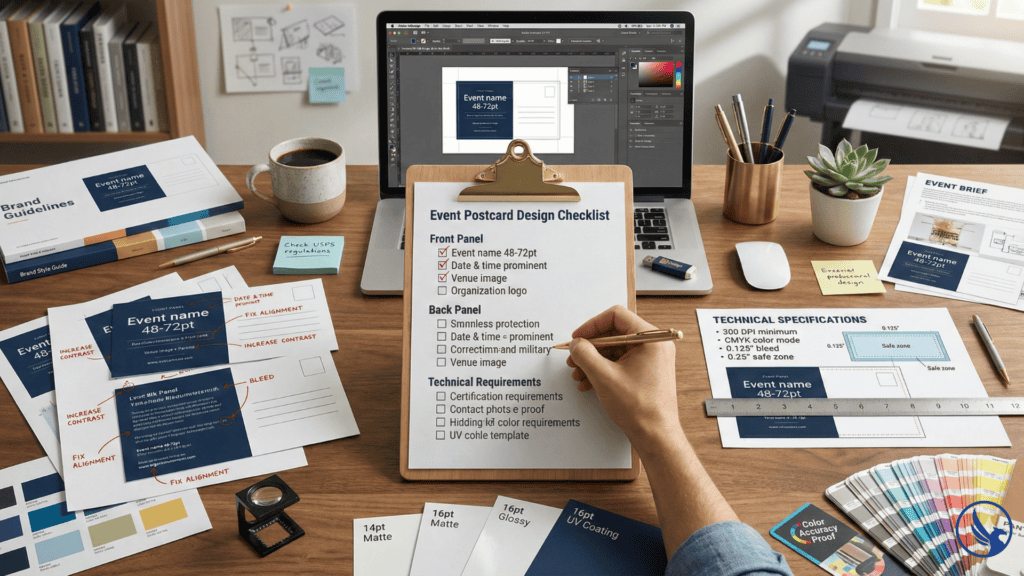
Use this checklist for every event postcard to prevent costly omissions.
Front Panel Must-Haves
- Event name in headline-sized text (48-72pt minimum)
- Clear event category (Workshop, Gala, Conference, Launch Party)
- Date and time prominent and impossible to miss
- Eye-catching image showing venue, past events, or event activity
- Your organization logo (but not dominating—event details matter more)
- Visual hierarchy guiding eye from headline to date to image
Back Panel Essentials
- Complete venue address with nearby landmarks (“Next to City Hall”)
- Parking instructions or public transit directions
- Full event description (2-3 sentences maximum)
- RSVP or ticket purchase instructions
- Website URL and QR code linking to registration page
- Contact phone number for questions
- Social media handles and event hashtag
- Accessibility information if relevant
Technical Print Requirements
- Files in CMYK color mode (not RGB)
- Images at 300 DPI resolution minimum
- 0.125-inch bleed on all sides
- Critical text/images 0.25 inches from trim edges (safe zone)
- All fonts embedded or converted to outlines
- File exported as high-quality PDF
Legal and Compliance Items
- Terms and conditions for ticketed events (or reference to website)
- Age restrictions or requirements stated clearly
- Cancellation policy or rain date if applicable
- Sponsorship logos if contractually required
Event-Specific Template Strategies
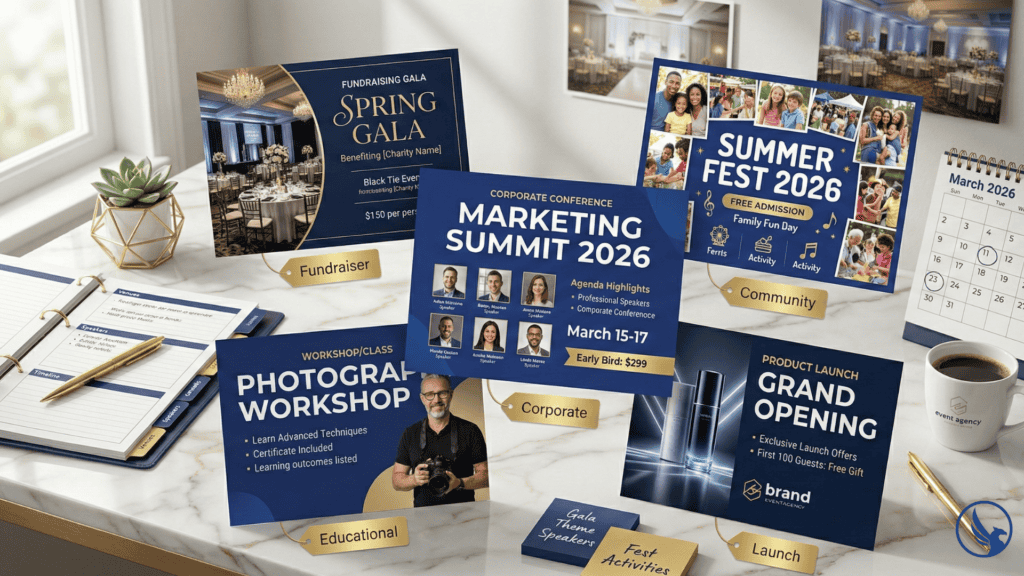
Different event types require different postcard approaches. Here’s what works for major categories.
Corporate Events and Conferences
Size recommendation: 6×9 for professional impact
Design approach: Clean, sophisticated layouts with ample white space
Critical elements:
- Speaker headshots and credentials
- Agenda or session highlights
- Networking opportunity messaging
- Early bird and group discount details
Messaging focus: Professional development value and ROI of attendance. Recipients need to justify time away from work.
Fundraising Galas and Charity Events
Size recommendation: 5×7 for premium feel without excessive cost
Design approach: Elegant, formal aesthetics matching event dress code
Critical elements:
- Cause or impact statement
- Honoree information if applicable
- Sponsorship levels and benefits
- Auction or entertainment highlights
Messaging focus: Emotional connection to mission and social prestige of attendance.
Learn more: Nonprofit Postcard Printing
Community Festivals and Public Events
Size recommendation: 4×6 for maximum volume at lower cost
Design approach: Vibrant, energetic design with multiple activities featured
Critical elements:
- Free admission messaging if applicable
- Activity schedule and entertainment lineup
- Food vendor highlights
- Family-friendly emphasis and kid activities
Messaging focus: Fun, accessibility, and community gathering opportunity.
Educational Workshops and Classes
Size recommendation: 6×9 to accommodate detailed curriculum
Design approach: Informative with instructor credentials emphasized
Critical elements:
- Learning outcomes (“What you’ll master”)
- Instructor bio and qualifications
- Materials included or required supplies
- Certificate or continuing education credits if offered
Messaging focus: Skill acquisition value and practical application of knowledge.
Product Launches and Store Openings
Size recommendation: 6×9 for visual product showcase
Design approach: Bold, branded design with product imagery
Critical elements:
- Exclusive launch-day offers
- First-look product previews
- VIP hour or early access details
- Giveaway or door prize information
Messaging focus: Exclusivity and limited-time opportunities.
Product launch strategies: Postcard Printing for Product Launches
Ready to create professional event invitations that maximize attendance? Request a detailed quote from CRST for expert event postcard design, strategic timeline planning, and complete mailing services.
Geographic Targeting for Event Postcards
Not every address in your city should receive your invitation. Specifically, smart targeting concentrates budget on likely attendees.
Local Events (Workshops, Classes, Store Events)
Target radius: 5-10 miles
Volume estimate: 5,000-15,000 postcards depending on density
Selection method: EDDM® carrier routes centered on venue location
Demographic considerations: Choose routes matching your audience profile. For instance, a wine tasting event should target routes with higher median incomes.
Regional Conferences and Festivals
Target radius: 25-50 miles
Volume estimate: 25,000-75,000 postcards
Selection method: County-wide EDDM® or purchased lists of relevant professionals
Strategic approach: Concentrate heaviest mailing within 15 miles, lighter coverage beyond. Consequently, attendance probability drops with distance.
Destination Events (Retreats, Large Conferences)
Target method: Purchased mailing lists based on profession or interest
Volume estimate: Varies widely; often 10,000-50,000
Selection criteria: Industry titles, previous event attendance, association memberships
Cost consideration: Purchased lists run $0.05-$0.15 per name. Budget accordingly.
Bulk mailing: Bulk Postcard Printing with Mailing Service
RSVP Tracking Systems That Measure Results
You can’t optimize what you don’t measure. Therefore, build tracking into your postcard campaigns from the start.
Unique Landing Pages
Create event-specific URLs that only appear on postcards: yourbusiness.com/spring-workshop
Use Google Analytics UTM parameters for detailed tracking:
yourbusiness.com/spring-workshop?utm_source=postcard&utm_medium=directmail&utm_campaign=march2026
This data shows exactly how many postcard recipients visited your site and registered.
QR Code Analytics
QR code generators (Bitly, QR Code Generator) provide scan tracking. Specifically, you’ll see:
- Total scans
- Scan times and dates
- Device types (iOS vs Android)
- Geographic locations
This reveals which mailing zones generated highest engagement.
Promo Code Tracking
Require unique discount codes for postcard-advertised offers. Consequently, track redemptions in your ticketing system or POS system.
Example: “Use code POSTCARD25 for 25% off registration”
This directly attributes ticket sales to the postcard campaign.
Phone Call Tracking
Use call tracking numbers unique to postcards. Services like CallRail provide dedicated numbers that forward to your main line while logging calls.
This captures phone-preferring demographics who won’t visit websites.
Post-Event Survey
Ask attendees: “How did you hear about this event?” Include “postcard” alongside social media, email, and word-of-mouth options using survey tools.
Self-reported data supplements digital tracking and captures less quantifiable awareness impacts.
Complete tracking guide: Direct Mail Postcard Tracking Methods
Budget Planning: Real-World Event Postcard Costs
Transparent cost breakdowns help allocate resources effectively.
Small Local Event (Workshop, Class, Meetup)
Audience: 5,000 postcards within 10 miles
Size: 4×6, 14pt stock, full color both sides
| Item | Cost |
|---|---|
| Design (template or freelancer) | $0-$300 |
| Printing (5,000 @ $0.08 each) | $400 |
| EDDM® postage (5,000 × $0.260) | $1,300 |
| Total | $1,700-$2,000 |
ROI calculation: If event generates $50 per attendee and 2% respond, that’s 100 attendees × $50 = $5,000 revenue vs $2,000 cost.
Budget guide: How Much Does Postcard Printing Cost
Medium Regional Event (Conference, Festival)
Audience: 15,000 postcards within 25 miles
Size: 6×9, 16pt stock, UV coating
| Item | Cost |
|---|---|
| Design (professional) | $500-$800 |
| Printing (15,000 @ $0.14 each) | $2,100 |
| Postage (USPS Marketing Mail®, purchased list) | $2,700 |
| List rental (15,000 @ $0.10 each) | $1,500 |
| Total | $6,800-$7,100 |
ROI calculation: If tickets are $150 and 1% register, that’s 150 tickets × $150 = $22,500 revenue vs $7,100 cost.
Large Destination Event (Multi-Day Conference, Retreat)
Audience: 50,000 postcards nationwide
Size: 6×9, premium stock, multiple waves
| Item | Cost |
|---|---|
| Design (two-wave campaign) | $1,500-$2,000 |
| Printing wave 1 (25,000 @ $0.12) | $3,000 |
| Printing wave 2 (25,000 @ $0.12) | $3,000 |
| Postage (50,000 @ $0.40 standard) | $20,000 |
| List rental and segmentation | $5,000 |
| Total | $32,500-$33,000 |
ROI calculation: If registration is $1,200 and 0.5% convert, that’s 250 attendees × $1,200 = $300,000 revenue vs $33,000 cost.
Integration with Digital Event Marketing
Postcards amplify digital efforts rather than replacing them. Consequently, coordinate channels for maximum impact.
Pre-Postcard Social Media Teasing
Two weeks before postcards hit mailboxes, post teasers on Facebook and Instagram: “Watch your mailbox next week for an exclusive invitation.”
This primes recipients to expect and notice your postcard among other mail.
Retargeting Campaigns
Install Facebook and Google tracking pixels on your postcard landing page. Subsequently, serve reminder ads to people who visited but didn’t register.
The multiplier effect: Recipients who see both postcards and retargeting ads typically convert at higher rates than those exposed to only one touchpoint.
Email Nurture Sequences
Capture emails through postcard landing pages, then send:
- Week before event: “What to expect” preparation guide
- Three days before: Parking, schedule, and logistics details
- Day before: “See you tomorrow” excitement builder
Hashtag Integration
Print your event hashtag on postcards. Moreover, encourage attendees to share postcard photos on social media with the tag.
This extends reach beyond your mailing list as followers see shared content.
Common Event Postcard Mistakes to Avoid
These errors sabotage otherwise strong campaigns:
Forgetting call-to-action clarity. “Learn more” is weak. Instead, “Register at EventName.com” or “Call 555-1234 to reserve your spot” drives action.
Overloading with information. Postcards aren’t brochures. Provide enough detail to create interest, then direct recipients to websites for full information.
Ignoring mobile optimization. Most postcard recipients will scan QR codes or type URLs on phones. Consequently, landing pages must load fast and display perfectly on mobile screens.
Missing accessibility details. Recipients with mobility needs, dietary restrictions, or sensory sensitivities need this information upfront. Furthermore, burying it on websites creates barriers. Review ADA compliance guidelines.
No follow-up plan for registrants. Capturing 200 registrations means nothing if you don’t nurture them with pre-event communications that build anticipation and reduce no-shows.
Mailing without testing. Send test postcards to yourself at multiple addresses. Verify they arrive intact, colors print correctly, and information is readable.
Design pitfalls: Postcard Design Mistakes to Avoid
Start Your Event Postcard Printing Campaign
Event postcards work when timelines align with printing realities and design serves strategic goals. Specifically, start planning 8 weeks before your event date. Design with intention. Mail in waves. Track results ruthlessly.
The events that sell out don’t rely on digital noise alone—they anchor campaigns with physical invitations that command attention and occupy space in recipients’ homes until event day arrives.
For full design specs, targeting strategies, and print specifications: Postcard Printing and Mailing Services Guide
Ready to fill your venue with strategic event invitations? Request a detailed quote for event postcard printing and mailing services. Our team specializes in multi-wave event campaigns with proven templates, systematic timeline execution, and complete tracking infrastructure. Whether you’re hosting workshops, conferences, or fundraising galas, we’ll help you maximize attendance through strategic physical invitations.
Additional resources:
- Postcard Printing ROI for Local Business
- Postcard Printing Response Rate Statistics
- Postcard Printing vs Digital Ads
- Real Estate Farming Postcard Printing
- Eco-Friendly Postcard Printing
- Postcard Printing for Moving Announcements