
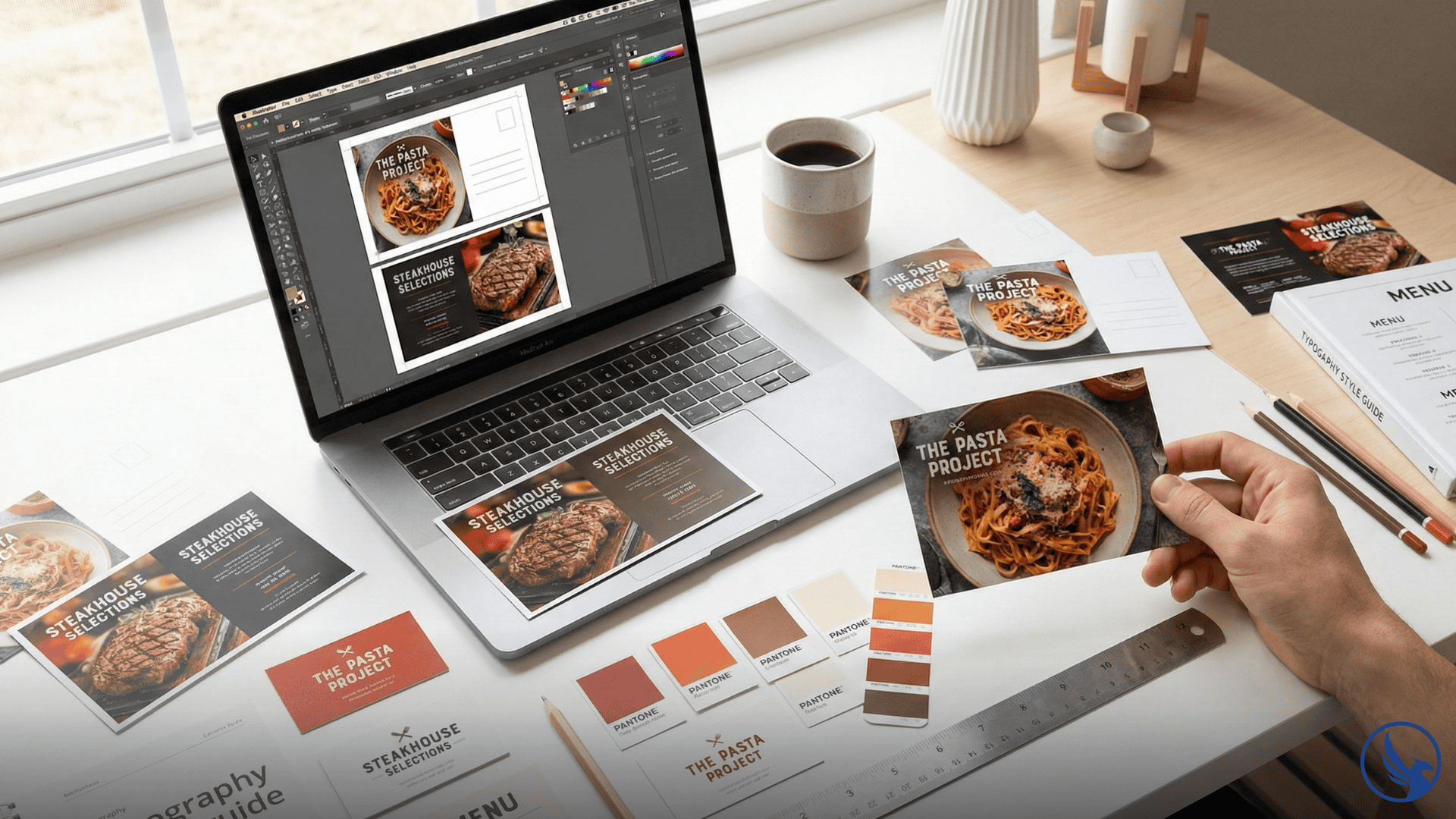
Postcard printing for restaurant marketing solves a problem most owners ignore until it’s too late: the slow fade of customer memory. Diners who loved your food three months ago have already moved on to whatever opened down the street. Digital ads compete with hundreds of other notifications. But a well-timed postcard lands on a kitchen counter and stays there. In 2026, the restaurants filling seats on slow weeknights aren’t relying on algorithms—they’re using direct mail to stay top of mind. Here’s how to build a postcard system that brings customers back.
Direct Mail Outperforms Digital
Restaurant Marketing Response Rate Comparison
Average Campaign ROI
3-Month Growth Pattern
Why Restaurants Still Thrive on Direct Mail
Industry estimates suggest the average American sees thousands of ads daily. Most vanish before registering. Email open rates for restaurants hover around 18%, and that’s if you’ve built a list in the first place. For a detailed breakdown of how direct mail stacks up against email campaigns, see our comparison of postcard printing vs email marketing. Social media reach without paid spend? Functionally zero.
Direct mail cuts through because it exists in physical space.
According to the ANA (formerly DMA), direct mail achieves response rates of 4.9% for prospect lists and 9%+ for house lists—significantly higher than email. For restaurants, where the goal is driving a specific action (visit this week, try this new dish, redeem this offer), that gap translates directly into revenue. These aren’t outlier numbers—direct mail response rate statistics consistently show this performance gap across industries.
Postcard printing for restaurant marketing works because it meets customers where decisions actually happen: at home, near the refrigerator, during the daily mail sort. A glossy card featuring your signature dish doesn’t compete with Instagram stories. It sits on a counter until someone gets hungry.
There’s also the targeting advantage. Digital ads guess at intent based on browsing behavior. A mailed postcard hits an actual household within your delivery radius or a specific neighborhood you want to own. No wasted impressions on people forty miles away who’ll never walk through your door.
The restaurants growing in 2026 understand something their competitors don’t: attention is scarce, but mailboxes are wide open.
Designing Restaurant Postcards That Actually Work
A postcard has two seconds to earn interest. For restaurants, those two seconds hinge on one thing: appetite. If the card doesn’t make someone hungry, it fails. Everything else—your logo, your hours, your story—comes second to visceral food appeal.
Here’s how to design postcards that drive visits.
Photography That Sells the Experience
The hero image carries the entire postcard. This isn’t the place for a photo of your building exterior or your logo on a white background. Feature your food—specifically, the dish that makes first-time visitors become regulars.
Hire a food photographer or learn basic food styling. Natural light, shallow depth of field, and steam or motion cues (cheese pull, sauce drizzle, fork mid-bite) create urgency. The image should make someone’s stomach growl.
Resolution matters more than most restaurant owners realize. Postcard printing requires 300 DPI minimum. That iPhone shot from a busy dinner service won’t survive the press. One professional shoot gives you assets for months of campaigns. Choosing the right dimensions matters too—standard postcard sizes affect both printability and postage costs.
Color psychology plays a role too. Warm tones (reds, oranges, golden browns) trigger appetite. Cool tones suppress it. If your signature dish photographs blue or gray, adjust your lighting or choose a different hero item.
Headlines That Create Urgency
Generic headlines get generic results. “Come Visit Us” says nothing. “We Miss You” feels desperate.
Effective restaurant postcard headlines do one of three things: announce something new, create scarcity, or make a specific offer.
Announcement headlines work for menu launches, seasonal items, or new locations: “Introducing Our Fall Harvest Menu” or “Now Open for Sunday Brunch.”
Scarcity headlines drive immediate action: “Limited Time: Truffle Season Ends March 15” or “Only 50 Reservations Available for Valentine’s Day.”
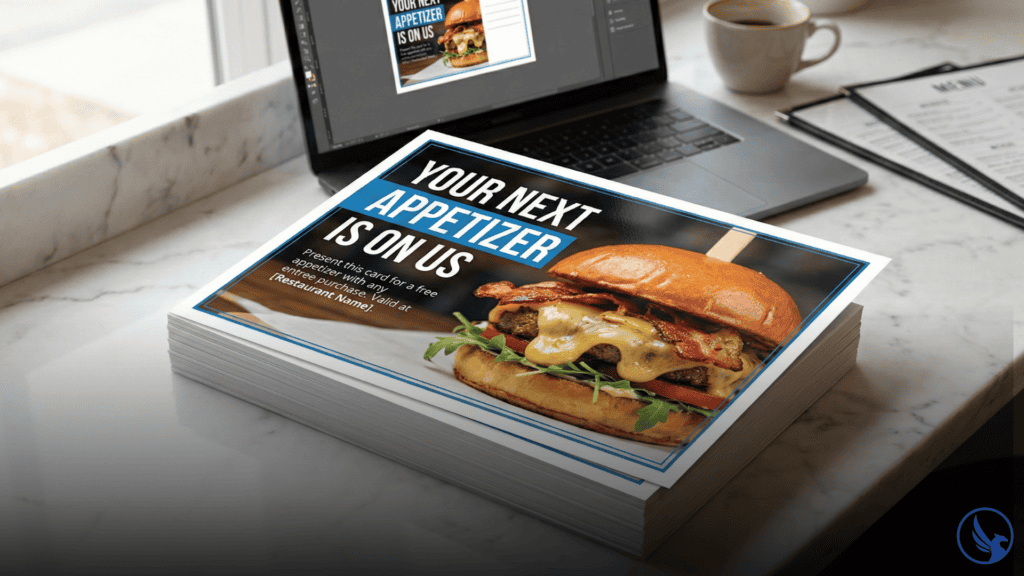
Offer headlines trade value for visits: “Your Next Appetizer Is On Us” or “$10 Off Your Table This Week.”
The headline and hero image should tell a complete story in one glance. If someone has to read body copy to understand the offer, you’ve already lost most of your audience.
Offers That Drive Measurable Response
Postcard printing for restaurant marketing only works if you can track results. That means every card needs a mechanism for measurement.
The simplest approach: a unique offer code. “Mention SPRING26 for a free dessert” tells you exactly which visits came from which campaign. Train your staff to ask and log these codes. For more sophisticated tracking approaches, see our guide to direct mail postcard tracking methods.
QR codes add sophistication. Link to a dedicated landing page with the offer details and a reservation button. Track scans to measure engagement even from people who don’t immediately redeem.
Expiration dates create urgency. An offer valid “this month” feels ignorable. An offer expiring “this Sunday” demands a decision. Test tight windows (7–10 days) against longer ones and measure which drives more redemptions.
One critical rule: the offer must feel valuable without destroying your margins. Free appetizers work because food cost is typically 28–32%. A 50% discount on the entire check might drive traffic but kill profitability. Design offers that bring people through the door without training them to expect constant discounts.
For the complete breakdown, see our Postcard Printing and Mailing Services Guide.
Real-World ROI: What Restaurant Postcard Campaigns Actually Cost
Postcard printing for restaurant marketing pencils out faster than most owners expect—if you run the numbers honestly. Understanding how much postcard printing costs upfront helps you forecast ROI accurately.
Printing and Mailing Costs
A standard 6×9 postcard on 14pt cardstock with UV coating runs $0.25–$0.35 per piece at quantities of 1,000–5,000. Larger runs drop the per-unit cost further.
For mailing, you have two primary options:
EDDM® (Every Door Direct Mail®): USPS® delivers to every address on selected postal routes without requiring a mailing list. Postage runs $0.260 per piece (Retail) or $0.259 (BMEU). The USPS® EDDM® program allows businesses to target specific carrier routes without purchasing mailing lists. This works well for restaurants wanting to blanket a neighborhood or target everyone within a delivery radius. For detailed EDDM® pricing, see EDDM postcard printing costs.
Targeted mailing lists: Purchase or build a list of specific households (past customers, certain demographics, homeowners vs. renters). Postage costs vary: First-Class Mail® presort ~$0.408–$0.46, Marketing Mail® presort ~$0.43+, or single-piece First-Class® stamps $0.56. You control exactly who receives the card.
Total delivered cost typically ranges from $0.50–$0.81 per household, depending on quantity, targeting, and postage class.
Rates current as of February 2026; verify at USPS.com/business.
View campaign ROI calculator on Pinterest
Calculating Return on Investment
Here’s a realistic scenario for a casual dining restaurant:
- Campaign size: 2,500 postcards
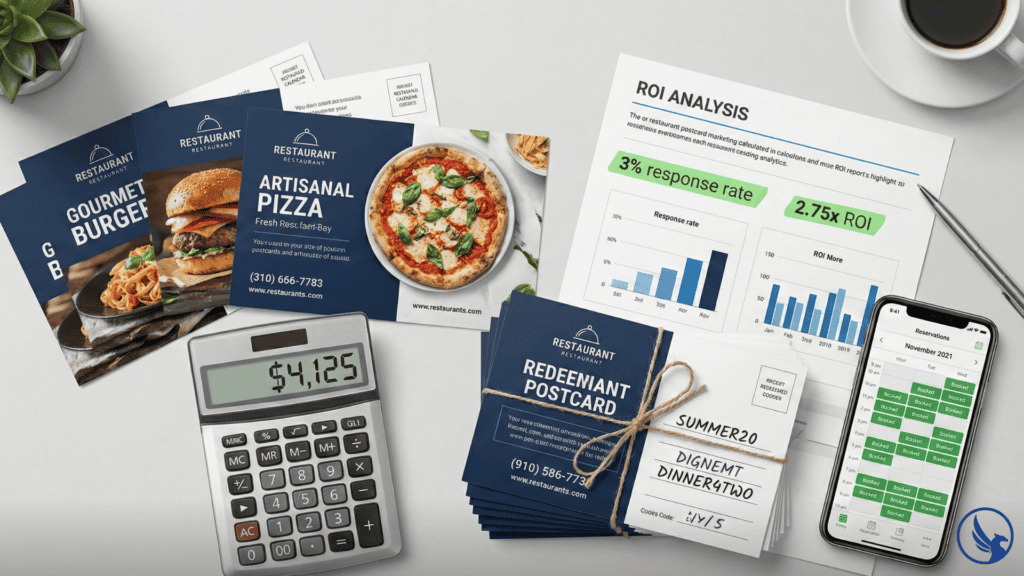
- Total cost: $1,400 (printing + EDDM® at $0.25-$0.35 print + $0.260 postage)
- Response rate: 3% (conservative for a compelling offer)
- Redemptions: 75 parties
- Average check: $55
- Revenue generated: $4,125
That’s a 2.9x return on a single campaign. This mirrors the benchmarks we see across local businesses—read more in our postcard printing ROI analysis. And this calculation ignores lifetime value—a reactivated customer who returns three more times over the following year represents far more than one $55 check.
The math improves with consistency. A restaurant mailing monthly to the same 2,500 households builds recognition. Response rates climb as the brand becomes familiar. By month six, you’re not introducing yourself anymore—you’re reminding people who already trust you.
Comparing to Digital Advertising
Facebook and Instagram ads for restaurants typically cost $0.50–$2.00 per click. Converting a click to an actual restaurant visit requires multiple touchpoints and significant drop-off at each stage.
A postcard arrives directly in the home, requires no click, and persists in physical space. The comparison isn’t apples to apples, but many restaurant owners find direct mail delivers lower cost-per-visit than digital once they track both channels properly. For restaurants weighing channel investments, our postcard printing vs digital ads analysis provides real conversion data across both channels.
The smartest operators don’t choose one or the other. They use digital for broad awareness and direct mail for conversion and retention.
Campaign Types That Work for Restaurants
Postcard printing for restaurant marketing isn’t one-size-fits-all. Different campaign types serve different business objectives.
New Mover Campaigns
Someone who just moved into your area doesn’t have a go-to pizza place yet. They haven’t found their regular brunch spot. They’re actively looking for options—and they’re checking their mail constantly for address-change confirmations and utility bills.
New mover lists identify households that relocated within the past 30–90 days. A welcome postcard with a first-visit offer reaches people at peak receptivity. This campaign type often produces the highest response rates because the timing aligns perfectly with intent.
Reactivation Campaigns
Your POS system contains gold: a list of customers who used to visit regularly but haven’t returned in 60, 90, or 180 days. These lapsed customers already know your food. They’ve already decided they like you. Something just interrupted the habit.
A reactivation postcard acknowledges the gap without guilt-tripping. “It’s been a while—here’s a reason to come back” paired with a meaningful offer can restart relationships that cost far more to rebuild from scratch through new customer acquisition.
Seasonal and Event Campaigns
Mother’s Day brunch. Super Bowl takeout packages. Valentine’s Day prix fixe. Holiday catering.
These high-margin moments justify dedicated postcard campaigns. Mail 2–3 weeks before the event with a clear call to action (reservation, pre-order, inquiry). The postcard serves as both advertisement and reminder in one physical artifact.
Loyalty and VIP Campaigns
Your best customers deserve recognition. A postcard thanking top spenders by name, offering exclusive access to a new menu preview, or inviting them to a private tasting builds emotional connection that digital communication can’t match.
These campaigns don’t need to reach thousands. Even 100–200 cards to your most valuable customers can generate disproportionate goodwill and word-of-mouth.
Case Study: How One Pizzeria Doubled Weeknight Traffic
A representative example based on restaurant weeknight campaign patterns: A family-owned pizzeria in suburban Connecticut faced a common problem: packed weekends, empty Tuesday and Wednesday nights. They’d tried Facebook ads, email blasts, and loyalty apps. Nothing moved the needle.
They committed to a three-month postcard printing test focused specifically on slow nights.
The campaign:
- 3,000 postcards mailed monthly via EDDM®
- Target radius: 3 miles from the restaurant
- Hero image: their signature Margherita with perfect cheese pull
- Headline: “Tuesday & Wednesday Special: Large Pie + Salad, $22”
- Offer code: WEEKNIGHT
- Expiration: Valid Tuesday/Wednesday only, refreshed each month
Month one results:
- 47 redemptions (1.6% response rate)
- Average check with add-ons: $31
- Revenue: $1,457
- Campaign cost: $1,640
- Net: -$183
The owner almost quit. Then month two arrived.
Month two results:
- 89 redemptions (3.0% response rate)
- Revenue: $2,759
- Campaign cost: $1,640
- Net: +$1,119
Month three results:
- 112 redemptions (3.7% response rate)
- Revenue: $3,472
- Campaign cost: $1,640
- Net: +$1,832
By month three, the recognition had built. People expected the postcard. They planned their week around it.
More importantly, approximately 34% of redemption customers returned on non-promotional nights within 60 days according to typical conversion patterns. The campaign wasn’t just buying one-time visits—it was building a weeknight habit.
The owner now runs postcard campaigns year-round, rotating offers seasonally. Her cost per new customer acquisition has dropped below $4, compared to $11 for digital ads.
Common Mistakes That Kill Restaurant Postcard Campaigns
Postcard printing for restaurant marketing fails when restaurants treat it like an afterthought. For a comprehensive breakdown, see our list of postcard design mistakes to avoid. The most common restaurant-specific errors include:
Weak photography: A dark, blurry food photo actively hurts your brand. If you can’t invest in professional photography, use a simple, bold graphic design instead.
No clear offer: “Visit us!” isn’t a reason to act. Give people a specific, valuable, time-limited reason to choose you this week.
Inconsistent mailing: One postcard is a flyer. Monthly postcards are a presence. Commit to at least three months before judging results.
No tracking mechanism: If you can’t measure redemptions, you’re guessing. Every campaign needs a unique code, QR link, or dedicated phone line.
Targeting everyone: Blanket-mailing a 10-mile radius wastes budget. Focus on your actual service area and the neighborhoods most likely to convert.
Start Your Restaurant Postcard Printing Campaign
Postcard printing for restaurant marketing isn’t about nostalgia. It’s about owning a channel where your competition stopped showing up.
The restaurants filling seats in 2026 aren’t waiting for algorithms to deliver customers. They’re landing directly in mailboxes with offers that drive visits and systems that track results.
Design with appetite in mind. Mail with consistency. Measure everything. The tables will fill.
For the complete breakdown, see our Postcard Printing and Mailing Services Guide.